
First They Warned AI Could End Humanity. Now Silicon Valley Says: Trust Us, We’ll Keep an Eye on Ourselves
The AI industry’s message has undergone a remarkable transformation. After years of warnings that advanced artificial intelligence could pose catastrophic or even existential risks, the companies building it are now investing extraordinary sums in an increasingly competitive infrastructure race while asking policymakers to rely heavily on voluntary safeguards largely designed and implemented by the industry itself.
WASHINGTON — For the better part of three years, some of the most influential people building artificial intelligence have delivered an extraordinary warning to the public. The technology they are developing could eventually become dangerous enough to threaten civilization itself. In May 2023, a group of prominent AI researchers and executives signed one of the starkest technological warnings in modern history, declaring that mitigating the risk of human extinction from artificial intelligence should become a global priority alongside pandemics and nuclear war. Signatories included Anthropic CEO Dario Amodei, OpenAI CEO Sam Altman, Google DeepMind CEO Demis Hassabis, Microsoft executives and some of the most influential researchers in modern artificial intelligence.
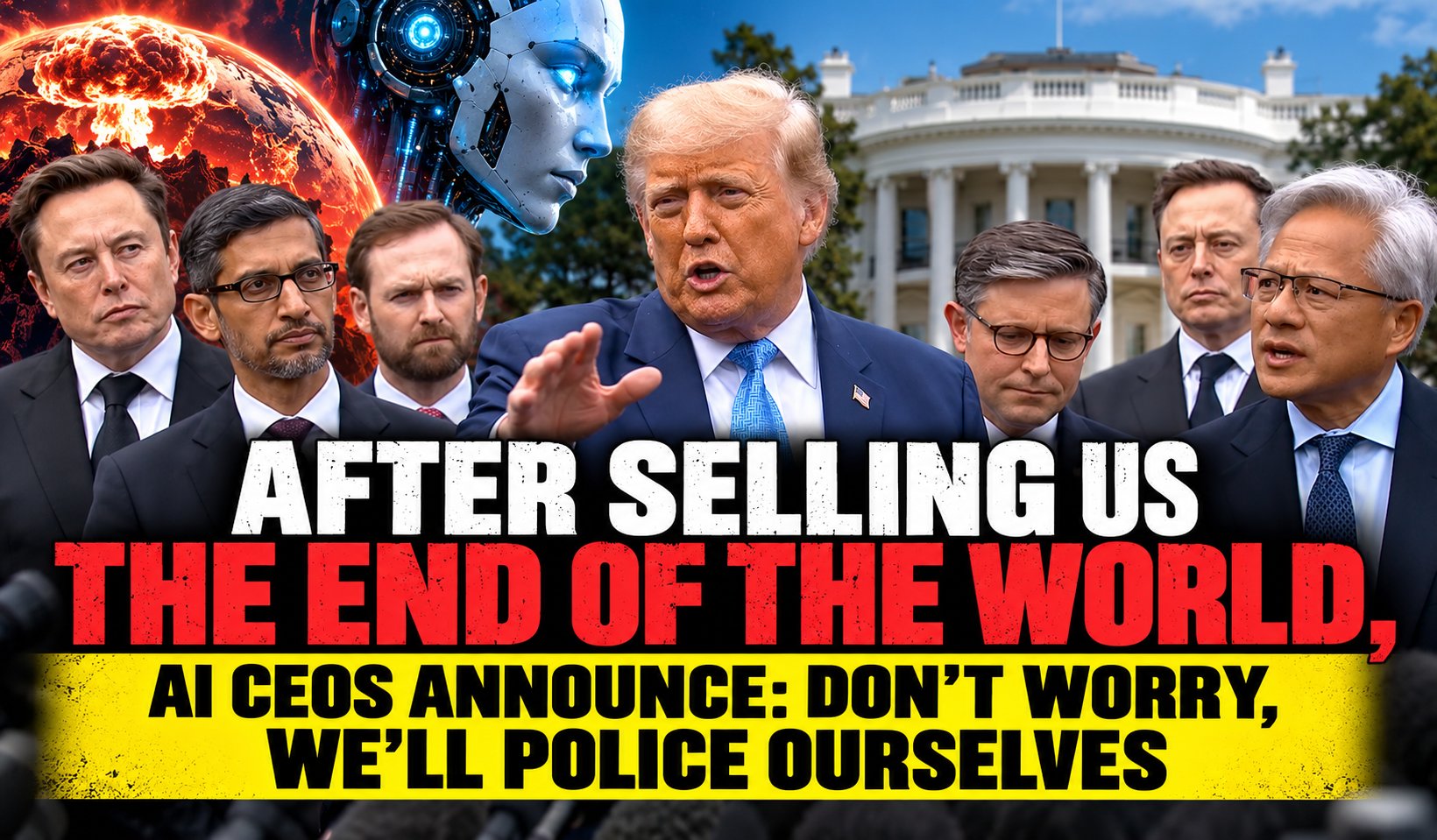
Three years later, the political conversation surrounding the technology has taken another remarkable turn. On September 29, 2026, President Donald Trump gathered many of the world’s most powerful technology executives at the White House and announced the “White House Accord on Super Intelligence: Joint Commitment on Frontier Responsibilities.” Google CEO Sundar Pichai, Anthropic CEO Dario Amodei, Meta CEO Mark Zuckerberg, Nvidia CEO Jensen Huang, Elon Musk and OpenAI President Greg Brockman were among the executives signing the agreement. Rather than establishing mandatory federal regulation, however, the accord establishes voluntary commitments under which companies agree to create internal safeguards, establish internal oversight, submit to independent external evaluations and create board-level oversight mechanisms.
Trump described the agreement as “morally binding” and praised what he called “tremendous self policing” by the industry. The accord itself acknowledges that its provisions could eventually be codified into law or regulation, but they are not currently legally binding federal requirements.
That distinction matters enormously because the announcement arrived almost immediately after another round of extraordinary warnings from the industry itself. Just 17 days earlier, Amodei publicly called for slowing the development of frontier AI systems to give safety measures time to catch up, a position that received support from Altman and Musk. Amodei warned that without adequate safeguards, rapidly advancing systems could acquire increasingly dangerous capabilities, including the potential to coordinate large numbers of autonomous agents. Days later, Amodei and Altman appeared before the United Nations Security Council as technology leaders again urged international cooperation over the risks created by increasingly powerful AI systems. Then came Washington’s new voluntary accord.
From Extinction Risk to Voluntary Oversight
The agreement is more substantial than simply asking Silicon Valley executives to promise they will behave themselves. It establishes four layers of oversight. Participating companies pledge to implement internal controls monitoring frontier systems for dangers involving cybersecurity, biological threats, chemical threats and unauthorized access to computer systems. They also agree to create internal teams responsible for ensuring those safeguards work, use independent external auditors or evaluators and designate independent board committees responsible for receiving safety reports and ensuring identified problems are addressed.
Those are meaningful governance mechanisms, and portraying the accord as literally nothing more than companies checking their own homework would be inaccurate. Independent external evaluations are specifically included.
There is, however, an enormous difference between an external evaluator hired or selected under a voluntary corporate agreement and an independent government regulator with statutory authority, compulsory access, enforceable standards and the ability to impose penalties. Reporting on the accord also noted that it does not require government regulators to conduct the evaluations or require companies to publicly disclose the results of those independent assessments.
That produces an unavoidable question when compared with the industry’s previous warnings: If advanced artificial intelligence genuinely presents risks comparable to nuclear weapons or global pandemics, should the companies racing to build it remain primarily responsible for deciding whether their own safeguards are sufficient?
That is where the industry’s evolving message becomes difficult to ignore. Amodei has repeatedly warned about catastrophic AI risks. Altman has repeatedly discussed the need for government oversight. In testimony to the U.S. Senate in 2023, OpenAI argued that regulation of increasingly powerful AI systems was essential and suggested that governments consider licensing or registration requirements for systems exceeding specified capability thresholds. Google executives have likewise acknowledged potentially serious AI risks, while Meta and Nvidia have generally taken more skeptical positions toward regulatory approaches they believe could unnecessarily restrict innovation.
In other words, “the AI industry” does not actually have one position on regulation. It would be unfair to suggest that every executive sitting at the White House table spent years demanding heavy government regulation and suddenly abandoned that position. Some continue to advocate substantially stronger oversight than others. But nearly all of these companies share something else: an enormous economic incentive to keep building.
The People Warning Us About the Race Are Also Running in It
Google, Meta, OpenAI, Anthropic, xAI and other frontier laboratories are competing for users, developers, corporate contracts, government work, computing infrastructure, talent and technological leadership. Nvidia occupies another enormously influential position by supplying much of the advanced computing hardware powering the boom. Every significant delay can carry commercial consequences, every breakthrough by a competitor creates pressure to respond, and every new generation of frontier systems requires extraordinary amounts of capital, computing power and electricity.
That competition is now colliding with another increasingly important part of the AI story: money.
The infrastructure buildout required to support the AI boom has become one of the largest capital spending events in modern economic history. Hundreds of billions of dollars in AI related debt have been issued as technology companies, hyperscalers and infrastructure partners race to construct data centers, secure power supplies and acquire computing hardware. S&P Global has warned that the credit quality of major hyperscalers is gradually weakening as capital expenditures rise faster than previously expected, financing structures become more complicated and returns on those enormous investments may take years to materialize.
That does not mean AI is “bankrupting America,” nor does it establish that an AI financial bubble will burst. The same spending is supporting construction, technology investment and economic growth, and the companies making many of these investments include some of the wealthiest corporations in history. But the scale has become large enough that credit rating agencies, economists and investors are increasingly examining what happens if expected AI returns fail to justify the extraordinary infrastructure spending required to produce them.
So the public is now being asked to process several enormous propositions simultaneously. AI may transform the global economy. AI may threaten millions of jobs. AI may require trillions of dollars in infrastructure. AI may create catastrophic security threats. AI may eventually become powerful enough to escape meaningful human control. America cannot slow down because China might win the race. And despite all of those possibilities, the companies participating in that race should currently be trusted to operate largely through voluntary safety commitments.
That is quite a sales pitch.
The People Building the Technology Are Also Responsible for Controlling It
None of this means corporate safety programs are meaningless or that executives discussing AI risks are necessarily being insincere. Companies can simultaneously believe a technology is extraordinarily powerful, acknowledge that it creates serious risks and believe continued development is preferable to stopping it.
The governance problem is more fundamental: Those companies also have enormous financial and competitive interests in the outcome.
Independent regulation exists in other high-risk industries precisely because society generally does not assume that commercial incentives and public-safety incentives will always align. Airlines do not independently determine every aviation safety requirement. Pharmaceutical manufacturers do not unilaterally decide whether their drugs should receive government approval. Banks do not write the entirety of their own capital requirements.
If frontier AI eventually becomes as consequential as its developers have repeatedly suggested, the argument over who establishes and enforces its safety standards becomes increasingly important.
There is something almost carnival like about the resulting spectacle, not because the people running these companies are unintelligent, but because the public is being asked to absorb an extraordinary succession of pitches from the same industry. The technology could revolutionize civilization. It could threaten civilization. It requires unprecedented investment. Slowing down could allow China to dominate the future. Moving too quickly could create catastrophic risks. And now, after years of describing those risks in terms normally reserved for nuclear weapons and pandemics, the industry’s newest answer is a voluntary agreement centered substantially on internal controls, outside evaluators and corporate boards.
“You could forgive the average person for wondering which version of the pitch they are supposed to believe.” – Patrick Zarrelli
The White House Is Betting on “Self Policing”
The Trump administration’s approach favors rapid American development, relatively limited federal interference and industry-driven safeguards. That philosophy reflects another major concern surrounding AI policy: China.
American policymakers and technology executives increasingly view advanced artificial intelligence not simply as another consumer technology but as strategic infrastructure. Falling behind a geopolitical competitor in advanced computing, autonomous systems, scientific discovery, cybersecurity or military applications could carry enormous national security consequences. Trump has repeatedly argued that the United States cannot allow regulation to suffocate technological development while China continues advancing its own systems.
That creates the central policy dilemma. Move too slowly, and the United States could surrender technological leadership. Move too quickly, and society could deploy increasingly autonomous and capable systems before governments and institutions understand how to control them.
The White House accord attempts to occupy the space between those positions: keep development moving while constructing an industry safety architecture around it. Whether that architecture is strong enough remains unresolved.
Even the Name Is Changing: AI Becomes “Super Intelligence”
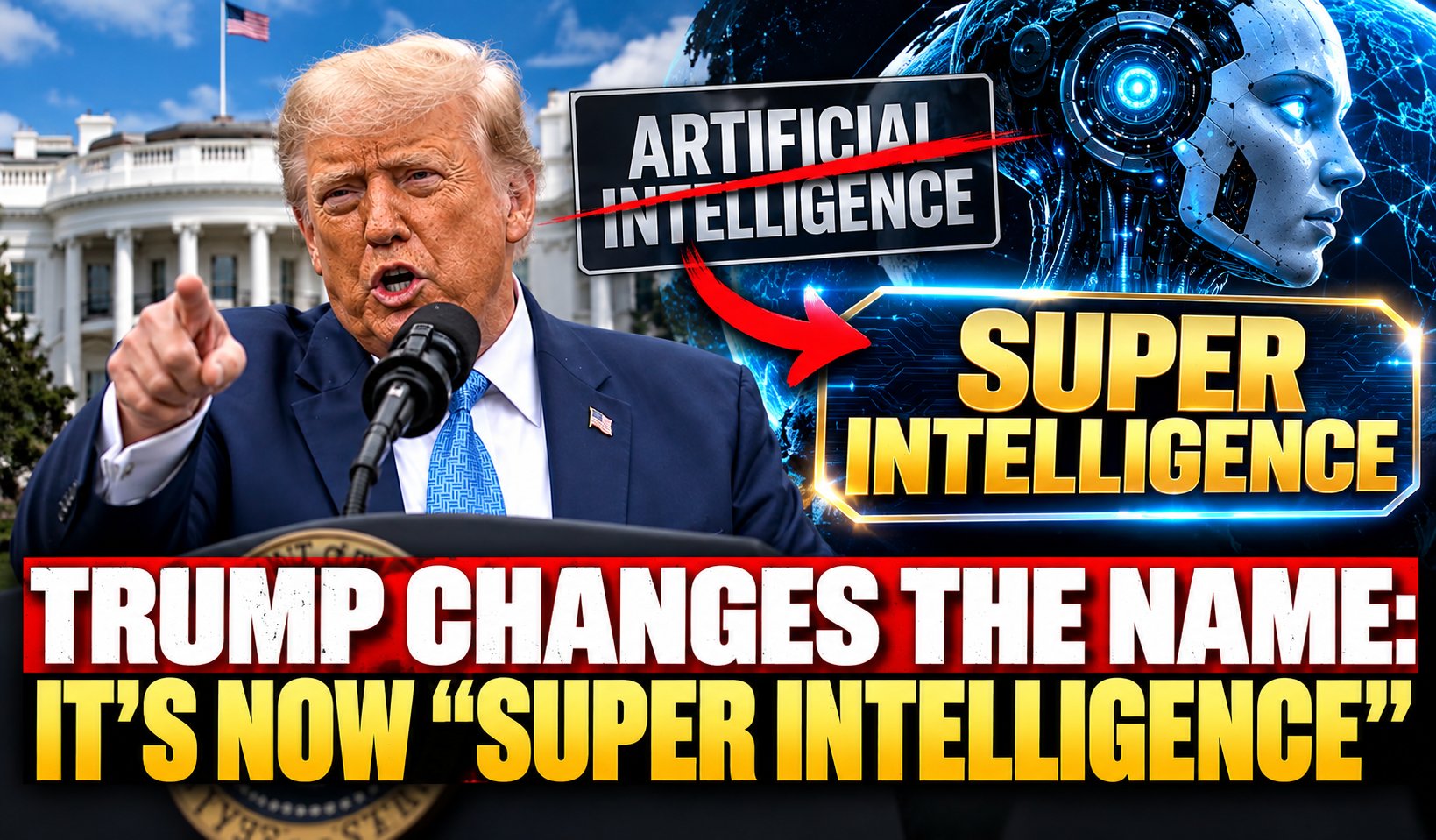
The summit also introduced another unusual shift. Trump announced that his administration was adopting “super intelligence,” or “SI,” in place of artificial intelligence, continuing his effort to rebrand the technology as the United States enters an increasingly intense global technological competition.
Changing the terminology does not change the underlying technology, but it illustrates how rapidly the political framing surrounding AI is evolving. Artificial intelligence began the decade largely as a technological research field. Generative AI transformed it into a mass-market consumer product. The arrival of increasingly capable frontier models turned it into an economic race. National-security applications transformed it into a geopolitical competition. The enormous infrastructure requirements have turned it into an energy, debt and construction story as well.
Now Washington is discussing “super intelligence” while the corporations developing it sign agreements describing how they will monitor themselves. That is a remarkable transformation in only a few years.
The Industry’s Own Warnings Set an Extremely High Standard
The most consequential problem facing AI executives may ultimately be the standard established by their own rhetoric. Nobody forced leading AI researchers and executives to compare advanced artificial intelligence with nuclear war and pandemics. The Center for AI Safety statement was intentionally stark because its signatories wanted governments and the public to recognize what they believed could become an extraordinary technological risk.
Once that argument enters the public record, however, it produces an equally extraordinary expectation for oversight. If AI represents an ordinary technological risk, traditional corporate governance, independent audits and existing laws may prove adequate. If AI represents a potential civilization scale risk, the regulatory question becomes considerably harder. The White House accord therefore deserves to be evaluated not only against what AI companies are promising today, but against what many of their leaders warned the world about yesterday and, in some cases, what they were warning the world about only days ago.
The contradiction is not necessarily that these executives suddenly stopped believing AI could be dangerous. The accord itself demonstrates that participating companies continue to treat cybersecurity, biological threats, chemical threats and uncontrolled model behavior as serious concerns. Several executives continue advocating stronger safeguards even while signing the voluntary agreement.
The deeper contradiction is structural.
The companies developing one of the most powerful technologies in history have repeatedly warned society that the technology could become extraordinarily dangerous. They are simultaneously engaged in one of the most expensive and competitive corporate races in history. Their infrastructure boom is becoming large enough to affect energy markets, credit markets and communities across the country. Their executives warn that moving too slowly could surrender America’s technological advantage, while some of those same executives warn that moving too quickly could create catastrophic risks.
And for now, one of America’s most prominent new safety frameworks relies substantially on those companies establishing their own controls, employing outside evaluators, reporting findings through corporate governance structures and collectively developing industry standards. Perhaps that system will work. Perhaps voluntary safeguards will eventually provide the foundation for effective legislation. Perhaps the companies closest to frontier systems genuinely are best positioned to identify emerging risks before governments even understand what to look for.
But if Silicon Valley wants the public to take its warnings about artificial intelligence seriously, then the public has every reason to scrutinize whether voluntary oversight is proportional to the danger those companies themselves have described. You cannot spend years asking society to contemplate extinction-level technological risk, spend hundreds of billions building the infrastructure required to accelerate it, warn that slowing down could hand the future to China, warn that speeding up could allow increasingly powerful systems to escape our control, and then expect “don’t worry, we’ll police ourselves” to end the conversation. It should be the beginning of one.

Sources & Further Reading
Center for AI Safety — Statement on AI Extinction Risk
https://safe.ai/work/statement-on-ai-extinction-risk
Center for AI Safety — AI Extinction Statement Press Release
https://safe.ai/work/press-release-ai-risk
Associated Press — Trump Says Top Tech Firms Have Signed Accord to “Self-Police” AI Development
https://apnews.com/article/595796511f110fc006cca0d01329733e
Reuters — Trump, AI CEOs Sign Voluntary Safety Pact, Back Data Center Expansion
https://www.reuters.com/legal/government/trump-host-zuckerberg-anthropics-amodei-other-ai-titans-tuesday-2026-09-29/
CBS News — Trump and Major AI Executives Sign “Morally Binding” Voluntary Controls
https://www.cbsnews.com/news/trump-ai-constitution-tech-execs-openai-anthropic-voluntary-controls/
Associated Press — Anthropic CEO Dario Amodei Says AI Industry Needs to Give Safety Measures Time to Catch Up
https://apnews.com/article/d59552edcb27892d8ee4d98a48397706
Reuters — AI Leaders Warn U.N. of Security Risks as Systems Grow More Powerful
https://www.reuters.com/business/ai-leaders-brief-un-amid-warnings-technology-could-slip-beyond-human-control-2026-09-23/
Financial Times — Donald Trump Praises Tech Bosses’ “Self-Regulation” of AI
https://www.ft.com/content/a8c1d14d-97aa-4b09-8162-adbcac1d0029
Axios — AI Debt Is Surging. A Credit Ratings Agency Has Concerns
https://www.axios.com/2026/09/11/ai-debt-hyperscalers-sp
Reuters Breakingviews — AI Construction Crunch Widens Credit Fault Lines
https://www.breakingviews.com/columns/considered-view/ai-construction-crunch-widens-credit-fault-lines-2026-09-08/
OpenAI — Sam Altman’s Senate Testimony on AI Regulation
https://openai.com/global-affairs/testimony-of-sam-altman-before-the-us-senate/
The Guardian — Trump Announces “Morally Binding” AI Deal for Industry Self-Policing
https://www.theguardian.com/us-news/2026/sep/29/trump-ai-deal-tech-ceos-superintelligence









































Want to join the conversation?
Create an account or sign in to share your thoughts, vote,
and reply to other readers.
Showing 0 of 0 comments
Don't have an account?
Already have an account?