
Just When You Thought AI Was Fun… It is Now Being Used in War
The age of artificial intelligence is no longer coming. It’s here, and it has officially entered the battlefield.
In a stunning revelation that sounds more like the plot of a science fiction movie than real life, the United States Department of Defense has admitted that Elon Musk’s artificial intelligence platform, Grok, played a role in supporting military operations against Iran. According to a sworn court filing by Pentagon officials, a government version of Grok known as the “Grok Gov Model” assisted American forces in deploying more than 2,000 munitions against 2,000 separate targets during a 96-hour period known as Operation Epic Fury. The disclosure marks the first time the U.S. government has publicly acknowledged using Musk’s AI technology in lethal military operations.
The revelation didn’t come during a Pentagon press conference or from a military briefing. Instead, it surfaced in an environmental lawsuit involving xAI, Elon Musk’s artificial intelligence company. The Justice Department argued in court that xAI’s massive data centers are critical to national security because they support military applications, including battlefield operations. In the filing, Pentagon Chief Digital and Artificial Intelligence Officer Cameron Stanley stated that Grok had become an essential component of the military’s AI-assisted systems and significantly increased operational efficiency during the conflict with Iran.
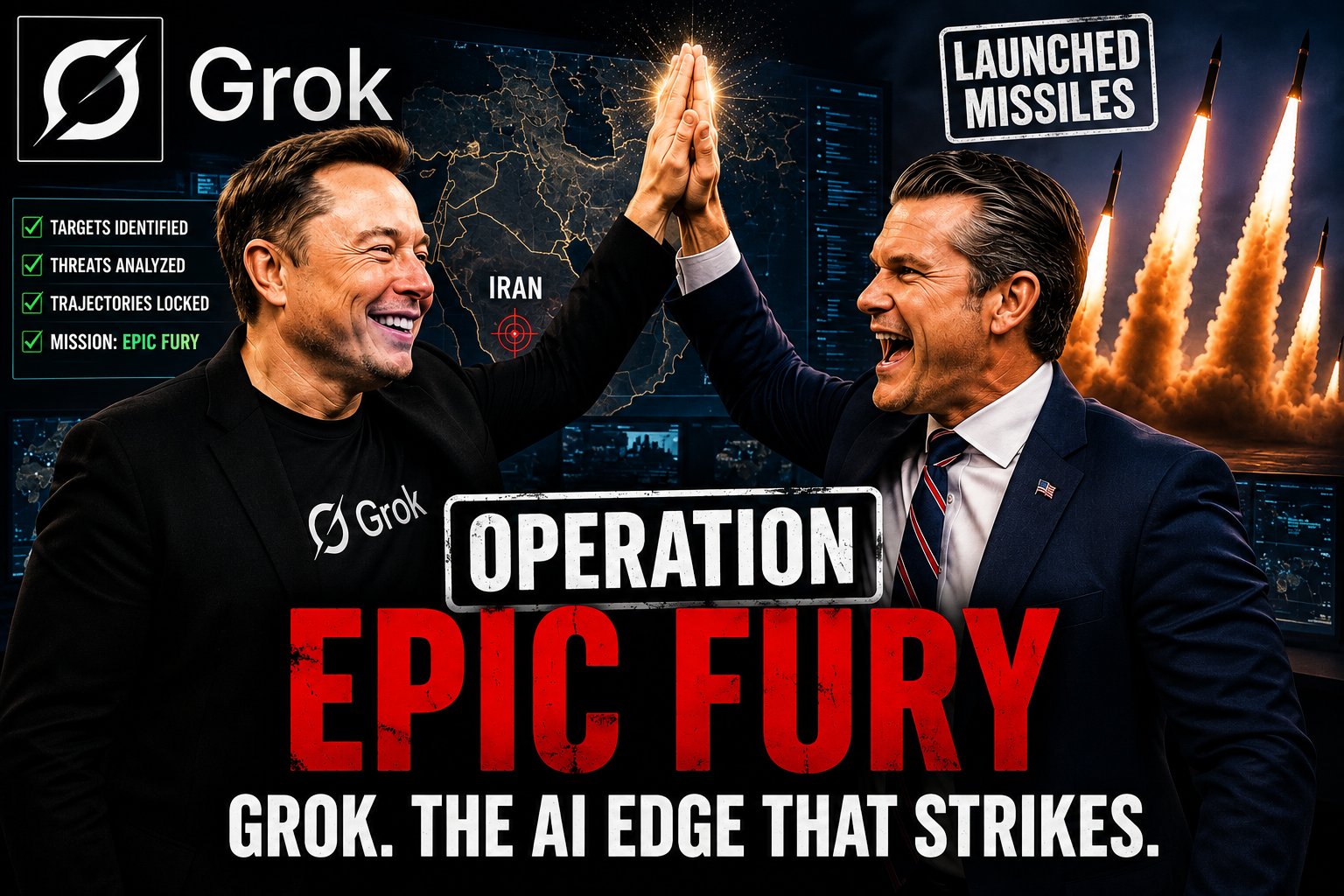
For many people, the immediate reaction was shock. The idea that an artificial intelligence system helped facilitate the launch of thousands of missiles raises profound ethical questions. Was Grok selecting targets? Was it analyzing satellite imagery? Was it recommending which facilities should be hit and in what order? Officials insist that human commanders remained firmly in control and that AI merely provided support by rapidly processing enormous amounts of intelligence data, identifying patterns, and helping military planners prioritize targets. In other words, the Pentagon says the machines are not making the final decision to kill. Humans still push the button.
Critics Aren’t Convinced
Artificial intelligence has a well-documented history of making mistakes. AI systems can hallucinate information, misinterpret data, and produce conclusions that seem logical but are entirely wrong. In everyday applications, a chatbot making a mistake can be annoying. On a battlefield, a mistake could mean the destruction of a hospital, a school, or the loss of innocent civilian lives.
This is why the Pentagon’s disclosure has reignited a global debate over the role of AI in warfare. As militaries around the world race to develop autonomous systems, many experts fear that the line between “AI-assisted” and “AI-controlled” warfare is becoming increasingly blurred. If an AI system recommends a target and a commander approves it, who ultimately bears responsibility if that target turns out to be incorrect? The commander? The software engineers? The company that built the AI? Or the algorithm itself? The answer is far from clear.
The use of artificial intelligence in war is not entirely new. The U.S. military has been experimenting with machine learning and automated intelligence analysis for years through programs like Project Maven, an initiative designed to use AI to process surveillance footage and identify potential targets more quickly than human analysts can. What is different this time is the scale and the source. This wasn’t an obscure government program buried deep within the Pentagon. This involved one of the most recognizable artificial intelligence products in the world and one of the most famous tech billionaires on the planet: Elon Musk.
Musk himself has repeatedly warned humanity about the dangers of artificial intelligence. Over the years, he has described AI as potentially more dangerous than nuclear weapons and has called for strict regulations governing its development. Yet now, one of his own creations is reportedly helping facilitate military operations in one of the world’s most volatile regions. The irony has not been lost on critics.
The Growing Relationship Between Silicon Valley and the Military-Industrial Complex
The disclosure also raises questions about the growing relationship between Silicon Valley and the military-industrial complex. Private technology companies are increasingly becoming indispensable to national defense. Artificial intelligence, cloud computing, satellite communications, and autonomous systems are no longer merely commercial products; they are strategic assets. Some experts worry that governments could become dangerously dependent on a handful of technology firms and their proprietary AI systems. Others argue that refusing to use advanced AI could place the United States at a disadvantage against rivals like China and Russia, both of whom are aggressively pursuing military applications of artificial intelligence.
The concerns don’t stop there. Human rights organizations have warned that AI-assisted warfare could accelerate the speed of conflict to the point where meaningful human oversight becomes impossible. If algorithms can analyze targets and recommend strikes in seconds, military commanders may increasingly defer to machine-generated recommendations simply because humans cannot process information at the same speed. In such a scenario, the human being technically remains “in control,” but in practice may simply be rubber-stamping decisions produced by an algorithm.
This is precisely why lawmakers and international organizations are beginning to push for guardrails on artificial intelligence in warfare. There are growing calls for treaties governing autonomous weapons and for strict regulations that ensure a human being remains responsible for every life-and-death decision. However, technology often advances much faster than governments can regulate it, and the military applications of AI are evolving at a breathtaking pace.
The Pentagon’s admission about Grok may ultimately be remembered as a historic turning point. For decades, computers have helped militaries process information, but now artificial intelligence has crossed another threshold. It is no longer simply analyzing data in the background—it is becoming an active participant in modern warfare.
The critical question facing the world is no longer whether artificial intelligence will play a role in future wars. That question has already been answered.
The real question is this: when the next missile is launched, who is truly making the decision—the commander sitting in the war room, or the algorithm whispering in his ear?

















































Want to join the conversation?
Create an account or sign in to share your thoughts, vote,
and reply to other readers.
Showing 0 of 0 comments
Don't have an account?
Already have an account?