
Spain Faces an Invasion Like Never Seen From Morocco
For most Americans, the tiny Spanish city of Ceuta is a place they’ve never heard of. Yet over the past several years, and especially during the latest migrant surge in 2026, this small territory has become one of Europe’s most explosive border flashpoints. Videos showing thousands upon thousands of migrants pouring across the border from Morocco have left many asking a simple question: if tens of thousands of people force their way into a sovereign nation’s territory in a matter of days, what else do you call it besides an invasion?
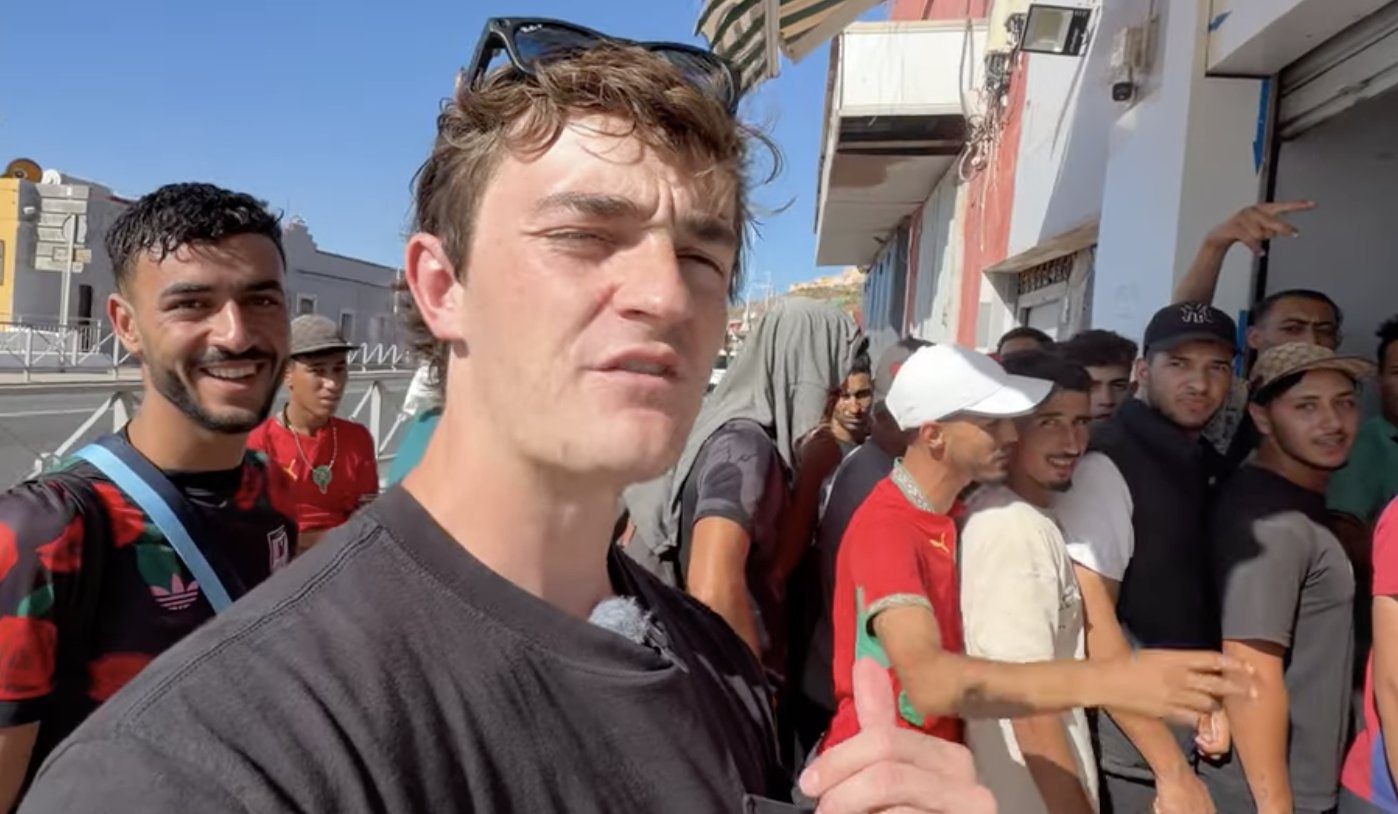
That is exactly the argument made by travel journalist and YouTuber Nick Shirley in his documentary-style video, “Ceuta Spain Was Invaded… Spain Falls to Moroccan Migrants.” Shirley travels to the Spanish enclave to document the aftermath of one of the largest mass migration events Europe has witnessed in recent history. Rather than relying on television reports, he walks the streets, interviews residents, speaks with migrants, and shows viewers the reality unfolding on the ground.
Where is Ceuta and What is the History?
Ceuta occupies a unique place on the map. Located on the northern coast of Africa, it is an autonomous Spanish city covering only about seven square miles. Although geographically attached to Morocco, it has been under European control for centuries. The Portuguese first conquered Ceuta in 1415, and when Portugal and Spain separated their crowns in the 17th century, Ceuta chose to remain loyal to Spain. It officially became part of Spain in 1668 and has remained Spanish territory ever since. Morocco has never accepted Spanish sovereignty over Ceuta and continues to claim the city as its own, making it one of Africa’s oldest territorial disputes.
Today, Ceuta represents one of only two land borders between the European Union and Africa, the other being the nearby Spanish enclave of Melilla. Because it is European Union territory, migrants who successfully enter Ceuta have technically entered Spain, although additional border controls generally prevent them from freely traveling to mainland Europe. This unique legal status has made the city an irresistible target for illegal migration for decades.
What Happened in Ceuta With all of These Moroccans?
The latest crisis dwarfed previous incidents. During the recent surge, upwards of 60,000 migrants crossed from Morocco into Ceuta over just a few days, overwhelming local authorities and creating chaos throughout the city. Many entered by swimming around the border barriers while others crossed through weakened border controls.
Spanish authorities were forced to deploy additional security forces while emergency shelters quickly exceeded capacity. Reports indicated dozens of people lost their lives attempting the dangerous crossing. Most migrants were eventually returned to Morocco, although several thousand remained inside Ceuta awaiting legal proceedings.
For many residents, the numbers alone transformed the event from an immigration issue into something much larger. Imagine a city of roughly 85,000 people suddenly receiving tens of thousands of unauthorized arrivals within days. Even those who generally support legal immigration questioned how any municipality could absorb such an influx without severe consequences for housing, healthcare, policing, and public services.
Nick Shirley’s documentary captures much of that sentiment. Throughout the video, he documents crowded streets, overwhelmed infrastructure, and widespread concern among local residents. Shirley argues that the situation reflects a broader failure of European border enforcement, suggesting that governments have lost control of who enters their territory. His reporting focuses heavily on the scale of the crossings and the visible strain placed upon Ceuta’s limited resources.
What Has to Be for This to be Considered “an Invasion”?
Supporters of stricter immigration enforcement have increasingly described events like those in Ceuta as an “invasion.” They argue that while traditional invasions involve armies, the defining characteristic is not military uniforms but the mass, unauthorized crossing of a sovereign border by overwhelming numbers of people that exceed a nation’s ability to maintain normal control.
Critics reject that terminology, arguing that the migrants are civilians seeking economic opportunity or asylum rather than organized military forces, and therefore should not be described using wartime language. The choice of words ultimately reflects differing political perspectives rather than a universally accepted definition.
Whatever terminology one chooses, Ceuta has become a symbol of Europe’s broader immigration debate. The city sits on the front line of migration from Africa into Europe, and every major crossing reignites questions about national sovereignty, border security, humanitarian responsibilities, and the limits of immigration policy. For many Europeans, Ceuta serves as a warning of what can happen when border infrastructure is overwhelmed faster than governments can respond.
What Role Did Spain’s Prime Minister Pedro Sánchez Play in all of This?
It is fair to criticize Prime Minister Pedro Sánchez and his government’s migration policies. Sánchez has governed Spain with one of the most immigration-friendly approaches in Europe. His government has repeatedly argued that Spain needs immigration to offset an aging population, fill labor shortages, and sustain economic growth.
In 2026, his administration launched a €500 million Integration and Citizenship Plan while promoting the regularization of hundreds of thousands of undocumented migrants already living in Spain. Sánchez defended these policies by saying immigration strengthens Spain’s economy and that the country should pursue “orderly, fair and intelligent” migration rather than simply closing its borders.
Critics, including Spain’s conservative People’s Party (PP), Vox, and several right-wing European leaders, argue that these policies created a ‘pull factor’. Their argument is that when migrants believe they have a greater chance of remaining in Spain or eventually obtaining legal status, more people attempt the journey. The Sánchez government rejects this argument, insisting that the regularization only applies to migrants who were already residing in Spain before the eligibility cutoff and was not intended as an invitation to new arrivals.
Shortly before the mass crossings, Spain’s Supreme Court ruled that migrants who entered by swimming could not automatically be returned under the same expedited procedures used for people who crossed physical border fences. According to Spanish authorities, migrant-smuggling networks and false social media rumors quickly spread the message that anyone reaching Ceuta by sea would be allowed to stay. The government blames those rumors and the smugglers for fueling the surge.
The Proof is in the Footage
Another major criticism concerns the initial security response. Videos from the first hours of the crisis showed thousands of migrants reaching Spanish beaches with little immediate resistance, leading opponents to accuse Sánchez of failing to secure the border quickly enough. After the scale of the crossing became clear, however, his government deployed additional security forces, announced new floating barriers, and sought rapid cooperation with Morocco to return many of those who had entered. Sánchez publicly described the mass crossing as “a violation of Spain’s territorial integrity.”
Much of the political dispute centers on Morocco’s role. Spanish intelligence reportedly concluded that Morocco did not plan the migration surge but did relax border enforcement and then exploited the situation politically. The leader of Ceuta accused Morocco of allowing the crossings to happen. This has led some critics to argue that Sánchez relied too heavily on cooperation with Morocco and failed to anticipate what would happen if that cooperation weakened.
Nick Shirley’s video resonates because it puts viewers directly into the middle of that debate. Rather than discussing immigration through statistics alone, it shows the physical reality of one of Europe’s most contested borders. Whether viewers ultimately agree with Shirley’s conclusion that Spain is experiencing an invasion or see the crisis through a humanitarian lens, the footage demonstrates that Ceuta remains one of the most strategically important and politically volatile border crossings in the Western world.
*****Editor’s Note*****
SPOILER ALERT…This YouTube video ended with Shirley running for his life from Moroccan’s throwing bottles, then throwing rocks, and then finally giving chase with a knife saying he was going to “stab Shirley and his bodyguard”.


















































Want to join the conversation?
Create an account or sign in to share your thoughts, vote,
and reply to other readers.
Showing 0 of 0 comments
Don't have an account?
Already have an account?