
Clearly an Unprecedented Push to Deepen Ties With a Country That is Fighting With the US
The European Union is opening a door that has never been opened before.
European Commission President Ursula von der Leyen has proposed that Canada become the European Union’s first-ever “associate member,” creating a new kind of relationship between Ottawa and the 27-nation European bloc. The proposal came on September 16th, during von der Leyen’s annual State of the Union address in Strasbourg, with Canadian Prime Minister Mark Carney sitting in the European Parliament as her guest.
“I said we must urgently reimagine our partnerships,” von der Leyen told the European Parliament. “So, I would like to work with you on opening the door for Canada to be the first associate member of the EU.”
The proposal is historic, but there is an important catch: the European Union currently has no formal legal category called “associate member.” In other words, Brussels has offered Canada something that does not yet have a clearly defined rulebook. Because apparently creating an entirely new category of international membership is easier than naming what the thing actually means.
Who are the Current Members of the EU?
The European Union currently consists of 27 member countries: Austria, Belgium, Bulgaria, Croatia, Cyprus, Czechia, Denmark, Estonia, Finland, France, Germany, Greece, Hungary, Ireland, Italy, Latvia, Lithuania, Luxembourg, Malta, the Netherlands, Poland, Portugal, Romania, Slovakia, Slovenia, Spain and Sweden.
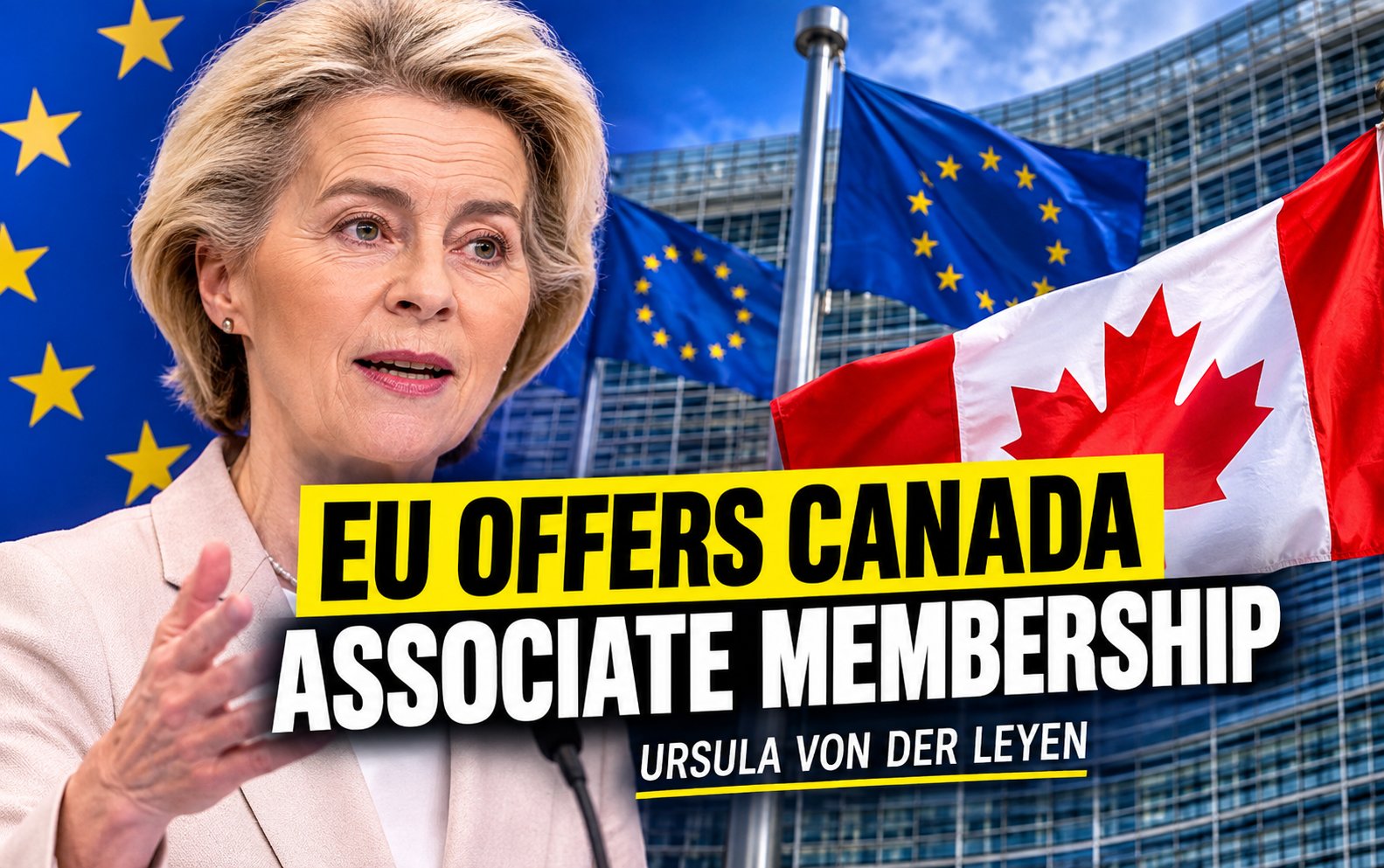
The United Kingdom is no longer an EU member, having formally left the bloc on January 31st, 2020, following Brexit. Canada is also not an EU member, which makes Ursula von der Leyen’s recent proposal particularly unusual. If the proposal moves forward, Canada could become the EU’s first associate member, a new category that would fall short of full EU membership while potentially giving Canada deeper economic, trade, security and political ties with the 27-nation bloc.
What makes this strange and why Canada would be considered an “associate member” is because of all the countries that are a part of the 27, Canada is NOT A PART OF EUROPE!!!
What Would Associate Membership Mean?
Exactly what Canada would receive under such an arrangement has not yet been determined.
Reports indicate that discussions could involve easier movement for Canadians in Europe, including potentially visa-free opportunities to live and work in EU countries, expanded access to European education and research programs, recognition of professional qualifications and reduced trade barriers. The details, however, remain subject to negotiations between Canada and the EU.
The proposal would not make Canada the EU’s 28th full member. Canadian officials have previously made clear that Ottawa is not seeking full EU membership, with Carney describing the desired relationship as a “unique security and economic alliance.”
Instead, the idea appears to be creating a relationship somewhere between an ordinary trade partner and a full EU member. That could potentially give Canada greater access to European markets and institutions while allowing Ottawa to retain its political and economic sovereignty.
Building on an Existing Trade Relationship
Canada and the EU already have a significant economic relationship through the Comprehensive Economic and Trade Agreement, or CETA.
CETA has been provisionally applied since 2017, and von der Leyen pointed to the agreement as evidence that closer economic integration can produce measurable results. According to the European Commission, trade in goods between Canada and the EU has grown by 75% since CETA began being applied.
Von der Leyen proposed moving beyond CETA toward what she called an “Alliance for the Future.”
Her proposed areas of cooperation include advanced manufacturing, technology, defense production, the Arctic, energy, critical minerals, batteries, artificial intelligence, quantum computing, cybersecurity and broader economic security. The economic implications could therefore extend well beyond traditional imports and exports.
Canada possesses enormous reserves of natural resources and critical minerals that are increasingly important to Western technology and defense industries. Europe, meanwhile, represents a massive consumer market and industrial base. For Canada, closer integration with Europe could provide another outlet for trade and investment. For the EU, Canada could become an important partner in areas ranging from energy and raw materials to defense and Arctic security.
The United States is the Giant Elephant in the Room
The timing of the proposal is impossible to ignore.
Canada has historically been heavily dependent on the United States for trade. Approximately 70% of Canadian exports go to the U.S., according to reporting from the Associated Press, while Canada-EU trade in goods and services reached roughly $147 billion in 2025. U.S.-Canada trade remains dramatically larger.
Relations between Ottawa and Washington have deteriorated amid tariff disputes and other disagreements involving President Donald Trump. Carney has therefore been attempting to diversify Canada’s economic relationships and reduce the country’s dependence on its southern neighbor.
The EU is facing a similar strategic problem from the opposite direction. European governments are attempting to strengthen their own economic and defense capabilities while dealing with Russia’s war against Ukraine, competition from China and uncertainty surrounding America’s future role in European security.
Von der Leyen explicitly connected the new partnership strategy to what she described as a changing international system.
“This is a partnership not against anyone else, but for our common strength,” she said.
Trump, however, apparently did not interpret the proposal quite so diplomatically. According to Reuters, Trump said that if the EU’s move toward Canada constituted a “hostile act,” he could respond with significant tariffs or restrictions on trade with Europe.
What This Could Mean for Canadians?
That is where the economics become particularly interesting.
Carleton University economics professor Christopher Worswick, whose research focuses on labor economics, immigration and the economic effects of migration, has been examining Canada’s economic relationship with immigration and labor markets.
Worswick has previously argued, along with co-authors Matthew Doyle and Mikal Skuterud, that immigration policy needs to consider not simply the number of people entering Canada but their expected economic contribution, including earnings and productivity. Their research was published in the Canadian Journal of Economics in 2025.
That broader economic perspective is relevant to the EU proposal because easier movement between Canada and Europe could potentially affect Canada’s labor market, education system and population flows. If negotiations eventually produce expanded rights for Canadians to work, study or establish businesses in Europe, the arrangement could create opportunities for Canadian professionals and students that currently require separate immigration or work-permit processes.
At the same time, greater labor mobility would mean that Canadians could have more opportunities to pursue employment abroad, while European workers and businesses could potentially gain greater access to Canada. The actual economic effect would depend heavily on the final agreement.
Canada Is Already Moving Closer to Europe on Defense
The proposed relationship isn’t purely about economics.
Canada has already become the first non-European country to participate in the EU’s Security Action for Europe, or SAFE, defense funding program. The initiative provides financing for joint European defense procurement, and Canadian defense companies can participate under the arrangement.
Von der Leyen wants that cooperation expanded. Her proposal specifically calls for integrating Canadian and European defense industrial capabilities while increasing cooperation in areas including Arctic security, critical minerals, cyber defense and advanced technology. The Arctic is particularly important.
Canada controls a massive portion of the Arctic region, while European countries are increasingly focused on Arctic security, shipping routes, natural resources and Russia’s military presence in the region. That gives Canada something Europe wants and gives Canada another potential strategic partner outside the United States.
There Is Still a Long Way to Go
Despite the dramatic announcement, Canada is not joining the European Union…yet.
Von der Leyen does not have the unilateral authority to create a new membership category, and any eventual arrangement would have to be negotiated and approved through the appropriate EU institutions and member states. Reuters reported that some EU diplomats were themselves unsure what the proposal would ultimately mean because there is currently no established legal framework for associate membership.
That uncertainty could become one of the biggest challenges. There are already different models for countries that maintain unusually close relationships with the EU without becoming members. Norway, Iceland and Liechtenstein participate in the European single market through the European Economic Area, while Switzerland, the United Kingdom and Ukraine have developed different arrangements with Brussels.
Canada’s proposed relationship would therefore have to be something different. For now, what von der Leyen has offered is less a finished treaty than an invitation to build something new. And the geopolitical significance is considerable.
Canada is looking to reduce its dependence on the United States. Europe is attempting to strengthen its economic and strategic independence. Both sides are confronting Russia, China, technological competition, supply-chain vulnerabilities and questions about America’s future role in the Western alliance.
A Canadian associate membership could ultimately become a new model for how major democracies cooperate without formally merging their political systems. For the moment, however, the biggest question remains the simplest one: what exactly is an “associate member”? Brussels has just invited Canada to find out.
SOURCES FOR STORY:
- Reuters: EU opens door for Canada to become first associate member
- European Commission: 2026 State of the Union Address by Ursula von der Leyen
- Associated Press: Canada builds ties with Europe and Asia amid trade tensions
- Atlantic Council: What von der Leyen and Carney are up to with Canada’s associate EU membership
- Carleton University: Christopher Worswick
- European Commission: EU-Canada relations and CETA



















































Want to join the conversation?
Create an account or sign in to share your thoughts, vote,
and reply to other readers.
Showing 0 of 0 comments
Don't have an account?
Already have an account?