
Viral Allegation: Canadian Commentator Mark Slapinski’s Trump Claim Sparks Legal and Media Firestorm
A fringe but rapidly spreading political controversy erupted online this week after Canadian political commentator Mark Slapinski publicly claimed that videos exist showing Donald Trump engaged in sexual acts with minors — an explosive accusation that, as of now, remains completely unsubstantiated by evidence, law enforcement, or credible investigative reporting.
The episode highlights a growing pattern in modern political discourse: viral allegations launched on social media that carry enormous reputational and legal implications long before facts are established.
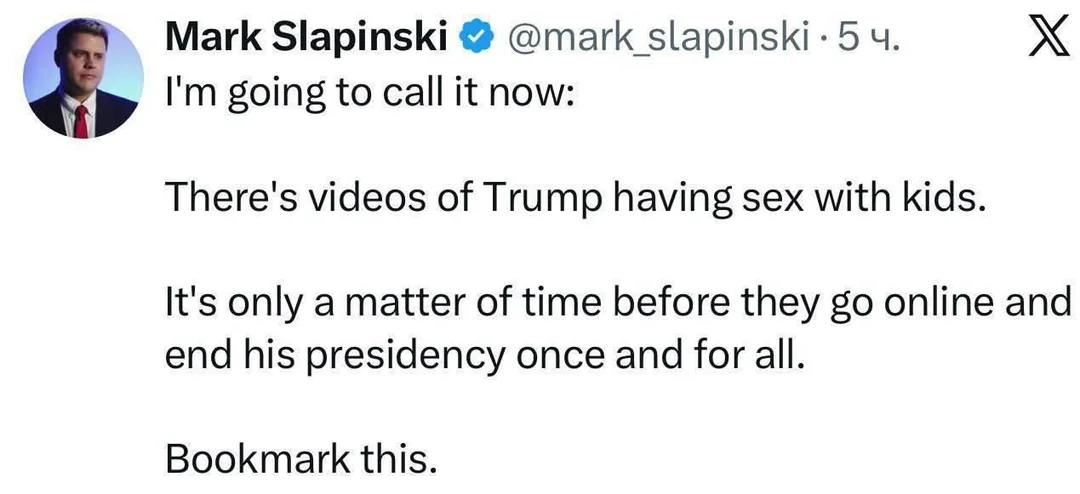
The Claim That Ignited the Controversy
In a post circulating widely on X, Slapinski wrote:
“I’m going to call it now: There’s videos of Trump having sex with kids. It’s only a matter of time before they go online and end his presidency once and for all. Bookmark this.”
He later reportedly stated he was “110% certain” the U.S. Department of Justice possesses compromising footage connected to Jeffrey Epstein’s network and openly dared Trump to sue him for defamation. Slapinski framed the posts as partly retaliatory commentary following Trump’s past remarks about Canada potentially becoming the “51st state.”
However, critically:
• No documents, recordings, witnesses, or law-enforcement confirmations have been presented
• No indictment or official investigation has cited such videos
• No major newsroom has independently verified the claim
At present, the allegation exists solely as political speech, not as established fact.
Epstein Surveillance: Real But Still Murky
The controversy is unfolding against the unresolved backdrop of Jeffrey Epstein’s surveillance practices. Former staff, visitors, and investigators have long suggested Epstein installed extensive camera systems in multiple properties, including his Palm Beach mansion and Manhattan townhouse.
“Epstein had cameras in many rooms,” former employees have said in interviews over the years.
Federal agents seized large amounts of evidence after Epstein’s 2019 arrest. Yet the full inventory of recordings, if any survived, remains largely sealed or undisclosed. This information vacuum has fueled speculation for years about what material may exist and who might appear in it. But speculation about surveillance does not equate to verified criminal evidence against specific individuals.
Michael Wolff’s disputed assertions
Adding further intrigue, journalist and author Michael Wolff has publicly claimed he saw photographs stored in Epstein’s safe that allegedly showed Trump with topless young girls sitting on his lap.
However:
• Wolff has not released the images
• He has not testified under oath about them
• He has not provided corroborating documentation
• He has not produced evidence directly implicating Trump in criminal conduct
From an investigative standpoint, such statements remain anecdotal unless substantiated through verifiable proof or sworn proceedings.
The legal chessboard: defamation and discovery
Slapinski’s public taunting, effectively inviting a lawsuit, has sparked debate about the strategic risks for both sides.
If Trump were to pursue defamation litigation:
• The defense could attempt to seek discovery into Trump’s historical contacts with Epstein
• Depositions, communications, travel records, and financial links could potentially be requested
• The process could become politically damaging regardless of ultimate legal outcomes
At the same time, defamation law cuts both ways. False statements presented as fact can expose the accuser to massive liability, particularly when reputational harm is clear and evidence is lacking. Truth is an absolute defense in defamation cases but the burden to substantiate claims can be severe. This creates what legal analysts often describe as a “mutual-risk environment,” where both plaintiff and defendant face significant exposure.
Viral politics vs. evidentiary journalism
The episode reflects a broader shift in how political narratives form.
Instead of emerging from investigative reporting or court filings, major allegations now frequently originate from:
• social media posts
• ideological commentators
• viral amplification networks
• partisan framing that portrays silence as guilt
Yet historically, real criminal accountability has hinged on:
• indictments
• sworn testimony
• documentary evidence
• corroborated witnesses
• sustained newsroom investigation
Without those elements, even the most explosive claims remain legally and journalisticly unproven.
What is Known Fact and What is Not
At this stage:
• There is no verified evidence Trump was filmed committing sex crimes with minors
• No law-enforcement agency has publicly confirmed such material exists
• No court record supports the allegation
• No major investigative outlet has validated Slapinski’s claim
Meanwhile, Epstein’s network its recordings, its clients, and the scope of federal evidence seizures continues to generate unanswered questions that sustain public fascination and political weaponization.
A Controversy Built on Uncertainty
Whether Slapinski’s statements represent reckless provocation, insider belief, or calculated political messaging remains unclear. What is clear is that the episode underscores a defining tension of the modern information era: Serious criminal allegations can now go global instantly, long before facts are established, evidence is tested, or accountability is determined. Until verifiable proof emerges, the story remains not about confirmed wrongdoing, but about the power of accusation itself, and the volatile intersection of law, politics, and viral media in the post-Epstein world.















































Want to join the conversation?
Create an account or sign in to share your thoughts, vote,
and reply to other readers.
Showing 0 of 0 comments
Don't have an account?
Already have an account?