
Ukraine Targets Russia’s ‘Amazon’: Drone Campaign Against Wildberries Strikes at the Kremlin’s Military Supply Chain and Consumer Economy
Ukraine’s long range drone campaign against Russia is expanding beyond oil refineries, military installations and weapons factories. Kyiv is now targeting something far more familiar to ordinary Russians, online shopping. A series of Ukrainian drone attacks has struck warehouses and logistics centers operated by Wildberries, Russia’s largest online marketplace and a company frequently described as the country’s answer to Amazon.
The strikes represent a significant evolution in Ukraine’s deep strike strategy. Rather than simply destroying conventional military infrastructure, Kyiv appears to be targeting the increasingly blurred line between Russia’s civilian economy and the logistical network supporting its war in Ukraine. Wildberries is at the center of that overlap.
Ukrainian officials contend that the company’s enormous distribution network has become an unofficial supply system for Russian soldiers, volunteers and pro-war organizations seeking everything from tactical body armor and radios to FPV drone components. Russia disputes that characterization and insists the warehouses are civilian facilities. But evidence that military related equipment continues to be available through the marketplace, combined with the enormous scale of the damage, has turned Wildberries into one of the most consequential economic targets of Ukraine’s expanding drone war.
Drone Strikes Hammer Wildberries Logistics Network
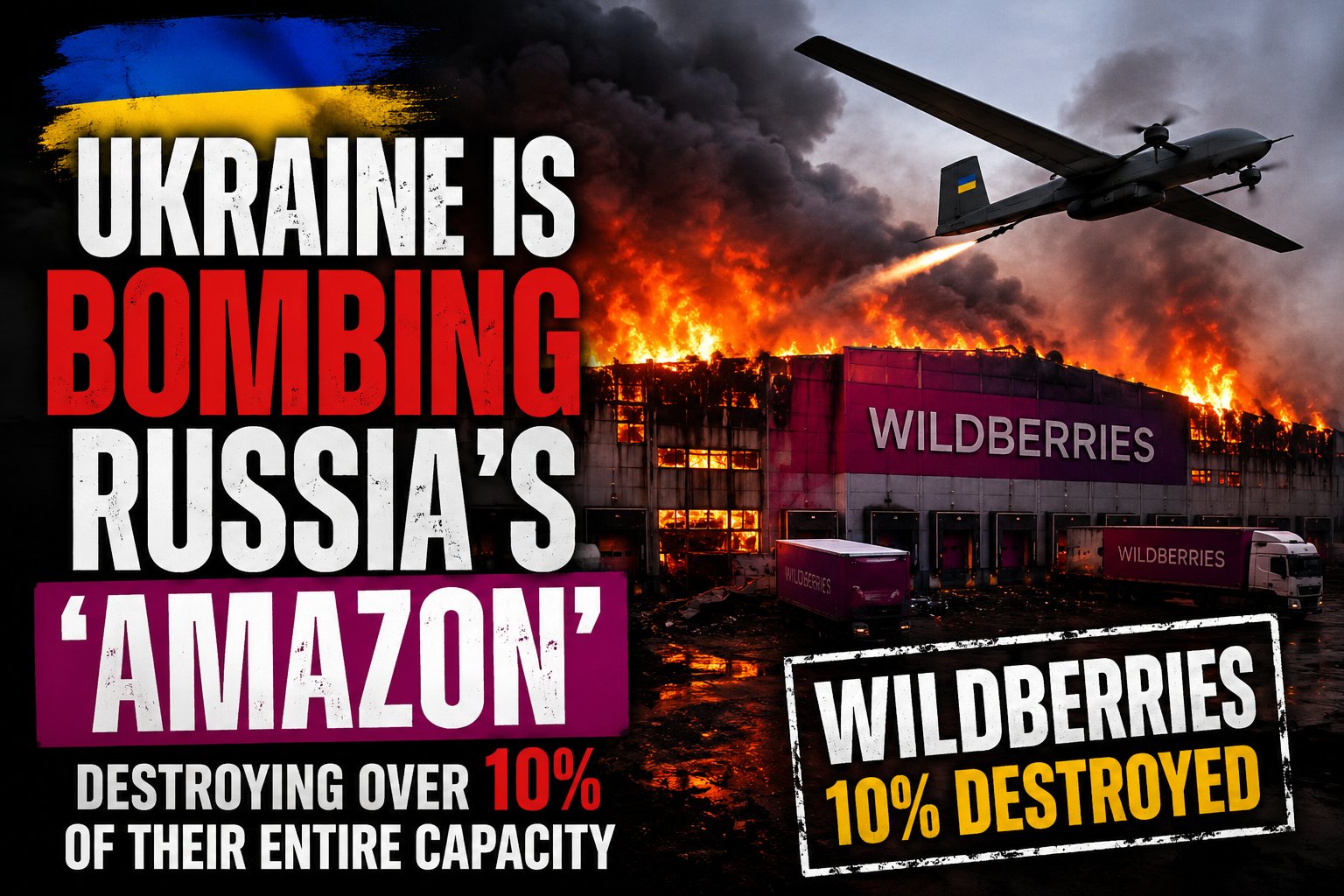
The attacks began escalating in mid July, with Ukrainian drones striking Wildberries facilities across several Russian regions. Reuters reported that attacks damaged at least seven Wildberries warehouses and disrupted approximately 10% of the company’s storage capacity. Russian authorities have subsequently considered financial assistance for the company and businesses affected by the destruction.
Russian business newspaper Kommersant calculated that approximately 552,000 square meters, nearly 5.9 million square feet, of Wildberries warehouse space had been affected during the initial wave of attacks. Roughly 444,000 square meters were reportedly rendered unusable at that point, representing approximately 8% of the company’s overall logistics capacity.
The financial consequences could be enormous. The Guardian, citing Moscow based research company Data Insight, reported estimates of roughly 170 billion rubles, approximately $2.2 billion, in destroyed merchandise. Much of that inventory belongs not directly to Wildberries but to independent merchants who use the company’s warehouses and distribution network. That means Ukraine is not merely damaging warehouses; it is sending economic shock waves through an enormous commercial ecosystem.
Why Would an Online Shopping Company Become a Wartime Target?
Wildberries is not a traditional defense contractor. It is an e-commerce marketplace selling clothing, electronics, household products and practically everything else consumed by Russian households. That is precisely what makes the situation unusual. Ukraine argues that Wildberries has also become part of Russia’s informal wartime logistics infrastructure. President Volodymyr Zelenskyy has said targeted Wildberries facilities were being used to supply Russian forces with drone components, navigation equipment and other gear.
The broader accusation is that weaknesses in Russia’s formal military procurement system have pushed soldiers, volunteer organizations and pro war civilian groups toward commercial marketplaces. Instead of waiting for Russia’s Ministry of Defense to provide every piece of equipment required at the front, soldiers and their supporters can purchase equipment through civilian supply chains. Wildberries provides an extraordinarily convenient one.
Body Armor, FPV Drones and Military Equipment Remain Available
Wildberries has attempted to distance itself from allegations that its marketplace functions as a military supplier, but military and dual use products remain readily available.
Independent Russian outlet Meduza reported that searches associated with Russia’s euphemism for the invasion of Ukraine, the “special military operation,” or SVO, had been restricted or removed from Wildberries. The merchandise itself, however, did not necessarily disappear. Searches using alternative terminology continued returning military first aid kits, radios, tactical backpacks and other equipment. The marketplace also reportedly contained thousands of listings for tactical body armor as well as FPV drones and related components.
That distinction matters because removing a search category does not remove the underlying supply network. Body armor can be categorized as sporting equipment. Drone components can appear under consumer electronics. Radios, backpacks, batteries, medical supplies and navigation equipment are inherently dual use products. Ukraine therefore appears to be treating the distribution infrastructure itself, rather than individual products, as the strategic target.
Russia’s Civilian Economy Has Become Part of the Battlefield
There is another dimension to Ukraine’s Wildberries campaign that goes beyond destroying military equipment. Wildberries is deeply embedded in Russian everyday life, with its distribution centers feeding an enormous network of pickup locations spanning cities, small towns and remote communities across the country.
Damaging that network therefore produces consequences that Russians who have little direct contact with the battlefield can potentially feel themselves. Packages arrive late, merchants lose inventory, warehouses close and businesses suffer financial losses. The Russian government may ultimately have to intervene.
Reuters reported that Moscow has explored potential financial assistance for Wildberries and affiliated businesses following the attacks, potentially involving loans, tax relief or subsidies. State controlled VTB could reportedly play a significant role in any assistance package. That creates an additional cost for the Kremlin, as every ruble used to stabilize businesses damaged by Ukrainian attacks represents another economic consequence of a war Russia originally expected would remain largely outside the daily experience of its domestic population.
Ukraine Is Turning Logistics Into a Weapon
The Wildberries campaign fits into a broader Ukrainian strategy that has become increasingly visible as Kyiv’s domestic drone capabilities improve. Ukraine cannot easily match Russia missile for missile, so it has increasingly relied on relatively inexpensive long range drones to attack strategically important infrastructure hundreds of miles inside Russian territory. Oil refineries, fuel depots, military factories, airfields and transportation infrastructure have all been targeted. Now major commercial logistics networks are entering the equation. The strategy exploits a fundamental reality of modern warfare: armies depend upon enormous civilian industrial and transportation systems.
A military does not function solely because it possesses tanks and missiles. It requires fuel, batteries, electronics, replacement parts, medical equipment, communications equipment, transportation networks and warehouses capable of moving those products efficiently. Disrupt the logistics network, and eventually the weapons themselves become harder to operate.
The Kremlin Faces an Uncomfortable Problem
Moscow insists Wildberries facilities are civilian targets, while Ukraine argues they are effectively dual use infrastructure supporting Russian forces. That dispute is likely to continue, but Kyiv’s strategy places the Kremlin in an increasingly difficult position. If Wildberries has no meaningful connection to Russia’s military supply system, Moscow must contend with evidence that military and dual use equipment remains accessible through the marketplace. If Russian troops and volunteer organizations are extensively using the platform to supply frontline forces, Ukraine can argue that portions of the company’s logistics network have become part of the infrastructure sustaining Russia’s invasion. The situation illustrates how difficult it has become to draw a clean line between civilian and military supply chains in a modern industrial war.
Ordinary Russian Businesses Are Also Paying the Price
There is also a significant humanitarian and economic complication. Wildberries warehouses do not exclusively contain military related products. Far from it. They contain enormous quantities of ordinary consumer merchandise belonging to thousands of businesses.
That means the economic casualties of these attacks include merchants who may have nothing whatsoever to do with the Russian military. Wildberries has already moved to provide relief to affected sellers, including reduced storage fees while losses are assessed, while Russian officials have publicly praised the company’s efforts to support merchants.
That collateral economic damage could ultimately become part of Ukraine’s broader pressure campaign, but it also raises difficult questions about how far the definition of dual use infrastructure can reasonably extend.
Russian Missile Enters Polish Airspace as Ukraine Faces Another Massive Barrage
The Wildberries campaign is unfolding as Russia simultaneously intensifies its own long range attacks against Ukraine. A massive Russian missile and drone barrage on July 30 killed at least 10 civilians and wounded more than 50, according to the Associated Press. Russia launched more than 70 missiles and approximately 280 drones during the assault.
The attack also produced a potentially dangerous confrontation with NATO when a Russian Kh-101 cruise missile entered Polish territory during the barrage, prompting NATO aircraft to scramble. Polish authorities said the missile ultimately caused no casualties. Reports indicated the object traveled roughly 90 kilometers into Poland before coming down, raising renewed questions about NATO air defenses and the risks created when Russian missiles operate close to alliance territory.
Whether the incident resulted from a navigation failure, electronic warfare or another cause remains an important distinction. Without definitive evidence, claims that Russia intentionally tested NATO defenses should be treated as speculation rather than established fact.
Ukraine Still Desperately Needs Air Defense
There is an important asymmetry between the two sides. Ukraine has developed increasingly sophisticated offensive drones capable of striking Russia’s economic infrastructure, but it still struggles to defend its own cities against Russia’s enormous arsenal of ballistic missiles, cruise missiles and attack drones.
President Zelenskyy has repeatedly pressed Western governments for additional Patriot air defense systems and interceptors as Russia attempts to overwhelm Ukraine’s existing defenses. The July 30 barrage again demonstrated the problem: Russia can launch hundreds of weapons during a single coordinated attack, forcing Ukraine to expend expensive and limited interceptor inventories.
That leaves Ukraine fighting two very different technological wars simultaneously. One is defensive, attempting to protect cities and civilians from Russian missiles. The other is offensive, using increasingly capable domestically produced drones to impose economic and military costs deep inside Russia.
Wildberries May Be a Preview of the Next Phase of the War
Ukraine’s attacks on Wildberries may ultimately prove more important than the destruction of individual warehouses because they demonstrate how Kyiv increasingly views Russia’s entire wartime economic ecosystem as vulnerable. A warehouse does not need a Russian Defense Ministry logo painted on the roof to contribute to the war effort, nor does a trucking company, electronics distributor or commercial marketplace.
Modern militaries operate through interconnected civilian and military systems, and Ukraine appears increasingly willing to exploit those connections. The result is a war expanding farther from the traditional battlefield. Russian soldiers may feel the consequences through shortages of drone components or tactical equipment, Russian merchants through destroyed inventory, consumers through delayed deliveries, banks through increased financial exposure and the Kremlin through the growing cost of protecting, and potentially rescuing, the sprawling civilian infrastructure that keeps Russia’s wartime economy functioning.
That appears to be the larger Ukrainian calculation: rather than merely attacking Russia’s army at the front, Kyiv is increasingly attacking the logistical and economic machinery that allows that army to keep fighting.



















































Want to join the conversation?
Create an account or sign in to share your thoughts, vote,
and reply to other readers.
Showing 0 of 0 comments
Don't have an account?
Already have an account?