
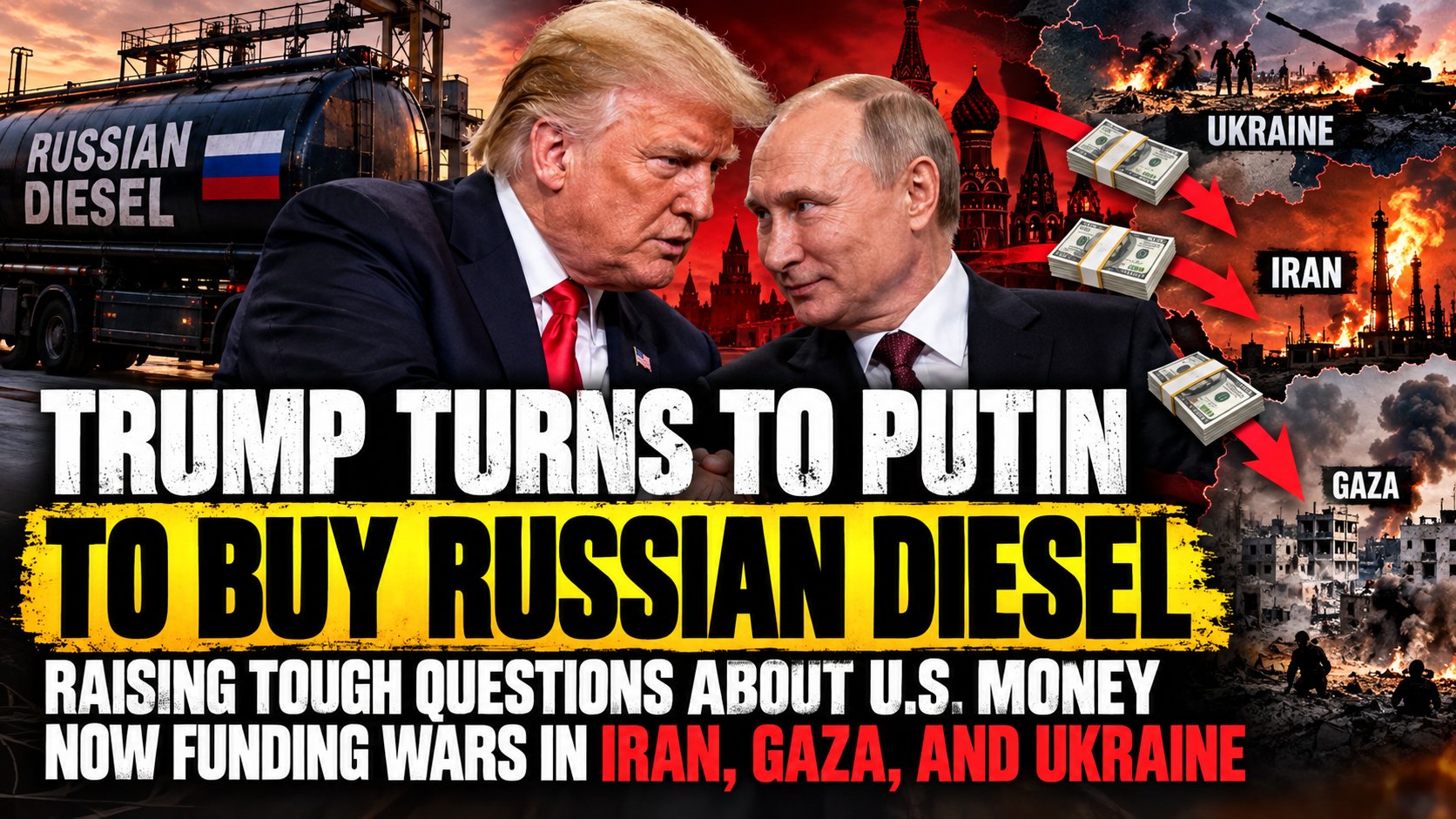
Trump Turns to Putin for Diesel as America Fights Iran, Raising Questions About Whether U.S. Energy Purchases Will Help Finance Russia’s War Against Ukraine
President Donald Trump’s agreement to reopen Russian diesel trade could provide Vladimir Putin with additional energy revenue while Moscow continues its invasion of Ukraine. The move, intended to ease soaring American fuel prices, has triggered a confrontation with Kyiv, bipartisan criticism in Washington, and new questions about the financial consequences of U.S. foreign policy.
President Donald Trump has reached an agreement with Russian President Vladimir Putin to bring millions of tons of Russian diesel into American and international energy markets, reversing a key element of Washington’s economic pressure campaign against Moscow while Russia continues its invasion of Ukraine. The arrangement, announced October 9, comes as the United States confronts soaring fuel prices following its war with Iran and growing political pressure over the economic consequences of the conflict.
The decision creates an extraordinary contradiction in American foreign policy. Washington has spent years restricting Russian energy transactions to reduce the revenue available to Moscow’s military economy, yet the Trump administration is now authorizing certain Russian diesel sales in an effort to stabilize fuel prices disrupted by another war. The policy change could generate additional income for Russian petroleum companies and the Russian government, potentially strengthening the same economy that supports military operations against Ukraine.
Trump announced that Russia would immediately make more than 300,000 metric tons of diesel available to American and global markets, followed by another 500,000 tons in November and 1 million tons shortly afterward. The administration subsequently authorized qualifying transactions involving Russian-origin diesel through the Treasury Department’s Office of Foreign Assets Control, creating a six month exception to existing sanctions restrictions.
The announcement has been confirmed, but the precise financial terms, purchasers, deliveries, and payments remain unclear. There is not yet sufficient public evidence to establish how much diesel will actually enter the United States, how much additional revenue Russia will receive, or whether the arrangement will produce lasting reductions in American fuel prices. Those uncertainties are central to understanding the agreement’s economic and geopolitical consequences.
For Putin, however, the potential benefit is significant. Petroleum exports have long been an important source of Russian government revenue, and Western sanctions have sought to limit the financial resources available to sustain Moscow’s war effort. Reopening commercial opportunities for Russian refined petroleum products could ease some of that pressure just as Ukraine continues targeting Russian energy infrastructure to weaken the country’s military economy.
The Iran War Created an Energy Crisis, and Trump Turned to Russia for Relief
The administration’s decision follows a dramatic escalation in global energy prices linked to the war with Iran and disruptions affecting the Strait of Hormuz, one of the world’s most strategically important petroleum shipping corridors. The waterway normally carries a substantial share of internationally traded oil, and disruptions to traffic through the region have consequences for crude prices, refined fuel availability, commercial transportation, and consumer costs across the global economy.
Diesel is particularly important because its economic impact extends far beyond drivers filling their vehicles. The fuel powers commercial trucking, agricultural equipment, construction machinery, freight transportation, and portions of the industrial economy. When diesel prices increase sharply, businesses face higher operating expenses that can eventually reach consumers through more expensive groceries, shipping charges, building materials, and everyday goods.
American diesel prices have climbed above $6 per gallon during the crisis, increasing pressure on truckers, farmers, and businesses already struggling with elevated costs. The Trump administration argues that increasing available supplies is necessary to stabilize markets, protect consumers, and prevent energy shortages from spreading through the broader economy. With congressional elections approaching on November 3, the economic consequences have also become an immediate political concern for Republicans attempting to retain control of Congress.
Trump’s solution, however, creates a foreign-policy dilemma. Rather than relying exclusively on domestic production, allied suppliers, or existing inventories, the administration has turned to a government that remains under extensive Western sanctions for invading Ukraine. That decision connects two separate international conflicts through the global energy market: the war with Iran, which has contributed to rising fuel prices, and Russia’s war against Ukraine, which the United States and its allies have attempted to constrain through economic restrictions.
Energy analysts have questioned whether the announced Russian shipments will be sufficient to produce a sustained reduction in American fuel prices. Additional Russian exports do not necessarily translate into equivalent increases in global supply if shipments are redirected from existing customers, while the initial 300,000 ton commitment represents less than a day’s worth of American distillate fuel demand.
America Could Be Paying Russia While Russia Continues Attacking Ukraine
The central controversy is not simply that the United States is reopening energy trade with an adversarial government. It is that payments for Russian diesel could enter an economy whose petroleum revenues help sustain an ongoing military invasion that Washington has spent years attempting to restrain.
Russian energy exports support the country’s economy through corporate earnings, taxation, and other government revenues. Those resources contribute to Moscow’s overall fiscal capacity, including its ability to finance weapons production, military personnel, transportation, logistics, and other expenses associated with the invasion of Ukraine.
Money received from diesel sales is not necessarily transferred directly into a military account, and it would be inaccurate to claim that every dollar paid for Russian fuel purchases a specific missile or artillery shell. The economic relationship remains important because government revenue is fungible. Additional income can strengthen a government’s overall finances, reduce fiscal pressure, and make it easier to sustain other spending priorities, including military operations.
That principle is central to the Western sanctions campaign against Russia. By restricting Moscow’s access to certain markets, financial services, and commercial transactions, the United States and its allies have attempted to reduce the economic resources available to support the invasion without causing a broader collapse in global energy supplies.
Trump’s diesel arrangement partially reverses that approach. Although the administration has not eliminated the broader sanctions framework, it has created an exception allowing qualifying transactions involving Russian-origin diesel. The actual benefit to Moscow will depend on shipment volumes, prices, buyers, applicable taxes, and whether the transactions generate genuinely additional revenue rather than simply redirecting existing exports.
The resulting policy question is substantial: if restricting Russian petroleum revenue is an important component of the effort to weaken Putin’s military economy, what happens when Washington authorizes additional commercial opportunities for the same industry while Russia’s invasion continues?
A Potential Financial Lifeline for Putin’s War Economy
For Russia, petroleum exports represent far more than an ordinary commercial industry. Oil and gas have historically provided a major source of government revenue, foreign currency, and geopolitical influence, making energy production and international fuel sales central to Moscow’s economic resilience.
Western sanctions were designed in part to restrict those advantages by limiting Russia’s access to profitable markets and complicating its ability to sell petroleum products through conventional financial and shipping networks. Ukraine has pursued a complementary strategy by attacking Russian refineries and other energy infrastructure, seeking to reduce refining capacity, disrupt fuel availability, and increase the economic cost of continuing the invasion.
Those attacks have placed additional pressure on Russia’s petroleum sector. According to reporting citing the International Energy Agency, Russian diesel output has fallen substantially amid disruptions to refinery operations. Moscow has also restricted diesel exports to protect domestic supplies, making Trump’s agreement potentially important for both Russian producers and international fuel buyers.
Russia’s government responded to the announcement by moving to ease restrictions on diesel exports, indicating that Moscow intends to make additional supplies available. The policy shift could allow Russian suppliers to resume or expand sales that had been constrained by domestic shortages and sanctions-related restrictions.
The potential benefits extend beyond direct revenue. Sanctions exemptions can affect commercial expectations, financing decisions, shipping arrangements, and the willingness of international companies to transact with Russian suppliers. A temporary authorization from the United States reduces certain legal obstacles to qualifying sales, although other sanctions, national restrictions, and commercial limitations remain in effect.
Whether the arrangement becomes a substantial financial benefit for Moscow will depend on actual implementation. Russia must have sufficient diesel available for export, buyers must be willing to purchase it, and shipments must move through functioning transportation and financial networks. Nevertheless, the agreement offers Putin an opportunity to expand petroleum commerce while his government remains under pressure from a prolonged and expensive war.
Ukraine Condemns the Agreement as Russia Continues Killing Civilians
Ukrainian President Volodymyr Zelenskyy responded angrily to Trump’s announcement, warning that easing economic pressure on Moscow could encourage Putin to continue the invasion rather than negotiate an end to the fighting. Kyiv has argued that expanding Russian energy revenues undermines efforts to weaken Moscow’s war economy while Ukrainian civilians continue facing Russian missile and drone attacks.
The controversy intensified on October 10 when Russian strikes killed 20 people, including children, in the southern Ukrainian city of Zaporizhzhia, according to reporting from the region. Zelenskyy connected the attack to his broader criticism of Washington’s policy, arguing that sanctions relief sends a dangerous signal to Moscow while Russian forces continue attacking Ukrainian communities.
The timing does not establish that the diesel agreement caused or influenced the attack, but it highlights the contrast between Washington’s effort to expand Russian energy commerce and the continuing destruction inflicted by Russian military operations. The diplomatic fallout has been particularly consequential because Ukrainian and European representatives were meeting with American negotiators in Miami to discuss possible approaches to ending the war. Trump’s announcement came while those discussions were underway, catching Kyiv by surprise and raising questions about whether the administration’s energy priorities were beginning to conflict with its diplomatic efforts.
The dispute escalated further when Trump publicly criticized Zelenskyy and suggested that Ukraine should replace its president with a leader more willing to negotiate an agreement with Moscow. Those remarks deepened concerns among Ukrainian officials that Washington’s approach was shifting away from economic pressure on Russia and toward greater demands for concessions from Kyiv.
Trump Pressures Ukraine to Stop Attacking Russian Oil Refineries
One of the most consequential developments surrounding the diesel agreement involves Trump’s opposition to Ukrainian attacks on Russian petroleum infrastructure. The administration has argued that strikes against refineries can worsen international fuel shortages and increase prices, while Ukraine considers those facilities economically and strategically important targets in its campaign to weaken Russia’s ability to sustain the invasion.
According to Axios reporting, an American official familiar with the discussions said Trump pursued the diesel arrangement after Zelenskyy ignored repeated U.S. requests to stop targeting Russian refineries. The official’s account suggests that the agreement was influenced not only by American fuel prices but also by Trump’s frustration with Ukraine’s military strategy.
Russian refineries help supply fuel to the domestic economy, including transportation and industrial systems that support military operations. Ukraine’s attacks have sought to reduce refining capacity, disrupt fuel availability, and impose additional economic costs on Moscow. Although the military significance of individual strikes varies, the campaign forms part of Kyiv’s broader effort to weaken Russia’s capacity to continue a prolonged war.
Trump’s demands place Ukraine in a difficult position. Washington is asking Kyiv to limit attacks on economically significant Russian infrastructure while simultaneously authorizing commercial transactions that could generate additional revenue for Russian suppliers. From Ukraine’s perspective, those policies risk weakening two forms of pressure on Moscow at the same time: physical disruption of its petroleum industry and restrictions on its ability to profit from energy exports.
The Financial Times has also reported that American officials warned Ukraine that continued refinery strikes could jeopardize intelligence sharing. If such warnings result in actual restrictions, the consequences could extend beyond petroleum markets to Ukraine’s defensive capabilities, given the importance of Western intelligence cooperation to its military operations.
The disagreement exposes competing objectives within American foreign policy. Stabilizing international energy markets may require increasing available petroleum supplies, while weakening Russia’s war economy involves restricting Moscow’s ability to produce and profit from those same resources.
Congress Objects as Trump Reverses Course on Russian Energy Sanctions
The agreement has drawn criticism from lawmakers in both parties, including officials who have supported legislation intended to strengthen economic pressure on Moscow. Democratic senators Jeanne Shaheen, Chuck Schumer, and Elizabeth Warren condemned the decision in an October 9 statement, arguing that authorizing additional Russian diesel transactions undermines American national security interests and weakens efforts to restrict revenue supporting Russia’s invasion.
Sen. Richard Blumenthal, another prominent advocate of stronger sanctions, also criticized the agreement, arguing that reopening Russian energy commerce conflicts with Congress’s efforts to deprive Moscow of financial resources. Republican Rep. Don Bacon raised objections as well, demonstrating that concern about the arrangement extends beyond the Democratic Party.
The controversy is compounded by the administration’s recent support for legislation targeting Russian energy revenues. Trump signed a sanctions law in September intended to increase economic pressure on Moscow, yet his administration has now authorized transactions involving a category of Russian petroleum products that had faced restrictions.
The Treasury Department’s General License 135 establishes the legal mechanism through which qualifying Russian diesel transactions can proceed. Issued October 9, the authorization covers certain activities involving the sale, delivery, offloading, and importation of Russian-origin diesel, including imports into the United States, through April 7, 2027.
The license does not eliminate all sanctions against Russia, and its scope is limited by its specific terms. Nevertheless, it represents an official relaxation of restrictions affecting Russian diesel commerce at a time when Washington’s broader sanctions strategy remains focused on limiting Moscow’s access to international revenue.
Is America Financially Entangled in Wars on Opposing Sides of the World?
The broader controversy raises difficult questions about the relationship between American military operations, international energy markets, and the financial resources available to governments engaged in war. The United States and Israel are fighting Iran, a conflict that has disrupted petroleum supplies and contributed to higher global fuel prices. Those disruptions have created demand for additional energy sources, leading Washington to authorize transactions involving Russian diesel. Russia, meanwhile, continues its invasion of Ukraine, and additional petroleum revenue could strengthen Moscow’s ability to finance that campaign.
The financial connections are consequential, but they must be described accurately. American military operations against Iran involve direct government spending. U.S. military assistance to foreign partners involves separate appropriations, equipment transfers, and other government programs. Purchases of Russian diesel would generally involve commercial payments from buyers to suppliers, potentially generating additional revenue for Russian companies and the Russian government.
Those are different financial mechanisms. The diesel agreement does not establish that American taxpayers are directly financing Russian military operations, nor does it mean the United States has formally joined Russia’s war against Ukraine. The more defensible conclusion is that American energy policy could now provide financial benefits to Russia while Washington continues diplomatic efforts intended to end Russia’s invasion.
The distinction matters because economic sanctions are specifically designed to limit an adversary’s access to the revenues and commercial relationships that help sustain military operations. Reopening those relationships can weaken the intended economic pressure even when the transactions themselves are commercial rather than military.
The situation also demonstrates how conflicts in separate regions can become financially interconnected through global commodity markets. A war affecting petroleum shipments in the Middle East can increase demand for alternative suppliers, including governments under sanctions. Higher energy prices can improve revenue opportunities for producers, while governments facing domestic economic pressure may become more willing to relax restrictions originally imposed for national security reasons.
In this case, the Trump administration’s effort to contain the economic consequences of the Iran war has created a potential commercial opening for Russia, even as Moscow remains the target of Western sanctions over its invasion of Ukraine.
How Much Money Could Russia Actually Make?
The financial scale of the agreement is central to determining whether the arrangement will materially strengthen Moscow’s war economy. Trump announced an initial supply of more than 300,000 metric tons of diesel, followed by 500,000 tons in November and another 1 million tons shortly afterward. Additional volumes discussed in reporting could bring the potential total to approximately 4.8 million metric tons.
Those quantities are substantial in commercial terms, but the actual revenue will depend on realized prices, delivery arrangements, discounts, transportation costs, and the amount ultimately sold by Russian suppliers. The public announcement does not establish the existence of completed contracts for every proposed shipment, nor does it prove that the full amount will reach buyers.
A hypothetical wholesale price of $800 per metric ton would place the gross sales value of an initial 300,000-ton shipment at approximately $240 million. At that same illustrative price, 4.8 million metric tons would represent roughly $3.84 billion in gross commercial sales. These figures are mathematical illustrations rather than verified contract values or confirmed payments to Russia.
The Russian government would not necessarily receive the entire amount. Producers, shipping companies, intermediaries, and other commercial participants would incur expenses, while government revenue would depend on applicable taxes and the financial circumstances of the companies involved.
Nevertheless, the potential scale helps explain why the arrangement has attracted scrutiny. Petroleum transactions involving millions of tons of fuel can generate billions of dollars in commercial activity, and even a portion of that activity becoming additional Russian government revenue could have economic significance.
The decisive figures will be actual shipments, realized prices, the identities of buyers and sellers, and the resulting government revenue. Until those details become available, the economic benefit to Moscow remains a serious possibility rather than a fully quantified outcome.
Will the Russian Diesel Agreement Actually Lower Prices for Americans?
The administration’s defense of the agreement rests on the argument that increasing diesel availability should help reduce fuel costs for American consumers and businesses. That objective has particular urgency because diesel prices influence transportation, agriculture, manufacturing, and the distribution of consumer goods, making sustained increases a potential driver of broader inflation.
However, energy analysts have questioned whether the Russian shipments will materially change market conditions. Michael Lynch of the Energy Policy Research Foundation argued that redirecting Russian diesel to American buyers could simply force existing customers to seek replacement supplies elsewhere, limiting the overall effect on global prices.
That distinction is important because moving fuel from one market to another does not necessarily increase worldwide production. If Russia redirects shipments that would otherwise have gone to existing customers, those buyers must obtain fuel elsewhere, potentially offsetting the expected price reduction. The arrangement could improve access to diesel for particular purchasers without substantially lowering prices throughout the international market.
Diesel futures declined following Trump’s announcement, but a short term market reaction does not establish that the agreement will produce sustained savings for American consumers. The more important test will be whether additional supply reaches the market, whether shipping disruptions ease, and whether wholesale price reductions eventually reach retail customers.
The United States could therefore provide Russia with additional commercial opportunities without obtaining the substantial domestic price relief the administration hopes to achieve. Conversely, if the agreement helps alleviate a severe fuel shortage, supporters may argue that the immediate economic benefits justify a narrowly defined sanctions exception.
The Midterm Elections Add Another Layer to the Controversy
The agreement arrives just weeks before the November 3 congressional elections, when voters will decide control of the House and Senate against a backdrop of elevated fuel prices, international military conflicts, and concerns about household expenses.
For the administration, lower diesel prices would offer a tangible economic benefit to businesses and consumers struggling with higher transportation costs. The White House has emphasized the importance of protecting farmers, truckers, and other industries heavily dependent on diesel, presenting the agreement as a practical response to an immediate economic problem.
Critics argue that the administration is prioritizing short-term price relief while weakening economic restrictions designed to constrain Russia’s invasion of Ukraine. Their concern is that potential domestic economic benefits may come at the expense of American foreign-policy objectives abroad.
The debate is therefore not simply about whether diesel should cost less. It concerns whether Washington should relax sanctions against a government conducting an ongoing invasion, what financial benefits that government might receive, and whether other means of stabilizing energy prices could achieve similar results without undermining existing restrictions.
The Larger Consequences of Trump’s Agreement With Putin
The diesel arrangement has exposed a difficult contradiction in American foreign policy. The United States is confronting the economic consequences of war in the Middle East while turning to Russia for energy supplies, even as Russia continues military operations against Ukraine and remains the subject of extensive Western sanctions.
The Trump administration maintains that additional diesel supplies are necessary to protect American consumers from rising costs. Ukraine and several American lawmakers argue that relaxing sanctions risks providing Moscow with resources that could help prolong the invasion. The eventual impact will depend on facts that remain unresolved, including actual delivery volumes, financial terms, Russian government revenue, and measurable changes in fuel prices.
What is already established is that Washington has authorized new transactions involving Russian diesel, creating an exception to restrictions originally intended to deprive Moscow of revenue. The administration has also increased pressure on Ukraine to stop attacking Russian petroleum infrastructure, even as those facilities remain part of Kyiv’s strategy for weakening Russia’s war economy.
The combination represents a significant change in how the United States is balancing energy security against economic pressure on Russia. It raises questions about whether Washington can simultaneously pursue lower fuel prices, support negotiations to end the invasion of Ukraine, and maintain meaningful financial restrictions on the Russian government.
For American consumers, the immediate concern is the cost of fuel. For Ukraine, the concern is whether additional Russian petroleum revenue will help finance a war that continues to kill civilians and destroy communities. For Washington, the challenge is determining whether the economic benefits of reopening Russian diesel commerce outweigh the strategic consequences of easing pressure on Moscow.
The central question is no longer whether Trump has authorized Russian diesel transactions. That decision has been made. It is how much money Russia will ultimately receive, whether American consumers will see meaningful savings, and whether the agreement will make it harder to bring Russia’s war against Ukraine to an end.

Sources & Further Reading
- U.S. Department of the Treasury — October 9, 2026. Office of Foreign Assets Control: Issuance of Russia-Related General License 135. Primary government record confirming the sanctions authorization.
- Associated Press — October 9, 2026. Trump Strikes Deal With Putin for Russian Diesel in Sharp Reversal of U.S. Policy Ahead of Midterms. Reporting on the announced shipments, sanctions relief, economic consequences, and political reaction.
- Reuters — October 9, 2026. Trump Says Russia Will Supply Diesel to U.S. and Global Markets. Reuters reporting on the agreement, fuel markets, and the potential economic benefits to Russia.
- Reuters — October 10, 2026. Trump Calls for Replacing Ukraine’s Zelenskyy in Dispute Over Diesel Deal With Russia. Reporting on Trump’s remarks, Ukraine’s objections, and Russian attacks on Ukrainian civilians.
- Associated Press — October 10, 2026. Trump Says Ukraine Should Get a New President as He Blames Zelenskyy for U.S. Diesel Prices. Reporting on the diplomatic confrontation following the agreement.
- Axios — October 9, 2026. Trump Announces Major Diesel Deal With Putin, Infuriating Ukraine. Reporting on the announcement and its implications for negotiations involving Ukraine.
- Financial Times — October 10, 2026. U.S. Warns Kyiv That Strikes on Russia Jeopardize Intelligence-Sharing. Reporting on U.S. pressure regarding Ukrainian strikes against Russian energy infrastructure.
- U.S. Senate Foreign Relations Committee — October 9, 2026. Shaheen, Schumer and Warren Condemn Trump’s Diesel Deal With Putin. Official congressional statement opposing the sanctions exception.
- U.S. Treasury Department. Russian Harmful Foreign Activities Sanctions Program. Background on the sanctions framework governing Russian economic transactions.


















































Want to join the conversation?
Create an account or sign in to share your thoughts, vote,
and reply to other readers.
Showing 0 of 0 comments
Don't have an account?
Already have an account?