
Saturday Night Live Turns a Police Talk Show Into a Hilarious Series of Traffic Stops, Shakedowns, and Completely Unnecessary Arrest Threats
In its latest sketch, Saturday Night Live imagines what would happen if two suspicious, overly aggressive police officers hosted their own daytime talk show. The result is a brilliantly absurd collision of celebrity interviews, police interrogations, and the kind of authority driven chaos that turns ordinary conversations into potential criminal investigations.
Saturday Night Live took aim at aggressive policing and the absurdities of law enforcement culture with “Cop Talk Show,” a sketch that transforms the familiar format of a friendly daytime interview program into a relentless series of interrogations, traffic stop procedures, and escalating confrontations. Instead of welcoming guests with cheerful questions about their careers and upcoming projects, the show’s two police officer hosts treat nearly everyone who walks onto the set as a potential criminal.
The fictional public access program is hosted by Officer Doyle Connelly, who sits behind a traditional talk-show desk, and Officer Dan Krajewski, a mustachioed, sunglasses-wearing cop stationed on the guest couch. The setting resembles a low budget local television production, complete with promotional interviews and awkward sponsor interruptions, but the hosts have apparently forgotten that their guests are appearing voluntarily rather than being pulled over on the highway.
The comedy comes from the officers’ inability to separate their professional instincts from ordinary human interaction. Every question becomes an interrogation, every movement looks suspicious, and every guest is one misunderstanding away from being searched, detained, or thrown out of the studio. The officers approach their hosting responsibilities with the same exaggerated suspicion and aggression they might bring to a dangerous police encounter, even when the person sitting across from them is simply trying to promote a book.
A Book Interview Becomes a Full Blown Traffic Stop
The first guest is Lawrence Cornfeld, an author appearing to promote his mystery novel, “Master of Mystery.” What should be a routine promotional interview immediately becomes an exercise in police intimidation when Connelly treats the couch as though it were the driver’s seat of a vehicle. Rather than asking about the book, Connelly orders the author to roll down an imaginary window, establishing that the officer is mentally conducting a traffic stop despite being seated inside a television studio. Cornfeld attempts to cooperate, but the situation deteriorates when the officers demand identification and become suspicious of his movements.
As Cornfeld reaches into his jacket to retrieve his identification, Krajewski abruptly slaps his hand away and orders him to move slowly. The exaggerated reaction transforms an ordinary gesture into a potentially dangerous confrontation, mocking the way routine police interactions can escalate when officers interpret harmless movements as threats.
The interrogation becomes even more ridiculous when the officers begin reading the author’s personal information aloud on television, including his home address. Cornfeld protests that he does not want his address broadcast to viewers, but his objections have little effect on the hosts, who appear more interested in asserting authority than conducting an interview.
By the time the segment ends, the author has barely discussed his novel. Instead, he has been questioned, intimidated, publicly embarrassed, and dismissed with a warning, completing what amounts to a traffic stop conducted entirely from a television couch.
Even the Commercial Break Turns Into a Police Intervention
The sketch briefly shifts away from guest interviews for what initially appears to be a conventional sponsor segment, but even the commercial interruption reveals another layer of dysfunction within the fictional police department. A fellow officer appears to deliver a public service announcement encouraging attendance at Alcoholics Anonymous meetings. Rather than promoting a business or local community event, the officer directly addresses Connelly about the importance of showing up for meetings and maintaining sobriety.
The exchange suggests that the announcement is less of a public service message than an intervention aimed at the show’s own host. Connelly responds with casual indifference, saying he will think about attending, before attempting to return to the program.
The joke adds another dimension to the parody by suggesting that the officers are so accustomed to treating their own problems as routine workplace business that they barely recognize the absurdity of conducting a personal intervention during a televised talk show.
A Local Artist Gets Treated Like a Drug Suspect
The next guest is a nervous young artist who arrives hoping to discuss his work, only to find himself subjected to an increasingly aggressive investigation. The officers quickly decide that his mannerisms are suspicious, accusing him of slurring his words and behaving as though he is under the influence of drugs. Rather than allowing the artist to explain himself, the hosts begin issuing commands, ordering him to stand and move away from his chair. The confrontation escalates when a police dog handler enters the studio to conduct a search, transforming the talk show set into an improvised narcotics checkpoint.
The officers’ suspicions appear vindicated when a small object falls from the artist’s belongings, but the supposed contraband turns out to be an Altoid breath mint. Instead of acknowledging the misunderstanding, the officers continue treating the guest as a dangerous criminal, threatening to use a Taser and eventually forcing him off the stage.
The sequence captures the sketch’s central comedic device: the officers repeatedly manufacture suspicion, escalate situations through their own behavior, and then interpret the resulting confusion as evidence that their aggression was justified. The artist, who arrived to discuss painting, leaves without receiving anything resembling an interview. The officers, meanwhile, appear completely satisfied with their handling of the situation.
The Stand Up Comedian Gets the Shortest Interview in Television History
After several increasingly confrontational encounters, the show introduces a young stand up comedian who arrives wearing a bright yellow hoodie and hoping to promote an upcoming performance at Magooby’s Joke House. The comedian barely makes it onto the set before Connelly abruptly announces that the interview is over and sends him away. There is no interrogation, no promotional discussion, and no opportunity for the guest to deliver a joke. The officer simply decides he has heard enough before the conversation has even begun.
The sudden dismissal provides one of the sketch’s sharpest comedic reversals. After watching the officers aggressively interrogate earlier guests over imaginary offenses, the audience is given an entirely different demonstration of their authority: the ability to terminate an encounter for absolutely no reason. The comedian’s appearance lasts only moments, turning what would normally be an opportunity for publicity into an absurdly brief rejection.
The Final Guest Reveals Just How Selective the Officers’ Aggression Really Is
The sketch reaches its climax when an energetic television actress arrives on the set, immediately transforming the atmosphere. Unlike the previous guests, who were treated with suspicion for minor gestures or nervous behavior, the actress is welcomed with enthusiasm despite openly admitting that she has been drinking and using drugs. Her bubbly personality and flirtatious interaction with Connelly produce an entirely different response from the officers. Instead of demanding identification, searching her belongings, or calling for backup, Connelly appears delighted by the attention and becomes increasingly relaxed.
The actress compliments his police hat, prompting the officer to exchange headwear with her in a playful moment that would have been unimaginable during the earlier interviews. The same host who treated a mystery novelist as a potential criminal and allowed an artist to be threatened over a breath mint now seems perfectly comfortable entertaining a guest who openly admits to intoxication. The reversal is central to the sketch’s satirical point. The officers’ aggressive enforcement of rules is not consistent or predictable, but appears to depend on their personal reactions to the people sitting in front of them.
Just as the conversation becomes increasingly informal, Connelly abruptly snaps back into his authoritarian persona. He stands up, begins shouting orders, and demands that the studio be cleared, bringing the broadcast to a chaotic conclusion.
The ending completes the sketch’s running joke: even when the officers briefly manage to behave like ordinary talk-show hosts, their instinct to take control through confrontation eventually overwhelms the entire production.
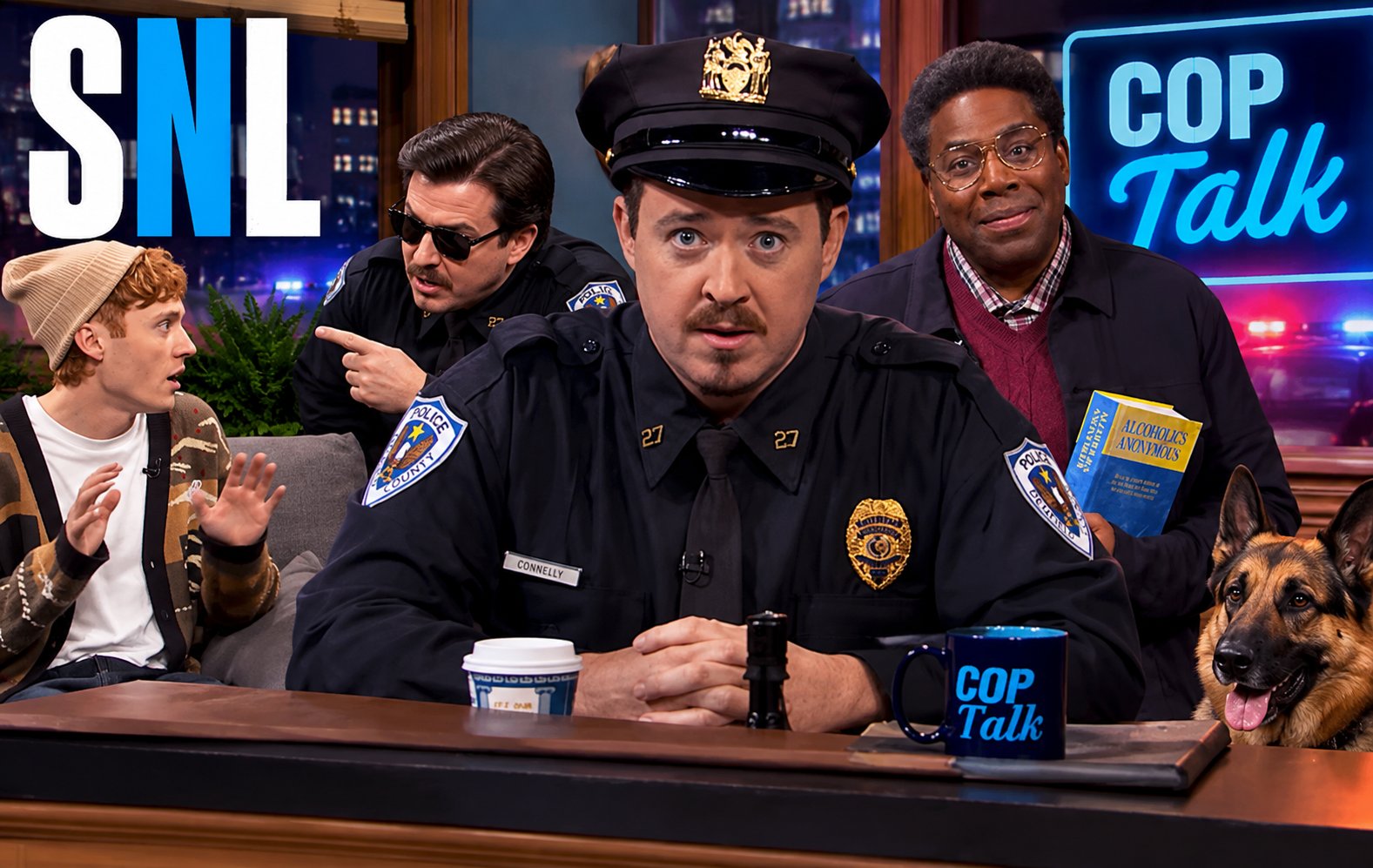
SNL Uses Absurdity to Satirize Police Authority and Selective Enforcement
What makes “Cop Talk Show” effective is the way it combines the familiar conventions of daytime television with recognizable elements of police encounters. The guest couch becomes a traffic stop location, a promotional interview becomes an identification check, and a nervous artist becomes the subject of a narcotics investigation over a breath mint.
The humor depends on the officers treating ordinary social interactions as situations requiring immediate control. Their exaggerated suspicion, aggressive commands, and inability to distinguish harmless behavior from criminal activity turn every segment into a demonstration of how authority can become absurd when exercised without context or restraint.
The sketch also takes aim at selective enforcement. The officers are relentlessly suspicious of guests who appear nervous or unremarkable, yet become accommodating when an attractive, outgoing actress admits to behavior that would ordinarily trigger the same scrutiny directed at the previous visitors. Rather than delivering a lengthy political argument about policing, Saturday Night Live allows the contradictions to emerge through increasingly ridiculous situations. The audience watches the officers repeatedly create the very tension they claim to be managing, while the traditional talk-show format provides a steady stream of innocent people for them to interrogate.
The result is a fast moving parody that works both as physical comedy and as social satire, using the absurdity of a police run television program to highlight how quickly ordinary encounters can become confrontational when every interaction is treated as a potential threat.
Saturday Night Live Finds Comedy in a Talk Show Where Nobody Is Safe From the Hosts
By the time “Cop Talk Show” reaches its chaotic conclusion, the fictional program has failed at nearly every basic responsibility of a talk show. Its guests have been intimidated, searched, dismissed, publicly embarrassed, and threatened, while almost nobody has been allowed to promote the projects they came to discuss. Yet from the officers’ perspective, the broadcast appears to have been an entirely successful exercise in maintaining order. That disconnect between the hosts’ self confidence and their obvious incompetence is what drives the sketch from beginning to end.
Saturday Night Live has a long history of turning familiar television formats into vehicles for cultural satire, and “Cop Talk Show” follows that tradition by exaggerating recognizable behavior until the underlying absurdity becomes impossible to ignore. The sketch ultimately imagines a world where even sitting on a couch and discussing a book can become grounds for police suspicion. In this particular television studio, the guests may have arrived voluntarily, but they quickly discover that leaving without being interrogated is an entirely different matter.

Sources & Further Reading
- Saturday Night Live / NBC — Official YouTube Channel: Cop Talk Show — Full Sketch
- NBC: Saturday Night Live — Official Program Website
- Saturday Night Live: Official Sketches and Videos






























Want to join the conversation?
Create an account or sign in to share your thoughts, vote,
and reply to other readers.
Showing 0 of 0 comments
Don't have an account?
Already have an account?