
Democrats Unleash Historic Blue Wave in 2026 Midterms, Seizing Congress and Toppling Republicans Across America
WASHINGTON — American voters delivered a devastating political defeat to President Donald Trump and the Republican Party in Tuesday’s midterm elections, handing Democrats control of both chambers of Congress and producing extraordinary victories in states that have served as Republican strongholds for decades. From Texas and Iowa to Ohio, Kansas, South Carolina, and Georgia, the Democratic wave swept across the country, transforming the political landscape and setting the stage for a dramatic confrontation between Congress and the White House during the final two years of Trump’s presidency.
The Democratic Party secured at least 54 seats in the U.S. Senate and more than the 218 seats necessary to control the House of Representatives, according to election projections from the Associated Press and other major news organizations. An Associated Press results snapshot supplied Wednesday afternoon showed Democrats with 233 House seats called and 29 additional races where Democratic candidates were leading. Republicans had secured 139 seats and were leading in 34 contests, with counting continuing in several states. The results represent one of the most significant midterm reversals for a sitting president’s party in modern American politics.
The election was more than a routine backlash against the party occupying the White House. Democrats broke through in states where Republican candidates had dominated statewide elections for generations, defeating prominent Trump allies, flipping governorships, and capturing congressional seats that Republicans had considered secure. Voter frustration over inflation, the cost of living, the administration’s war with Iran, and concerns about government corruption helped produce an unusually broad coalition against the president’s political agenda.
For Democrats, the immediate victory is control of Congress. The larger consequence is the restoration of meaningful congressional oversight of an administration that will now face opposition party leadership in both chambers. For Trump, the results represent a major political setback, threatening his legislative agenda and giving Democrats the institutional authority to investigate federal spending, government contracting, executive conduct, and potential abuses of power.
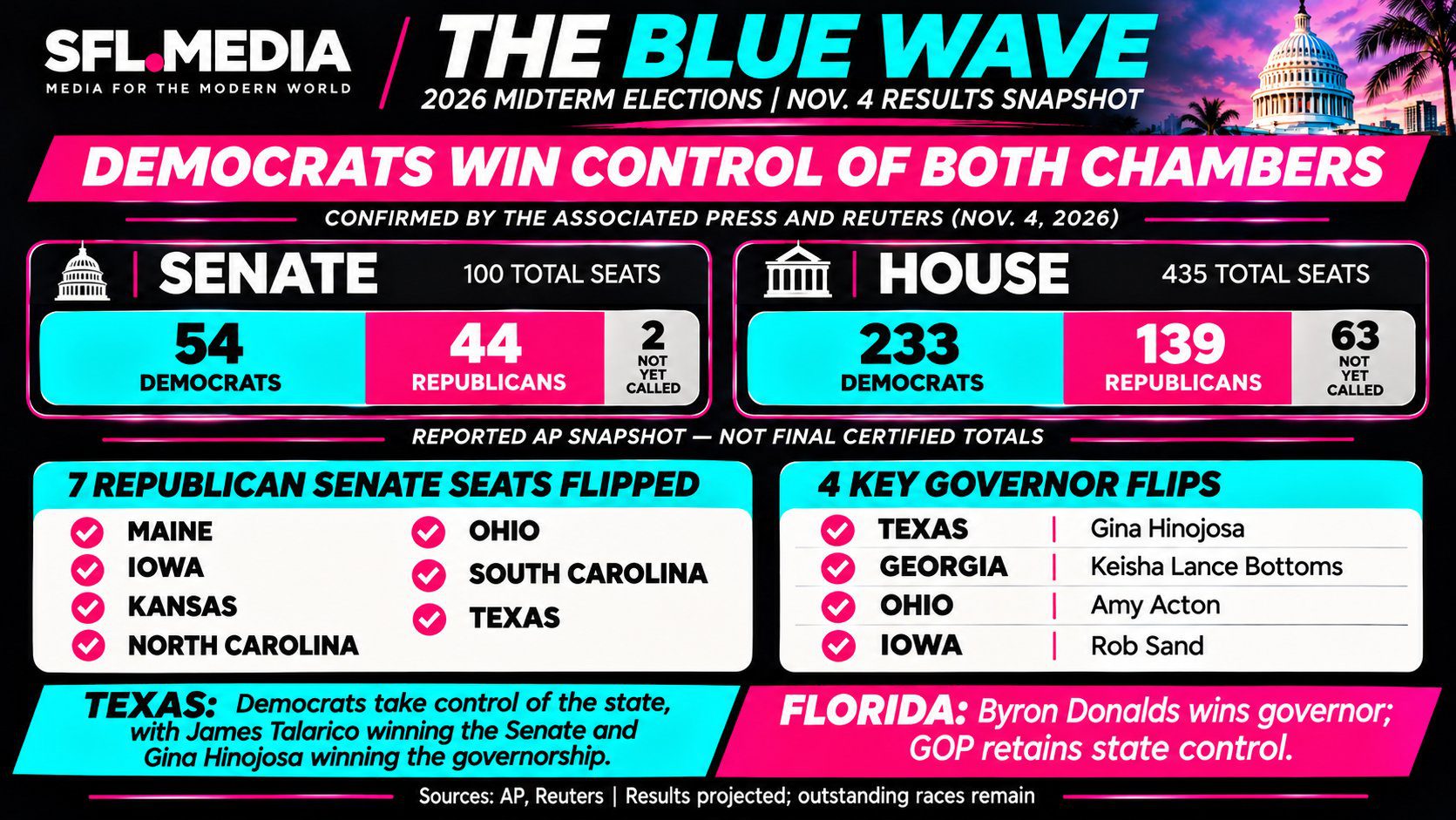
Democrats Capture the Senate With Seven Republican Seat Flips
The Senate results delivered one of the most remarkable political transformations of election night. Democrats flipped seven Republican held seats, including victories in Iowa, Kansas, Maine, North Carolina, Ohio, South Carolina, and Texas. Each of those states voted for Trump in the 2024 presidential election, underscoring the extent to which the Republican coalition fractured just two years after returning him to the White House.
In Maine, Democrat Troy Jackson defeated longtime Republican Senator Susan Collins, ending her nearly three decade career in the Senate. Collins had cultivated a reputation as an independent minded Republican, occasionally breaking with her party on high profile issues, but her record was insufficient to overcome the political backlash facing Republicans nationally. Jackson’s victory gave Democrats an important pickup in New England and removed one of the Republican Party’s most recognizable moderate figures from Washington.
Iowa delivered another major upset when Democrat Josh Turek defeated Republican Ashley Hinson. The victory was particularly significant because Iowa has moved steadily toward Republicans in recent presidential and statewide elections. Turek’s success demonstrated that Democrats could rebuild support among voters in Midwestern communities where the party had struggled to remain competitive.
In Kansas, Democrat Adam Hamilton defeated incumbent Republican Senator Roger Marshall, giving the state its first Democratic U.S. senator elected since 1932. South Carolina produced an equally extraordinary result when Democrat Annie Andrews defeated Republican Senator Darline Graham, breaking through in a state that Trump carried by a substantial margin in 2024. Together, the Kansas and South Carolina victories demonstrated that the Democratic wave had reached well beyond traditional swing states.
North Carolina voters elected former Democratic Governor Roy Cooper over Republican Michael Whatley, while Ohio voters returned former Democratic Senator Sherrod Brown to Washington by defeating Republican incumbent Jon Husted in a special election. Brown’s victory represented a significant political comeback after his previous Senate defeat, while Cooper’s win restored Democratic representation to a Senate seat in a state where Republicans had enjoyed considerable electoral success.
Texas delivered the seventh Republican Senate seat flip, with Democrat James Talarico defeating Republican Ken Paxton in one of the most closely watched contests in the country. Meanwhile, Minnesota Lieutenant Governor Peggy Flanagan won the seat being vacated by retiring Democratic Senator Tina Smith, maintaining Democratic control of that seat. Democrats also defended important Senate seats elsewhere, including Georgia, where Senator Jon Ossoff won reelection.
The resulting Democratic Senate majority fundamentally changes the balance of power in Washington. Republicans will lose control over the confirmation process for many presidential nominees, while Democratic committee chairs will gain authority to conduct oversight hearings and investigate federal agencies. Although Democrats will still face Senate procedural rules and presidential vetoes, the election substantially reduces Trump’s ability to advance his agenda without negotiating with the opposition.
Texas Delivers a Political Earthquake as Democrats Defeat Abbott and Paxton
Texas emerged as perhaps the single most dramatic battleground of the 2026 midterms, delivering two statewide Democratic victories that would have seemed nearly unimaginable just a few years earlier. Democrat Gina Hinojosa defeated incumbent Republican Governor Greg Abbott, while Democrat James Talarico defeated Ken Paxton in the U.S. Senate contest, ending decades of Republican dominance in two of the state’s most powerful elected offices.
Hinojosa’s victory was particularly historic. She became the first Latina elected governor of Texas and the first Democrat to win the office since Ann Richards in 1990. Abbott, one of the Republican Party’s most prominent governors and a close political ally of Trump, entered the campaign with substantial financial resources and a powerful statewide political organization. Despite those advantages, Hinojosa built a winning coalition around economic concerns, public education, healthcare, and dissatisfaction with Republican leadership.
The Senate result was equally consequential. Talarico, a Democratic state representative who gained national attention for his political messaging and willingness to challenge Republican positions on religion, education, and economic inequality, defeated Paxton in a race that attracted intense national attention. Paxton had been a prominent figure in conservative politics and a close ally of Trump’s political movement, making his defeat a significant setback for the Republican Party’s most aggressively pro-Trump faction.
The magnitude of the Democratic breakthrough cannot be overstated. Texas had not elected a Democrat to the U.S. Senate since 1988, and Republicans had dominated statewide offices since the 1990s. The victories by Hinojosa and Talarico suggest that demographic changes, shifting suburban political attitudes, and frustration with Republican governance may be creating a more competitive political environment in the nation’s second-most-populous state.
Democrats also made gains in Texas congressional contests, including the 15th Congressional District, where Bobby Pulido defeated Republican incumbent Monica De La Cruz. That result was particularly notable because South Texas had become a major focus of Republican efforts to expand support among Latino voters. The combination of statewide and congressional victories raises serious questions about the durability of the Republican electoral coalition in a state that has long served as a foundation of the party’s national political strategy.
Democrats Flip Governorships in Georgia, Ohio, Iowa, and Texas
The Democratic wave extended far beyond Congress, as voters elected Democratic governors in several states that had been controlled by Republicans. Four Republican held governorships flipped to Democrats in Georgia, Iowa, Ohio, and Texas, while Democrats also won other important gubernatorial contests, including Nevada and Wisconsin. The results placed Democrats in control of at least 27 governorships, according to Ballotpedia’s early Wednesday count, giving the party a majority of the nation’s governorships for the first time since 2010.
In Georgia, former Atlanta Mayor Keisha Lance Bottoms defeated Republican Rick Jackson, becoming the first Black woman elected governor in United States history. Her victory also returned Georgia’s governor’s office to Democratic control for the first time since 2003, marking a major political breakthrough in a state that has become central to national electoral competition. Bottoms’ victory carried significance beyond party politics, representing a historic milestone for Black women seeking executive office in American government.
Ohio delivered another major upset when Democrat Amy Acton defeated Republican Vivek Ramaswamy, the businessman and former presidential candidate closely associated with Trump’s political movement. Acton, a physician and former state health director, overcame a nationally recognized Republican opponent in a state that had moved decisively toward Republicans during recent presidential elections. Her victory returned the Ohio governor’s office to Democratic control for the first time since Ted Strickland’s administration.
In Iowa, Democrat Rob Sand defeated Republican Zach Lahn, giving Democrats their first gubernatorial victory in the state since 2006. Combined with Josh Turek’s Senate victory and Democratic gains in congressional races, Sand’s win helped make Iowa one of the clearest examples of the national political shift. In Nevada, Democratic Attorney General Aaron Ford defeated Republican Governor Joe Lombardo, becoming the state’s first Black governor and preventing Republicans from retaining control of another competitive statehouse.
The gubernatorial results carry major policy implications. Governors oversee state budgets, appoint agency leaders, influence education and healthcare policy, and play important roles in implementing federal programs. Democratic victories in these states will create new opportunities for the party to shape policy outside Washington while potentially challenging Republican led initiatives on issues ranging from public education to reproductive rights.
Democrats Retake the House as Republican Incumbents Fall Across the Country
The Democratic takeover of the House of Representatives completed the party’s sweeping congressional victory, ending Republican control of the chamber and giving Democrats the power to set its legislative agenda. The party captured competitive districts across the Midwest, Northeast, South, and West, including several constituencies that had supported Trump in the previous presidential election. The geographic breadth of those gains demonstrated that the political backlash extended beyond traditionally Democratic cities and into suburban, rural, and working-class communities where Republicans had built much of their electoral strength.
Iowa emerged as a particularly important battleground, with Democrats winning three competitive House contests. Christina Bohannan defeated Republican incumbent Mariannette Miller-Meeks in the 1st Congressional District, Lindsay James defeated Republican Joe Mitchell in the 2nd District, and Sarah Trone Garriott defeated Republican incumbent Zach Nunn in the 3rd District. Combined with Democratic victories in the state’s Senate and gubernatorial races, the results represented a dramatic reversal in a state that had become increasingly Republican over the past decade.
Wisconsin and Pennsylvania also contributed to the Democratic majority. In Wisconsin, Rebecca Cooke defeated Republican Derrick Van Orden in the 3rd Congressional District, while Democrats made gains in other competitive races. Pennsylvania saw significant Democratic advances, including victories by Janelle Stelson and Paige Cognetti in Republican held districts. The results reflected growing dissatisfaction with Republican leadership in competitive suburban communities and regions where voters have frequently shifted between the two major parties.
Democrats also secured important victories in Colorado, Nebraska, Missouri, Virginia, California, and Texas. These gains were particularly consequential because Republicans had undertaken an unusually aggressive round of mid decade congressional redistricting in several states before the election. Despite changes that generally favored Republican candidates, Democrats won enough competitive districts to overcome those structural advantages and reclaim the House.
The new majority positions House Democratic leader Hakeem Jeffries to become the first Black speaker of the House in American history. It also gives Democrats control over committee assignments, investigative priorities, legislative scheduling, and the congressional budget process. Those powers will allow the party to challenge Trump’s agenda more directly while conducting investigations into executive branch decisions that previously received limited scrutiny from Republican controlled committees.
Inflation, the Cost of Living, and the Iran War Helped Drive the Republican Defeat
The Democratic victories were fueled by a combination of economic frustration, foreign policy concerns, and dissatisfaction with the direction of the federal government. Although individual voters had different priorities, election reporting and voter surveys identified the cost of living, inflation, the administration’s war with Iran, and concerns about government corruption as major factors shaping the results.
Economic anxiety was particularly damaging for Republicans because Trump had returned to office promising improvements in affordability and economic conditions. For households struggling with housing expenses, groceries, insurance, utilities, and other recurring costs, political assurances about economic performance were not necessarily consistent with their personal financial circumstances. Democrats successfully connected those frustrations to Republican leadership, arguing that the administration had failed to deliver the economic relief voters expected.
The war with Iran created another significant political liability. The conflict contributed to concerns about energy prices, American military commitments, and the administration’s foreign policy priorities. Vice President JD Vance publicly acknowledged the war’s political consequences on Wednesday, identifying it as a major reason Republicans had lost support among voters who backed Trump in 2024. His assessment underscored the growing recognition within Republican leadership that the administration’s foreign policy decisions had become an electoral burden.
Concerns about government corruption, presidential power, and the erosion of institutional accountability also played a role. Many voters who supported Democrats expressed a desire for stronger congressional checks on the administration, particularly after two years in which Republicans controlled both chambers. The resulting coalition included traditional Democrats, independents, disaffected Republicans, and voters whose primary concerns centered on economic stability rather than partisan ideology.
The election results do not establish that every Democratic voter shared the same motivations. They do, however, demonstrate that opposition to the administration was broad enough to overcome longstanding Republican advantages in states that had appeared politically secure only two years earlier.
Congressional Oversight and Accountability Return to Washington
Perhaps the most consequential result of the election is the restoration of opposition party congressional oversight. When the new Congress convenes in January 2027, Democrats will control the committees responsible for examining executive branch conduct, federal spending, government contracting, agency operations, and potential conflicts of interest involving administration officials.
For much of Trump’s second presidency, Republican control of Congress reduced the likelihood of aggressive investigations into the White House and federal agencies. Democratic majorities will change that balance by giving the opposition authority to schedule hearings, request government records, subpoena witnesses through established congressional procedures, and investigate allegations of misconduct involving federal officials.
The House Oversight and Government Reform Committee, House Judiciary Committee, Senate Judiciary Committee, and other congressional panels will be positioned to examine matters that Democratic lawmakers believe have not received sufficient scrutiny. Potential subjects include federal contracting decisions, political influence over government agencies, the use of taxpayer resources, and allegations of improper relationships between public officials and private financial interests.
Congressional oversight and criminal law enforcement serve different constitutional functions. Congress can investigate government conduct, expose wrongdoing, recommend legislative reforms, and refer evidence of potential crimes to appropriate authorities. Criminal investigations and prosecutions remain the responsibility of law enforcement agencies and prosecutors operating under applicable laws and constitutional protections. A congressional investigation does not itself establish criminal guilt, and allegations involving government officials must be evaluated against verifiable evidence.
The distinction matters because accountability cannot depend solely on which political party controls Washington. A functioning system of government requires independent law enforcement, meaningful legislative oversight, and consistent application of the law regardless of political affiliation. Democratic control of Congress creates an opportunity to strengthen those institutional safeguards, but the credibility of any investigation will depend on the evidence presented and the fairness of the process.
The new majority will also face practical limitations. Trump retains presidential veto authority, and many legislative proposals will still require bipartisan cooperation to overcome Senate procedural obstacles. Democrats can block legislation and scrutinize administration decisions, but they cannot unilaterally enact their entire agenda or direct the Justice Department to prosecute political opponents.
Nevertheless, the election fundamentally changes the administration’s relationship with Congress. For the first time during Trump’s second term, the White House will face two chambers controlled by lawmakers who have both the political incentive and institutional authority to challenge its decisions.

Republicans Face a Leadership Crisis as Trump Loses Control of Congress
The scale of the Republican defeat has triggered a leadership crisis within the party, raising questions about its political direction and dependence on Trump’s personal brand. House Speaker Mike Johnson has indicated that he will not remain the Republican leader in the next Congress, while senior Republicans are preparing for internal leadership contests following the loss of their congressional majority.
The results have also intensified debate over the administration’s political strategy. Republican candidates suffered defeats in states that Trump won comfortably in 2024, suggesting that the president’s electoral coalition did not translate into dependable support for his party during the midterms. The losses were particularly damaging in Texas, Kansas, South Carolina, and Iowa, where Republicans had enjoyed significant structural and historical advantages.
Trump will remain president through January 2029, but his ability to advance major legislation will now depend heavily on negotiations with Democratic congressional leaders. His administration will also face more aggressive oversight and a Senate less willing to approve nominees without scrutiny.
For Republicans, the challenge extends beyond recovering individual congressional seats. The party must determine whether its current political message can win back independents, suburban voters, and economically frustrated Americans who rejected Republican candidates in 2026. Those decisions will help shape the party’s leadership contests and its strategy for the 2028 presidential election.
Florida Remains Republican as the National Blue Wave Stops Short of the Sunshine State
While Democrats celebrated historic victories across much of the country, Florida remained a notable exception to the national trend. Republicans swept the state’s major statewide races, demonstrating that the party continues to maintain a powerful electoral organization even as Republican candidates suffered defeats elsewhere.
Republican Byron Donalds defeated Democrat David Jolly in the governor’s race, becoming Florida’s first Black governor. The contest was considerably closer than many Republicans might have expected, with Donalds receiving approximately 50% of the vote and Jolly securing nearly 49%, according to reported election returns. Republican Senator Ashley Moody also defeated Democratic challenger Angie Nixon, preserving the GOP’s control of Florida’s U.S. Senate seat.
Republicans retained the state’s other major executive offices, including attorney general, chief financial officer, and agriculture commissioner. The results demonstrated that Florida’s political environment remains distinct from states such as Georgia, Texas, and Iowa, where Democrats successfully converted national dissatisfaction with the Republican Party into major statewide victories.
For South Florida, the election creates an unusual political environment. Florida’s Republican state government will operate alongside a Democratic-controlled Congress, potentially increasing disagreements over immigration enforcement, healthcare funding, environmental protections, disaster assistance, and federal infrastructure spending. Those disputes could have significant consequences for Broward, Miami-Dade, and Palm Beach counties, where federal policy decisions frequently intersect with local economic and environmental concerns.
Florida’s results also illustrate an important limitation of the national Democratic victory. Although the party successfully expanded its electoral reach into several Republican strongholds, its gains were not universal. The ability to compete consistently in Florida remains an unresolved challenge for Democrats heading toward the 2028 presidential election.
The Blue Wave Has Changed Washington, but What Democrats Do Next Will Define Its Legacy
The 2026 midterm elections have produced a remarkable political reversal. Just two years after Trump returned to the White House, Democrats have regained both chambers of Congress, captured governorships in traditionally Republican states, and demonstrated that the president’s political coalition can be defeated even in places that appeared firmly aligned with his movement.
The victories in Texas, Kansas, South Carolina, Iowa, Ohio, and Georgia carry particular historical significance because they challenge assumptions about the electoral boundaries of the two major parties. Democrats did not simply recover ground in familiar battlegrounds. They won races in states where Republicans had maintained political dominance for years or, in some cases, generations.
Yet winning an election and governing effectively are different accomplishments. Democrats will enter the next Congress with substantial authority but also considerable expectations. Voters who demanded economic relief will expect the party to pursue policies addressing affordability, while those concerned about corruption and presidential power will expect credible investigations and meaningful institutional accountability.
For Trump, the election represents a decisive political setback that will complicate the final two years of his presidency. For Republicans, it is a warning that loyalty to the president and reliance on familiar political messages cannot necessarily overcome public frustration with economic conditions, foreign policy decisions, and government conduct.
For Democrats, the election creates an opportunity to demonstrate that they can do more than oppose the administration. They now have the congressional authority to investigate, negotiate, legislate, and offer Americans an alternative vision of government.
The blue wave has returned Democrats to power in Congress. Whether November 3, 2026, becomes remembered as a temporary political backlash or the beginning of a lasting transformation will depend on what the party accomplishes with that power.
Sources & Further Reading

National election results and analysis
State races and gubernatorial results
SFL Media coverage
SFL Media — National Politics, Government Accountability, and South Florida News




















































Want to join the conversation?
Create an account or sign in to share your thoughts, vote,
and reply to other readers.
Showing 0 of 0 comments
Don't have an account?
Already have an account?