

Trump Fires Cybersecurity Director as NSA Network Outage, Nationwide Tech Failures and New Cyberattack Warnings Rock Washington
WASHINGTON — President Donald Trump’s administration is facing mounting scrutiny over America’s cybersecurity readiness after White House National Cyber Director Sean Cairncross was removed from his position, the National Security Agency experienced a prolonged disruption to its classified communications network, and cybersecurity experts raised concerns about emerging digital threats. The developments follow an extraordinary week of technology failures affecting federal aviation systems, major financial institutions, communications networks and some of the country’s largest technology companies, raising questions about the resilience of the digital infrastructure supporting the American economy and national security.
Cairncross’s departure on Thursday, November 19, 2026, represents the administration’s first major cybersecurity leadership change since the recent disruptions began. CNN and Reuters reported that President Trump supported his removal, with a source close to the White House questioning Cairncross’s cybersecurity qualifications. Pentagon Chief Information Officer Kirsten Davies is expected to assume the national cyber director’s responsibilities temporarily, placing an experienced technology official in charge of coordinating federal cybersecurity strategy during a period of heightened concern.
The leadership shakeup comes as investigators examine a series of incidents that have disrupted essential services across the United States. Although the timing has fueled speculation about possible coordinated cyberattacks, federal intelligence officials have repeatedly stated that the outages appear to have different technical causes and that investigators have not identified evidence of a coordinated foreign operation. The distinction is critical: A series of simultaneous or closely spaced technology failures can expose serious national security vulnerabilities without necessarily being the result of malicious activity.
The growing controversy also follows congressional demands for answers about a nationwide Federal Aviation Administration ground stop, a classified NSA communications failure affecting intelligence operations connected to the Middle East, and criticism of Homeland Security Secretary Markwayne Mullin’s public explanations for the disruptions. Together, the developments have created a significant political and technological challenge for an administration responsible for protecting some of the world’s most sophisticated digital systems.
Trump Removes National Cyber Director Sean Cairncross Amid Growing Cybersecurity Concerns
Sean Cairncross, who had served as national cyber director since August 2025, was removed from his position Thursday as the administration faced increasing criticism over its handling of widespread technology disruptions. CNN reported that a source close to the White House said Trump fully supported firing Cairncross because he lacked the cybersecurity credentials necessary for the job. A White House official confirmed his departure, although the administration did not immediately provide a detailed public explanation of the decision or announce his final day in office.
The circumstances surrounding the departure initially produced conflicting accounts. Axios reported that Cairncross was leaving on amicable terms and wanted to allow sufficient time for the administration to select a replacement before Democrats assume control of the Senate in January. Subsequent reporting from CNN and Reuters, however, characterized the departure as a firing. Cairncross issued a statement describing his service in the administration as the honor of a lifetime, but the available reporting did not establish that the recent outages themselves caused his dismissal.
The Office of the National Cyber Director plays an important role in coordinating cybersecurity policy across federal agencies, advising the president on national digital security priorities and helping establish a unified strategy for protecting critical infrastructure. Unlike agencies responsible for responding directly to individual incidents, the office focuses on government-wide policy, coordination and long term cybersecurity preparedness. Its leadership becomes particularly important when technological disruptions affect multiple sectors and require cooperation among intelligence agencies, civilian departments, military organizations and private companies.
Kirsten Davies, the Defense Department’s chief information officer, is expected to serve as acting national cyber director while the administration considers a permanent replacement. The position requires Senate confirmation, potentially setting up another contentious confirmation process when Democrats take control of the chamber in January. The transition also comes as the administration faces questions about other cybersecurity leadership vacancies, including the future direction of the Cybersecurity and Infrastructure Security Agency, which is responsible for helping defend civilian federal networks and critical infrastructure.
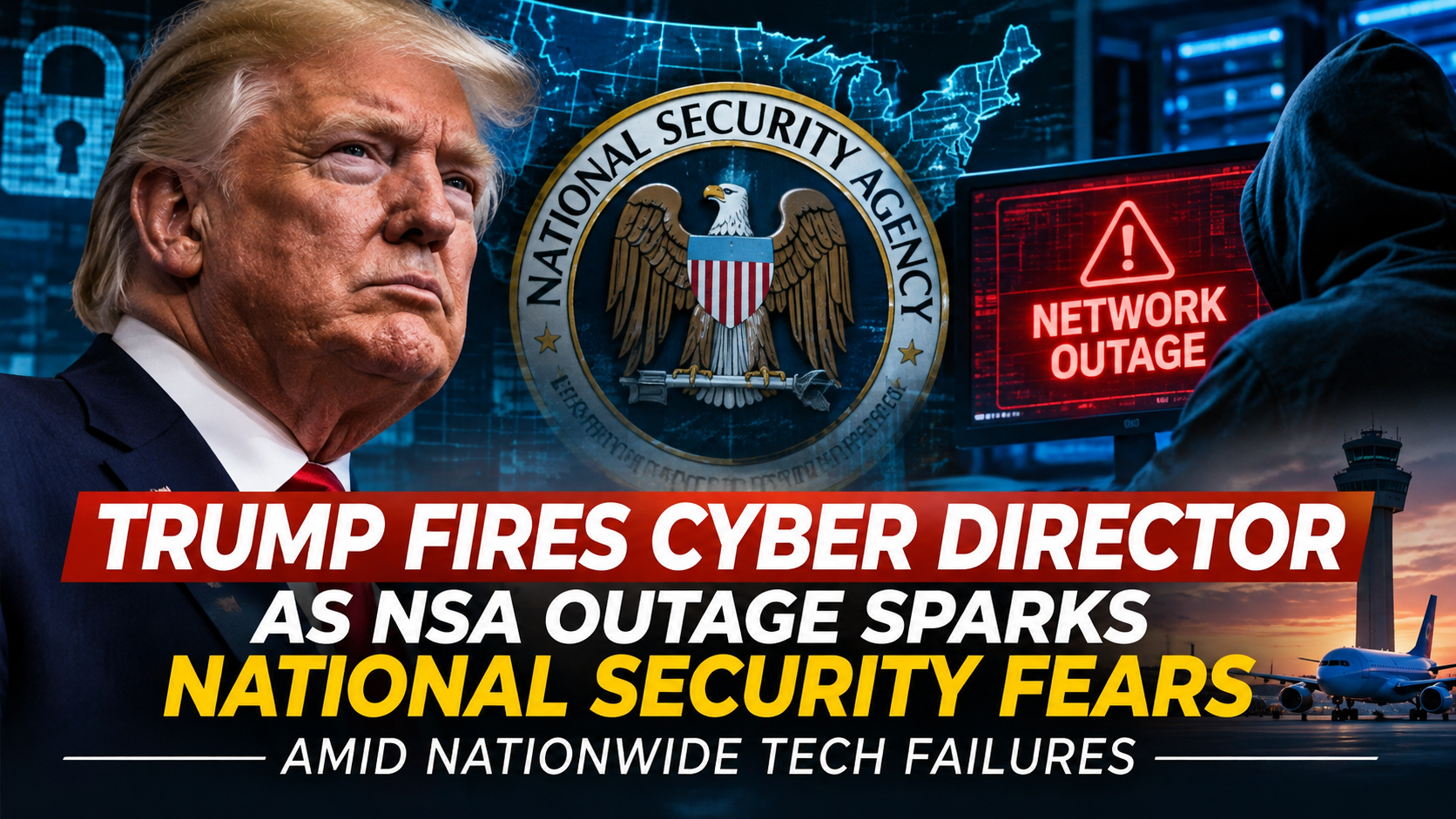
NSA Classified Network Outage Disrupts Intelligence Communications for Third Day
The National Security Agency’s internal network disruption has emerged as one of the most consequential incidents of the week because of its potential implications for classified communications and military intelligence operations. CNN reported that the outage affected NSANet, an internal classified communications system used to exchange sensitive intelligence information among NSA personnel and facilities. The disruption continued for several days, forcing adjustments to employee schedules, restricting access to the agency’s Fort Meade headquarters in Maryland and complicating communications with personnel supporting American operations overseas.
The disruption also affected NSA Georgia, a major intelligence facility responsible for supporting signals intelligence and cybersecurity operations focused on the Middle East. According to CNN’s reporting, personnel at the Georgia facility were temporarily unable to use NSANet to communicate through normal channels with colleagues deployed in the region. Officials relied on alternative communications methods and backup systems to maintain essential intelligence exchanges, while multiple sources emphasized that the agency’s most sensitive intelligence gathering capabilities remained operational.
At NSA headquarters, employees received emergency operating notifications, including a “Code Orange” designation that kept most personnel away from the main campus. The agency also used a “Code Gray” notification to coordinate staggered employee arrivals as technicians worked to restore network access. These designations reflected internal operating restrictions rather than confirmation of a cyberattack or a broader national security emergency. The extended disruption nevertheless demonstrated how problems within a central communications platform can affect thousands of employees and complicate operations across multiple intelligence facilities.
The NSA attributed the disruption to temporary degradation associated with scheduled maintenance and emphasized that its infrastructure includes multiple layers of redundancy. Reporting from CNN and Nextgov indicated that investigators were examining software updates involving vulnerabilities in PHP, a widely used programming language, as a possible factor in the network problems. Officials familiar with the investigation said there was no evidence that the outage resulted from a malicious intrusion, although restoration work was reportedly proceeding more slowly than anticipated.
Homeland Security Secretary Markwayne Mullin Faces Scrutiny Over Outage Explanations
Homeland Security Secretary Markwayne Mullin has also faced criticism over his handling of the recent technology disruptions, particularly his public statements about their possible causes. Reports that the White House had curtailed Mullin’s television appearances added another political controversy to an administration already confronting questions about the reliability of critical infrastructure. His comments attracted attention because they appeared to connect the disruptions to emerging technological developments without clearly explaining the evidence supporting that assessment.
During congressional testimony, Mullin said federal investigators had found nothing indicating that the incidents were connected and expressed 98% confidence that the disruptions were not the result of malicious foreign activity. He acknowledged, however, that the concentration of major technology failures within such a short period was unusual. His statements reflected the administration’s broader position that investigators had not identified evidence of a coordinated cyber campaign, even as lawmakers demanded more detailed explanations of the individual incidents.
Mullin also faced criticism over his attendance at a college football game in Louisiana while the nation was dealing with significant aviation disruptions. The controversy intensified questions about how senior administration officials were communicating during the outages and whether the federal government was providing sufficiently clear information about the condition of essential systems. Although criticism of the secretary’s public appearances is a separate political issue from the technical investigations, both controversies have contributed to broader concerns about the administration’s crisis management.
Cybersecurity Expert David Kennedy Raises Alarm About Potentially Undisclosed Attack
Cybersecurity expert David Kennedy, a former NSA hacker and founder of cybersecurity firm TrustedSec, appeared in CNN’s coverage to discuss emerging threats and concerns about an additional potentially significant cyberattack that had not yet been publicly disclosed. His reported warning added another dimension to the debate over whether the recent infrastructure failures reflect isolated technical problems or vulnerabilities that malicious actors could exploit.
The available description of Kennedy’s interview does not identify the alleged victim, the systems involved, the suspected attackers or the technical evidence supporting the warning. Consequently, the possible incident cannot yet be independently confirmed or connected to the NSA outage, the FAA disruption or the other technology failures. Without a transcript or additional verified reporting, it would also be premature to characterize Kennedy’s comments as proof that another major attack has successfully compromised American infrastructure.
The distinction between a cyberattack and a technology failure remains central to understanding the broader situation. Cyberattacks involve malicious activity such as unauthorized access, espionage, ransomware, data theft or deliberate interference with computer systems. Technology outages can produce similar operational consequences through defective software updates, configuration errors, equipment failures or maintenance problems. Determining whether an incident was malicious requires technical evidence, including forensic analysis, system logs and indicators of unauthorized activity.
FAA, Microsoft, Banking and Airline Outages Expose America’s Digital Infrastructure Vulnerabilities
The cybersecurity leadership shakeup follows a remarkable series of disruptions involving the Federal Aviation Administration, Microsoft, JPMorgan Chase, United Airlines and other major technology providers. The incidents affected different systems and organizations, but their proximity drew attention to the extraordinary dependence of American transportation, banking, communications and government operations on complex interconnected networks.
The November 13 FAA ground stop was particularly disruptive, interrupting air travel nationwide and affecting thousands of flights. Federal transportation officials linked the incident to a telecommunications equipment problem during a modernization project involving air traffic control infrastructure. However, congressional lawmakers questioned whether the government’s explanation adequately identified the underlying cause of the failure and why a localized equipment problem could produce consequences across the national aviation system.
As SFL Media previously reported, Democratic members of the Senate Commerce, Science and Transportation Committee demanded a detailed technical accounting of the FAA disruption, including information about network redundancy, equipment testing, contractor oversight and recovery procedures. The lawmakers questioned discrepancies between explanations provided by transportation officials and equipment manufacturers, arguing that identifying a malfunctioning router was not equivalent to determining why the failure occurred or whether similar problems could happen again.
The broader series of disruptions also included reported problems affecting Microsoft workplace services, JPMorgan Chase banking operations, United Airlines technology systems and Apple’s cloud services. Although the failures involved different technical environments, they demonstrated how quickly disruptions can interfere with essential services. An airline’s dispatch system, a bank’s transaction-processing network or a federal agency’s communications infrastructure may serve entirely different purposes, but each depends on software, hardware and telecommunications systems that require constant maintenance and protection.
Artificial Intelligence May Be Accelerating Both Cybersecurity Discoveries and Technical Failures
One of the more significant explanations emerging from cybersecurity specialists involves the growing use of artificial intelligence to discover software vulnerabilities. Advanced AI tools can help researchers identify weaknesses in widely deployed applications and infrastructure at unprecedented speed, creating pressure on companies and government agencies to implement security updates more rapidly than their systems may be prepared to accommodate.
Cybersecurity experts interviewed by Reuters suggested that the recent disruptions may be related in part to organizations rapidly patching newly discovered vulnerabilities. In the NSA’s case, reporting indicated that software maintenance involving PHP vulnerabilities was being examined as a possible cause of the classified network failure. The issue illustrates a difficult challenge for cybersecurity teams: Delaying critical updates can leave systems exposed to exploitation, while deploying complicated changes without adequate testing can introduce operational problems of their own.
Sen. Mark Warner, the Democratic vice chairman of the Senate Intelligence Committee, warned that AI-assisted vulnerability discovery is increasing pressure on organizations to patch systems immediately, sometimes creating instability in infrastructure that was never designed for such rapid changes. The concern is not that artificial intelligence has necessarily launched attacks against these organizations, but that its growing role in software development and security research is changing the pace at which vulnerabilities are discovered, corrected and potentially exploited.
For federal agencies responsible for national security, this creates an increasingly complicated balancing act. Intelligence organizations must adopt advanced technologies to remain competitive against sophisticated adversaries while maintaining the reliability of legacy systems that support classified communications and military operations. The NSA outage demonstrates that even organizations with exceptional technical expertise and extensive backup capabilities are not immune to the operational risks associated with maintaining complex infrastructure.
Federal Intelligence Officials Say There Is No Evidence of a Coordinated Cyberattack
Despite the alarming timing of the disruptions, federal intelligence officials have maintained that investigators have not discovered evidence of a coordinated cyberattack against American infrastructure. During congressional testimony, Director of National Intelligence Jay Clayton said investigators had examined the incidents for indicators commonly associated with malicious cyber operations and had not identified evidence connecting them to a single campaign.
The administration’s assessment is supported by reporting indicating that the NSA outage was associated with software maintenance and that other disruptions involved separate technical failures. While investigators may continue examining individual incidents, the available evidence does not support claims that a foreign government successfully launched a synchronized attack against American aviation, banking, technology and intelligence systems.
That conclusion does not eliminate the broader national security concerns raised by the failures. A country can experience significant operational disruption without a hostile actor being responsible, particularly when essential systems depend on aging infrastructure, complicated software environments and shared technological dependencies. The ability to recover quickly, preserve backup communications and prevent localized failures from spreading across national networks is therefore as important as preventing malicious intrusions.
South Florida Airports, Ports and Financial Institutions Face Similar Infrastructure Risks
The national discussion has important implications for South Florida, where international aviation, maritime commerce, financial services, healthcare and tourism depend heavily on reliable digital infrastructure. Miami International Airport and Fort Lauderdale-Hollywood International Airport rely on federal aviation communications systems, while PortMiami and Port Everglades operate within extensive logistics networks involving shipping companies, customs authorities, telecommunications providers and private contractors.
South Florida’s financial institutions, hospitals, municipal governments and technology businesses also depend on interconnected digital systems that must remain available during emergencies. A major outage affecting cloud computing, telecommunications or payment processing infrastructure can create widespread economic consequences even when no cyberattack has occurred. For a region with substantial international trade, tourism and financial activity, the reliability of those systems is a practical economic concern rather than an abstract cybersecurity debate.
There is no verified evidence connecting South Florida facilities to the NSA disruption or to a coordinated nationwide cyberattack. However, the recent incidents reinforce the importance of infrastructure redundancy, tested recovery procedures, secure software maintenance and clear communication between federal agencies and private-sector operators.
Congress Demands Answers as Trump Administration Faces Cybersecurity Leadership Test
The political consequences of the outages are likely to continue as lawmakers seek explanations about the government’s preparedness, the causes of the disruptions and the effectiveness of federal cybersecurity coordination. Republican Sen. Josh Hawley has called for administration briefings, while Democratic lawmakers have raised concerns about whether federal defenses are keeping pace with emerging technological threats and the increasing complexity of modern infrastructure.
Cairncross’s removal adds another question to the congressional debate: Whether the administration can maintain consistent cybersecurity leadership while agencies are confronting major operational problems. The appointment of Kirsten Davies as acting national cyber director provides an interim leadership structure, but the White House must still select a permanent replacement capable of coordinating policy across federal departments and working with the private companies responsible for much of America’s critical infrastructure.
The unresolved questions surrounding the NSA outage, FAA ground stop and other technology failures will require detailed technical investigations rather than speculation. Lawmakers must determine whether existing backup systems performed as intended, whether software maintenance procedures were adequate, whether contractors and government agencies communicated effectively, and what changes are necessary to prevent similar disruptions.
The evidence available so far does not establish that the United States is under a coordinated cyberattack. What it does establish is that some of the country’s most important technological systems experienced significant disruptions within days of one another, exposing operational vulnerabilities and prompting serious questions about federal preparedness.
America’s immediate challenge is not simply determining whether hackers were responsible. It is establishing why critical systems failed, whether those failures could have been prevented, and whether the federal government has the leadership, technical expertise and infrastructure necessary to keep essential services operating when the next crisis arrives.
Sources & Further Reading

National Cybersecurity Leadership
-
Reuters — Trump Ousts Cyber Director After Nationwide Technology Disruptions
-
CNN — White House National Cyber Director Replaced Amid Technology Outages
NSA Network Disruption and Cybersecurity
-
CNN — NSA Network Outage Disrupts Middle East Intelligence Communications
-
CNN Video — Trump’s Cyber Director Quits; DHS Chief Sidelined; New Cyberattacks
Previous SFL Media Reporting














Loading comments…