
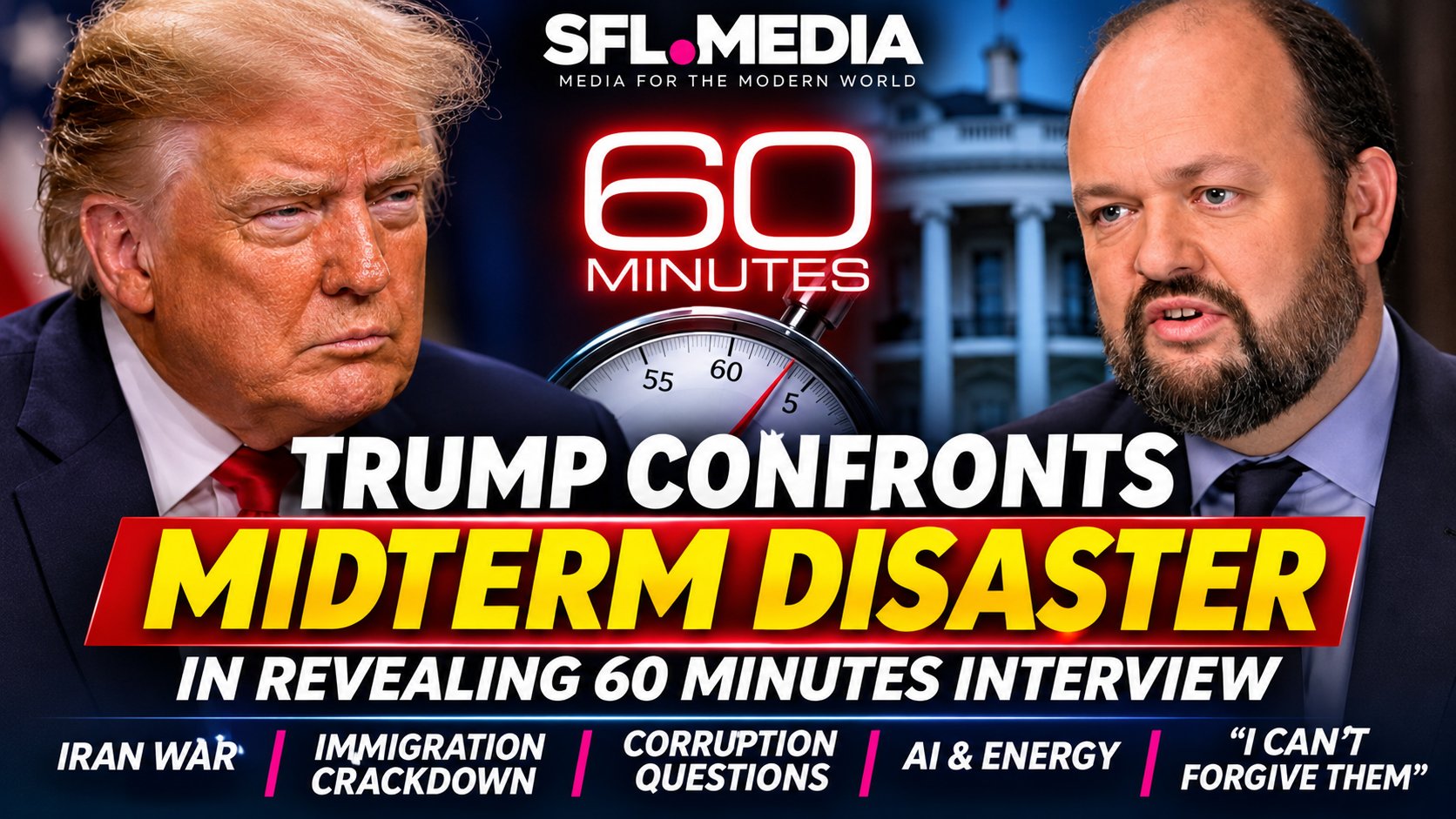
Trump Confronts Midterm Disaster on 60 Minutes, Defends Iran War, Admits Immigration Crackdown Went Too Far and Refuses to Forgive Political Enemies
In a revealing post election interview with CBS correspondent Ross Douthat, President Donald Trump struggled to explain sweeping Republican defeats, acknowledged the economic consequences of mass deportations, defended his administration’s war in Iran, and dismissed questions about his growing personal fortune. The conversation also exposed deep contradictions between Trump’s promises of bipartisan cooperation and his continued hostility toward political opponents.
WASHINGTON — President Donald Trump faced a dramatically altered political landscape during a wide ranging 60 Minutes interview broadcast Sunday, November 8, 2026, following a midterm election that stripped Republicans of control of both chambers of Congress and delivered unexpected Democratic victories in several traditionally conservative states. Speaking with CBS correspondent Ross Douthat in the Roosevelt Room of the White House, Trump offered an expansive assessment of the political damage inflicted on his party, acknowledged problems with Republican messaging, and conceded that his administration’s immigration crackdown had sometimes gone too far. He also defended the controversial military campaign against Iran, which has contributed to growing public dissatisfaction with his presidency.
The conversation exposed deeper contradictions within Trump’s second administration. He expressed interest in negotiating immigration legislation with the incoming Democratic majorities while defending policies that have divided voters and elevated one of the administration’s most hard line immigration strategists. He rejected concerns about personal enrichment despite questions about substantial increases in his reported net worth, and he suggested that his political movement could survive beyond his presidency even as Republicans confronted the consequences of their electoral defeat. Perhaps the most revealing moment came near the interview’s conclusion, when Douthat questioned Trump about Christianity, forgiveness, and whether he could ever abandon his hostility toward political opponents. The president acknowledged that his resentment would likely endure, even when confronted with the religious implications of refusing forgiveness.
The interview, recorded Friday and broadcast Sunday, offered a rare extended examination of a president confronting the loss of congressional power, growing questions about his legacy, and an increasingly uncertain final two years in office.
Republicans Lose Both Chambers as Trump Distances Himself From the Defeat
The 2026 midterm elections delivered a sweeping repudiation of Republican candidates, with Democrats projected to regain control of the House and Senate while securing significant victories in states where Republicans had long enjoyed political advantages. CBS News reported that Democrats had gained more than 40 House seats, with additional races still awaiting final results, and had picked up seven Senate seats while contests in Alaska and Mississippi remained unresolved at the time of its initial election assessment. Democratic victories also extended into statewide contests in Texas, Kansas, and South Carolina, underscoring the breadth of the Republican Party’s difficulties.
Trump’s first explanation for the defeat centered on his absence from the ballot. He argued that Republican candidates would have performed substantially better had he personally been running, pointing to the enthusiasm generated by his rallies and his own electoral record. Douthat challenged that argument by noting that Trump had personally endorsed candidates who suffered major defeats, including Ken Paxton in Texas and Darline Graham in South Carolina. Trump defended his endorsements and argued that alternative Republican candidates would not necessarily have performed better. The exchange illustrated a central problem facing Republicans after the midterms: Trump’s influence remains enormous within the party, but his ability to transfer personal political loyalty to other candidates appears increasingly uncertain.
Trump also acknowledged that Republicans had struggled to communicate their economic message. While defending the administration’s broader economic performance, the president recognized that voters remained concerned about inflation, household expenses, and the consequences of overseas military commitments. The political consequences are substantial, as Democratic control of Congress will give the opposition greater influence over federal spending, legislative negotiations, committee investigations, and the subpoena process. For an administration that has relied heavily on executive authority, the transition could fundamentally alter the balance of power in Washington.
Trump Admits Immigration Enforcement Has Hurt Workers and Businesses
One of the interview’s most significant policy developments came when Trump acknowledged that his administration’s aggressive deportation campaign had produced consequences extending beyond the removal of people convicted of serious crimes. The president continued to praise his administration’s border enforcement record, awarding himself an A+ for reducing unlawful crossings and arguing that the crackdown had delivered on a central campaign promise. However, he also recognized that deporting people who had established jobs and productive lives in the United States had created difficulties for businesses and communities.
Trump specifically discussed immigrant workers employed in hotels, landscaping, restaurants, and other labor intensive industries, acknowledging that removing longtime employees whose primary immigration violation involved entering the country unlawfully could disrupt established businesses. His comments represented a notable departure from the administration’s more sweeping rhetoric about mass deportations, as he distinguished between immigrants involved in serious criminal activity and workers who had otherwise established productive lives. The president also acknowledged that some officials within his administration favored removing virtually everyone living in the country unlawfully, while others supported a more selective enforcement strategy.
The distinction matters because immigration enforcement has become one of the administration’s defining political issues. Businesses in agriculture, hospitality, construction, food service, and other industries depend heavily on immigrant labor, and large-scale removals can create staffing shortages, increase operating costs, and disrupt local economies. Trump’s comments suggest that the administration recognizes at least some of those consequences, although whether that recognition produces meaningful policy changes remains uncertain, particularly given the influence of officials who continue to advocate an expansive deportation program.
Trump Offers Democrats an Immigration Deal but Stephen Miller’s Promotion Complicates the Message
Despite the election defeat, Trump expressed a willingness to work with the incoming Democratic majorities on immigration legislation. When Douthat asked which policy area might offer an opportunity for bipartisan cooperation, the president identified immigration as a priority. The exchange suggested that Trump could be open to discussing legal status for certain established immigrant workers, although he did not present a detailed legislative proposal or commit to a specific pathway toward legal residency. Douthat also pressed the president on whether he could moderate his rhetoric long enough to negotiate successfully with Democrats, prompting Trump to insist that he could refrain from insulting political opponents if doing so were necessary to reach an agreement.
The administration’s personnel decisions, however, complicate that message. Approximately one hour after the interview, Trump replaced White House Chief of Staff Susie Wiles with Stephen Miller, the architect of many of the administration’s most aggressive immigration policies. Miller’s elevation places a prominent immigration hard liner at the center of White House operations just as Trump publicly acknowledges that deportation policies may have gone too far. That contradiction could become one of the defining political challenges of the administration’s remaining term, particularly if Democrats seek compromises involving legal status, deportation protections, or enforcement limits.
Trump’s stated openness to compromise will ultimately be judged by legislative proposals and administrative decisions rather than interview rhetoric. While the president has demonstrated a willingness to negotiate when politically advantageous, the influence of Miller and other hard line advisers could significantly restrict the administration’s room for compromise.
Trump Declares Victory in Iran but Acknowledges the Political Costs of War
The war in Iran emerged as another major subject of the interview, with Trump defending the military campaign while acknowledging that its political consequences had contributed to Republican difficulties. The president insisted that American military operations had prevented Iran from developing a nuclear weapon and argued that the campaign would ultimately be regarded as a historically important decision. He maintained that the Iranian government had been severely weakened and that the United States had achieved its central strategic objectives.
Douthat challenged those assertions by questioning the status of Iran’s remaining nuclear material, the security of the Strait of Hormuz, and the continuing American military presence required to protect commercial shipping. Trump argued that Iran’s nuclear infrastructure had been buried beneath enormous quantities of debris and that the country’s ability to develop a nuclear weapon had been neutralized. Those claims reflect the president’s assessment and should not be treated as independently established conclusions about the complete destruction of Iran’s nuclear capabilities.
The president also indicated that he was not seeking another escalation of military operations following the election, suggesting a preference for maintaining pressure on Tehran while avoiding an additional expansion of the conflict. That position comes amid continued questions about the war’s economic consequences, the costs of protecting international shipping routes, and the long term stability of the Middle East. Even if major combat operations have diminished, the continuing American military commitment raises questions about whether the conflict can reasonably be described as concluded.
Trump’s defense of the war illustrated the tension between his administration’s national security objectives and domestic political pressures. The president argued that preventing Iran from obtaining nuclear weapons justified the military campaign, even if the decision created short term political problems for Republicans.
Ukraine, Russia and Trump’s Controversial Sanctions Decisions
The interview also addressed Russia’s war against Ukraine, including Trump’s decision to ease restrictions affecting Russian petroleum exports. Douthat questioned whether the administration had reduced pressure on Moscow by allowing additional Russian diesel and oil supplies to reach international markets. Trump rejected the suggestion that he had provided Russia with a significant favor, arguing that the decision was intended to increase global energy supplies rather than directly benefit the Kremlin.
The distinction is important because petroleum exports remain a major source of revenue for Russia, and changes in sanctions enforcement can affect Moscow’s ability to finance military operations. Trump expressed confidence that the war would eventually end through a negotiated settlement, but his description of a future Ukraine with altered borders raised additional questions about whether the administration would accept territorial concessions as part of a peace agreement. Any settlement involving Ukrainian territory would carry profound implications for European security, NATO credibility, and the international principle that borders should not be changed through military aggression.
The president did not provide a detailed explanation of how his administration would reconcile those concerns with its desire to end the conflict, leaving significant questions about the terms of any potential settlement and the security guarantees that might accompany it.
Trump Defends His Growing Fortune as Questions About Presidential Corruption Intensify
The interview took a more confrontational turn when Douthat questioned Trump about the substantial increase in his reported personal wealth since returning to the presidency. Citing a Forbes estimate, Douthat noted that Trump’s net worth had increased by approximately $3 billion during his second term. Trump responded by suggesting that many wealthy Americans had benefited from rising financial markets and argued that he devoted little attention to his personal finances. The president emphasized that he does not accept the presidential salary and said his sons oversee his business interests, defending their right to pursue commercial opportunities because the family’s business activities predated his political career.
Those explanations do not resolve the underlying ethical questions. Declining the presidential salary does not eliminate conflicts of interest involving private business income, foreign investments, licensing agreements, cryptocurrency ventures, or commercial transactions involving entities associated with the president and his family. Nor does delegating business management to relatives necessarily eliminate the possibility that presidential decisions could affect the value of family holdings. The distinction is particularly relevant as congressional investigators prepare to examine financial arrangements involving major corporations, presidential projects, and companies seeking favorable regulatory treatment.
The reported increase in Trump’s wealth is not itself evidence of illegal conduct. Market appreciation, asset valuations, and legitimate commercial activity can increase a president’s net worth without violating the law. However, the combination of substantial personal financial interests and extraordinary executive authority creates legitimate questions about whether government decisions have benefited businesses associated with the president. Douthat’s questioning highlighted a central issue Democrats are likely to pursue as they gain investigative authority: whether the administration maintained adequate boundaries between presidential responsibilities and private financial interests.
Congressional Investigations Could Become Trump’s Biggest Domestic Challenge
With Democrats preparing to take control of congressional committees, Trump faces the prospect of renewed investigations into his administration’s financial relationships, government contracts, immigration enforcement, foreign policy decisions, and potential conflicts of interest. Douthat asked whether the president could negotiate with Democrats while simultaneously facing congressional investigations. Trump argued that he had already endured years of political scrutiny, citing his previous impeachments and criminal prosecutions as examples of what he considers unfair treatment. The president also suggested that another impeachment would be difficult to justify, describing his second-term record in extraordinarily favorable terms.
Congressional oversight, however, is not dependent on the president’s approval. The House and Senate possess constitutional authority to investigate executive branch conduct, request records, summon witnesses, and examine whether public officials have abused government power. Those powers could become especially consequential if Democrats investigate the financial relationships between the administration and major corporate donors, presidential library settlements, White House construction contributions, or federal regulatory decisions involving politically connected businesses.
Trump’s willingness to cooperate with such investigations remains uncertain. His statements during the interview suggested that he views many previous inquiries as politically motivated, raising the possibility of prolonged legal battles over subpoenas, executive privilege, and access to administration records. For Democrats, the challenge will be distinguishing legitimate oversight from political theater while pursuing credible evidence of misconduct. For Trump, the challenge will be governing under sustained scrutiny from a Congress no longer controlled by his party.
Trump Signals Additional White House Changes but Defends Pete Hegseth
The president also acknowledged that further changes to his administration could follow the midterm defeat. Asked whether he intended to dismiss members of his team, Trump indicated that some personnel changes were likely, although he expressed broad confidence in his Cabinet. The most significant immediate change came shortly after the interview, when Wiles was replaced by Miller as White House chief of staff, elevating one of Trump’s longest serving and most ideologically committed advisers at a moment when Republicans were confronting demands for a political reset.
Douthat also questioned Trump about Defense Secretary Pete Hegseth, whose handling of military operations and leadership of the Pentagon have generated controversy. Trump defended Hegseth and credited his administration with military successes in Venezuela and Iran, portraying those operations as evidence of American strength and arguing that his defense leadership had delivered results. His defense of Hegseth suggested that, despite Republican electoral losses and public concerns about overseas conflicts, Trump was not preparing to fundamentally abandon his administration’s military strategy.
The contrast between his stated openness to political compromise and his defense of controversial administration officials underscored the uncertainty surrounding the White House’s next direction.
Artificial Intelligence and Energy Become Central to Trump’s Economic Strategy
Beyond the immediate political controversies, Trump outlined his administration’s approach to artificial intelligence and the infrastructure required to support the rapidly expanding technology sector. The president emphasized the importance of maintaining American leadership in advanced computing, arguing that the United States must compete aggressively with China and other international rivals. A major component of that strategy involves expanding domestic electricity generation to support increasingly energy-intensive data centers, whose enormous computing requirements are placing growing pressure on regional power grids and raising questions about electricity costs, transmission capacity, and long-term energy security.
Trump emphasized nuclear power and fossil fuel production as essential components of meeting that demand while continuing to advocate a relatively light federal regulatory approach toward emerging technologies. The administration’s strategy reflects a broader debate over whether the United States can expand artificial intelligence infrastructure quickly enough to maintain global technological leadership without placing excessive costs on consumers or weakening environmental protections.
For South Florida and other rapidly growing regions, those questions have practical implications. Rising electricity demand, expanding data infrastructure, and competition for energy resources can affect utility rates, development decisions, and the reliability of regional power systems. The administration’s challenge will be balancing corporate investment and technological competitiveness against the costs imposed on households and communities.
J.D. Vance and the Republican Party’s Uncertain Future
The conversation also turned toward the Republican Party’s leadership after Trump leaves office. Vice President J.D. Vance remains one of the most prominent potential successors, but the midterm defeat has complicated the party’s political outlook and intensified questions about whether Trump’s coalition can survive without him at the center. Trump expressed confidence in Vance while acknowledging that other Republican figures could emerge as contenders, avoiding a definitive endorsement and suggesting that he might ultimately choose not to intervene in the succession contest.
The uncertainty reflects a deeper challenge for Republicans. Trump’s political identity has dominated the party for a decade, shaping its messaging, policy priorities, candidate selection, and relationship with traditional conservative institutions. The 2026 election results suggest that the coalition may face difficulties when Trump himself is not on the ballot. Republican candidates must now determine whether to continue embracing his confrontational political style, adopt a more conventional governing approach, or develop a different version of the populist movement he created.
Vance’s position will be particularly important because he must balance loyalty to the president with the need to establish an independent political identity capable of attracting voters beyond Trump’s existing base. The midterm losses also raise questions about whether Republicans can rebuild support among suburban voters, younger Americans, and independents who have become increasingly skeptical of the administration’s economic and foreign policy decisions.
Trump’s Most Revealing Admission: He Cannot Forgive His Political Enemies
The interview concluded with an unusually personal discussion about mortality, religion, and the president’s relationship with his political opponents. Douthat asked Trump what he believed would happen after his death and whether he expected to enter heaven. Trump expressed hope that he would, while acknowledging uncertainty about the afterlife. The conversation then turned toward Christian teachings about forgiveness, with Douthat referencing remarks made at Charlie Kirk’s memorial service, where Kirk’s widow had emphasized forgiveness while Trump had spoken about his hostility toward political enemies.
Douthat presented a hypothetical question: If forgiveness toward figures such as Nancy Pelosi and James Comey were necessary for Trump to enter heaven, would he be willing to forgive them? Trump initially resisted the premise, arguing that his opponents had treated him unfairly and that claiming to forgive them would be dishonest. When Douthat pressed him, the president ultimately acknowledged that he could not bring himself to forgive certain political enemies and expected that hostility to continue.
The exchange was striking because it moved beyond the familiar political language of investigations, elections, and personal grievances. It asked whether Trump could reconcile his religious beliefs with the resentment that has become a defining feature of his public identity. Rather than offer a conventional answer about faith and reconciliation, the president openly acknowledged the limits of his willingness to forgive. The moment also provided an unusually revealing contrast with Trump’s earlier insistence that he could stop insulting Democrats long enough to negotiate legislation. While he expressed confidence in his ability to make political compromises, his comments about forgiveness suggested that his personal hostility toward opponents remains deeply entrenched.
A President Facing the Limits of His Political Power
Trump’s 60 Minutes interview revealed a president attempting to navigate one of the most consequential political setbacks of his second administration. Republicans have lost control of Congress, Democrats are preparing to investigate his administration, and the president faces growing pressure to explain the economic, humanitarian, and political consequences of his policies. On immigration, Trump acknowledged that his crackdown had harmed workers and businesses. On Iran, he defended military decisions that have contributed to public dissatisfaction while indicating that he does not intend to expand the conflict. On corruption, he rejected concerns about his growing wealth without fully addressing the broader conflicts of interest surrounding presidential financial relationships.
His willingness to discuss immigration legislation with Democrats offered a possible opening for bipartisan cooperation, but his elevation of Stephen Miller and continued hostility toward political opponents raised doubts about how far that cooperation could extend. The interview also exposed the difficulty of separating Trump’s political calculations from his personal grievances. He portrayed Republican losses as a failure of candidates and messaging rather than a rejection of his presidency, defended controversial administration officials, and remained unwilling to reconsider his hostility toward political enemies.
With Democrats preparing to control congressional investigations and legislative negotiations, Trump’s remaining presidency will be shaped by forces he can no longer command through party loyalty alone. The most important question is whether he will respond to those constraints by pursuing meaningful compromises or by intensifying the confrontations that helped define his political career.
For a president who has spent much of his political career presenting himself as an unstoppable force, the 2026 midterms delivered a reminder that electoral power is temporary, congressional oversight is constitutional, and voters retain the final authority to change the direction of government.
Trump may still control the White House, but after the 2026 midterms, he no longer controls Washington. His next two years will determine whether he can adapt to that reality — or whether his administration becomes consumed by the political conflicts, investigations, and personal grievances he has spent years cultivating.
Sources & Further Reading

Primary Reporting and Interview
- CBS News — Full Transcript of Trump’s November 8, 2026, 60 Minutes Interview
- CBS News — 60 Minutes Post-Midterm Interview and Broadcast Report
- CBS News — 10 Major Takeaways From Trump’s 60 Minutes Interview
- CBS News — Trump Says He Cannot Forgive His Political Enemies
- CBS News — Trump’s First Sit-Down Interview Following the 2026 Midterms
South Florida Media Related Political Coverage














































Want to join the conversation?
Create an account or sign in to share your thoughts, vote,
and reply to other readers.
Showing 0 of 0 comments
Don't have an account?
Already have an account?