
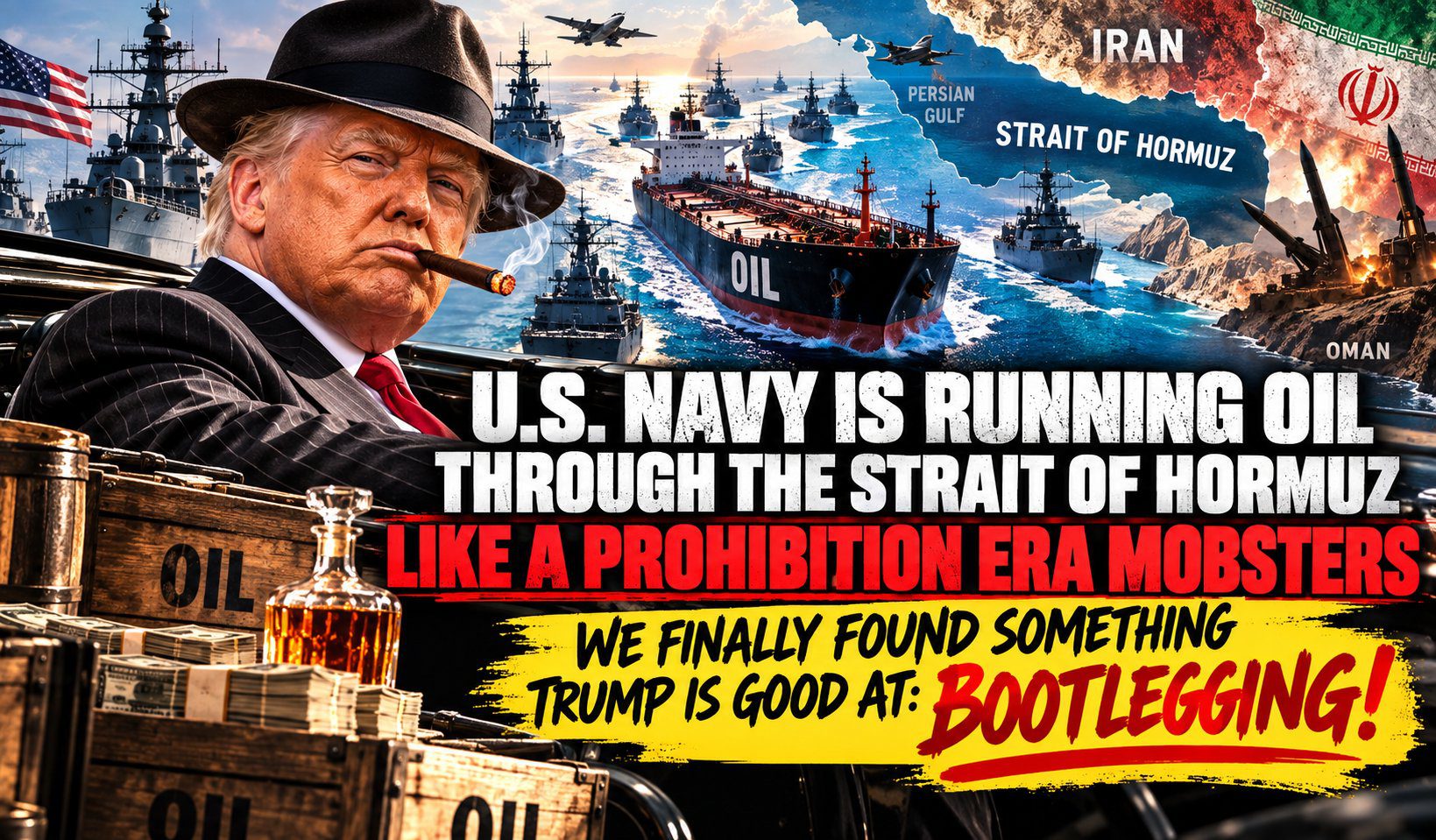
We Finally Found Something Trump Is Good At: Bootlegging!
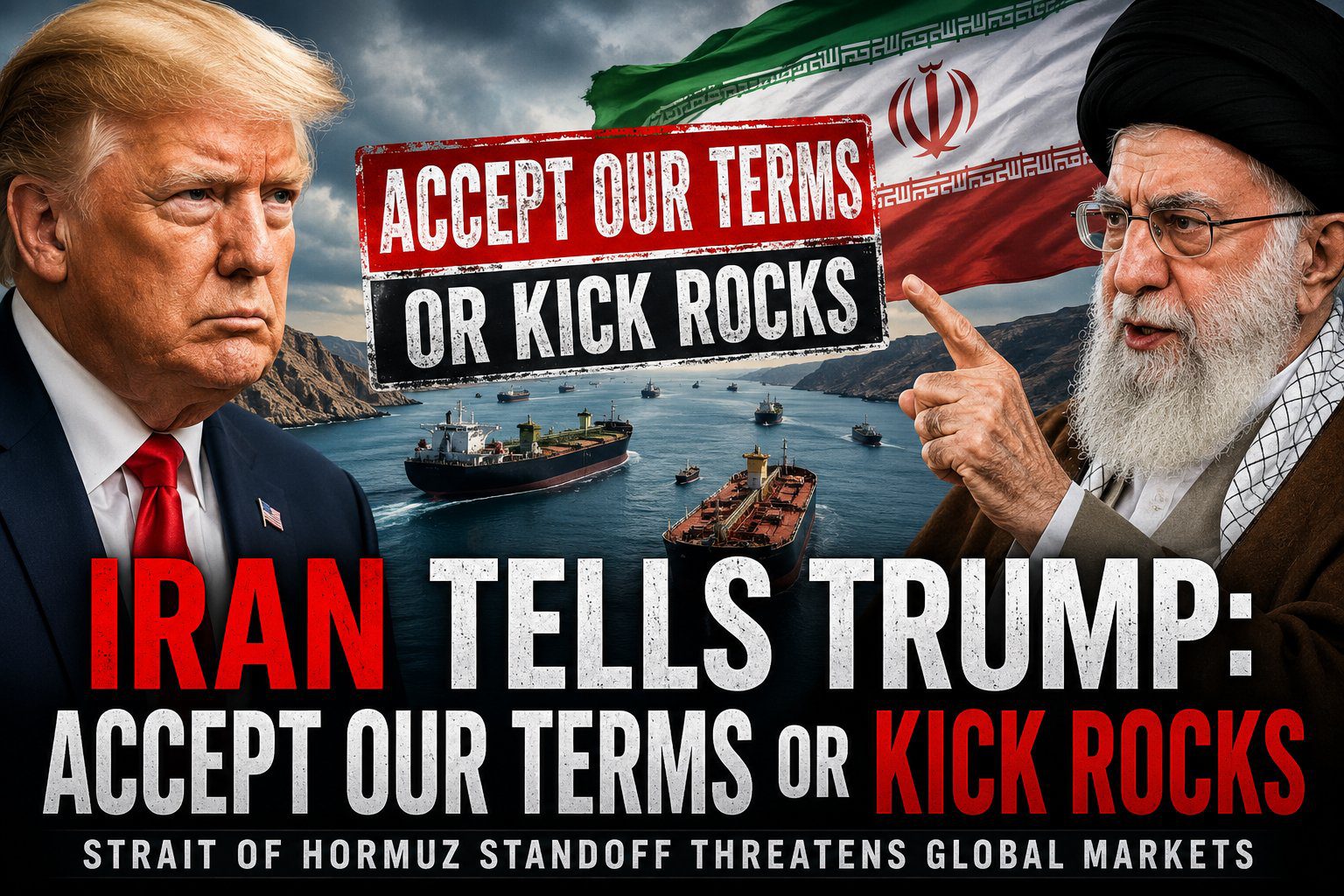
With Iran threatening one of the world’s most important energy corridors, the United States has built an extraordinary military operation around keeping commercial shipping moving through the Strait of Hormuz. Tankers are coordinating their movements with U.S. forces, receiving military protection and moving through a specially protected corridor while Washington simultaneously enforces a blockade against maritime traffic entering and leaving Iranian ports. It is less an ordinary shipping lane than a wartime convoy system built around one of the most valuable commodities on Earth.
WASHINGTON — Somewhere between a naval blockade, a wartime convoy and an old school Prohibition run, the United States has developed an extraordinary system for moving oil through the Strait of Hormuz while simultaneously attempting to choke off maritime commerce with Iran. The comparison to Prohibition-era smuggling is obviously imperfect, the tankers are carrying legal commercial cargo rather than contraband, and the United States says its operation is intended to restore freedom of navigation through an international waterway. But the mechanics of what has emerged in the Persian Gulf are remarkable. Commercial vessels are coordinating movements with the U.S. military and traveling through a protected corridor while American warships, aircraft and surveillance systems provide defensive coverage against Iranian missiles, drones, mines and naval forces.
The operation is not merely an American naval blockade of the Strait of Hormuz, an important distinction that can easily get lost in descriptions of the conflict. U.S. Central Command is conducting two related but separate missions: enforcing a blockade against vessels entering and leaving Iranian ports while supporting commercial vessels from other countries attempting to transit the Strait of Hormuz. In practical terms, Washington is attempting to restrict Iran’s maritime commerce while keeping everybody else’s commerce moving through the same broader theater of war.
America Is Running Two Different Maritime Operations
CENTCOM began enforcing its original blockade against Iranian maritime traffic on April 13. By the time the first phase ended on June 18, CENTCOM said U.S. forces had redirected more than 140 compliant vessels, disabled nine noncompliant ships and allowed more than 50 vessels carrying humanitarian aid to pass. The United States resumed the blockade on July 14, applying it to vessels traveling to or from Iranian ports and coastal areas while explicitly stating that American forces would continue supporting regional maritime traffic not violating the blockade.
The enforcement operation has not been theoretical. On July 15, CENTCOM said U.S. forces disabled the Curaçao-flagged tanker M/T Belma after it ignored warnings while traveling toward Iran’s Kharg Island. According to CENTCOM, an American aircraft fired Hellfire missiles into the empty tanker’s smokestack, preventing the vessel from continuing toward the Iranian port. By July 22, CENTCOM said it had redirected nine commercial vessels and disabled one since the blockade resumed, while more than 50,000 U.S. service members were operating across the broader Middle East.
At the same time, Washington has been conducting a fundamentally different mission inside the Strait of Hormuz itself. In May, CENTCOM launched military support for “Project Freedom,” an effort intended to restore commercial navigation through the strait while maintaining the separate blockade against Iran. CENTCOM initially committed guided-missile destroyers, more than 100 land- and sea-based aircraft, unmanned platforms and approximately 15,000 service members to the operation.
CENTCOM commander Adm. Brad Cooper described the distinction explicitly when Project Freedom began, explaining that American forces were taking two separate actions: enforcing a blockade preventing commerce from entering and leaving Iran while opening a passage through the Strait of Hormuz for international commercial traffic. Cooper said the United States had effectively assumed the military risk necessary to reopen the waterway.
That distinction changes the entire picture. The United States is not simply blocking the Strait of Hormuz. It is attempting to decide which commercial traffic gets through it while using American military power to protect the traffic it considers legitimate.
The Oil Tankers Are Moving Under American Protection
By August, the operation had evolved into something that increasingly resembled a wartime convoy system. Axios reported, citing two U.S. officials, that the military was conducting what it described as a stealth operation to move oil through Hormuz using a shipping corridor along the southern portion of the strait. The operation was reportedly coordinated through a task force at Fort Bragg and involved helping empty tankers enter the Persian Gulf before escorting or protecting loaded vessels as they returned through the corridor.
According to those officials, approximately 15 to 20 tankers were moving through the southern channel each night during one period in August, carrying millions of barrels of crude and other petroleum products. The operation followed an American military campaign targeting Iranian radar, maritime-surveillance and other capabilities that could threaten ships attempting the passage. Oil exports through Hormuz remained below their prewar levels, but the protected corridor gave Gulf producers a functioning route through a waterway that had become extraordinarily dangerous.
The picture is remarkable: enormous tankers carrying cargo worth tens or hundreds of millions of dollars moving through one of the most strategically important waterways on Earth while American military planners coordinate the security environment around them. Warships, aircraft, unmanned platforms, surveillance systems and missile defenses have effectively become part of the infrastructure required to move commercial energy through the region.
That is where the Prohibition comparison begins to make a certain kind of sense. Nobody is smuggling illegal whiskey past federal agents, and the ships are not engaged in criminal activity. Instead, some of the largest commercial vessels on Earth are moving legal oil through a contested international chokepoint while two military powers dispute who can safely use the route. The scale is radically different, but the underlying operational logic is recognizable: protect the cargo, reduce its exposure, control the route and get the ship through before the opposing force can stop it.
Shipping Through Hormuz Is Still Far From Normal
The existence of a protected American corridor does not mean the Strait of Hormuz has returned to anything resembling normal commercial operations. Before the conflict, approximately 125 large commercial vessels crossed the strait each day, and roughly 20% of global oil and liquefied natural gas supplies moved through the waterway. Current traffic remains substantially below those levels and can fluctuate dramatically from one day to another depending on attacks, military operations and the willingness of shipping companies and insurers to accept the risk.
The uncertainty is compounded by the limitations of commercial ship tracking data. Some vessels transiting dangerous waters can operate without continuously broadcasting their Automatic Identification System signals, meaning publicly available tracking platforms may not capture every movement. That makes it difficult to independently verify some government claims about the number of ships and barrels moving through the strait, particularly when military-protected movements are involved.
Recent Reuters reporting illustrates that problem. Preliminary Kpler data showed 19 crude tankers carrying approximately 33.7 million barrels through Hormuz during the week beginning September 20, while the previous week’s total was later revised to approximately 49.2 million barrels. The vessels were primarily carrying Saudi and Iraqi crude, and most were very large crude carriers capable of transporting enormous volumes in a single voyage.
Traffic nevertheless remained volatile. On one day in late September, approximately 60 commercial vessels reportedly crossed the strait, producing the highest daily crude flow since early July. On other days, the number of observable commodity vessels dropped into the single digits. Reuters reported an average of roughly 18 visible vessel crossings per day during the period, far below the approximately 125 large commercial vessels that used the strait daily before the war.
Those figures do not necessarily contradict American claims that additional ships are moving under military protection. They demonstrate how difficult it has become to measure commercial activity accurately inside an active military theater.
Saudi Arabia Is Pushing More Oil Back Through Hormuz
The pressure on the strait intensified further after attacks disrupted Saudi Arabia’s ability to bypass it. Saudi Arabia’s East West Pipeline normally provides the kingdom with a strategically valuable alternative, allowing crude produced near the Persian Gulf to travel across the country to the Red Sea rather than passing through Hormuz. A September attack forced the pipeline and associated export infrastructure offline, temporarily pushing more Saudi crude back toward the Persian Gulf route.
The consequences were immediate. Reuters reported that more than 60 million barrels of Saudi crude were sold for ship to ship transfer near Sohar, Oman, as Saudi exports through Hormuz surged. Saudi shipments through the strait were expected to rise from roughly 900,000 barrels per day in August to approximately 3.6 million barrels per day in September, requiring dozens of additional very large crude carriers.
The sudden demand created its own logistical crisis. Ship to ship transfer areas in the Gulf of Oman approached capacity, vessel availability tightened and charter rates for the largest crude tankers reportedly reached approximately $1.27 million per day. Congestion forced some cargoes toward alternative transfer locations and encouraged buyers to examine options farther away, including waters near India and Malaysia.
Saudi Arabia has since restarted the East West Pipeline and resumed loadings at the Red Sea port of Yanbu, providing some relief. Reuters reported on September 29 that throughput had recovered to an estimated 2 million to 2.65 million barrels per day and could increase to between 3 million and 4 million barrels per day, although a full return to pre-attack levels could take longer. The episode nevertheless demonstrated how quickly damage to alternative infrastructure can force enormous quantities of crude back toward Hormuz.
Qatar’s LNG Ships Are Moving Again Too
Oil is only part of the story. The Strait of Hormuz is also essential to the global liquefied natural gas market, particularly because Qatar, one of the world’s largest LNG exporters, relies on the waterway to move cargo from its massive Ras Laffan facilities into international markets.
Reuters reported on September 28 that Qatar linked LNG traffic through Hormuz had increased after becoming significantly less visible during August. Kpler and LSEG data showed multiple QatarEnergy linked vessels either transiting the strait or appearing outside it with cargoes destined for markets including India, Pakistan and China. Some vessels may previously have moved without active AIS signals, but the renewed visibility suggested at least a partial normalization of LNG traffic.
That development matters because disruption to Hormuz does not simply threaten gasoline and crude-oil markets. Extended interruptions can affect natural gas prices, electricity generation, fertilizer production and industrial energy costs across Asia and Europe. The waterway is therefore not merely an oil chokepoint; it is one of the central arteries of the global energy system.
Why Hormuz Matters So Much
Geography gave the Strait of Hormuz extraordinary power over the world economy long before the current conflict. The narrow waterway connects the Persian Gulf with the Gulf of Oman and the Arabian Sea, providing the primary maritime exit for oil and gas produced by Saudi Arabia, Iraq, Kuwait, Qatar, Bahrain and the United Arab Emirates. CENTCOM estimates that approximately one-quarter of the world’s seaborne oil trade passes through the strait, along with significant volumes of fuel, LNG and fertilizer products.
There are alternatives, but none can immediately replace the waterway’s full capacity. Saudi Arabia and the United Arab Emirates operate pipelines capable of moving some production around Hormuz, while strategic reserves can temporarily compensate for lost supplies. The United States and other members of the International Energy Agency have already turned to emergency petroleum reserves as the conflict has disrupted markets. On September 29, the United States announced another offer to loan as much as 40 million barrels from the Strategic Petroleum Reserve as part of the broader international response to supply disruptions associated with the Iran war.
The economic consequences extend far beyond the Persian Gulf. Disruptions in Hormuz can increase crude and refined-fuel prices, tanker charter rates, maritime insurance premiums, LNG prices, transportation expenses and manufacturing costs. Those pressures can eventually reach consumers through gasoline, diesel, electricity, airline tickets, shipping charges and the prices of goods moved across global supply chains.
Keeping Hormuz functioning is therefore not simply a matter of protecting a handful of oil tankers. It is an attempt to prevent a regional military confrontation from developing into a sustained global energy shock.
Iran Is Still Trying to Decide Who Gets Through
The United States is not the only power attempting to impose rules on commercial shipping. Iran has created its own restrictions and blacklists for vessels attempting to use the strait, producing an extraordinary situation in which Washington and Tehran are effectively maintaining competing ideas of legitimate maritime traffic through the same international chokepoint.
Reuters reported in September that Iran had expanded its blacklist to 56 vessels, including crude tankers, LNG carriers, LPG carriers and refined-product ships. Tehran has warned that vessels cooperating with blacklisted ships through practices such as ship-to-ship transfers could face additional consequences. Some of the affected vessels have links to major regional shipping companies, and the threat has already influenced decisions by refiners and energy companies considering whether particular ships are worth the risk.
Iran has also continued using control of the strait as leverage in negotiations with Washington. Iranian officials have tied reopening or normalizing the waterway to broader demands involving the U.S. blockade, frozen Iranian assets, oil sanctions and the country’s nuclear program. Washington, meanwhile, insists that international commercial vessels have a right to move through the strait and has demonstrated that position with military force.
The result is not uncontested American control or uncontested Iranian control. The United States has enough military power to move significant volumes of commercial traffic through the waterway and defend portions of that traffic against attack, while Iran retains enough missiles, drones, mines and naval capability to make those passages dangerous, expensive and unpredictable.
That tension is precisely why commercial shipping through Hormuz now looks less like ordinary international trade and more like a military logistics operation.
A Global Oil Chokepoint Has Become a Wartime Convoy Route
For decades, analysts described the Strait of Hormuz as one of the world’s most dangerous economic chokepoints, but the phrase can sound abstract when tankers are quietly moving through it every day. The current conflict has made the meaning considerably more tangible. Commercial vessels are coordinating with American forces, U.S. warships and aircraft are supporting protected passages, Iranian authorities are blacklisting ships, American forces are intercepting vessels headed toward Iranian ports, and Gulf producers are restructuring entire export systems depending on which routes remain open.
The Prohibition-era comparison works as an image because the mechanics have become so unusual: valuable cargo moving through a dangerous corridor under protection while another armed force attempts to dictate who can use the route. But the stakes are dramatically higher than anything associated with smuggling liquor. These ships carry the fuel that powers transportation networks, electrical grids, factories and economies across the world, and a successful attack on the wrong vessel or a sustained interruption of the route can immediately reverberate through international markets.
The United States is now attempting something extraordinarily difficult: block maritime commerce with Iran while simultaneously convincing the rest of the world that commercial traffic can safely continue through waters immediately adjacent to it. So far, significant quantities of oil and LNG are getting through, but traffic remains volatile, shipping costs have increased and the system depends heavily on American military power.
The world’s energy market is effectively watching a military protected convoy operation unfold in real time. Every tanker that successfully clears the Strait of Hormuz is carrying more than oil. It is another test of whether the United States can keep one of the world’s most important commercial arteries functioning in the middle of a war.
Sources & Further Reading
U.S. Central Command — Project Freedom in the Strait of Hormuz
U.S. Central Command — Adm. Brad Cooper Briefing on Project Freedom
U.S. Central Command — Resumption of Naval Blockade Against Iran
U.S. Central Command — U.S. Forces Disable Tanker Attempting to Reach Iranian Port
U.S. Central Command — July Strikes and Blockade Operations
Axios — U.S. Conducting Stealth Operation to Transport Oil Through Hormuz
Reuters — Crude Exports Through Hormuz and Vessel Traffic
Reuters — Gulf of Oman Oil Transfers Reach Capacity as Saudi Exports Surge
Reuters — Qatar-Linked LNG Traffic Through Hormuz Increases
Reuters — Saudi Arabia Restarts Yanbu Oil Loadings
Reuters — U.S. Offers Another 40 Million Barrels From Strategic Petroleum Reserve
Reuters — Iran Expands Blacklist of Ships Attempting Hormuz Transit













































Want to join the conversation?
Create an account or sign in to share your thoughts, vote,
and reply to other readers.
Showing 0 of 0 comments
Don't have an account?
Already have an account?