
Hanukkah Barbie Sparks Celebration, Criticism and a Debate Over Her Nose
For more than six decades, Barbie has managed to become almost everything imaginable. She has been an astronaut, doctor, athlete, president, movie star, scientist, pilot and approximately 47 other professions that make the average adult wonder what happened to their own career trajectory. Now, in 2026, Barbie has officially added another role to the list: Hanukkah Barbie.
Mattel has released its first official Barbie specifically dedicated to Hanukkah, making the doll a notable milestone for both the company and Jewish representation in one of the world’s most recognizable toy brands. The release is part of Mattel’s 2026 “Holiday Sweater” collection, alongside two Christmas themed Barbies. Mattel itself calls the product the Barbie Holiday Sweater Doll, product number JML11. The doll is marketed for children ages 6 and up.
And naturally, because this is the internet, the conversation did not stop at, “Hey, that’s a nice Hanukkah sweater.”
What Does Hanukkah Barbie Look Like?
The doll has wavy brunette hair, brown eyes, an olive toned complexion and freckles. Instead of the traditional blonde haired Barbie look, Mattel gave this version a distinctly different appearance. She wears a blue Hanukkah themed sweater featuring a light up menorah, Stars of David, dreidels and snowflake designs. She also wears blue gingham/plaid pants and cozy winter boots. Mattel describes the sweater as a knitted Hanukkah sweater, although collectors and consumers have debated the quality and appearance of the printed elements.
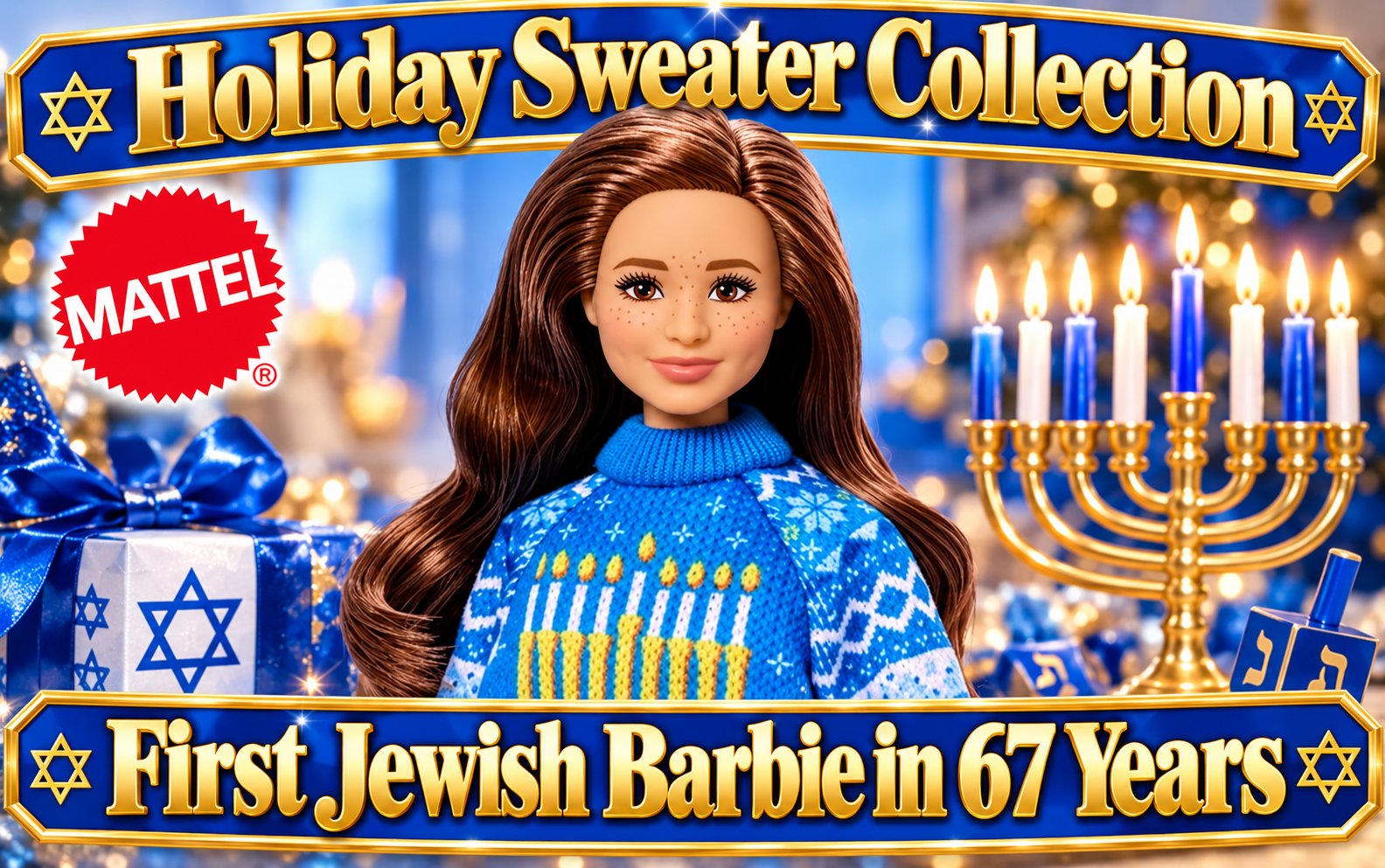
The menorah is particularly significant because the doll gets an important detail right: the Hanukkah candelabrum has nine branches, corresponding to a hanukkiah, rather than the seven-branched menorah associated with the ancient Temple. The sweater also lights up, because apparently even Hanukkah Barbie needs a little electrical assistance to make it through the holiday season. The doll is selling for roughly $27 to $28, depending on retailer. Target has listed it at approximately $27.49, while Mattel’s own product listing confirms the doll is part of the 2026 Holiday Sweater collection.
Why Is This Such a Big Deal?
There is an amusingly appropriate piece of history behind the release. Barbie was created by Ruth Handler, the Jewish American co-founder of Mattel. Handler introduced Barbie in 1959 and named the doll after her daughter, Barbara. That means the world’s most famous fashion doll was created by a Jewish woman, yet it took 67 years for Mattel to release an official Barbie specifically celebrating Hanukkah.
Jewish Barbie fans have pointed out the irony and significance of that connection. Rabbi Yael Buechler, a Jewish educator and founder of Midrash Manicures, has enthusiastically embraced the doll. Writing for Kveller after purchasing one herself, Buechler called the release a historic moment for Jewish representation and praised the accuracy of details such as the Hebrew letters on the dreidels and the nine-branched hanukkiah.
She also pointed out something that might get lost in the online controversy: for many Jewish children, simply seeing their holiday represented by a mainstream cultural icon can be meaningful. And there is evidence that people were waiting for this. A request for a Hanukkah Barbie appeared on a Mattel collectors’ forum as far back as 2010, with collectors discussing what such a doll might look like. Sixteen years later, Mattel finally delivered one.
Then Came the Nose Controversy
Here is where things get considerably more complicated. After images of the doll began circulating, some consumers noticed that Hanukkah Barbie’s nose appears more prominent than the noses of some other Barbies. Online commenters began describing it as a “Jewish nose” or even a “hooked” nose. Critics argued that this could unintentionally invoke a long history of antisemitic caricatures that exaggerated Jewish facial features.
That criticism has been reported by multiple outlets, including the New York Post, Ynet and JNS. The concern isn’t completely pulled from thin air. Exaggerated noses have historically been used in antisemitic imagery to portray Jews as physically different or inferior. That history makes facial representation a particularly sensitive issue.
Some critics essentially asked: Why give the first official Hanukkah Barbie a facial feature that could be interpreted through one of the oldest stereotypes about Jewish people? One New York woman quoted by the New York Post said she loved the idea of a Hanukkah Barbie but questioned why the doll needed to have a visibly different nose. Other consumers were much more enthusiastic.
Other Jewish Women Had the Opposite Reaction
For some Jewish women, the more prominent nose was not offensive. It was actually one of the reasons they liked the doll. Some women online said they appreciated finally seeing a Barbie whose facial features looked more like their own. One woman described becoming emotional because she finally saw a Barbie with a curved nose resembling hers. Other commenters said they saw nothing wrong with the feature and welcomed a doll that didn’t conform to the traditional Barbie facial template.
Dafna Michaelson Jenet, executive director of the David Merage Foundation for Confronting Antisemitism, acknowledged that the nose appeared larger to her but argued that the doll’s appearance could instead be viewed positively. Her position was essentially that Jewish girls should not be taught to regard Jewish looking features as something embarrassing or undesirable. Rabbi Buechler has similarly defended the doll and celebrated the fact that Hanukkah has finally become part of Barbie’s official holiday universe.
So the nose debate isn’t simply Jewish people versus everyone else. Jewish consumers themselves have expressed very different reactions. Some see representation. Some see an unfortunate stereotype. Some simply see a Barbie with a nose. The internet, naturally, has managed to turn all three positions into a full-scale cultural referendum.
Is Mattel Actually Trying to Make Her Look “Jewish”?
This is where it is important to separate what people are interpreting from what Mattel has actually said. Mattel has not publicly stated that it intentionally gave Hanukkah Barbie a larger nose to make her look Jewish. The company has also not publicly explained the precise facial sculpt used for the doll, nor has it confirmed that the nose was designed specifically around Jewish facial characteristics. When questioned about whether Jewish community members participated in the design, Mattel did not provide a comment to the New York Post.
Some Barbie collectors have suggested that the face resembles or may be an iteration of Mattel’s existing Violet face sculpt, which dates back to 2018. Rabbi Buechler examined the doll alongside existing Violet-sculpt Barbies and argued that the Hanukkah doll appears to share characteristics with an existing facial design rather than proving that Mattel created a stereotypically Jewish nose specifically for this release. She also noted that the back of the Hanukkah Barbie’s head is marked “2026,” while existing Violet dolls carry a “2018” marking.
That doesn’t conclusively settle the design question, but it does complicate the idea that Mattel necessarily sat down and said, “Let’s give Jewish Barbie the stereotype nose.” There simply isn’t public evidence establishing that intention.
The Outfit Has Its Own Critics
Not everybody’s complaint is about the doll’s face. Some Barbie collectors have criticized the quality of the clothing. The sweater uses printed graphics rather than the sort of detailed knitted garment some collectors expected. Some Barbie enthusiasts have described the outfit as inexpensive looking and argued that Mattel could have done more with the first official Hanukkah Barbie.
Reddit discussions among Barbie collectors include complaints that the clothing should have been sold as a fashion pack or produced with better quality materials. At the same time, other collectors have said they like the doll, her hairstyle and the overall concept. That distinction is worth noting. The criticism isn’t necessarily that Hanukkah Barbie shouldn’t exist. A substantial portion of the collector criticism is essentially: “We waited 67 years for this, and this is the outfit you gave her?” That’s a rather different complaint.
And Then There Are the People Who Absolutely Love Her
Despite the controversy, there is plenty of genuine enthusiasm. Jewish consumers and Barbie collectors have celebrated finally seeing Hanukkah represented alongside Christmas within Mattel’s mainstream holiday collection. Some social media users have immediately purchased the doll, while others have talked about buying additional dolls for family members.
Kveller’s Buechler reported that the doll had repeatedly sold out at major retailers and described herself as delighted with the release. Other reports have also described strong early consumer interest, including hundreds of purchases reported by Walmart shortly after the doll’s release. That doesn’t establish nationwide demand or prove that the doll will become a commercial blockbuster. It does demonstrate that the product has attracted significant attention ahead of Hanukkah.
The Broader Representation Question
There is another criticism that is somewhat separate from the nose controversy. Some Jewish consumers have pointed out that Jewish people do not all look alike. Hanukkah Barbie has an appearance that many people would associate with an Ashkenazi Jewish aesthetic, but Jewish communities around the world include people with a huge range of skin tones, hair textures and physical characteristics.
Some online commenters have therefore argued that if Mattel wants to expand Jewish representation, one Hanukkah Barbie should not necessarily be the end of the conversation. That criticism is particularly relevant because Jewish communities exist throughout the Middle East, North Africa, Europe, Ethiopia, the Americas and elsewhere. In other words, there isn’t one universal “Jewish Barbie.” There are Jewish Barbies. Plural.
The Strange Irony of Hanukkah Barbie
There is something almost perfectly fitting about the controversy. Barbie has spent decades evolving from a single physical template into a brand designed to represent an enormous variety of women. Mattel has increasingly emphasized different cultures, disabilities, professions, body types and identities through its Barbie releases.
Hanukkah Barbie is part of that larger effort. But representation is a remarkably difficult thing to get exactly right. Make the doll look too generic, and people complain that the company ignored cultural identity. Give the doll culturally recognizable features, and people may argue that the company has crossed into stereotyping. Make the outfit simple, and collectors complain. Make it elaborate, and someone will complain that Mattel is commercializing a religious holiday. Welcome to making a toy in 2026.
One Thing Is Hard to Argue With
Whatever someone thinks of the face, sweater or overall design, Hanukkah Barbie is historically significant for Mattel. It is the first official Barbie specifically dedicated to Hanukkah. It arrives more than six decades after Barbie was created by Jewish entrepreneur Ruth Handler. It includes recognizable Hanukkah imagery and gets several important religious details right.
And it has generated enough discussion to become much more than another holiday toy on a store shelf. The debate over the nose will probably continue, particularly because the history of Jewish caricature makes that issue more sensitive than an ordinary discussion about Barbie’s facial sculpt. But there is another way to look at the release.
For Jewish children who have spent years seeing Christmas dominate the holiday aisles while their own holiday received considerably less representation, there is now a Barbie wearing a Hanukkah sweater with a light up hanukkiah on it. That’s a pretty big change for a little plastic person.
And if Mattel eventually follows this up with a more elaborate collector-edition Hanukkah Barbie, perhaps with a genuinely knitted outfit, better accessories and a little Hanukkah Dreamhouse, the company may discover that the demand for Jewish representation extends considerably beyond one ugly sweater.
For now, Hanukkah Barbie has accomplished something that very few toys manage to do before they’ve even been on shelves for a full holiday season: she has become a cultural conversation. And somewhere, Ruth Handler’s ghost is probably wondering why it took Mattel 67 years to figure this one out.
Primary source
- Mattel Customer Service / Official Product Listing
Mattel Official Product Listing
Reporting and commentary
- New York Post, September 24, 2026
New York Post article - Kveller, September 29, 2026
Kveller article
















































Want to join the conversation?
Create an account or sign in to share your thoughts, vote,
and reply to other readers.
Showing 0 of 0 comments
Don't have an account?
Already have an account?