
Israeli Newspaper Op Ed Floats Debt Relief to Recruit Americans for Iran Ground War, Igniting Furious Backlash
An extraordinary opinion column published by has ignited international outrage after proposing that the United States use one of the greatest financial pressures facing younger Americans, personal debt, as an incentive to generate the enormous number of soldiers its author believes could be required for a ground war against Iran. The proposal is not Israeli government policy, was not issued by the Israel Defense Forces and has not been adopted by the Pentagon or any branch of the U.S. government. Its author, A.J. Jaff, is a retired Canadian Armed Forces officer who writes under a pseudonym and whose biography says he works in international security and crisis management. Those distinctions are essential because describing the column as an Israeli government proposal would fundamentally misrepresent what happened.
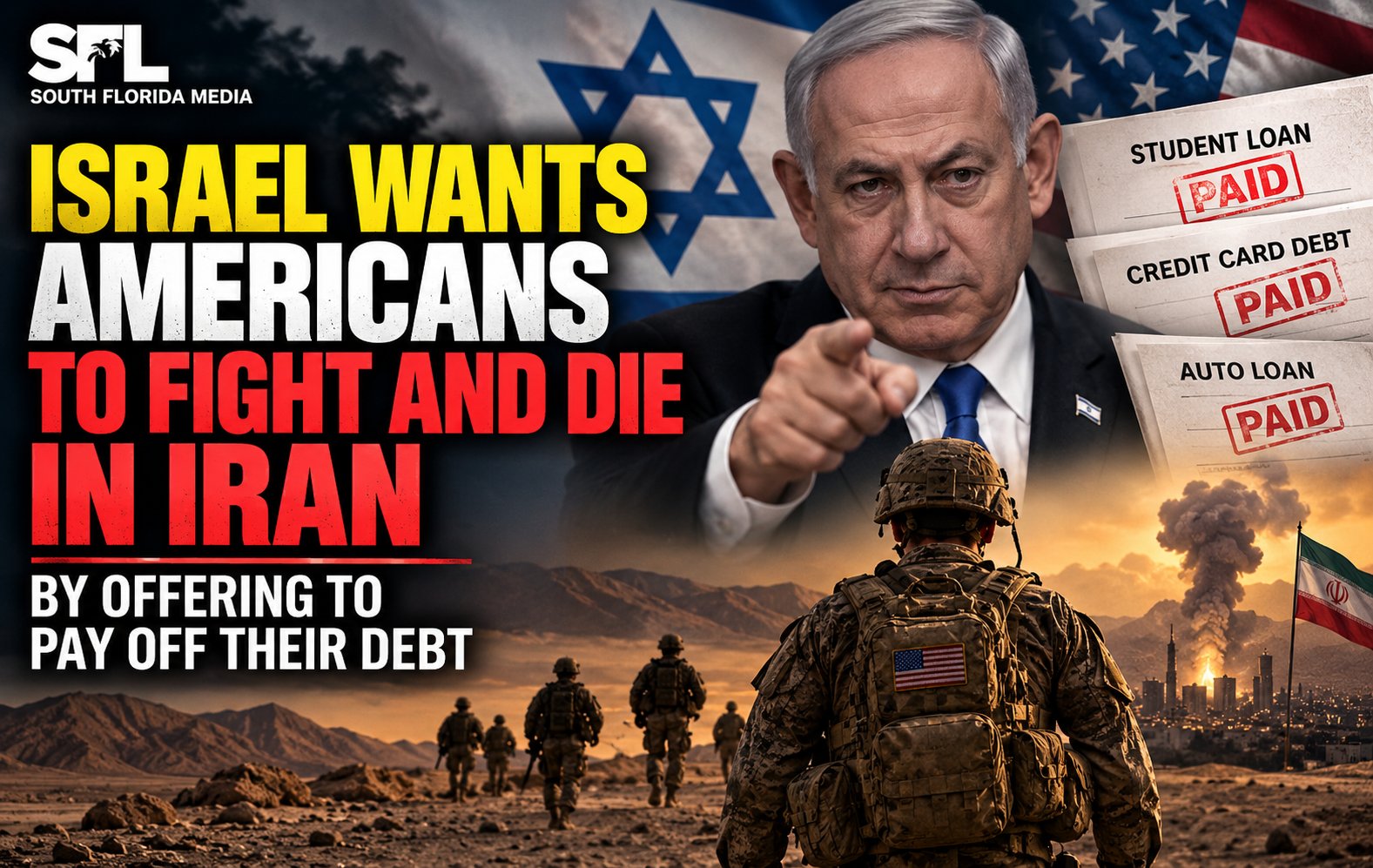
Yet accurately identifying the source does little to diminish the controversy surrounding the argument itself. Published August 30 under the headline “The war with Iran will not be won through airstrikes, so what’s left?,” Jaff’s column argued that air power has failed to produce a decisive resolution and outlined several possible strategies for Washington. Among them was a federally administered program that would forgive qualifying debts for Americans willing to enlist in the military. Under Jaff’s proposal, student loans, credit card balances and other consumer debts could be discharged after 24 or 36 months of military service. The author argued that such a program could generate voluntary enlistment on the scale necessary for a massive ground campaign without imposing a politically explosive national draft.
That is the idea that transformed an opinion column into an international controversy. At a moment when millions of Americans are confronting student debt, credit card balances, housing costs and other financial pressures, the proposal effectively treats economic hardship as a potential source of military manpower.
The Proposal Turns American Debt Into a Military Recruiting Strategy
Military service in the United States has long carried substantial financial incentives. The GI Bill, tuition assistance, housing benefits, healthcare, enlistment bonuses and other programs are established parts of the compensation America provides to people willing to assume the extraordinary obligations associated with military service. Jaff’s proposal is different because of the scale and context in which it was presented. He estimated that the kind of ground operation he was contemplating could require between 750,000 and 1.5 million troops, a force dramatically larger than the active duty U.S. Army. Rather than recommending conscription to generate that manpower, he proposed using debt forgiveness to make military service financially attractive to indebted Americans in their 20s and 30s.
The ethical controversy therefore extends beyond whether service members should receive generous benefits. Americans who volunteer to defend the country deserve substantial compensation and long term support. The more difficult question is whether policymakers should intentionally treat widespread financial distress as a strategic recruiting opportunity for an enormous overseas war. That distinction explains much of the anger surrounding the column. A government rewarding military service is one thing; identifying crushing personal debt as a mechanism capable of producing soldiers “at scale” is something considerably more uncomfortable.
The U.S. Israel Relationship Makes the Optics Politically Explosive
The controversy is especially combustible because the proposal appeared in a prominent Israeli newspaper while the United States maintains one of the world’s most consequential military relationships with Israel. Under the current U.S. Israel security-assistance agreement covering fiscal years 2019 through 2028, Washington provides approximately $3.8 billion annually, consisting of roughly $3.3 billion in Foreign Military Financing and $500 million for cooperative missile defense programs. Israel has historically been among the largest cumulative recipients of American foreign assistance, although much of the current aid is structured around military procurement, including purchases from American defense manufacturers. Against that backdrop, an Israeli newspaper publishing an argument for using the debts of young Americans to help generate the manpower for an Iran ground war was virtually guaranteed to produce a political backlash.
For Americans already skeptical of Washington’s Middle East commitments, the question is straightforward: after American taxpayers provide billions of dollars annually in military assistance to an ally, why should financially struggling Americans then be regarded as a potential manpower pool for a vastly expanded regional war? That does not establish that Israel ordered the proposal, supports it or expects American troops to fight on its behalf. It does, however, expose a legitimate debate about the limits of alliances and who ultimately bears the financial and human costs when regional wars escalate.
Americans Do Not Directly Pay for Israelis’ Healthcare or College
The outrage has also produced claims that require important factual corrections. Israel has universal health coverage while the United States does not, but American military assistance does not directly finance routine healthcare for Israeli citizens. Israel’s national health insurance system is financed domestically through taxation, health insurance contributions and government spending. Israelis are required to participate in the national system and receive coverage through health funds. Describing that arrangement simply as “free healthcare paid for by American taxpayers” is inaccurate.
Similar caution is necessary regarding higher education. Israel subsidizes public universities and its education system operates differently from America’s, but Israeli citizens do not universally receive free college financed by U.S. foreign aid.
There is nevertheless a legitimate economic argument beneath the exaggerated version of that claim. National budgets involve competing priorities, and outside military assistance can reduce the amount a recipient government must otherwise finance entirely from domestic resources. Israel’s own Institute for National Security Studies estimated earlier this year that American assistance still represents roughly 15% of Israel’s defense budget, even though it amounts to only about half a percent of Israel’s GDP.
Critics can therefore reasonably argue that American military assistance affects Israel’s overall fiscal choices. That is very different from claiming that Washington directly pays Israeli medical bills or university tuition, and keeping that distinction clear makes the larger debate substantially more credible.
Americans Can Ask Why Debt Relief Requires a Battlefield
The deeper political issue raised by Jaff’s proposal is not really about Israeli healthcare. It is about the conditions under which the American government becomes willing to substantially improve the economic circumstances of its own citizens. If Washington could theoretically erase student loans, credit card balances or other consumer debts to persuade Americans to spend several years in uniform during a massive overseas conflict, people are entitled to ask why economic relief should suddenly become achievable when the government needs soldiers.
Military compensation exists for good reason. Service members accept restrictions, hardships and dangers that ordinary civilian employees do not, and those sacrifices justify significant benefits. But designing an enlistment program specifically around the financial vulnerability of indebted young adults raises a fundamentally different ethical question. The proposal risks creating an economic version of conscription in which service remains technically voluntary while the government deliberately makes enlistment most attractive to people with the fewest financial alternatives. It would not be a draft in the legal sense, but critics understandably see the possibility of economic coercion when the escape route from debilitating debt runs through a military recruiting office.
Iran Immediately Exploited the Controversy
Iranian officials quickly recognized the propaganda opportunity created by the column. Foreign Ministry spokesman Esmaeil Baqaei seized on the proposal to argue that Americans were being asked to become “cannon fodder” in a war they had not chosen and characterized the debt for service concept as an effort to turn financially pressured Americans into mercenaries. Iran is a combatant with an obvious strategic interest in driving a wedge between the American public, Washington and Israel. Its rhetoric should therefore be understood as wartime messaging rather than independent analysis of American foreign policy. The effectiveness of that propaganda, however, comes from the fact that Tehran did not invent the underlying proposal. An opinion writer in a major Israeli newspaper really did suggest using student, credit-card and consumer debt forgiveness to increase American military enlistment for the kind of ground campaign he believed could become necessary against Iran.
That gave Iranian officials an unusually simple narrative to exploit: American taxpayers help finance an ally, indebted Americans are offered financial relief to provide manpower, and American families potentially bear the casualties of the resulting escalation. The United States and Israel can reject that framing, but arguments like Jaff’s make it considerably easier for their adversaries to sell.
A Ground War Against Iran Would Be an Enormous Undertaking
There is also a strategic issue underneath the controversy that is arguably more important than the proposed recruiting mechanism: what objective could justify putting hundreds of thousands of American troops into Iran in the first place? Iran is a nation of roughly 90 million people spread across a vast territory containing mountains, deserts, enormous urban centers and difficult transportation corridors. A ground invasion would be fundamentally different from airstrikes against missile facilities, naval assets, command centers or nuclear infrastructure.
Even if American forces could rapidly defeat conventional Iranian military formations, military victory would answer only the first of many questions. Washington would have to determine whether the mission was regime change, occupation, securing nuclear facilities, reopening maritime routes, destroying military infrastructure or installing and protecting a successor government. The United States learned in Iraq and Afghanistan that defeating a government’s conventional forces can be far easier than determining what comes afterward. Occupation, insurgency, political reconstruction and the establishment of a functioning postwar government can transform an apparently decisive military victory into a generational commitment.
An argument contemplating a force approaching 1.5 million troops should therefore trigger a national debate far larger than how those soldiers might be recruited. Americans should first demand to know what the mission would be, what victory would mean, how many casualties policymakers anticipate, how long troops could remain and what would happen after the Iranian government was defeated.
Israel Is an American Ally, Not the Employer of the U.S. Military
The controversy also exposes a basic principle that can become obscured when alliances are treated as unlimited commitments: American military personnel serve the United States. Israel faces genuine security threats from Iran, and the two countries maintain extensive defense, intelligence and diplomatic cooperation. Iran has spent decades building military capabilities and supporting armed organizations across the Middle East that threaten Israel, American forces and other U.S. partners.
None of those facts automatically means that every Israeli security objective is an American military objective. Washington can support Israel’s ability to defend itself without accepting an unlimited obligation to fight every war that could advance Israeli strategic interests. Providing weapons and missile defense assistance is one policy decision. Sending hundreds of thousands of Americans into a massive Iranian ground campaign would be another decision of an entirely different magnitude. If such a war were genuinely necessary to protect American national security, the president and Congress should have to make that argument directly to the American people. The public deserves an explanation of the objectives, anticipated casualties, financial costs, duration and exit strategy before American troops are committed to a conflict on that scale.
Economic Desperation Should Not Become America’s Backdoor Draft
The United States abandoned military conscription more than half a century ago and built an all volunteer force around the principle that Americans choose whether to serve. Financial incentives have always been part of maintaining that force, and generous compensation for military personnel is entirely appropriate. The troubling line is crossed when widespread economic distress itself becomes the recruiting strategy.
A society should be uncomfortable when student debt, credit card balances and other financial obligations begin to look attractive to military planners because they could make hundreds of thousands of citizens easier to recruit for an unpopular overseas war. If policymakers conclude that they cannot assemble enough volunteers for a conflict without offering extraordinary debt cancellation, that shortage of willing soldiers is itself politically meaningful. It may indicate that the public does not believe the proposed war is sufficiently important to justify the risks being demanded of its citizens. The solution to that democratic problem should not automatically be finding a sufficiently large financial incentive to overcome public reluctance.
The Column Said Something Washington Should Hear
The lasting importance of Jaff’s column may ultimately have little to do with whether his specific proposal ever receives serious consideration in Washington. There is currently no evidence that the Pentagon or U.S. government intends to implement such a program. Its significance is that the column unintentionally concentrated several major American political anxieties into a single proposal: frustration with foreign wars, anger over personal debt, skepticism toward foreign military assistance, distrust of Washington’s foreign-policy establishment and growing resistance to the idea that American military power should automatically resolve every crisis in the Middle East.
The facts require important qualifications. The proposal came from an opinion writer, not Israel’s government. The author is a retired Canadian military officer, not an Israeli official. American assistance does not directly finance universal healthcare or free college for Israelis. Iran’s furious response is also propaganda produced by a government actively fighting the United States and Israel.
None of those corrections erase the central controversy. A serious argument published by a major Israeli newspaper proposed turning the debts of young Americans into an incentive for generating the extraordinary number of soldiers its author believes could be necessary for a ground war with Iran. America can support its allies, finance military partnerships and cooperate with Israel against genuine security threats. But American soldiers are not another category of foreign assistance, and their lives cannot be treated as an endlessly renewable strategic resource. Before Washington ever begins calculating how much student debt or credit card debt would have to disappear to persuade hundreds of thousands of Americans to deploy to Iran, the country deserves an answer to a much more fundamental question: why should those Americans be sent into that ground war at all?

Sources & Further Reading
Original Opinion Column
The Jerusalem Post — “The war with Iran will not be won through airstrikes, so what’s left?”
The Jerusalem Post — A.J. Jaff Author Profile
U.S.-Israel Military Assistance
Reuters — U.S.-Israel Defense Cooperation and Current Military Assistance
Coverage of the Debt-for-Service Proposal
Iranian Reaction
Iranian officials publicly seized on the column to attack the proposal and warn Americans against participating in an expanded ground war. Because Iran is an active party to the conflict, those statements are included here as attributed reaction rather than independent factual analysis. (tehrantimes.com)




















































Want to join the conversation?
Create an account or sign in to share your thoughts, vote,
and reply to other readers.
Showing 0 of 0 comments
Don't have an account?
Already have an account?