
U.S. Bomb Linked to Deadly Strike on Iranian Wedding as Pentagon Faces New Questions Over Civilian Casualties
A U.S. made bomb appears to have directly struck a residential building hosting a wedding celebration in southern Iran, killing civilians and wounding dozens more, according to visual investigations by The New York Times and Reuters that are raising new questions about American targeting practices and the Pentagon’s decision to scale back a military program specifically designed to reduce civilian casualties.
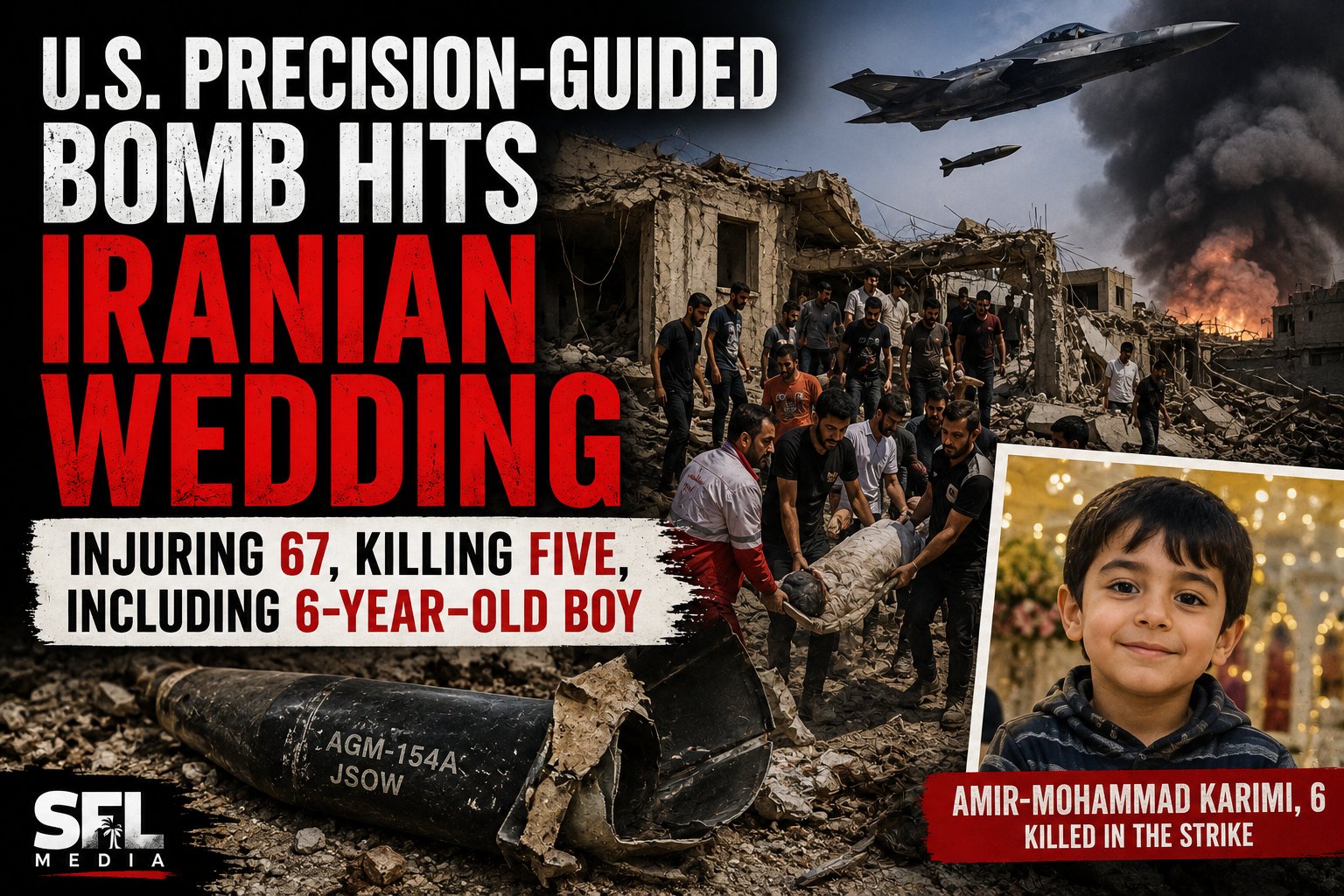
The September 1 strike hit the coastal town of Kuhestak near the strategically critical Strait of Hormuz as U.S. forces conducted a new wave of attacks against Iranian military infrastructure. Iranian authorities said five wedding guests were killed and 67 people were wounded. The New York Times reported that the dead included a 6 year old boy. Reuters, conducting a separate investigation, reported four deaths and at least 68 injuries based on the information available to its reporters, underscoring that the precise casualty count remains disputed.
What is becoming considerably clearer is the origin of the weapon. The New York Times analyzed photographs and videos of munition fragments recovered from the wedding site and consulted Trevor Ball, a former U.S. Army explosive ordnance disposal technician and weapons analyst, who identified components consistent with a U.S. Joint Standoff Weapon, or JSOW, an air launched precision guided glide bomb used by American forces.
Reuters independently examined imagery from the scene and consulted weapons specialists who similarly concluded that the destruction was consistent with a direct strike by an American munition rather than an errant Iranian air defense weapon. The findings substantially strengthen evidence that American firepower was responsible for the devastation at the wedding and place renewed scrutiny on how the United States is selecting, verifying and attacking targets during its expanding military campaign against Iran.
A Wedding Celebration Became a Scene of Destruction
The attack occurred while families were gathered for a traditional wedding celebration inside homes in Kuhestak. According to The New York Times, dozens of guests had assembled at the Malahi family’s home and neighboring buildings when the explosion ripped through the residential structure at approximately 9:30 p.m. The strike reportedly hit the portion of the celebration where women and children had gathered, contributing to the high number of civilian casualties.
Videos and photographs from the aftermath showed collapsed ceilings, shattered doors, damaged concrete walls, bloodied personal belongings and emergency workers moving through the wreckage. Among those reported killed was 6 year old Amir Mohammad Karimi, who had been preparing to begin kindergarten. Iranian reporting identified additional civilians among the dead, while the bride and groom reportedly survived the attack.
The wedding was taking place approximately 150 yards from a communications tower near Kuhestak’s port that U.S. forces were also attacking. Verified imagery showed that the communications tower was struck separately and collapsed across a nearby street, making the distinction between the two impacts critical to understanding what occurred. Available visual evidence indicates that American forces struck communications infrastructure in the immediate area while another munition hit the residential location where the wedding was underway.
Weapons Evidence Points to an American Glide Bomb
The New York Times collected imagery showing fragments recovered from the residential strike site and provided them to weapons specialists for analysis. Ball identified a tail fin and casing characteristics consistent with the AGM-154 Joint Standoff Weapon, commonly known as JSOW, a precision guided glide munition designed to allow aircraft to attack targets from significant distances. Imagery released by U.S. Central Command around the time of the operation also appeared to show a JSOW mounted beneath an American fighter aircraft participating in the strikes.
Reuters reached a similar conclusion through its own analysis. Weapons experts reviewing verified photographs and videos told the news organization that the damage appeared consistent with a direct American strike rather than a ricochet, failed interception or Iranian air defense munition.
Those investigations do not establish why the residential building was struck, which remains one of the central unanswered questions surrounding the incident. Determining whether the building was intentionally selected, mistakenly identified, hit because of incorrect coordinates or struck following some other targeting failure will be essential to establishing responsibility for the civilian deaths.
CENTCOM Says the United States Does Not Target Civilians
U.S. Central Command has acknowledged conducting military operations around Kuhestak but has denied intentionally attacking civilians. CENTCOM said American forces were striking communications infrastructure and other sites associated with Iranian military forces, and a Central Command spokesman responding to questions about the wedding casualties said the U.S. military does not target civilians, contrasting American operations with those of Iran’s Islamic Revolutionary Guard Corps.
That distinction is important because evidence that an American weapon caused civilian deaths does not, by itself, establish that civilians were deliberately targeted. The central questions are whether the residential building was mistakenly identified as a military objective, whether a legitimate military target existed at or near the property, whether targeting coordinates were incorrect, whether the weapon malfunctioned or whether another breakdown occurred somewhere between intelligence collection and weapons release.
Reuters reported that U.S. officials acknowledged military operations in Kuhestak and were examining the incident. The Pentagon has not publicly provided a complete explanation for why an American munition appears to have struck the wedding location, leaving the precise sequence of events and targeting decisions unresolved.
The Strike Comes After the Pentagon Cut Its Civilian Harm Program
The incident is receiving additional scrutiny because it follows major changes to the Pentagon’s Civilian Harm Mitigation and Response program, known inside the military as CHMR. The initiative was developed after years of civilian casualties during American operations in Iraq, Afghanistan and other conflicts, with the goal of incorporating civilian-protection expertise directly into military planning rather than merely investigating civilian deaths after they occurred.
An August investigation by ProPublica found that Defense Secretary Pete Hegseth moved to substantially reduce the program despite opposition from senior military commanders. According to a memo reviewed by ProPublica, Hegseth asked nine senior commanders to choose among several options for reducing or eliminating the civilian-harm operation. All nine reportedly selected the option that would preserve as much of the program as possible, even though that alternative still contemplated substantial staffing reductions. Hegseth nevertheless proceeded with major cuts.
The revelation is particularly significant because the civilian harm program represented an extremely small portion of overall Pentagon spending. ProPublica reported that the center near the Pentagon operated on an annual budget of approximately $7 million, while civilian protection work across military commands was estimated at roughly $80 million before the reductions. Within a U.S. defense budget measured in the hundreds of billions of dollars, the program represented a comparatively small investment whose supporters argued could prevent civilian deaths while protecting broader American strategic interests.
Civilian Casualties Can Become a Strategic Liability
The debate surrounding civilian harm extends beyond the immediate moral consequences of killing innocent people. American military commanders have repeatedly confronted the strategic damage created when civilian casualties turn local populations against U.S. forces, undermine relationships with allies, strengthen enemy propaganda and provide extremist organizations with material that can be used for recruitment and radicalization.
Those lessons were among the reasons the Pentagon formalized its Civilian Harm Mitigation and Response effort after examining two decades of post September 11 warfare. Civilian protection became increasingly understood not simply as a humanitarian consideration but as part of military effectiveness, intelligence gathering, force protection and long-term political strategy. That concern is particularly acute in Iran, where the government has faced significant domestic opposition, especially among younger and more urban populations. Civilian casualties caused by American attacks risk transforming anger directed at Tehran into anger directed at Washington, potentially strengthening nationalist forces and weakening the credibility of claims that U.S. military pressure is intended to benefit or protect the Iranian population.
An Iranian civilian can oppose the Islamic Republic while simultaneously opposing American bombs falling on Iranian neighborhoods. Those positions are not contradictory, and civilian deaths can rapidly change how foreign military intervention is perceived even among people who strongly oppose their own government.
The Wedding Strike Is Not the First Civilian Casualty Controversy of the Campaign
The Kuhestak attack is not occurring in isolation. The New York Times has reported several episodes during the conflict in which structures without an apparent military function were struck and civilians were killed, adding to concerns about the targeting procedures being used during the campaign.
Among the most serious incidents was a February 28 strike on an elementary school in Minab, also in Hormozgan Province. Iranian authorities reported a large number of civilian deaths in that attack, many of them children, while questions have persisted over how the school came to be struck. The Times has also reported civilian deaths associated with American attacks near residential areas in Lamerd and on Qeshm Island.
Iranian casualty figures require independent scrutiny because Tehran is an active participant in the conflict and has an obvious interest in emphasizing civilian deaths. Nevertheless, independently verified imagery, weapons analysis and reporting from international news organizations have produced evidence that American weapons have struck civilian locations during the campaign. The Kuhestak wedding attack now adds another major incident requiring a detailed explanation from U.S. military authorities.
The Pentagon Faces a Basic Question: What Went Wrong?
Precision guided weapons are frequently described as “smart” bombs, but precision refers primarily to the ability of a weapon to reach designated coordinates. It does not guarantee that those coordinates are correct, that intelligence accurately identified the intended target or that civilians were adequately accounted for before an attack was authorized.
A precision weapon directed at an incorrect target can therefore produce a precisely delivered catastrophe. That is why civilian harm mitigation involves far more than the capabilities of the weapon itself. Effective targeting requires intelligence analysis, target verification, persistent surveillance, assessments of civilian activity, legal review and procedures that allow commanders to delay or cancel attacks when the risk to noncombatants becomes unacceptable.
The destruction at Kuhestak consequently raises a question extending beyond the identification of the munition. Investigators need to determine how an American weapon apparently struck a residential building filled with wedding guests approximately 150 yards from another target. If the building was intentionally selected, the Pentagon must explain what intelligence established it as a legitimate military objective. If it was not intentionally selected, investigators must determine where the targeting process failed. Either explanation carries serious implications for the conduct of the American campaign.
Congress Is Simultaneously Fighting Another Battle Over Israel and Campus Speech
The MS NOW discussion also highlighted a separate but politically connected development in Washington involving American policy toward Israel. On September 3, the House of Representatives voted 237-169 to approve the Protect Economic and Academic Freedom Act, legislation that would restrict federal support for colleges and universities participating in certain boycotts involving Israel.
Thirty three Democrats joined nearly all voting Republicans in supporting the measure, demonstrating that substantial bipartisan support for anti-boycott legislation remains in Congress even as Democratic voters and elected officials increasingly debate American policy toward Israel. Supporters argue that institutions receiving federal taxpayer dollars should not participate in discriminatory commercial boycotts targeting Israel or other U.S. allies. Critics counter that the legislation risks punishing universities for political activity protected by the First Amendment and could provide the federal government with additional leverage over campus speech, protests and institutional decisions related to Israel.
The measure has passed the House but has not become law and would still require Senate approval and presidential action. The vote nevertheless arrives amid a broader political shift inside the Democratic Party over Israel, Gaza and American military involvement in the Middle East, with increasingly visible divisions over weapons transfers, boycotts and the appropriate limits of U.S. support for the Israeli government.
Civilian Protection Is Becoming a Test of American Strategy
The destruction of an Iranian wedding presents the Pentagon with a problem that cannot be resolved simply by insisting that American forces do not intentionally target civilians. The more consequential question is whether U.S. targeting systems are doing enough to prevent civilians from being killed when military targets are attacked, particularly during a large and rapidly evolving air campaign.
Available evidence increasingly indicates that an American munition struck the residential building in Kuhestak. What remains unknown is why. Establishing that distinction will be essential to determining whether the incident resulted from faulty intelligence, targeting error, weapon malfunction, an incorrect assessment of civilian presence or another breakdown in the strike process.
The timing of the Pentagon’s civilian protection cuts makes those questions particularly significant. The United States spent years constructing an institutional system intended to learn from civilian casualties in Iraq, Afghanistan and other conflicts, and senior military commanders reportedly urged Hegseth to preserve as much of that capability as possible. The Defense Department substantially reduced it anyway.
As American forces conduct a widening military campaign against Iran, the consequences of how the Pentagon identifies targets, evaluates intelligence and protects civilians are no longer theoretical. The U.S. military may have been attempting to destroy communications infrastructure in Kuhestak, but a nearby family celebrating a wedding instead found itself pulling wounded relatives from the rubble and burying loved ones.
The United States now owes Congress, the American public and the civilians caught beneath its weapons a credible explanation of how that happened, whether existing safeguards failed and what will be done to prevent the next military target from becoming another civilian tragedy.

Sources & Further Reading
The Kuhestak Wedding Strike and Weapons Analysis
The New York Times — In a Small Iranian Town, a U.S. Attack Turns a Wedding Into a Tragedy
https://www.nytimes.com/2026/09/02/video/iran-us-attack-wedding.html
Reuters — Deadly Strike on Iranian Wedding Was Likely a Direct Hit by a U.S. Munition, Analysis Shows
https://www.reuters.com/investigations/deadly-strike-iranian-wedding-was-likely-direct-hit-by-us-munition-analysis-2026-09-03/
Associated Press — What to Know About a Reported U.S. Airstrike That Hit a Wedding in Iran
https://apnews.com/article/0b8dbb60863eb28e3dde59ff59e88735
U.S. Military Operations in Iran
U.S. Central Command — Operation Epic Fury Fact Sheet
https://www.centcom.mil/Portals/6/Documents/Publications/260406-FactSheet.pdf
Reuters — U.S.-Iran Strikes Raise Fears of Renewed War Across the Middle East
https://www.reuters.com/world/middle-east/us-iran-exchange-attacks-lull-war-appears-over-2026-09-02/
Pentagon Civilian Harm Protections
ProPublica — Top Commanders Told Hegseth Not to Cut Civilian Protection Program, Poll Showed. He Did It Anyway
https://www.propublica.org/article/hegseth-civilian-harm-mitigation-response-trump-defense-department
Congressional Vote on University Boycotts of Israel
Reuters — U.S. House Passes Bill to Crack Down on University Boycotts of Israel
https://www.reuters.com/world/us/us-house-passes-bill-crack-down-university-boycotts-israel-2026-09-03/
U.S. House of Representatives — Roll Call Vote 295
https://clerk.house.gov/Votes/2026295
Original Video Report
MS NOW / MSNBC — NYT Analysis Links U.S. Bomb to Iran Wedding Strike
https://www.youtube.com/watch?v=JXOSHqkNlzA

















































Want to join the conversation?
Create an account or sign in to share your thoughts, vote,
and reply to other readers.
Showing 0 of 0 comments
Don't have an account?
Already have an account?