
How Does the Sunshine State Stack Up Against the Rest of America?
A new nationwide ranking reveals a growing divide in America’s financial health. Minnesota takes the top spot, Mississippi sits at the bottom, and Florida finds itself falling below the national average.
Your credit score can make a pretty big difference in how much money you spend over your lifetime. Whether you’re buying a house, financing a vehicle, applying for a credit card, or trying to secure a personal loan, those three little digits can determine whether you get a decent interest rate or end up paying thousands more. And according to the latest nationwide data, some states are doing considerably better than others.
A new map published by Visual Capitalist, using Experian’s September 2025 credit score data, breaks down the average FICO scores across all 50 states. The results reveal a noticeable geographic divide, with states in the Upper Midwest and Northeast leading the country while several Southern states struggle to keep up.
So where does Florida rank? Not exactly where you would want it to be. Florida’s average FICO score comes in at 704, nine points below the national average of 713. That puts the Sunshine State well behind some of the country’s highest-ranking states and alongside several other states dealing with weaker credit scores.
Minnesota Takes the Crown While Southern States Fall Behind
Leading the nation is Minnesota, with an impressive average FICO score of 741. Vermont and Wisconsin are tied for second place at 737, followed by New Hampshire at 735. The highest ranking states are largely concentrated in the Upper Midwest and New England, where average credit scores are generally stronger. At the opposite end of the rankings is Mississippi, which posts the lowest average score in the country at just 677. That’s a 64 point difference between Minnesota and Mississippi.
Other states struggling to reach the 700 mark include Louisiana (686), Alabama (689), Georgia (692), Texas (692), Arkansas (693), Oklahoma (693), Nevada (699), South Carolina (699), and West Virginia (699). The numbers paint an interesting picture of America’s financial landscape. While credit scores are influenced by individual financial decisions, broader economic conditions, income levels, debt burdens, and access to financial resources can also play a role.
Florida Ranks Below the National Average
For Floridians, the numbers are worth paying attention to. The state’s average FICO score of 704 puts Florida nine points below the national average. It also represents a three point decline from its 2024 average of 707. Florida isn’t alone. Several major Southern states are also below the national average, including Georgia (692), Alabama (689), Louisiana (686), and Texas (692).
Interestingly, California comes in at 721, comfortably above the national average, while Texas and Florida both fall behind. Of course, an average doesn’t tell the entire story. Florida has millions of residents with excellent credit, just as it has millions of residents dealing with financial challenges. Your state doesn’t determine your credit score, but these numbers provide an interesting snapshot of the financial conditions across the country.
America’s Average Credit Score Is Going in the Wrong Direction
Perhaps more concerning than the differences between states is the direction of the national numbers. America’s average FICO score dropped from 715 in 2024 to 713 in 2025. While two points might not sound like much, it marks a reversal after more than a decade of generally improving or stable credit scores.
Meanwhile, Americans are dealing with increasingly expensive monthly debt obligations. Average monthly debt payments reached $1,256 in 2025, representing a 2.6% increase. Interestingly, average total debt balances increased by only 0.4%. In other words, Americans are paying more every month without necessarily borrowing substantially more money. Higher borrowing costs and household expenses can make it increasingly difficult for consumers to stay ahead of their financial obligations.
Student Loan Debt Is Creating Another Credit Score Nightmare
One of the biggest developments affecting credit scores in 2025 involved federal student loans. During the pandemic, federal student loan payment protections provided borrowers with an extended period during which missed payments generally were not reported to credit bureaus as delinquencies. That protection eventually came to an end.
As negative reporting resumed, millions of borrowers who had fallen behind suddenly faced consequences on their credit reports. According to research from the Federal Reserve Bank of New York, more than 2 million borrowers who became newly delinquent during the first quarter of 2025 experienced credit score declines exceeding 100 points.
Think about that for a moment. Someone who previously had decent credit and qualified for a car loan, apartment, or mortgage could suddenly find themselves facing much more expensive financing options. The problem was particularly noticeable in Southern states, where student loan delinquency rates were among the highest. And the consequences don’t stop with student loans. A damaged credit score can follow borrowers into nearly every other major financial decision they make.
A Good Credit Score Could Save You More Than $70,000
Here’s where credit scores really start hitting Americans in the wallet. When it comes to purchasing a home, borrowers with stronger credit generally have access to better mortgage rates. Even a relatively small difference in interest rates can translate into tens of thousands of dollars over the life of a loan.
Consider a $300,000 mortgage with a 30-year repayment term at a 6% interest rate. The monthly principal and interest payment would be approximately $1,799. At 7%, that payment jumps to approximately $1,996. That’s an additional $197 every month.
Over 30 years, the difference amounts to approximately $71,000 in additional interest. And that’s just the mortgage. Credit scores can also influence financing costs for vehicles, credit cards, and other loans. For Americans already struggling with the cost of living, paying thousands more simply because of a lower credit score can make an already difficult financial situation considerably worse.
What Actually Determines Your FICO Score?
According to FICO, your credit score is calculated using several factors. Some carry considerably more weight than others.The two biggest factors are payment history and the amount of debt you owe.
- Payment History – 35%: Whether you consistently pay your bills on time. Late payments can seriously damage your score.
- Amounts Owed – 30%: How much debt you carry, particularly how much of your available credit you’re using.
- Length of Credit History – 15%: How long your credit accounts have been established.
- Credit Mix – 10%: The different types of credit you manage, such as credit cards, mortgages, and installment loans.
- New Credit – 10%: Recently opened accounts and applications for additional credit.
The takeaway is relatively straightforward: paying bills on time, keeping credit card balances manageable, and avoiding unnecessary new debt can help establish a stronger credit profile.
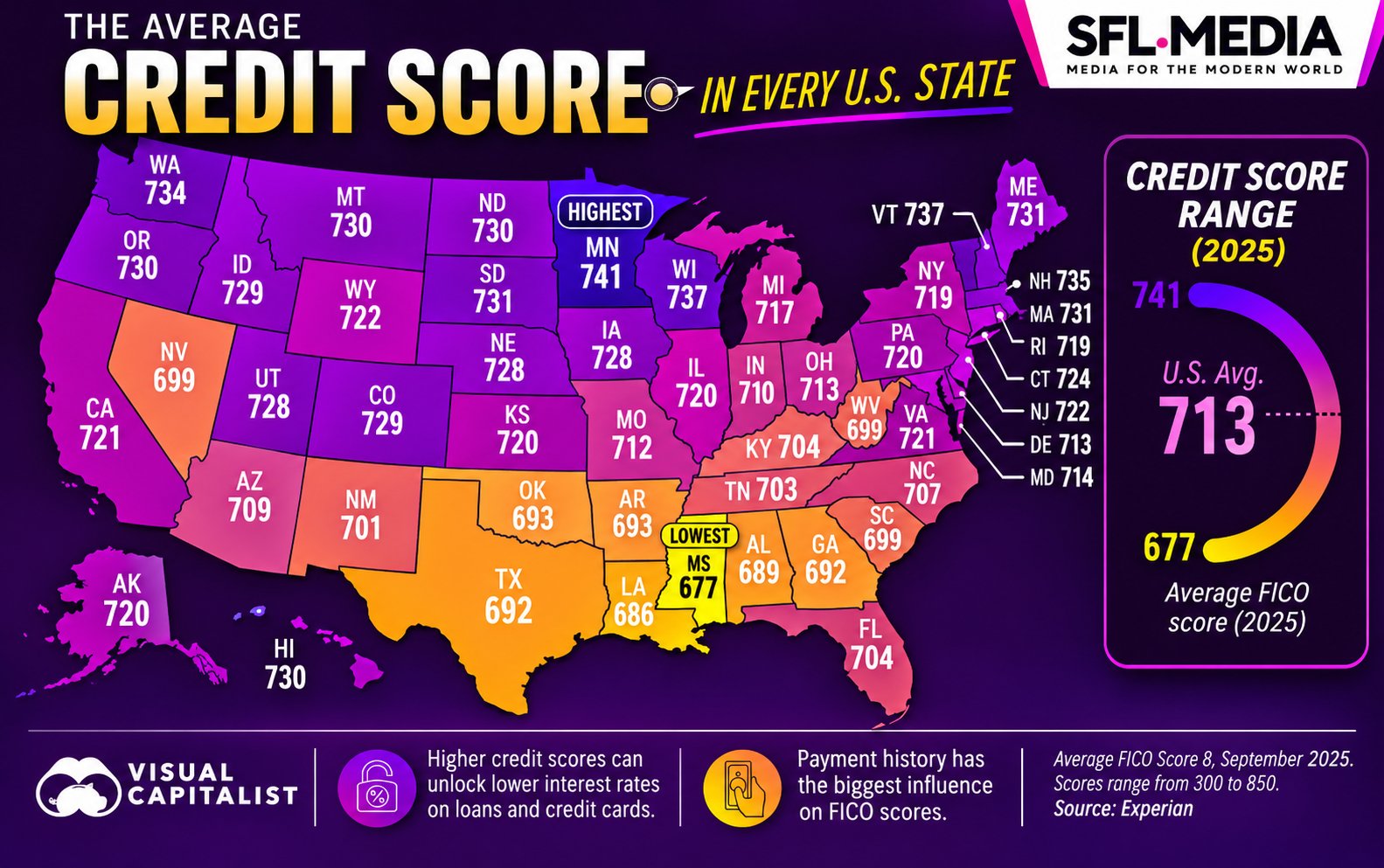
The Complete Credit Score Rankings: All 50 States
Here is how the states compare using Experian’s September 2025 FICO Score 8 data.
| State | Average FICO Score |
|---|---|
| Minnesota | 741 |
| Vermont | 737 |
| Wisconsin | 737 |
| New Hampshire | 735 |
| Washington | 734 |
| Massachusetts | 731 |
| Maine | 731 |
| South Dakota | 731 |
| Hawaii | 730 |
| Montana | 730 |
| North Dakota | 730 |
| Oregon | 730 |
| Colorado | 729 |
| Idaho | 729 |
| Iowa | 728 |
| Nebraska | 728 |
| Utah | 728 |
| Connecticut | 724 |
| New Jersey | 722 |
| Wyoming | 722 |
| California | 721 |
| Virginia | 721 |
| Alaska | 720 |
| Illinois | 720 |
| Kansas | 720 |
| Pennsylvania | 720 |
| New York | 719 |
| Rhode Island | 719 |
| Michigan | 717 |
| Maryland | 714 |
| Delaware | 713 |
| Ohio | 713 |
| Missouri | 712 |
| Indiana | 710 |
| Arizona | 709 |
| North Carolina | 707 |
| Florida | 704 |
| Kentucky | 704 |
| Tennessee | 703 |
| New Mexico | 701 |
| Nevada | 699 |
| South Carolina | 699 |
| West Virginia | 699 |
| Arkansas | 693 |
| Oklahoma | 693 |
| Georgia | 692 |
| Texas | 692 |
| Alabama | 689 |
| Louisiana | 686 |
| Mississippi | 677 |
U.S. Average: 713
Source: Experian, September 2025 FICO Score 8 data. The District of Columbia is excluded from the 50-state ranking.
The Bottom Line
Credit scores might seem like just another number, but they can have a tremendous impact on a person’s financial future.
For Florida residents, the state’s average of 704 is a reminder that the Sunshine State has some catching up to do. And with household debt payments increasing and student loan delinquencies affecting millions of borrowers, maintaining good credit is becoming increasingly important.
The difference between having excellent credit and struggling with a poor credit score isn’t simply about bragging rights. It can mean the difference between qualifying for an affordable mortgage and paying tens of thousands of dollars more over the life of a loan.
Florida might be one of the most popular places in America to live, but when it comes to credit scores, we’re not exactly leading the pack.

Visual Capitalist – Mapped: Average Credit Score by State
Original nationwide map and state-by-state credit score rankings using September 2025 Experian data.
https://www.visualcapitalist.com/mapped-average-credit-score-by-state/- Experian – Average Credit Score by State
Official Experian data showing average FICO scores for all 50 states, including Florida’s decline from 707 in 2024 to 704 in 2025.
https://www.experian.com/blogs/ask-experian/what-is-the-average-credit-score-in-the-u-s/ - Experian – 2025 Consumer Credit Review
National credit score trends, average debt balances, and monthly debt obligations.
https://www.experian.com/blogs/ask-experian/consumer-credit-review/ Federal Reserve Bank of New York – Student Loan Delinquencies Are Back, and Credit Scores Take a Tumble
Research documenting the return of student loan delinquencies and the resulting credit score declines affecting millions of borrowers.
https://libertystreeteconomics.newyorkfed.org/2025/05/student-loan-delinquencies-are-back-and-credit-scores-take-a-tumble/Federal Reserve Bank of New York – Credit Score Impacts from Past Due Student Loan Payments
Research examining how newly reported student loan delinquencies affect borrowers’ credit scores.
https://libertystreeteconomics.newyorkfed.org/2025/03/credit-score-impacts-from-past-due-student-loan-payments/- FICO – What’s in Your Credit Score?
Official explanation of the five primary factors used to calculate FICO scores, including payment history, amounts owed, credit history, credit mix, and new credit.
https://www.myfico.com/credit-education/whats-in-your-credit-score FICO – How Payment History Impacts Your Credit Score
Additional information about why payment history represents 35% of a FICO score.
https://www.myfico.com/credit-education/credit-scores/payment-history



















































Want to join the conversation?
Create an account or sign in to share your thoughts, vote,
and reply to other readers.
Showing 0 of 0 comments
Don't have an account?
Already have an account?