

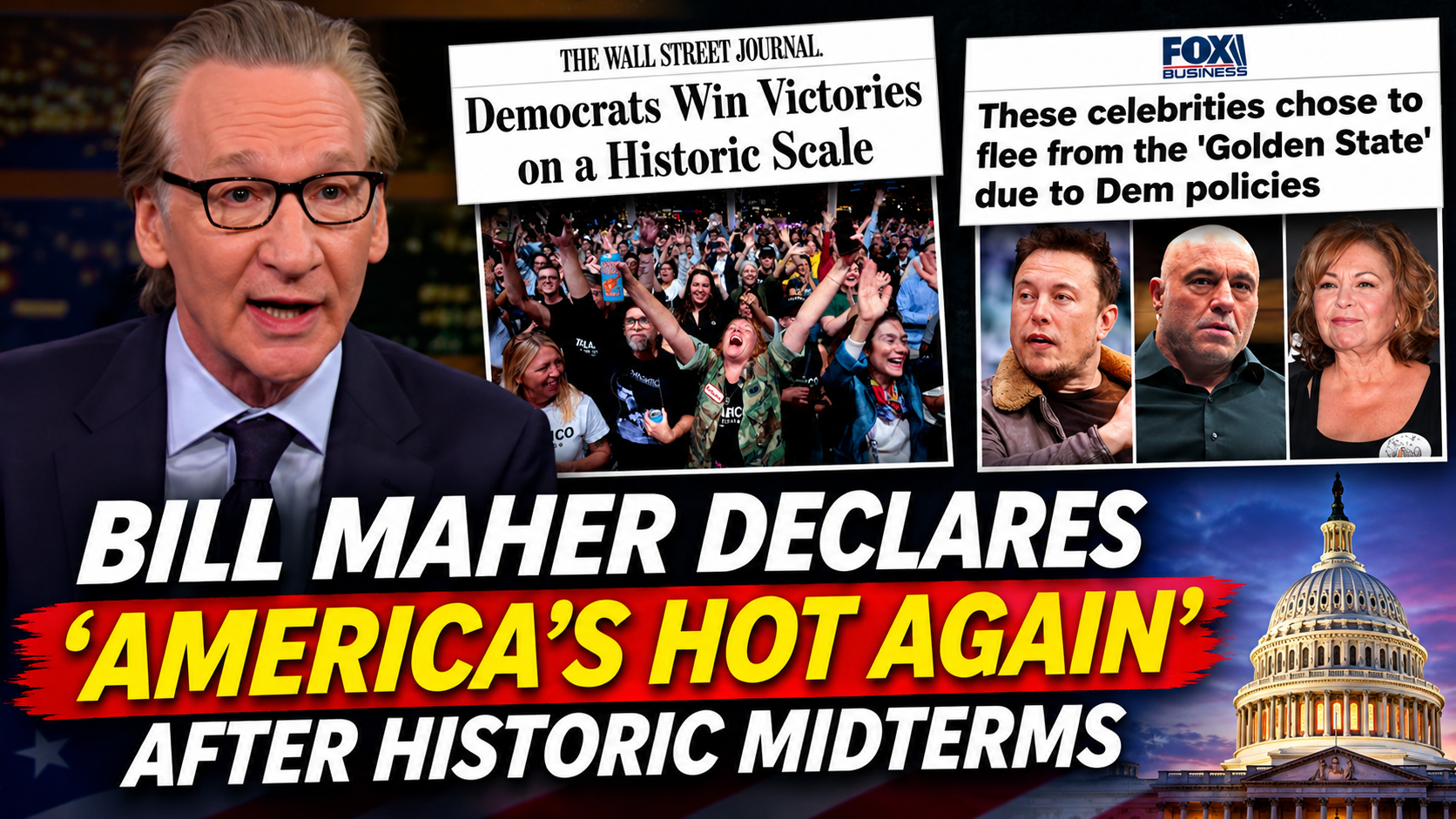
Bill Maher Declares ‘America’s Hot Again’ After Historic Midterm Elections, Says Democracy Proved It Can Still Fight Back
Bill Maher closed the 24th season of HBO’s Real Time with an unusually optimistic message about American democracy, arguing that the 2026 midterm elections demonstrated the country’s ability to correct its political course through the ballot box. In his latest “New Rules” segment, the comedian celebrated historic electoral breakthroughs, mocked Americans who abandoned the country over Donald Trump, and challenged the belief that the United States is permanently divided between red and blue states. His central argument was that the democratic system remains capable of producing meaningful change when Americans actually participate in it.
LOS ANGELES, CALIFORNIA — Political comedian and HBO host Bill Maher delivered a spirited defense of American democracy in the Season 24 finale of Real Time with Bill Maher, using his signature “New Rules” segment to argue that the 2026 midterm elections offered something increasingly rare in American political life: a reason for optimism.
In the segment, titled “New Rule: America’s Hot Again,” Maher celebrated what he described as a historic electoral transformation, pointing to Democratic victories, political breakthroughs, and changing voting patterns as evidence that the country’s political future is not predetermined. Rather than accepting the idea that the United States has become irreversibly divided or that its democratic institutions are beyond repair, Maher argued that voters had demonstrated their ability to change the direction of government.
The commentary represented a notably upbeat conclusion to a season dominated by political conflict, institutional uncertainty, and debates about the future of American democracy. Maher, who has frequently criticized both Republicans and Democrats, used the finale to challenge the increasingly common belief that the American political system is incapable of correcting its own mistakes. His message was not that the country had solved its problems or that future elections would be any less contentious. Instead, he argued that the mechanisms of representative democracy still offer Americans a practical way to confront political extremism, reject unpopular policies, and replace elected officials without abandoning the constitutional system.
Maher Mocks Americans Who Fled the Country Over Trump
Maher opened the segment by targeting Americans who had become so disillusioned with domestic politics that they relocated overseas or contemplated leaving the United States altogether. He joked about liberals who moved to countries such as England and Ireland to escape the political climate under President Donald Trump, only to find themselves reconsidering their decisions after the midterm elections.
The comedian compared their predicament to someone who leaves a marriage only to discover that the person they abandoned has suddenly become more attractive. The joke provided the foundation for the segment’s title, “America’s Hot Again,” and established Maher’s larger argument that political frustration can cause Americans to underestimate their country’s capacity for renewal. Maher also ridiculed assumptions about permanently Republican or Democratic states, suggesting that people who made major life decisions based on the political color of an electoral map may have misunderstood how quickly those maps can change. His point was that political identities, voter coalitions, and state-level elections are not fixed indefinitely, even in places long considered strongholds of one party.
The humor carried a broader political message. Maher argued that Americans who regard every election as an existential catastrophe risk losing sight of the country’s long history of political realignment, institutional adaptation, and democratic competition.
Historic Election Firsts Become a Celebration of American Progress
One of the centerpiece arguments in Maher’s monologue involved what he characterized as an extraordinary series of historic breakthroughs in the 2026 midterm elections. Rather than focusing on the familiar political slogan “America First,” Maher highlighted what he called America’s firsts, emphasizing candidates who broke longstanding racial, religious, gender, and political barriers.
The segment cited milestones involving Muslim, Native American, Black, Hispanic, and LGBTQ elected officials, including reported breakthroughs in Senate races, governorships, and state judicial elections. Maher also celebrated women’s growing representation in Congress, presenting those developments as evidence that American political institutions continue to expand opportunities for candidates from historically underrepresented communities. Among the examples discussed were the reported election of a Black governor in Florida, Hispanic governors in Texas and California, a Native American woman governor, and a Muslim U.S. senator. Maher also referenced New Hampshire politician Chris Pappas, political changes in Alaska, and an openly lesbian judicial candidate in Texas.
For Maher, the significance of these examples extended beyond the individual candidates. He argued that electoral victories by people from different backgrounds demonstrated that voters were capable of rejecting conventional political expectations and expanding the boundaries of representation. The underlying message was that American democracy should not be judged exclusively by its most divisive political figures. Its capacity to produce new leaders, shift governing coalitions, and elevate candidates who previously faced substantial barriers is also part of the country’s political story.
Maher Defends the Founding Fathers and America’s Constitutional System
Maher devoted another major portion of the monologue to defending the American constitutional system, pushing back against the argument that the country’s founding institutions are fundamentally incapable of surviving modern political extremism. He acknowledged the imperfections of the Founding Fathers and the limitations of the political system they created, but argued that its central safeguards had demonstrated their continued relevance.
The comedian pointed to the separation of powers, judicial independence, federalism, and constitutional checks and balances as mechanisms designed to prevent any single political leader from exercising unlimited authority. He described the system through the language of emergency safeguards, comparing constitutional protections to circuit breakers and fail safe mechanisms capable of limiting political abuses.
The argument was especially pointed in the context of Trump’s presidency. Maher suggested that the constitutional system had been subjected to extraordinary political pressure but that elections, courts, state governments, and other institutions continued to provide avenues for accountability. His conclusion was that Americans should recognize the importance of those protections rather than assume that the entire system had already failed.
That distinction is important. Constitutional safeguards do not automatically prevent abuses of power, nor does the outcome of a single election establish that democratic institutions are permanently secure. Their effectiveness depends on public officials respecting legal limits, courts enforcing constitutional protections, and citizens remaining willing to participate in the political process. Maher’s argument was ultimately a defense of the system’s capacity for correction, not a claim that American democracy had become immune to future threats.
The 2026 Elections Remind Maher of Barack Obama’s Historic 2008 Victory
Maher also compared his reaction to the 2026 midterms with the optimism surrounding Barack Obama’s historic presidential victory in 2008. Obama’s election as the first Black president represented a major milestone in American political history and inspired widespread expectations that the country might be entering a new era of political and social progress. The comparison was revealing because Maher has spent much of the intervening period criticizing political polarization, institutional dysfunction, and the inability of both major parties to confront difficult national problems. By invoking 2008, he suggested that the latest election results had rekindled some of the optimism that once accompanied major political breakthroughs.
The two moments nevertheless emerged from different political circumstances. Obama’s victory followed the financial crisis and eight years of Republican control of the White House, while the 2026 elections took place against a backdrop of intense disputes over Trump’s presidency, federal authority, and the direction of American government. Maher’s comparison centered on the emotional and democratic significance of the elections rather than suggesting that the political conditions were identical. In both cases, he argued, voters demonstrated that assumptions about who could win and which political coalitions could succeed were vulnerable to change.
Red States and Blue States Are Not Permanent Political Identities
Perhaps the most consequential argument in Maher’s monologue involved the American electoral map. He challenged the widespread assumption that states can be permanently categorized as Republican or Democratic, pointing to historical political realignments as evidence that electoral coalitions are constantly evolving.
For much of the 20th century, Southern states were strongly associated with the Democratic Party, although that political alignment existed within a vastly different racial and ideological landscape. Over subsequent decades, civil rights legislation, changes in party coalitions, demographic shifts, and national political developments contributed to the South’s transformation into a predominantly Republican region. Maher used that history to argue that today’s electoral map should not be treated as permanent. He highlighted reported Democratic breakthroughs in traditionally conservative states, including Mississippi, Alaska, and Texas, as examples of how political expectations can change when candidates, issues, and voter participation align.
His broader point was that treating large portions of the country as politically unreachable can become a self-fulfilling prophecy. Political parties that abandon competitive organizing in difficult states may reinforce the very electoral disadvantages they consider inevitable. At the same time, historical realignments rarely happen overnight. Durable political change typically requires sustained organizing, demographic developments, candidate recruitment, and shifts in public attitudes. One election can signal an emerging trend without proving that a state has undergone a permanent partisan transformation. Maher’s commentary emphasized the possibility of change rather than the certainty of any particular electoral outcome.
Maher Rejects the Idea That America Is Beyond Repair
The final portion of the segment addressed one of the most persistent themes in contemporary American politics: the belief that the country has become so polarized that democratic government can no longer function.
Maher criticized the tendency to interpret every political confrontation as evidence of an approaching national collapse. He referenced fears of another civil war, the possibility of Trump seeking an unconstitutional third term, and concerns about the gradual erosion of democratic institutions, arguing that the election results demonstrated the continuing importance of constitutional safeguards and public participation.
The comedian also challenged Americans who spend enormous amounts of time expressing political outrage online while overlooking the practical mechanisms available to influence government. Social media platforms can amplify legitimate concerns, expose misconduct, and organize political movements, but they cannot substitute for voting, campaigning, civic participation, or the institutional work required to translate public demands into policy.
Maher’s criticism was particularly directed at political fatalism. He suggested that repeatedly declaring the country hopeless or unfixable can discourage the very participation necessary to improve it. His conclusion was that Americans do not need to abandon their country or wait for an entirely new political system to emerge. They can use the democratic institutions already available to them to demand accountability and change their government.
A Rare Moment of Political Optimism From One of America’s Most Combative Comedians
Maher’s commentary stood out because his political reputation has been built largely on criticism rather than reassurance. Throughout his career, the HBO host has attacked Republican policies, Democratic messaging, religious fundamentalism, political correctness, conspiracy theories, and what he considers ideological excesses across the political spectrum.
His willingness to criticize Democrats has sometimes put him at odds with progressive audiences, while his repeated attacks on Trump and Republican political movements have made him a frequent target of conservatives. That independent and often confrontational approach has helped establish Real Time as a prominent forum for political satire and debate. The Season 24 finale adopted a different emphasis. Rather than spending the closing monologue cataloging the country’s failures, Maher argued that Americans should recognize evidence of political resilience when it appears.
That does not mean the country’s institutional problems have disappeared. Questions about executive power, election administration, political violence, judicial independence, and public confidence in government remain consequential regardless of which party wins an election. Nor does a favorable electoral outcome guarantee that elected officials will deliver effective policies or lasting reforms. Maher’s argument was more limited and arguably more meaningful: American democracy retains the capacity to produce change, even after periods of extraordinary political conflict.
America’s Future Is Not Written in Red and Blue
The central message of Maher’s season-ending monologue was that Americans should resist confusing political disappointment with permanent national decline. Elections can change governing coalitions, constitutional institutions can constrain political power, and states once considered electorally predictable can become competitive under changing circumstances. His celebration of historic candidates and shifting electoral patterns also reflected a broader argument about the American political experiment. The country’s history includes serious democratic failures, institutional exclusions, and periods of political repression, but it also includes movements that expanded participation and transformed who could exercise political power.
Whether the 2026 elections ultimately produce lasting reforms, more competitive state elections, or another period of partisan conflict will depend on decisions made long after the votes have been counted. The results of an election can create an opportunity for change, but they cannot guarantee what elected leaders will accomplish. For Maher, however, the more immediate lesson was that Americans still possess meaningful political agency, and that abandoning faith in democratic participation risks surrendering one of the most effective tools available for changing the country.
The message of “America’s Hot Again” was ultimately about something larger than a Democratic electoral victory or a setback for Donald Trump. It was about the enduring possibility that American voters, rather than political personalities or predictions of national collapse, can still determine the country’s direction.
After a season of political confrontation and warnings about America’s future, Maher ended with an unusually hopeful conclusion: the United States remains a country capable of surprising itself, and democracy works best when its citizens refuse to give up on it.














Loading comments…