
Bill Maher Says Gen Z Has Become “Generation TMZ” Afraid to Dance, Date or Make a Mistake Without Someone Filming It
Bill Maher used his latest “New Rule” segment on HBO’s Real Time to take aim at one of the stranger consequences of life in the smartphone era: Americans may complain about surveillance, but millions of ordinary people now willingly participate in it, carrying high definition cameras everywhere they go and potentially turning another person’s embarrassing moment into permanent internet content.
In “Generation TMZ,” released Oct. 3 following the Oct. 2 episode of Real Time, Maher argued that constant recording, screenshots and viral public shaming have helped create a culture in which younger Americans increasingly police their own behavior because they never know when a mistake, bad dance move, awkward date or private conversation could become somebody else’s content. Maher’s argument is deliberately comedic and sweeping, and the available evidence does not establish that smartphone surveillance alone explains Gen Z’s reported anxiety or loneliness. But the cultural phenomenon at the center of his monologue is real enough that journalists, DJs, nightclub operators and researchers have increasingly begun asking a similar question: What happens to spontaneous human behavior when everyone knows a camera could be pointed at them?
Maher’s Argument: Everybody Is a Potential Paparazzo
Maher began with the familiar idea that modern Americans live under unprecedented levels of observation. Security cameras, Ring doorbells, vehicle cameras, drones, smartphones, license-plate readers and increasingly sophisticated wearable devices have dramatically expanded the number of places where someone’s movements can potentially be recorded. But Maher’s central point was not simply that governments and corporations are watching people. It was that ordinary citizens have joined them. Smartphones have effectively given millions of people the equipment necessary to become amateur paparazzi, documentary crews and, in Maher’s characterization, self-appointed “morality police.”
That is where Maher arrived at the segment’s defining phrase: “Gen Z is now Gen TMZ.” The joke references TMZ’s celebrity surveillance model, but Maher’s broader argument was about the democratization of that culture. The subject no longer has to be a movie star leaving a nightclub. An ordinary person can become the center of a viral story because someone nearby recorded an argument, embarrassing fall, awkward interaction or questionable decision and uploaded it for millions of strangers to dissect.
The Dance Floor Has Become Ground Zero
Maher pointed to a phenomenon that has received growing attention throughout 2026: people apparently becoming increasingly reluctant to dance at concerts and clubs because they fear being recorded and mocked online. The Wall Street Journal previously examined the trend, while The Washington Post revisited the phenomenon in January, reporting that fear of embarrassment, unwanted recording and potentially becoming social media content had become part of the psychology surrounding modern dance floors.
The issue has since spread beyond newspaper trend pieces. DJs and club operators have complained about crowds standing with phones raised rather than dancing, while some venues and promoters have experimented with phone restrictions designed to restore the anonymity and spontaneity that once defined nightlife. In September, Time Out reported on a New York funk party built around an explicit no-recording rule, where attendees caught filming could be removed.
That makes Maher’s observation about dancing more than a punchline. Smartphones have altered the social environment of concerts and clubs because participants are no longer simply surrounded by other people; they are potentially surrounded by cameras connected instantaneously to audiences numbering in the millions. The old expression was “dance like nobody’s watching.” The modern problem, as Maher framed it, is that somebody probably is.
From Government Surveillance to Voluntary Surveillance
There is an important distinction between government surveillance and people filming one another with smartphones, but Maher deliberately placed them beside each other to illustrate how thoroughly recording technology has entered everyday life. Americans routinely encounter surveillance cameras in stores, parking garages, office buildings, apartment complexes and residential neighborhoods. Modern cars can carry multiple exterior cameras, while automated license plate reader systems can record vehicles moving through communities. Doorbell cameras have transformed millions of front porches into privately operated surveillance points, while wearable cameras and smart glasses increasingly allow people to capture photographs and video without holding a phone directly in front of their face.
The result is not literally a single centralized surveillance system. It is something messier: overlapping networks of government cameras, private security systems, commercial databases, vehicle cameras and millions of individuals carrying smartphones capable of recording nearly anything they encounter. Maher’s point was that the psychological effect can become similar even when the technology and operators are completely different. People behave differently when they believe they are being watched.
Andy Warhol’s 15 Minutes of Fame Got an Uncomfortable Upgrade
Maher invoked Andy Warhol’s famous prediction that everyone would eventually be famous for 15 minutes, arguing that social media has delivered a darker version of that future: people can now become famous without wanting to be famous at all. Viral culture is filled with people who became recognizable because someone else happened to record them. Sometimes the footage documents legitimate misconduct or matters of obvious public interest. Other times, the “story” is simply an ordinary human being experiencing an embarrassing moment in public.
The distinction matters because social media platforms reward attention rather than proportionality. A video does not need to reveal corruption, criminal conduct or significant wrongdoing to spread. It merely needs to be funny, outrageous, embarrassing, emotionally provocative or sufficiently strange to stop someone from scrolling. Once uploaded, the person being filmed may have almost no control over what happens next.
The Coldplay Kiss Cam Scandal Became the Perfect Example
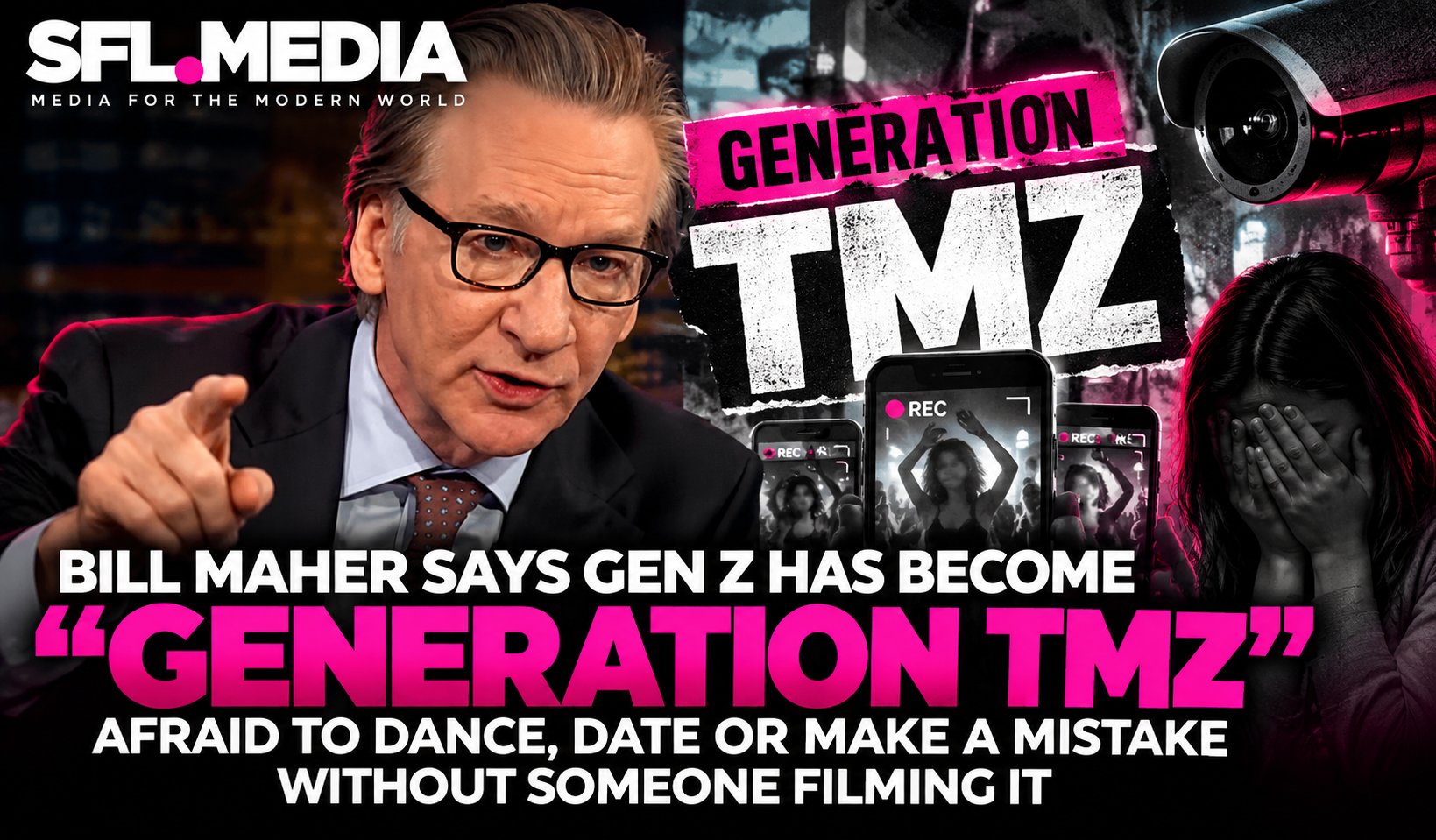
Maher referenced the Coldplay concert incident that became one of the most famous examples of accidental viral exposure. During a 2025 Coldplay concert, a stadium kiss cam captured Astronomer CEO Andy Byron embracing the company’s chief people officer, Kristin Cabot. Their startled reaction immediately attracted attention, and the footage exploded across social media. What began as several seconds on a stadium screen became an international news story, generated countless memes and ultimately produced serious professional consequences. Byron resigned as CEO shortly afterward, while Cabot also left the company.
The incident was newsworthy because both were senior executives at the same company and the footage raised legitimate workplace questions, but it also demonstrated the extraordinary speed with which a previously private person can become globally recognizable after appearing unexpectedly on camera. One moment captured by one camera and uploaded to the internet can suddenly produce an audience of millions.
The Screenshot Changed Private Communication Too
Maher extended the argument beyond cameras because surveillance culture no longer requires video. A private text message can be screenshotted, a dating-app conversation can be posted publicly and a direct message intended for one person can suddenly appear before thousands of strangers. That changes the nature of communication itself.
People have always risked rejection, humiliation and gossip when flirting, dating or confiding in friends. What previous generations generally did not face was the possibility that an embarrassing romantic overture could be perfectly preserved, distributed globally and remain searchable years later. Maher cited survey figures suggesting substantial numbers of young adults hold back emotionally or avoid asking someone on a date because they fear awkward interactions could be recorded or shared.
Those specific percentages require caution without examining the underlying survey methodology, sample and population, but the broader concern about screenshot culture has become a recognizable feature of modern dating and online communication. The important distinction is between saying digital exposure causes Gen Z’s broader mental health problems, a much larger scientific claim, and observing that permanent, shareable records can change how people approach vulnerable social interactions. The latter is considerably easier to defend.
“Cringe” Has Become a Form of Social Enforcement
The word running underneath Maher’s entire segment was “cringe.” Internet culture can turn almost any sincere behavior into material for ridicule: dancing badly, flirting awkwardly, singing terribly at karaoke, dressing differently, expressing too much enthusiasm or simply trying something publicly and failing.
That creates a peculiar incentive structure in which the safest way to avoid embarrassment is not to participate. Don’t dance too enthusiastically, don’t say too much, don’t send the vulnerable message, don’t approach the stranger, don’t sing unless you know you can sing and don’t do anything that might look ridiculous when stripped of context and compressed into a 15-second video. Taken to its extreme, Maher argued, the result is a culture where everybody watches and nobody wants to be watched.
There Is a Growing Backlash Against Phones at Live Events
Maher’s argument also arrives as parts of nightlife and live entertainment begin pushing in the opposite direction. Phone-free concerts are no longer unusual, with artists and venues increasingly using locked pouches or explicit recording restrictions to prevent audiences from spending entire performances staring through screens. Some clubs have adopted similar approaches. The reasoning is partly artistic — performers want audiences engaged with the show — but there is also a social dimension: removing phones can remove some of the pressure to perform for the camera.
New York’s WHO’S DANCING? party has taken that philosophy particularly seriously, building its identity around dancing without recording. Organizers have described the concept as a response to nightlife environments where crowds increasingly film instead of participating. Whether that becomes a broader cultural movement remains unclear, but the appeal is obvious: when nobody can upload your bad dancing tomorrow, bad dancing suddenly becomes fun again.
Maher Wants the Camera Turned Back on the People Doing the Filming
Maher ultimately proposed a cultural reversal rather than a technological solution. His argument was that society should stop treating the person behaving awkwardly as automatically embarrassing and begin questioning the person who reflexively pulls out a phone to record someone else’s vulnerable moment. That distinction becomes particularly important when the behavior being documented is harmless. Recording police misconduct, violence, discrimination, dangerous behavior or matters of genuine public interest can provide critical evidence and accountability, and citizen video has repeatedly exposed events that otherwise might never have been documented. Recording a stranger dancing badly so millions of people can laugh at them is something else entirely.
Maher’s closing message was essentially an argument for restoring permission to be imperfect in public: dance badly, eat messy food, bomb at karaoke, say something awkward, risk rejection and live without assuming that every mistake deserves an audience. He summed up the idea by urging people to “dance like your doorbell isn’t watching,” embrace embarrassing moments and live more freely despite the cameras surrounding them. Behind the joke is a legitimate cultural question. Previous generations worried about Big Brother watching them. The smartphone era has introduced another possibility: maybe Big Brother doesn’t need to watch everybody anymore because everybody is already watching everybody else.

Sources & Further Reading
Bill Maher — Real Time with Bill Maher
https://www.billmaher.com/
The Washington Post — The Death of the Dance Floor — and the Movements to Replace It
https://www.washingtonpost.com/style/trends/2026/01/22/is-dancing-dead/
KCRW — Did Social Media Kill the Dance Floor?
https://www.kcrw.com/shows/the-sam-sanders-show/stories/did-social-media-kill-the-dance-floor
The Boston Globe — People Aren’t Dancing in Clubs Anymore. Who’s to Blame?
https://www.bostonglobe.com/2026/08/14/arts/djs-clubs-cameras/
Time Out New York — WHO’S DANCING? Is an Underground Party Where Phones Aren’t Invited
https://www.timeout.com/newyork/news/this-viral-funk-party-in-nyc-doesnt-allow-phonesand-thats-a-good-thing-091926
DJ Mag — Phones on the Dancefloor: Where Do We Go From Here?
https://djmag.com/features/phones-dancefloor-where-do-we-go-here

















































Want to join the conversation?
Create an account or sign in to share your thoughts, vote,
and reply to other readers.
Showing 0 of 0 comments
Don't have an account?
Already have an account?