
Bill Maher Says America Has Entered an Era of “Accidental Bipartisanship” and It May Be Quietly Producing Results
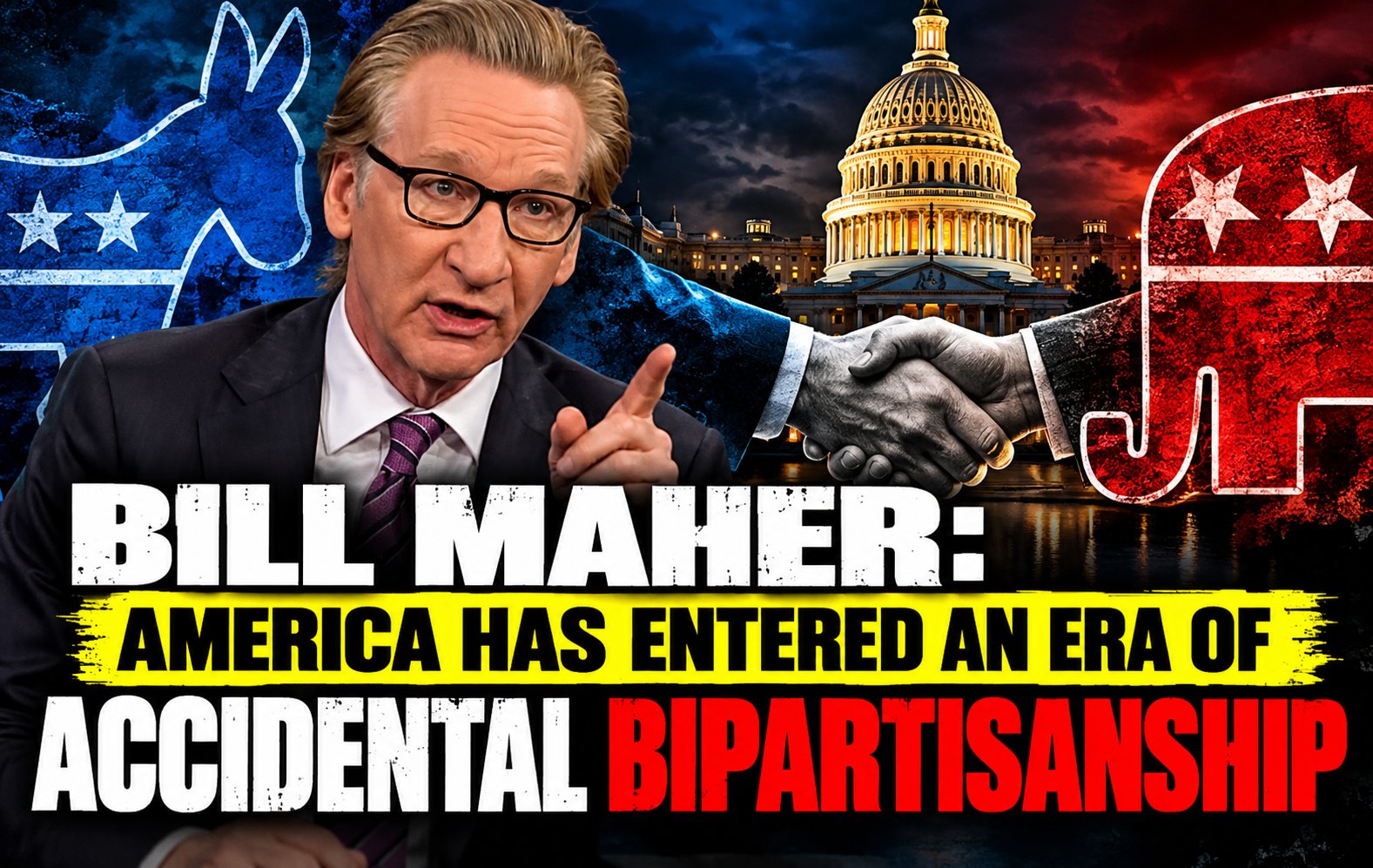
Bill Maher used his latest Real Time “New Rule” segment to make an argument that cuts against much of modern American political culture: Democrats and Republicans may despise giving each other credit, but some of the country’s most encouraging recent trends are emerging while policies associated with both parties operate simultaneously.
In a segment titled “Collab Request,” Maher argued that bipartisan cooperation has become politically embarrassing in an era when politicians can face backlash from their own supporters simply for sitting down with someone from the opposing party. His larger point was not that Washington has suddenly rediscovered traditional bipartisanship, but almost the opposite. The parties remain deeply divided, yet policies championed separately by the left and right can sometimes attack different parts of the same problem and produce complementary results. Maher called the phenomenon an era of “accidental bipartisanship” a country in which politicians may be unwilling to cooperate openly but can still end up contributing to the same outcome from opposite ideological directions.
The comedian pointed to three areas in particular: America’s dramatic decline in overdose deaths, falling violent crime and declining prescription drug prices. The broad trends behind those examples are real, although Maher’s explanation of what caused them is considerably more difficult to establish than the statistics themselves.
Maher Says Bipartisanship Has Become Something Politicians Have to Hide
Maher began with the recent private meeting between House Democratic leader Hakeem Jeffries and Jared Kushner, President Donald Trump’s son in law and former senior White House adviser. The meeting itself became notable precisely because open cooperation between senior figures associated with opposing parties has become politically sensitive. Maher’s point was that none of this should be remarkable. Political leaders are elected to govern a country containing people who disagree with them, and congressional legislation historically required relationships across party lines.
In today’s political environment, however, even talking with the opposing side can generate suspicion from activists and primary voters. That reality, Maher argued, has produced a strange new form of governing: politicians do not necessarily have to agree with one another, or even admit that the opposing party contributed anything useful, for policies originating on opposite sides to work together.
America’s Overdose Crisis Is Improving Dramatically
Maher’s strongest example was the remarkable decline in American overdose deaths after years of catastrophic losses from fentanyl and other drugs. The underlying trend is substantial and confirmed by federal data, although some of the specific percentages Maher cited require additional context.
CDC provisional data estimated approximately 69,973 drug overdose deaths in the United States during 2025, down almost 14 percent from an estimated 81,313 in 2024. That represented the third consecutive annual decline and followed an even larger improvement from 2023 to 2024. The downward trajectory has continued into 2026, with the CDC estimating 67,798 overdose deaths during the 12 months ending in March 2026, 12.3 percent below the comparable previous period.
Final CDC data for 2024 show just how dramatic the earlier decline had already become. The age adjusted drug overdose death rate fell 26.2 percent from 2023 to 2024, dropping from 31.3 deaths per 100,000 people to 23.1. Death rates involving synthetic opioids other than methadone, a category dominated by illicit fentanyl, fell 35.6 percent, heroin involved death rates fell 33.3 percent, cocaine involved death rates fell 26.7 percent and deaths involving psychostimulants such as methamphetamine declined 19.8 percent.
Maher cited even larger declines for several individual drugs during his monologue. Those numbers should not be treated as interchangeable with the CDC’s national year-over-year mortality statistics because percentages can vary dramatically depending on the dataset, metric and comparison period being used. The larger conclusion, however, is indisputable: after years of devastating increases, America has experienced a major and sustained decline in fatal overdoses.
Maher Credits Both Harm Reduction and Supply Side Enforcement
Maher’s argument is that neither political party should claim exclusive credit. Democrats and public-health advocates pushed aggressively for wider availability of naloxone, commonly sold under the brand name Narcan, along with addiction treatment and other harm-reduction programs designed to keep people alive. Republicans, meanwhile, have emphasized border enforcement, interdiction and aggressive action against drug cartels and trafficking networks.
In Maher’s formulation, those approaches attack the crisis from opposite directions. Harm reduction attempts to prevent people who consume dangerous drugs from dying, while enforcement attempts to reduce the supply of lethal drugs reaching communities in the first place. Instead of treating those approaches as mutually exclusive, Maher argues that the country can pursue both simultaneously.
Assigning precise causal credit is considerably more difficult. Researchers and public-health officials have identified numerous potential contributors to the overdose decline, including wider naloxone distribution, expanded treatment, changes in the illicit drug supply, shifts in drug-use behavior, public health interventions and law enforcement activity. The CDC itself has emphasized cooperation between public health and public safety rather than attributing the decline to a single administration, party or policy.
The data therefore support Maher’s broader observation more clearly than they prove his exact political formula. Policies traditionally associated with both sides have operated during one of the most significant improvements in the overdose crisis in years, but determining exactly how much credit belongs to each intervention requires substantially more evidence.
Crime Is Falling Too, but the Cause Is Complicated
Maher applied the same theory to crime, where the underlying national improvement is also substantial. Recent national crime data show major declines in violent offenses, while preliminary analyses of major cities indicate that homicides have continued falling in 2026.
Maher argues that this improvement also occurred amid a mixture of policies traditionally associated with opposing political camps. Democrats have emphasized social programs, violence prevention, intervention services and economic support, while Republicans have emphasized policing, prosecution, deterrence and tougher rhetoric surrounding criminal behavior. Maher also pointed to the increasing use of surveillance and investigative technologies, including automated license-plate readers, as another factor changing modern law enforcement.
The temptation for either party is to claim that its preferred policies caused the decline, but the evidence is considerably messier. Crime had already begun falling substantially before Trump returned to office, and researchers have proposed numerous explanations for the continuing improvement, including the fading effects of pandemic-era disruption, changes in policing and prosecution, demographic trends, community intervention programs, technological improvements and broader economic and social conditions.
That complexity actually reinforces Maher’s larger philosophical argument. If the country does not fully understand which combination of interventions is producing encouraging results, reflexively eliminating policies simply because the opposing party supports them makes little sense.
Prescription Drug Prices Give Maher Another Example
Maher’s third major example was prescription drug prices, which he said recently experienced their steepest annual decline since 1963. He used the trend to argue that Democratic and Republican administrations have approached pharmaceutical pricing differently while nevertheless embracing versions of the same underlying idea: using government leverage, competition and purchasing power to challenge high drug prices.
The Biden era Inflation Reduction Act established Medicare drug-price negotiations and other pharmaceutical pricing reforms, while Trump has promoted his own initiatives aimed at forcing manufacturers to reduce U.S. prices and bring them closer to prices available in other developed countries. The administrations differ significantly over the mechanisms, scope and political philosophy behind those policies, making it misleading to portray them as identical programs. Maher’s point is narrower: both sides have increasingly accepted that government can exert leverage against pharmaceutical pricing rather than simply accepting whatever price manufacturers set.
Maher jokingly reduced the economic principle to something he said he understood from selling marijuana in college: buying in volume gives the buyer leverage. Beneath the joke was a serious point about purchasing power. When an enormous buyer can negotiate across a large market, it may have considerably greater leverage over suppliers than millions of individual consumers acting independently.
As with overdose deaths and crime, however, assigning political credit for changing prescription prices is complicated. Drug prices can be affected by federal policy, generic competition, patent expirations, manufacturer decisions, negotiated agreements, insurance structures and changes that began years before they appear in consumer inflation statistics. The direction of the trend can be measured far more confidently than responsibility for producing it.
The Statistics Are Real; Political Credit Is Much Harder to Assign
This is where Maher’s comedy segment becomes a serious public policy argument. America is experiencing several encouraging trends simultaneously: drug overdose deaths have fallen dramatically from their peak, violent crime and homicide have declined substantially in many parts of the country, and some measures of prescription drug prices have moved downward.
What cannot be established nearly as cleanly is that any single president, party or ideology caused those outcomes. Crime statistics are influenced by local governments, police departments, prosecutors, economic conditions, demographics and long-running social trends. Drug deaths reflect treatment availability, naloxone distribution, illicit supply changes, enforcement and individual behavior. Prescription prices reflect federal policy, pharmaceutical competition, patents, generic drugs, negotiated agreements and market changes. Maher’s central observation is that American politics often demands a much simpler story: our side fixed it and their side made it worse. Reality rarely cooperates.
“Accidental Bipartisanship” May Be a Better Description Than Gridlock
Maher’s phrase “accidental bipartisanship” captures a peculiar feature of contemporary Washington. Traditional bipartisanship means lawmakers from opposing parties deliberately negotiate, compromise and attach their names to the same legislation. Maher’s version requires almost none of that.
Republicans can increase enforcement while Democrats expand treatment. Democrats can create Medicare drug negotiations while Republicans pressure pharmaceutical manufacturers through different pricing mechanisms. Progressive cities can fund community intervention programs while police departments deploy more sophisticated investigative technology. The parties can publicly attack each other’s approach while pieces of both remain in operation, and when conditions improve, each side can claim its preferred half of the equation while dismissing the contribution of the other.
Maher’s argument is that Americans should care less about which political tribe receives the trophy and more about identifying which combinations actually work. That does not mean every Democratic and Republican policy complements the other, nor does it mean their political differences are meaningless. Many policies are genuinely incompatible, and some produce measurable costs as well as benefits. Falling overdose deaths, declining crime and lower prescription-drug prices nevertheless provide useful case studies because they challenge simplistic partisan explanations for complicated national trends.
Maher’s Real Target Is the Politics of Refusing to Give Credit
The deeper target of Maher’s monologue was not Democrats or Republicans individually. It was a political culture in which acknowledging that an opponent did something useful can itself be treated as betrayal. The Jeffries Kushner meeting provided Maher with an almost perfect opening example. Two politically opposed figures meeting privately to discuss issues where cooperation might be possible should ordinarily be an unremarkable function of government. In the current political environment, the mere existence of such conversations can become a political story of its own.
Maher’s argument is ultimately straightforward: Americans do not need their politicians to like one another, and voters do not need to abandon their ideological differences. But governing a country of hundreds of millions of people inevitably requires political opponents to communicate, negotiate and occasionally accept that an idea associated with the other side might work.
The irony is that the country may already be demonstrating another possibility. Democrats and Republicans remain deeply divided, frequently refuse to share credit and may not even agree on why conditions are improving. Yet in several major areas, policies associated with both sides have operated simultaneously while important national indicators have moved in an encouraging direction.
Maher’s “Era of Accidental Bipartisanship” is therefore partly a joke and partly a challenge to Washington: if America can sometimes produce better outcomes while the two parties cooperate almost by accident, the more consequential question is what might be possible if political leaders became less afraid to work together deliberately.












































Want to join the conversation?
Create an account or sign in to share your thoughts, vote,
and reply to other readers.
Showing 0 of 0 comments
Don't have an account?
Already have an account?