
Bill Maher Takes Aim at College Fraternities and Sororities, Calling Greek Life a Toxic American Tradition That Has Outlived Its Purpose
In a blistering “New Rule” segment on HBO’s Real Time, Maher argues that fraternities and sororities perpetuate hazing, elitism, sexual misconduct, and social segregation while universities continue defending institutions that contradict their own educational values.
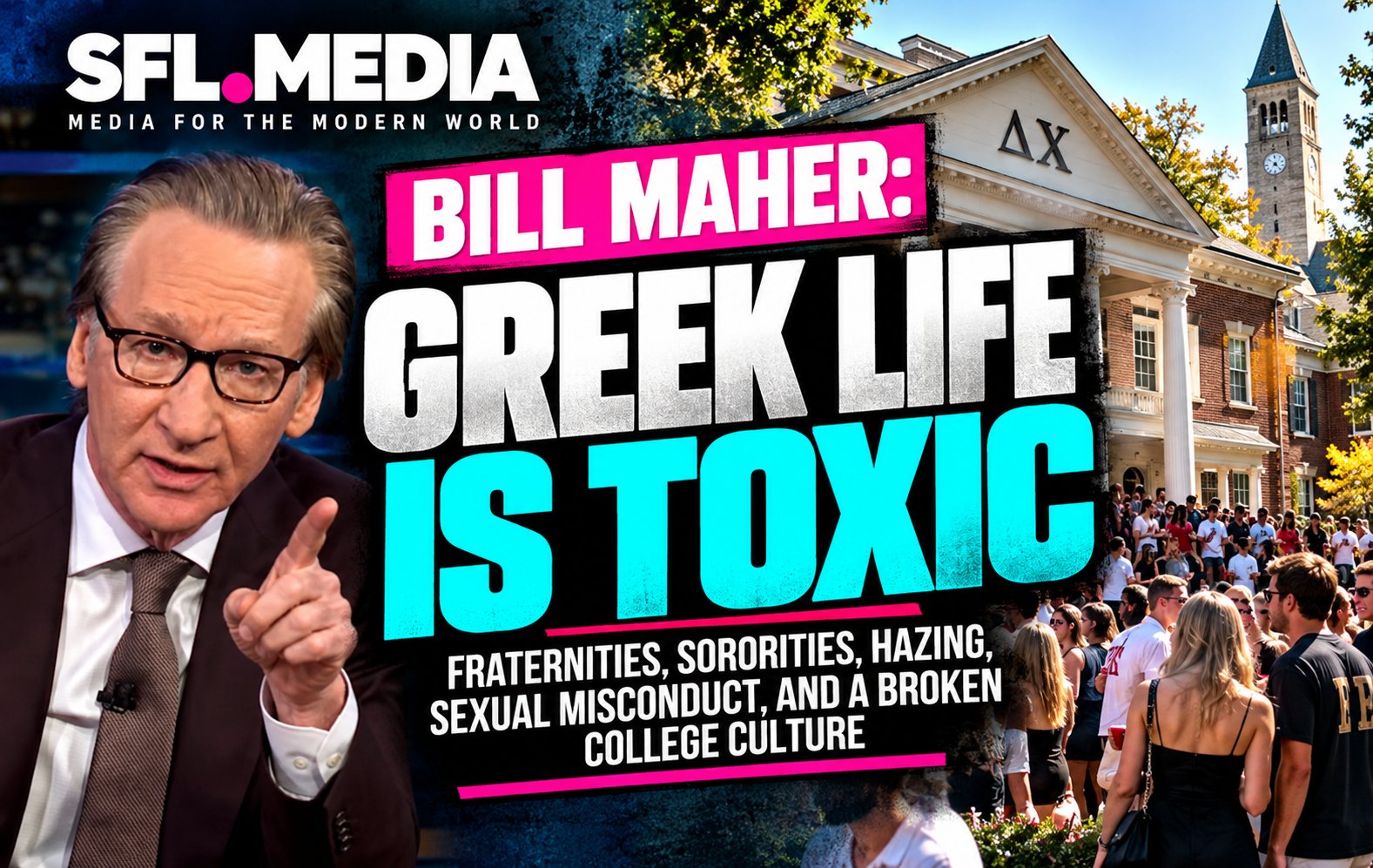
Bill Maher has taken aim at one of America’s most deeply entrenched college traditions, arguing that fraternities and sororities have become outdated institutions that encourage some of the worst aspects of campus culture while undermining the fundamental purpose of higher education. In his latest “New Rule” segment on HBO’s Real Time with Bill Maher, the comedian and political commentator delivered a sweeping indictment of Greek life, challenging universities to explain why organizations associated with hazing, excessive drinking, exclusion, and sexual misconduct continue to occupy such a privileged position on American campuses.
The segment, titled “Greek Out,” uses an alleged sexual assault case involving a Cornell University fraternity as the starting point for a broader examination of the fraternity system. Maher, himself a Cornell alumnus, argues that the problem extends far beyond individual scandals or isolated chapters. In his view, the organizational structure of Greek life creates environments where social status, secrecy, loyalty, and peer pressure can override personal accountability, while universities remain reluctant to dismantle institutions supported by generations of influential alumni.
Maher’s criticism also extends to sororities, which he portrays as institutions that reinforce exclusionary social hierarchies and superficial measures of popularity. His central argument is that universities cannot credibly celebrate diversity, inclusion, and intellectual exploration while simultaneously supporting social organizations that frequently sort students into narrowly defined groups based on gender, social connections, wealth, and perceived status.
Although the segment relies heavily on comedy and provocative generalizations, it raises longstanding questions about campus safety, institutional responsibility, and whether Greek organizations continue to provide educational or social benefits sufficient to justify their risks.
Cornell’s Alleged Gang Rape Case Becomes the Center of a National Debate
Maher opened his commentary by referencing the allegations surrounding Cornell University’s Chi Phi fraternity, where a former student claims she was drugged and sexually assaulted by seven fraternity members during an October 2024 gathering. The woman, identified in court documents as Jane Doe, filed a civil lawsuit in September 2026 against the accused men, Cornell University, and several other defendants, alleging that the university and fraternity system failed to protect her.
The case has attracted national attention not only because of the severity of the allegations but also because of the university’s handling of the initial investigation. Cornell conducted an internal disciplinary inquiry involving dozens of interviews and witnesses, ultimately expelling two students and imposing lesser sanctions on others. Local prosecutors initially declined to bring criminal charges, prompting criticism from the woman’s attorneys and advocates who questioned whether the investigation adequately addressed evidence of incapacitation and nonconsensual sexual activity.
New York Governor Kathy Hochul subsequently appointed Attorney General Letitia James as a special prosecutor, removing the case from the local district attorney’s oversight. Cornell President Michael Kotlikoff has acknowledged the seriousness of the allegations and promised greater transparency and an independent review of the university’s response. The accused men have denied wrongdoing, and the allegations remain subject to ongoing legal proceedings.
The controversy became even more complicated when court documents mistakenly identified the address of an unrelated U.S. Marine who shared a name with one of the defendants. The mistake reportedly resulted in threats against the Marine and his family, leading a judge to order sensitive documents sealed and corrected versions filed. The episode illustrates how quickly public outrage surrounding serious allegations can produce additional harm when identities and evidence are not carefully verified.
For Maher, the Cornell case is not simply about the alleged misconduct of individual students. He presents it as an example of what can happen when exclusive social organizations operate within universities while maintaining powerful traditions of internal loyalty, secrecy, and institutional influence.
The Greek Life Tradition Is an American Invention, Not an Ancient Greek Institution
One of Maher’s central arguments challenges the historical mythology surrounding college fraternities and sororities. Despite their Greek letter names and elaborate rituals, the modern American fraternity system did not originate in ancient Greece. Its roots lie primarily in American collegiate literary and social societies, with the Kappa Alpha Society, founded at Union College in Schenectady, New York, in 1825, widely recognized as the first continuously operating secret Greek letter social fraternity.
The system expanded during the nineteenth century as additional organizations adopted Greek letters, initiation ceremonies, exclusive membership practices, and eventually dedicated residential houses. Over time, fraternities and sororities developed into influential social institutions, particularly at universities where Greek membership became closely associated with campus leadership, alumni networking, philanthropy, and social status.
Maher argues that the age of a tradition should not automatically justify its preservation. His criticism is directed at the assumption that fraternities deserve a permanent place in American higher education simply because generations of students have participated in them. He suggests that universities should evaluate Greek organizations according to their present day behavior and contributions rather than their historical prestige.
The historical distinction is important. Greek life may borrow ancient symbols and terminology, but its contemporary structure is an American creation shaped by American social values, institutional practices, and cultural expectations. As Maher sees it, universities are free to reconsider that structure without abandoning any essential part of classical education or academic tradition.
Hazing, Alcohol Abuse, and the Culture of Institutional Loyalty
Maher’s most forceful criticism concerns the culture of initiation and group loyalty that has historically characterized portions of the fraternity system. He argues that fraternities can reward excessive drinking, humiliation, bullying, and conformity while encouraging members to prioritize acceptance within the group over independent judgment.
During the segment, Maher cites 128 college hazing deaths during the twenty first century, using the figure to challenge the idea that dangerous initiation practices are merely harmless traditions or isolated mistakes. The precise total depends on how hazing related deaths are defined and counted, and the figure should not be interpreted as representing fraternity deaths exclusively. Hazing has also occurred in athletic teams, marching bands, and other student organizations.
Nevertheless, the broader problem is well documented. Fatal hazing incidents have repeatedly exposed situations in which students were pressured to consume dangerous amounts of alcohol, endure physical punishment, or participate in degrading activities as conditions of membership. Investigations into such incidents have frequently raised questions about whether fellow members, alumni advisers, or university administrators failed to intervene before dangerous behavior escalated.
Maher argues that the underlying incentive structure is part of the problem. When belonging to a prestigious group requires students to demonstrate loyalty through humiliation or risk taking, destructive behavior can become normalized as a measure of commitment. The resulting culture may also discourage members from reporting misconduct when doing so could threaten friendships, housing arrangements, or the reputation of the organization.
Supporters of Greek life counter that many chapters prohibit hazing, participate in educational programming, and provide leadership development, charitable fundraising, and lasting social connections. Those benefits are real for many participants, but they do not resolve the question of whether existing oversight systems are sufficient to prevent dangerous conduct in chapters where rules are ignored.
Sororities Are Not Exempt From Maher’s Criticism
Although fraternities receive the harshest treatment in the segment, Maher also criticizes sororities for perpetuating social exclusion, superficiality, and rigid hierarchies of popularity. He portrays portions of sorority culture as organized around image, status, appearance, and competition for acceptance, arguing that these priorities can undermine the development of authentic relationships and individual identity.
His critique focuses particularly on recruitment practices and the pressure students may experience to conform to an organization’s expectations. In highly competitive Greek systems, membership can become a marker of social standing, with students evaluating themselves and others according to which organizations extend invitations and which do not.
Such systems can create significant emotional pressure, particularly for young adults entering college and attempting to establish new friendships and social identities. Critics argue that recruitment structures emphasizing exclusivity can reinforce socioeconomic differences, appearance-based judgments, and existing campus hierarchies.
Sorority organizations, however, also emphasize academic achievement, community service, leadership opportunities, mentoring, and philanthropy. Many provide substantial scholarship support and alumni networks that continue long after graduation. Maher’s argument does not establish that every sorority is harmful, but rather challenges universities to consider whether the broader system of selective social membership promotes the values they claim to prioritize.
Universities Celebrate Diversity While Allowing Exclusive Social Enclaves
Perhaps the most consequential portion of Maher’s argument concerns what he sees as a contradiction between university diversity initiatives and the continued prominence of Greek organizations. Colleges routinely emphasize the importance of exposing students to different backgrounds, cultures, experiences, and viewpoints, yet many simultaneously maintain social systems built around selective membership and, in some cases, gender-specific housing.
Maher argues that such arrangements can encourage students to retreat into familiar social environments rather than engage with people whose lives and perspectives differ from their own. He questions whether universities should continue supporting organizations that may reinforce social divisions while promoting diversity and inclusion elsewhere on campus.
The issue is more complicated than the suggestion that Greek life is uniformly segregated. Membership practices differ substantially across organizations, and historically Black fraternities and sororities, multicultural Greek organizations, and other identity based groups have played important roles in providing community, leadership opportunities, and institutional representation for students historically excluded from predominantly white organizations.
These organizations also have distinct histories and purposes that cannot be reduced to the social practices associated with some predominantly white fraternity and sorority systems. The broader question is whether universities can maintain inclusive educational environments while permitting student organizations to establish membership standards that may limit participation.
Maher’s criticism ultimately concerns the educational consequences of social separation. When students spend much of their college experience surrounded by people who share similar backgrounds, economic circumstances, and social expectations, opportunities for meaningful exposure to different perspectives may become more limited.
The Bigger Question: What Is College Supposed to Accomplish?
Maher concludes by returning to the fundamental purpose of higher education. In his view, college should challenge students intellectually and socially, forcing them to encounter unfamiliar ideas, question assumptions, and develop relationships beyond the communities in which they were raised.
His argument is that Greek life, particularly when organized around exclusive housing and tightly controlled social circles, can undermine that mission by encouraging students to remain within comfortable and predictable environments. Instead of broadening their experiences, students may spend four years reinforcing the same social habits, prejudices, and hierarchies they brought with them to campus.
The Cornell controversy has made that debate especially urgent. University administrators now face renewed scrutiny over whether existing disciplinary procedures, fraternity oversight systems, and campus sexual misconduct policies adequately protect students. The outcome of the Cornell investigation will depend on the evidence and applicable law, but the institutional questions raised by the case extend far beyond the individuals involved.
Maher’s proposed direction is clear: universities should reconsider whether fraternities and sororities, as currently structured, belong at the center of campus social life. That position is likely to face resistance from Greek organizations, alumni, and students who view membership as an important source of friendship, mentorship, and community.
Yet the continuing debate is not simply about whether students should be permitted to join private social organizations. It is about the responsibilities universities assume when they recognize, promote, house, or otherwise support those organizations, particularly when misconduct occurs.
For institutions that claim to prepare students for an increasingly diverse and interconnected world, Maher’s segment poses a question that extends well beyond Greek letters and fraternity houses: whether the social structures universities have preserved for generations are helping students grow beyond their existing boundaries or simply teaching them to remain comfortably inside them.





















































Want to join the conversation?
Create an account or sign in to share your thoughts, vote,
and reply to other readers.
Showing 0 of 0 comments
Don't have an account?
Already have an account?