
George Santos Admits the Lies, Talks Federal Prison and Tries to Explain Himself to Bill Maher on “Club Random”
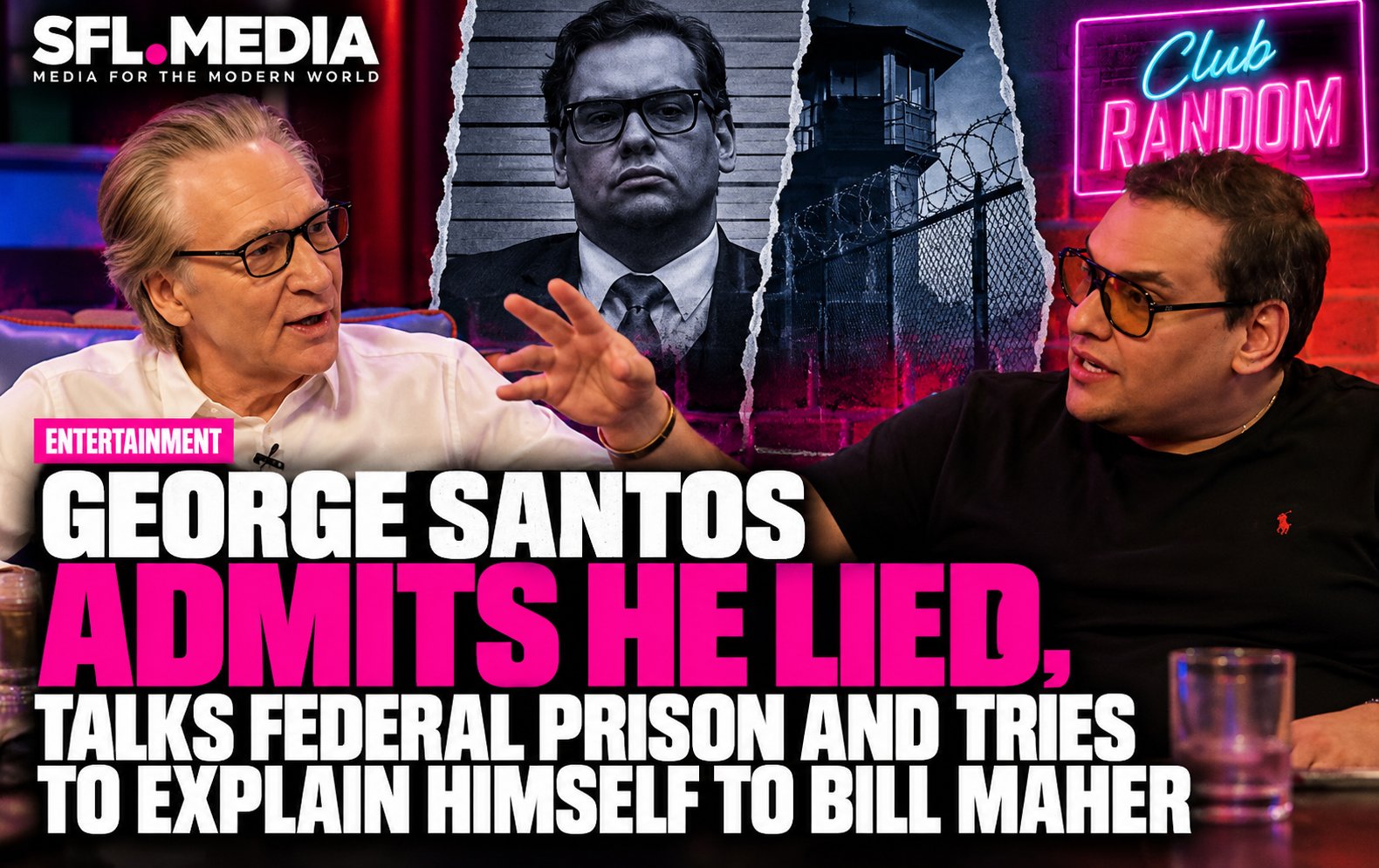
Former Rep. George Santos sat down with Bill Maher for an 85 minute episode of “Club Random” that was always going to revolve around one unavoidable subject: the truth. Santos, the former Republican congressman from New York whose spectacular political collapse involved fabricated credentials, fraudulent campaign filings, donor identity theft, expulsion from Congress, a federal conviction and an 87 month prison sentence, joined Maher for a sprawling conversation released Sept. 28.
And this time, at least on some of the stories that helped turn Santos into a national punchline, he stopped trying to defend the indefensible. Santos acknowledged that some of his most notorious biographical claims were simply false, including stories about attending college and playing volleyball. He discussed how smaller lies and embellishments accumulated into the fictionalized résumé that exploded into public view shortly after he was elected to Congress.
But Maher was not particularly interested in conducting a redemption interview. Instead, the conversation repeatedly returned to the question that has followed Santos since his political career imploded: When someone becomes famous for lying, how is anyone supposed to know when he is finally telling the truth?
Santos Finally Admits Some of His Most Infamous Stories Were “Complete BS”
The political scandal surrounding Santos initially became extraordinary because it was not centered on one fabricated credential or exaggerated accomplishment. Reporters discovered problems across enormous portions of the biography he had presented to voters, with his education, employment history, finances and personal background all coming under scrutiny. Santos had falsely claimed to have attended Baruch College and made claims about playing volleyball there, despite never graduating from the institution.
On “Club Random,” Santos acknowledged that the college and volleyball stories were false. That admission may sound unremarkable years after those claims were publicly debunked, but it gets at the central tension of the entire Maher interview. Santos appears more willing now to acknowledge some of his lies while still attempting to explain how he became the person who told them.
The result is an unusual exercise in self examination because Santos is simultaneously the narrator and the person whose credibility is under examination. Maher repeatedly challenged him rather than simply accepting his explanations, creating a conversation in which nearly every attempt at clarification raised the same underlying problem: George Santos explaining George Santos requires trusting George Santos.
The Scandal Was Much Bigger Than a Fake Résumé
The mythology surrounding Santos can sometimes obscure an important distinction. Lying about college, employment or athletic achievements made him notorious, but those fabrications were not what ultimately sent him to federal prison. His criminal conduct was considerably more serious.
Santos pleaded guilty in August 2024 to wire fraud and aggravated identity theft. According to federal prosecutors, he admitted to filing fraudulent Federal Election Commission reports, embezzling money from campaign donors, repeatedly charging contributors’ credit cards without authorization, stealing identities, fraudulently obtaining unemployment benefits and lying in financial disclosures submitted to the House of Representatives.
Federal prosecutors said Santos and his campaign treasurer also submitted false fundraising information designed to make it appear that his campaign had met financial thresholds necessary to qualify for additional support from a national political party committee. Santos was sentenced in April 2025 to 87 months in federal prison and ordered to pay approximately $374,000 in restitution and more than $205,000 in forfeiture.
The distinction matters because Santos did not go to prison because he lied about playing volleyball. He went to prison after pleading guilty to federal fraud and identity theft crimes.
Santos Takes Maher Inside Federal Prison
Santos also offered Maher an account of life behind bars, including his experience in solitary confinement. His stay in federal custody ultimately proved dramatically shorter than his original sentence. Santos began serving his 87 month sentence in July 2025. Three months later, President Donald Trump commuted the remainder of his prison sentence and ordered his release. Santos served roughly 84 days. Trump described Santos as a “rogue” while announcing the commutation but argued that others had committed comparable or worse misconduct without receiving such a severe punishment. The decision immediately revived debate over presidential clemency and Trump’s willingness to intervene in cases involving political allies and high profile supporters.
Santos emerged from prison with something extraordinarily valuable for someone attempting to build a career in entertainment: another story to tell. His political résumé was destroyed, but his celebrity résumé was suddenly expanding.
Maher and Santos Clash Over Trump and What Even Counts as a Lie
One of the interview’s sharpest exchanges arrived when the conversation moved from Santos’ dishonesty to Trump’s. Maher argued that Trump has told an extraordinary number of falsehoods throughout his political career, while Santos resisted the characterization and attempted to offer a different interpretation of some of Trump’s statements.
“Is it a lie, or is it a strategic, like, disruption of the matrix?” Santos asked.
Maher laughed and immediately reduced the argument to its practical implications, joking about how absurd the same defense would sound if someone tried using it to explain infidelity in a relationship. “We’re redefining lying now,” Maher responded. The exchange exposed one of the more interesting contradictions in Santos’ attempt to reconstruct his public identity. He is trying to acknowledge that dishonesty helped destroy his own career while simultaneously defending a political movement in which exaggeration, provocation and deliberate disruption are often treated as features rather than defects. Maher refused to allow that distinction to pass without scrutiny.
The Gay Republican Question
The conversation also moved into Santos’ identity as an openly gay Republican and his complicated relationship with both conservative and LGBTQ political culture. Santos has long presented himself as someone who does not fit comfortably into conventional partisan categories. His election initially carried historical significance because he became the first openly gay Republican elected to Congress as a non-incumbent, but that milestone was quickly overwhelmed by the scandals surrounding him.
Maher and Santos discussed political tribalism, cancel culture, the reaction Santos received from the left and the famous images that appeared to show Santos dressed in drag in Brazil. The broader discussion reflected a recurring theme of “Club Random”: Maher’s fascination with people who complicate ideological stereotypes. Santos certainly qualifies. He is gay, Republican, a former congressman, a convicted felon, a recipient of presidential clemency and now increasingly a reality television personality. If American politics has become inseparable from entertainment, Santos may be one of its strangest finished products.
From Congress to “Special Forces”
Santos’ post prison reinvention has already taken him somewhere few former members of Congress end up: reality television. He joined Season 5 of Fox’s “Special Forces: World’s Toughest Test,” appearing alongside a cast that includes Candace Cameron Bure, Ruby Rose, Mauricio and Alexia Umansky, Matt Barnes, Brandi Glanville and other celebrities. The series puts participants through physically and psychologically demanding challenges modeled after military training, with the current season filmed in Malaysia. Santos told Maher about the experience and the relationships he developed with other cast members, and he has specifically spoken warmly about Ruby Rose and Cameron Bure despite the obvious political and cultural differences among the cast.
Santos has described the show as an opportunity for audiences to see something beyond the scandal driven caricature that defined his congressional career. Whether viewers accept that version of Santos is another question entirely. Reality television, however, may be an unusually natural environment for him. Modern reality programming is built around oversized personalities, controversy, confession, conflict and the blurry line between authenticity and performance, qualities that also provide a fairly accurate description of George Santos’ political career.
Bill Maher Has Another Career Idea for Santos: Hollywood
By the end of the conversation, Maher began considering where Santos could go next, and his suggestion was essentially Hollywood. It sounded like a joke, but perhaps not entirely.
Santos is unlikely to escape the conduct that ended his political career. He was expelled from the House in December 2023, becoming only the sixth member in U.S. history to be expelled and the first to be removed without first having been convicted of a crime or having supported the Confederacy. He subsequently pleaded guilty to serious federal crimes, received a sentence of more than seven years and escaped serving most of that sentence only because the president commuted it.
That is not a conventional route into entertainment, but very little about George Santos has been conventional. He possesses something the modern attention economy rewards relentlessly: people want to watch him.
Some watch because they like him, some because they despise him, and others because they still cannot quite believe that the entire George Santos story actually happened. From that perspective, reality television, podcasts and entertainment may offer him something electoral politics no longer can: a business model in which notoriety itself has value.
The George Santos Problem Has Always Been Bigger Than George Santos
The most revealing part of the Maher interview may ultimately be what it says about American political culture rather than what it reveals about Santos. Santos lied extensively about his biography, became a member of the United States Congress, was exposed, indicted, expelled, pleaded guilty to federal crimes, received a seven year prison sentence, served less than three months after receiving presidential clemency and then moved almost immediately into reality television and celebrity podcasts. That sequence would have sounded like political satire a generation ago. In 2026, it is a career trajectory.
Maher’s conversation with Santos works precisely because the host never fully resolves the central question hanging over the interview. Santos can admit that he lied, describe prison, explain his motivations, discuss his mistakes and attempt to introduce audiences to a different version of himself, but confession is not the same thing as credibility.
For a man whose public identity became inseparable from fabrication, every attempt to tell the real story confronts the same paradox: To believe George Santos’ explanation of George Santos, eventually you have to believe George Santos.
That may be the hardest political campaign he has ever run.

Sources & Further Reading
U.S. Department of Justice — George Santos Guilty Plea
U.S. Department of Justice — George Santos Sentenced to 87 Months in Federal Prison
Reuters — Trump Commutes George Santos’ Prison Sentence
Entertainment Weekly — Santos Discusses Special Forces and Ruby Rose














































Want to join the conversation?
Create an account or sign in to share your thoughts, vote,
and reply to other readers.
Showing 0 of 0 comments
Don't have an account?
Already have an account?