
Bill Maher Predicts Historic Republican Defeat as Trump’s Political Coalition Fractures Ahead of Midterms
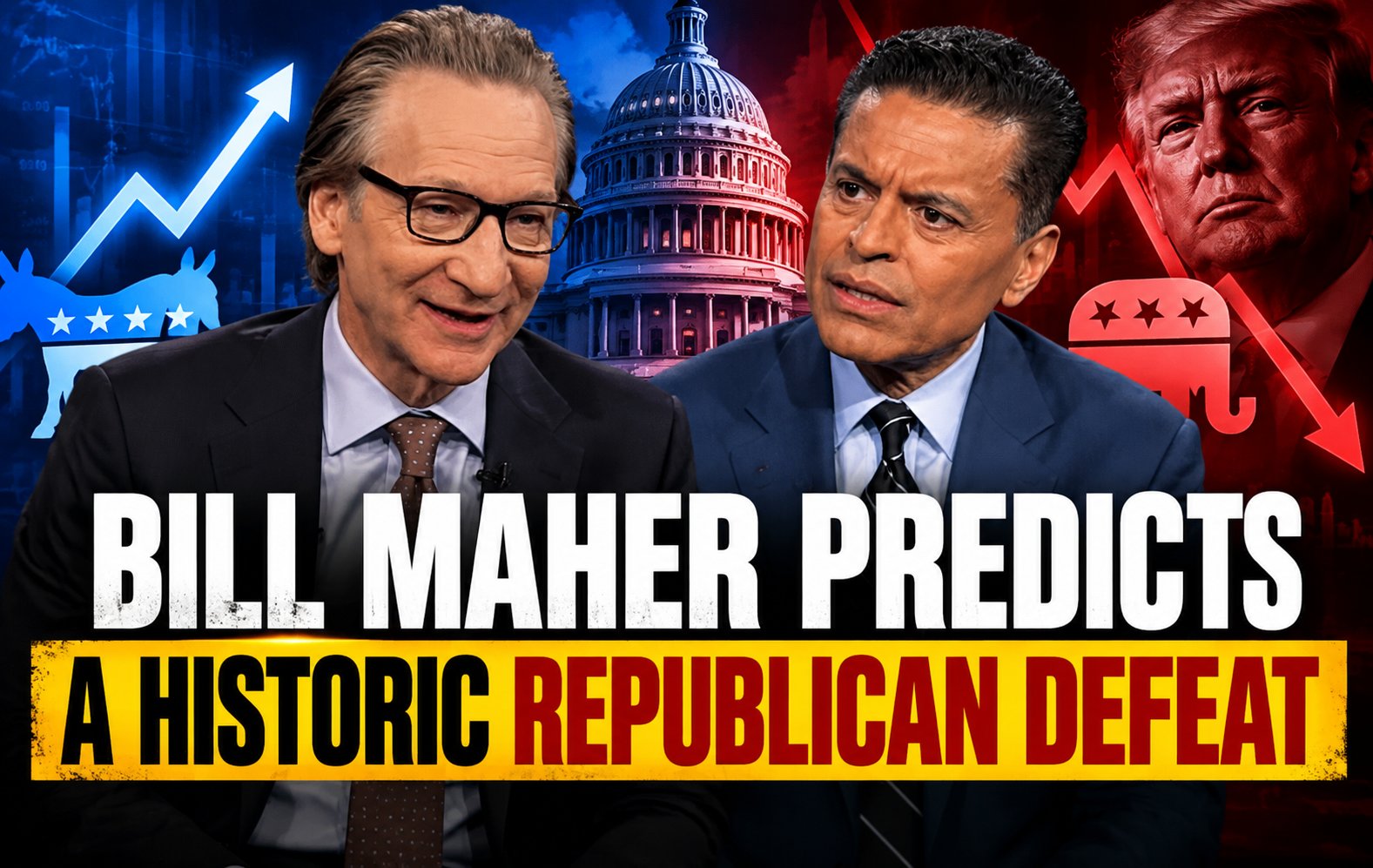
In a wide ranging CNN interview with Fareed Zakaria, the HBO host argued that Donald Trump’s political overreach, unfulfilled campaign promises, and deteriorating support among independent voters have put Republicans on a collision course with electoral disaster. But Maher also warned that Democrats could squander their advantage by misinterpreting a midterm victory as an endorsement of the party’s most divisive ideological positions.
Bill Maher believes President Donald Trump has made one of the most consequential political miscalculations of his career, transforming his return to the White House into a potential electoral catastrophe for the Republican Party. With the November midterm elections approaching, the comedian and political commentator says Trump’s aggressive governing style, failure to meet key campaign promises, and growing alienation of independent voters have created the conditions for a sweeping Democratic victory.
During a wide-ranging interview with CNN’s Fareed Zakaria, Maher delivered a blistering assessment of Trump’s second presidency, arguing that the president has mistaken his 2024 electoral victory for unlimited public approval. Maher predicted what he called a “classic historical ass whooping” for Republicans, describing the coming election as an opportunity for Americans to register their dissatisfaction with the administration. His criticism, however, was not confined to Republicans. Maher also warned that Democrats could squander their political advantage if they interpret an anti-Trump backlash as a mandate to embrace ideological positions that remain unpopular with moderate and independent voters.
Trump Won the Election, Then Mistook Victory for a Blank Check
At the center of Maher’s argument is the belief that Trump has dramatically overestimated the political mandate delivered by his 2024 victory. Although Republicans returned to power with control of the White House and Congress, Maher suggested that Trump has governed as though voters endorsed every element of his political agenda rather than a narrower set of promises involving the economy, immigration, and America’s involvement in foreign conflicts.
Maher accused Trump of getting “drunk with power,” arguing that the administration’s increasingly aggressive approach has alienated Americans who were willing to support the president but never intended to grant him unrestricted political authority. The distinction is particularly important among independent voters, who frequently determine the outcome of competitive congressional elections and whose support can shift when an administration fails to deliver the results they expected.
The HBO host pointed specifically to economic expectations and foreign policy, arguing that Trump campaigned on promises to lower living costs, reduce gasoline prices, and avoid new wars, only to pursue an agenda that has left many voters dissatisfied. For Republicans defending competitive House and Senate seats, that dissatisfaction could become especially damaging because congressional candidates depend on voters who may support one party in a presidential election while choosing the opposition in congressional races. If those voters begin treating the midterms as a referendum on Trump’s presidency, Republican candidates could find themselves defending an administration whose political liabilities extend well beyond their individual campaigns.
The Polling Shift That Has Maher Predicting a Republican Collapse
Maher referenced political analyst Nate Silver while discussing what he characterized as a substantial movement toward Democrats in the national political environment. He described a roughly 10 point shift in the party’s favor, interpreting the movement as evidence that Trump’s electoral coalition is weakening ahead of November. Although a 10 point polling swing is not necessarily equivalent to a 10 point Democratic lead, and national polling does not translate directly into congressional seats, Maher believes the broader political trajectory points toward significant Republican losses.
His argument reflects a familiar pattern in American politics. The party controlling the White House frequently struggles during midterm elections, particularly when presidential approval declines or voters become dissatisfied with economic conditions. Opposition voters become more motivated, independents reconsider their allegiances, and congressional candidates from the president’s party must decide whether their association with the White House remains politically beneficial. Maher believes that dynamic has become especially pronounced under Trump, whose personal political identity has dominated the Republican Party for more than a decade.
The stakes are substantial. Democrats need a net gain of four Senate seats to secure a majority under the current chamber alignment, while control of the House will be determined by competitive districts across the country. A favorable national political environment could improve Democratic prospects in both chambers, although the Senate’s state by state electoral map presents a more difficult challenge than the House. Maher’s prediction remains a political forecast rather than an established electoral outcome, but the movement he described suggests Republicans have reason to be concerned about the direction of the electorate.
Republicans Are Beginning to Distance Themselves From Trump
One of the interview’s most revealing themes concerned the changing relationship between Trump and Republican politicians who previously treated his endorsement as essential to their political survival. Maher argued that some Republican candidates are becoming less eager to advertise their association with the president, describing politicians who have reduced Trump’s visibility in campaign materials or removed references to his endorsements from their websites.
For years, Trump’s ability to influence Republican primaries gave him extraordinary leverage over elected officials. Candidates who challenged him risked alienating loyal Republican voters, attracting a Trump-backed primary opponent, or losing support from influential conservative activists. That political structure encouraged public displays of loyalty even when disagreements existed behind the scenes, allowing Trump to maintain considerable control over the party’s elected leadership.
Maher suggested that the calculation may now be changing as Republican candidates confront the possibility that Trump’s endorsement could become a liability in competitive general elections. The tension is particularly significant in politically divided states and districts, where candidates cannot rely exclusively on Trump’s most committed supporters. Although the president continues to command substantial influence within the Republican electorate, the possibility that candidates are becoming more selective about publicly embracing him points to a growing conflict between maintaining party loyalty and protecting their own electoral prospects.
For a president whose political power has long depended on the perception that Republican politicians cannot survive without his support, even a limited shift in that calculation could carry consequences beyond November.
Democrats Face a Different Problem: Winning the Midterms Without Losing 2028
Despite his confidence that Republicans will suffer significant losses, Maher expressed considerable skepticism about the Democratic Party’s ability to translate an anti-Trump backlash into a durable governing coalition. He warned that a Democratic victory in November could embolden ideological factions whose priorities do not necessarily reflect the views of the broader electorate, particularly if party leaders interpret Republican losses as an unconditional endorsement of progressive policies.
Maher singled out the Democratic Socialists of America and criticized positions associated with police abolition and the political debate surrounding Israel’s war in Gaza. He argued that making agreement with particular positions on those issues a test of Democratic loyalty could alienate voters who oppose Trump but remain uncomfortable with elements of the progressive left. His criticism reflects his longstanding opposition to ideological purity tests, although the positions of individual activists and socialist organizations should not be confused with the Democratic Party’s official platform. Democratic elected officials hold substantially different views on policing, economic policy, and the Israeli Palestinian conflict, and the party has not adopted police abolition as a national policy.
The larger political challenge remains significant. Americans who support Democrats as a means of restraining Trump may not automatically endorse the party’s candidates or policies in a presidential election two years later. A Democratic congressional victory could therefore produce competing interpretations within the party, with moderates viewing the result as evidence that voters want economic stability and institutional accountability while progressive activists argue that their organizing efforts and policy priorities helped mobilize the electorate.
Maher’s concern is that Democrats will mistake a rejection of Trump for approval of their entire political agenda, potentially recreating the conditions that helped Republicans regain power in 2024. His warning underscores a fundamental distinction between winning an election because voters reject the opposing party and building a governing coalition capable of maintaining power.
Maher Says ‘Wokeness’ Is Still Alive Despite Claims That the Culture Wars Have Ended
The interview also revisited one of Maher’s most persistent political targets: what he describes as the excesses of progressive cultural politics. Maher rejected the idea that the cultural movement commonly described as “wokeness” has disappeared, arguing that institutional pressure and ideological conformity remain influential forces in American workplaces and public life.
To illustrate his argument, Maher cited a reported incident involving a corporate executive who allegedly lost her position after appearing in a family photograph wearing clothing bearing the words “Lake America.” He characterized the situation as an example of disproportionate punishment over a relatively minor expression that was not necessarily intended as a political statement, questioning whether employers have become too willing to treat cultural disagreements as professional misconduct. The underlying circumstances of the employment dispute, including the employer’s stated reasons for the executive’s departure, have not been independently established here, and the incident should not be presented as proof that the photograph alone caused her dismissal.
More broadly, Maher’s criticism reflects an ongoing debate over workplace speech, political expression, and institutional accountability. Supporters of workplace inclusion policies argue that organizations have legitimate responsibilities to address discrimination and protect employees, while critics contend that those policies can become excessive when they punish ambiguous statements, harmless humor, or political disagreements. Maher believes these controversies remain politically relevant because Democrats risk alienating otherwise sympathetic voters when cultural disputes overshadow economic concerns and practical governing priorities.
Maher Says Trump Is Losing the Fear That Once Kept Republicans in Line
Beyond the immediate electoral consequences, Maher suggested that Trump’s weakening political standing could undermine the personal authority he has exercised over the Republican Party. For much of Trump’s political career, his ability to mobilize supporters and threaten primary challenges discouraged Republican lawmakers from publicly confronting him. Maher argued that this arrangement becomes less sustainable when association with the president threatens a politician’s chances of winning a general election.
In Maher’s view, political power is partly sustained by the perception that challenging a leader carries unacceptable consequences. Once candidates conclude that Trump can no longer reliably protect their careers, they may become more willing to distance themselves from his positions or challenge his decisions. That shift could weaken the culture of political deference that has characterized much of the Republican Party during Trump’s rise to power.
Zakaria raised a competing possibility during the discussion, suggesting that a president confronted with a Democratic Congress might respond by becoming even more aggressive in asserting executive authority. Electoral setbacks would not automatically eliminate Trump’s presidential powers, and even a Democratic takeover of Congress would leave him with significant authority over executive agencies, foreign policy, and federal administration, subject to constitutional and statutory limitations. Congress could nevertheless create substantial obstacles through oversight investigations, budget negotiations, and legislation, while Senate control would influence the confirmation of presidential nominees.
The broader implication of Maher’s analysis is that Trump’s greatest vulnerability may not simply be declining approval ratings, but the possibility that Republican politicians begin questioning whether his political authority remains as absolute as it once appeared.
Despite Trump’s Personal Attacks, Maher Says He Would Have Dinner With Him Again
Perhaps the most unexpected part of the conversation concerned Maher’s willingness to maintain a personal dialogue with a president he routinely criticizes. Maher previously attracted considerable attention after meeting privately with Trump, an encounter that did not prevent him from continuing to criticize the administration but demonstrated his belief that political opponents should remain willing to communicate.
During the CNN interview, Maher said Trump’s subsequent social media attacks had little effect on him, comparing the insults to being mocked by legendary comedian Don Rickles. The comparison suggested that Maher regards the president’s personal attacks as predictable political theater rather than meaningful criticism, and he indicated that he would remain open to another meeting despite their continued disagreements.
Maher also offered an observation about Trump’s personal relationships, suggesting that the president enjoys being praised but may privately have little respect for people who constantly flatter him. He argued that Trump could benefit from hearing more dissenting opinions rather than surrounding himself exclusively with supporters who reinforce his existing beliefs. His willingness to engage with the president reflects a distinction he has repeatedly drawn between communicating with political opponents and endorsing their actions, a position that has occasionally placed him at odds with critics who believe such encounters normalize Trump’s behavior.
The Midterm Backlash Is Already Reshaping the Congressional Map
Maher’s prediction comes as Democrats are expanding their electoral ambitions beyond traditional battleground districts. According to Reuters reporting published October 10, the Democratic Congressional Campaign Committee has expanded its target list to 66 Republican held House districts, including territory that strongly supported Trump in 2024. The strategy is designed partly to force Republicans to spend resources defending seats that would ordinarily be considered relatively secure, potentially stretching the party’s financial and organizational resources across a wider electoral battlefield.
The political environment has also become increasingly competitive in several Senate contests, where Democrats are attempting to capitalize on voter dissatisfaction over living costs, tariffs, and foreign policy. Republicans retain important financial advantages and opportunities to mobilize Trump’s loyal supporters, but recent reporting suggests that Democrats have become more competitive in races that could determine control of the chamber.
An October 8 Washington Post analysis described a national Democratic polling advantage of approximately eight points, although Republican strategists continue to question whether surveys are accurately measuring participation among Trump’s supporters. Reuters separately reported that Democratic gains of approximately 15 to 20 House seats appeared plausible, while cautioning that a historic landslide remained far from certain. Those assessments highlight the difference between Maher’s confidence in a sweeping Republican defeat and the more cautious projections of election analysts, who must account for district-level conditions, turnout patterns, campaign spending, and the possibility that polling may shift before Election Day.
The distinction does not invalidate Maher’s broader argument that Republicans face serious electoral danger. It does, however, demonstrate why a favorable national political environment cannot automatically be interpreted as a guarantee of congressional control, particularly in the Senate, where a relatively small number of closely contested state races will determine the outcome.
Is Trump Beginning to Lose His Political Grip on America?
Maher’s interview ultimately raised a question extending beyond the November election: whether Trump’s political dominance has begun to weaken in ways that could reshape the Republican Party. Trump has repeatedly survived controversies, criminal proceedings, political defeats, and predictions that his influence was nearing an end. His return to the presidency demonstrated the extraordinary resilience of his political coalition and the willingness of Republican voters to remain loyal despite years of intense controversy.
The 2026 midterms, however, present a different political test. Trump himself is not on the ballot, and Republican candidates must persuade voters to support his party without the president’s personal appeal necessarily generating the same turnout as a presidential election. If Democrats capture Congress, the result could sharply constrain Trump’s remaining legislative ambitions, embolden Republican officials who have grown uncomfortable with his leadership, and accelerate internal debates over the party’s direction after he leaves office. Conversely, if Republicans outperform current expectations, Trump could argue that his political influence remains stronger than his critics acknowledge, reinforcing his position within the party.
For Democrats, the challenge is equally consequential. A midterm victory would provide new opportunities to investigate the administration, shape federal spending, and contest Trump’s policies, but winning an election driven by public dissatisfaction is not the same as establishing a sustainable political majority. Maher believes Trump has created the conditions for a major Republican defeat, yet he remains unconvinced that Democrats have resolved the ideological divisions that could jeopardize their next presidential campaign.
With Election Day approaching on November 3, the question is whether the backlash against Trump’s administration has become powerful enough to overcome Republican advantages in campaign spending, incumbency, and the electoral map. Maher is convinced the president has overplayed his hand, alienated critical voters, and placed his own party in an increasingly dangerous position. Whether that produces an ordinary midterm correction or the historic Republican defeat Maher envisions will ultimately be decided by voters.

Sources and Further Reading
CNN — Fareed Zakaria GPS (October 4, 2026): Full Interview Transcript Featuring Bill Maher. Primary source for Maher’s comments about Trump, Republican midterm prospects, Democratic politics, and political polarization.
CNN / YouTube — Bill Maher Interview: Bill Maher and Fareed Talk Trump, Wokeness, Midterms & More. Original video interview containing Maher’s remarks and predictions.
Reuters — October 10, 2026: The Midterm Strategy Driving Democrats Deep Into Trump Country. Reporting on Democrats expanding their target list to 66 Republican-held House districts.
Reuters — October 8, 2026: Are Democrats Too Confident About U.S. Midterms?. Analysis of Democratic prospects, potential House gains, and the risks of predicting a landslide.
The Washington Post — October 8, 2026: GOP Hope, Democratic Worry: Are Midterm Polls Underestimating Republicans?. Examination of Democrats’ national polling advantage and the possibility of polling errors.
Axios — October 9, 2026: Cook Political Report Tilts 18 House Races Toward Democrats. Independent electoral ratings showing growing Democratic momentum in competitive congressional districts.
CBS News — October 4, 2026: Battleground Tracker Poll Finds Democrats Maintain House Advantage Amid Concern About Prices. National polling analysis of voter dissatisfaction, turnout expectations, and congressional control.







































Want to join the conversation?
Create an account or sign in to share your thoughts, vote,
and reply to other readers.
Showing 0 of 0 comments
Don't have an account?
Already have an account?