
Byron Donalds Defends Scrubbing Trump From Campaign Website as Florida Governor’s Race Turns to the General Election
FORT LAUDERDALE — Republican gubernatorial nominee Byron Donalds came to Broward County Wednesday facing a question that followed him straight onto the stage: Why did a candidate who spent much of his campaign prominently advertising President Donald Trump’s endorsement suddenly remove much of that Trump branding from his campaign website?
Donalds’ answer was that the overhaul had been planned for months and was designed to shift the website toward Florida specific policy proposals for the general election. The timing, however, has attracted scrutiny because the redesign removed several of the campaign’s most prominent references to Trump just as the president’s national approval rating has fallen sharply and Republicans prepare for the November midterms. Reuters reported this week that Trump’s approval had fallen to 32% among U.S. adults surveyed, the lowest measurement of his political career in that poll.
The issue dominated part of Donalds’ appearance at WLRN’s Sunshine Economy Summit in Fort Lauderdale, where Donalds and Democratic nominee David Jolly participated in separate 30 minute interviews with WLRN CEO Tom Hudson. The forum was not a debate, and the candidates currently have no head to head debate scheduled before the Nov. 3 election. WLRN reported that if none occurs, it would be the first Florida gubernatorial election in 50 years without one.
What Actually Disappeared From Donalds’ Website
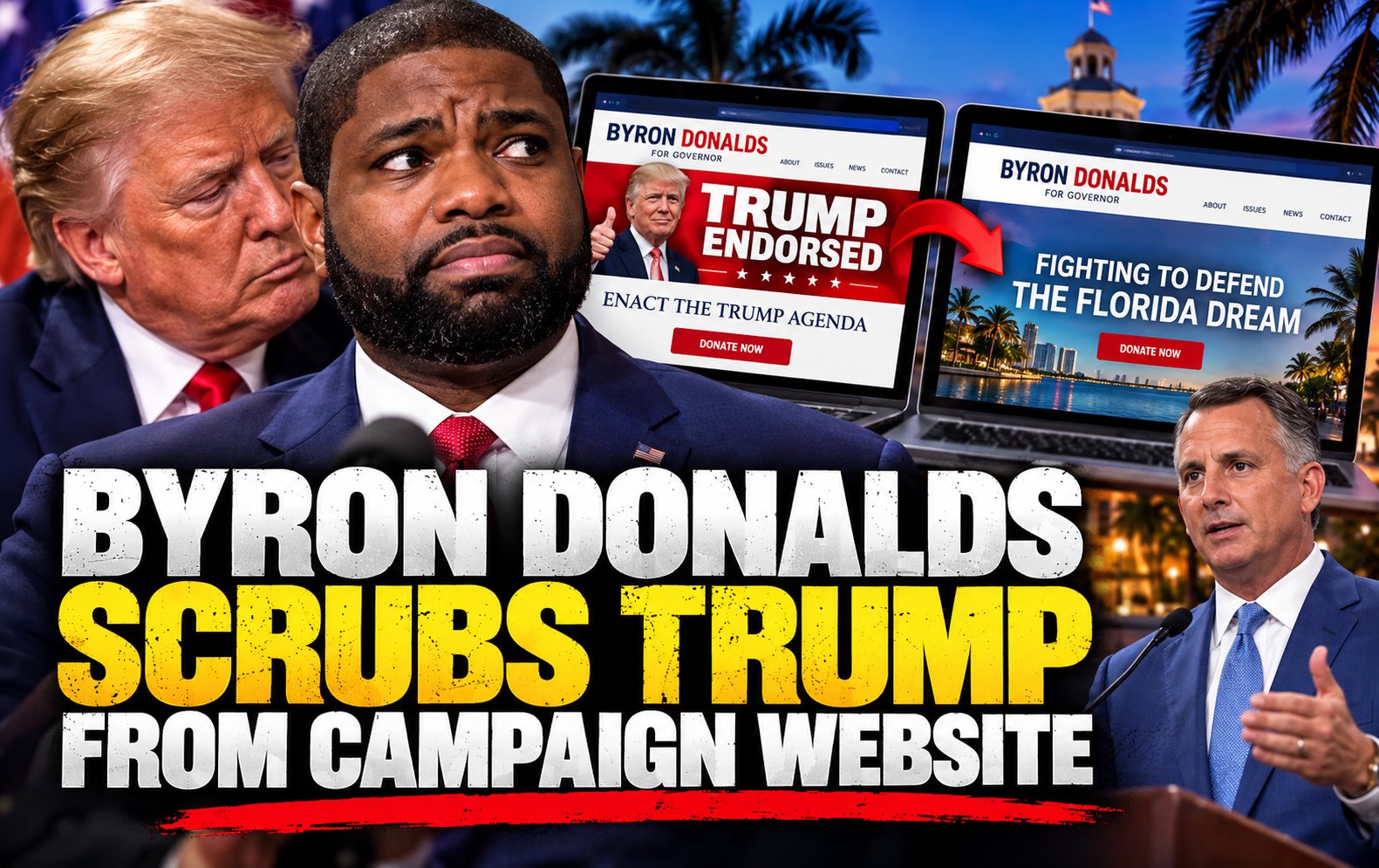
The changes were substantial enough to draw coverage from multiple Florida and national news organizations. Before the redesign, Donalds’ homepage repeatedly emphasized his relationship with Trump. Archived versions of the website showed a fundraising button urging visitors to support “Trump Endorsed Byron Donalds,” described Donalds as a “TRUMP ENDORSED Proven Conservative Fighter,” displayed an “ENDORSED BY PRESIDENT TRUMP!” banner and showcased Trump’s “RUN, BYRON, RUN!” endorsement.
The campaign also displayed a photograph of Donalds and his wife, Erika, with Trump. On Donalds’ issues page, “Enact the Trump Agenda” had been presented as his first major priority. Those elements disappeared from their prominent positions when the redesigned site went live.
Trump has not disappeared completely. Donalds’ current endorsement page still identifies Trump as an endorser, and his biography continues to describe him as a Trump-endorsed candidate and references his role as a Trump campaign surrogate. That distinction matters, describing the website as having erased every reference to Trump would be inaccurate. What changed was the prominence of Trump throughout the campaign’s principal messaging and the removal of “Enact the Trump Agenda” as the campaign’s lead issue.
Donalds Says Website Overhaul Had Been Planned for Two Months
Hudson confronted Donalds directly about the change Wednesday, noting that the campaign’s former top issue had been enacting Trump’s agenda and asking why the website now emphasized an “accountable, achievable, affordable” Florida.
“We have been working on website changes for, like, two months now,” Donalds said.
Donalds said the new website reflects themes he has discussed at campaign events for months and argued that a general election website should focus more heavily on the policies he would pursue as governor.
“I think in light of, obviously, for the general election, the voters of Florida wanna know the policies you’re going to implement to make their lives better,” Donalds said.
Donalds separately maintained that he remains proud of Trump’s endorsement and directed voters toward the campaign’s expanded policy pages.
Hudson Presses Donalds: Do You Still Want to Enact the Trump Agenda?
Hudson followed with the question at the center of the controversy: Did removing “Enact the Trump Agenda” mean Donalds no longer intended to enact it?
Donalds initially called it a “separate question” before Hudson reminded him that the phrase had appeared on his campaign website until the previous day. Donalds then defended elements of Trump’s agenda, describing it in terms of law and order, border security, economic growth and cooperation between Florida and the federal government on immigration enforcement.
The exchange highlighted a tension Donalds is navigating in the general election. His campaign has not repudiated Trump, and Donalds continues to defend major Trump policies. But the visual and rhetorical emphasis of his website has unmistakably shifted from a primary campaign heavily centered on Trump’s endorsement toward a general election presentation centered on affordability, health care, housing, education, economic development, law enforcement, space and technology.
Donalds’ current homepage now leads with “Fighting to defend the Florida dream” and directs visitors toward his Florida policy proposals rather than making Trump’s endorsement the dominant message.
The Political Environment Has Changed
The website controversy is unfolding in a markedly different national political environment from the one in which Donalds built his primary campaign around Trump’s support. A Reuters/Ipsos poll conducted in September put Trump’s approval rating at 32%, with 17% approving of his handling of the cost of living and 34% approving of his handling of the Iran conflict. Trump remained substantially more popular among Republicans, with 73% approval within his party, illustrating why association with the president can carry different political implications in a Republican primary than among the broader electorate.
Donalds has rejected the suggestion that Trump has become a political liability and continues to defend the president’s economic, immigration and trade policies.
Whether Donalds’ website redesign represents political repositioning is ultimately an interpretation rather than an established fact. The documented record is narrower but significant: Trump occupied substantially more prominent space on Donalds’ website before the redesign; much of that material was removed after the primary; Donalds says the redesign had been planned for approximately two months; and he continues to publicly support Trump and significant components of his agenda.
Donalds Gets Pressed on Why He Wants to Be Governor
The website controversy was only part of a broader interview that tested Donalds on what he would actually do in Tallahassee. Hudson began with a fundamental question for any gubernatorial candidate: After serving in both the Florida Legislature and Congress, why does Donalds want to become governor? Donalds said his mission is to keep Florida economically competitive while confronting insurance costs, housing affordability and the difficulty younger Floridians face establishing careers and buying homes. He also argued that Florida’s population growth demonstrates the success of the state’s policies, saying more Americans were moving to Florida “than any other state in the country.”
WLRN and PolitiFact subsequently checked that claim and reported that Florida is now second to Texas in net domestic migration, with the state’s migration boom slowing substantially from its 2022 peak. Broward and Miami-Dade were among the large metropolitan counties experiencing population losses.
Interview Shifts From Florida to Trump’s Federal Policies
Hudson then used Donalds’ former pledge to “Enact the Trump Agenda” to test what that commitment meant in practice. On tariffs, Donalds defended Trump’s use of them as leverage to renegotiate international trade agreements, arguing that economic pressure is sometimes necessary to obtain better terms for American workers and businesses.
The discussion then moved to federal tax policy. Donalds argued that Trump backed tax changes had allowed Floridians to keep more of their income and pointed to larger tax refunds. Hudson noted that Florida does not impose a state individual income tax, prompting a testy exchange in which Donalds responded, “Come on. Don’t be cute,” before emphasizing that Floridians still pay federal income taxes.
There was substance behind part of Donalds’ tax argument, although the explanation requires context. WLRN and PolitiFact found that average federal refunds increased significantly in 2026, with the average direct-deposit refund rising from $3,034 in 2025 to $3,273 this year. Their fact check also noted that unusually high refunds were partly connected to payroll withholding tables that had not immediately adjusted after the 2025 tax law, meaning a larger refund does not necessarily represent an equivalent permanent reduction in an individual taxpayer’s ultimate liability.
Immigration Produces Another Tense Exchange
Hudson also pressed Donalds about immigration enforcement and its economic consequences for Florida industries dependent on immigrant labor. Donalds said Florida would continue cooperating with the federal government and argued for an immigration system based on legal immigration, assimilation and consistent enforcement. Hudson then raised comments from Republican Rep. María Elvira Salazar, who has said some of Trump’s immigration enforcement actions went too far. Donalds disagreed.
As Hudson continued questioning him about federal immigration policy, Donalds pushed back on the direction of the interview and asked when they would discuss insurance and housing. Hudson responded that Donalds himself had previously identified “Enact the Trump Agenda” as his campaign’s top issue and that questions about that agenda were therefore relevant.
The exchange demonstrated a practical consequence of Donalds’ earlier campaign branding: after spending the primary explicitly tying his candidacy to Trump’s national agenda, he was being asked to explain individual components of that agenda while simultaneously attempting to redirect the conversation toward Florida specific issues.
Donalds Lays Out His Florida Affordability Agenda
Once the interview moved squarely onto state policy, Donalds provided considerably more detail. On housing, he argued that Florida should accelerate and modernize local permitting and proposed a statewide technology platform that local governments could use to streamline approvals, with the state covering subscription costs. His argument is that delays in permitting increase developers’ costs, which are ultimately reflected in housing prices.
On property insurance, Donalds proposed eliminating what he described as an unnecessary surcharge associated with the Florida Hurricane Catastrophe Fund. He argued that because the fund has accumulated more than $12 billion, savings from eliminating the charge should be passed to policyholders.
Donalds also rejected Jolly’s proposal to tax certain insurance companies benefiting from state support. Instead, Donalds said the Office of Insurance Regulation should more aggressively oversee carriers and ensure premiums are being used appropriately to cover claims. When Hudson asked whether Donalds would restrict money flowing from insurers to affiliated companies, Donalds answered that he was “not in a restricting mode,” instead emphasizing regulation and transparency.
Property Taxes and Amendment 3
Donalds also endorsed Amendment 3, which would significantly expand Florida’s homestead property tax exemption and reduce the annual assessment cap for non-homestead properties. Under the proposal, the homestead exemption would increase from $50,000 to $150,000 in 2027 and then to $250,000 in 2028, while the annual assessment cap for non-homestead property would fall from 10% to 5%. The constitutional amendment requires 60% voter approval.
Local governments have raised concerns about the potential effect on their revenue and services. Donalds argued that local governments had benefited from rapidly increasing property values without sufficiently reducing tax rates, saying statewide property-tax collections had climbed from approximately $32 billion to $53 billion over six or seven years.
When Hudson asked whether a Donalds administration would regulate local property taxes directly, however, Donalds stopped short of endorsing that approach. He said he would instead have the Taxation and Budget Reform Commission examine alternatives while working with local governments on how they raise revenue.
Donalds Defines How He Would Differ From DeSantis
Near the end of the discussion, Hudson asked Donalds how his administration would differ from eight years under Republican Gov. Ron DeSantis. Donalds said there would be continuity on conservative constitutional philosophy and law enforcement while identifying housing affordability and workforce training as areas where his administration would concentrate additional attention.
His current campaign website reflects that broader platform, including proposals addressing affordability, health care price transparency, business regulation, education and workforce development, law enforcement, and Florida’s space and technology industries.
That policy material complicates any characterization that Donalds presented “no ideas” at the summit. He did identify specific proposals, particularly on permitting, property insurance and Amendment 3. A more supportable criticism is that several moments of the interview exposed unresolved questions about implementation, including how Florida communities would absorb revenue reductions associated with property-tax changes and precisely how Donalds’ proposed insurance oversight would operate without the restrictions Hudson asked about.
Two Candidates, Two Very Different Presentations
The Fort Lauderdale appearances also offered voters an unusual opportunity to observe the two major party nominees answering questions in the same setting, even though they did not appear together.
Jolly used his appearance to discuss his own proposals, including a state-backed disaster insurance plan, while opposing Amendment 3 and arguing that the property-tax proposal could threaten funding for local services. Donalds used his session to defend his affordability agenda, property tax proposals and approach to insurance while repeatedly facing questions about the Trump agenda that had occupied such a prominent position in his campaign until the website redesign.
For South Florida Media the contrast was notable.
“Watching the two candidates under sustained questioning, my impression was that Jolly looked more comfortable with the moment while Donald’s appeared increasingly defensive when his previous Trump centered campaign messaging was put directly in front of him. The general election is applying a different kind of pressure, and voters are now getting a much clearer look at how both candidates respond to it.” – Patrick Zarrelli
That assessment is my personal commentary, but the underlying exchanges are part of the public record. Donalds challenged the direction of Hudson’s questioning at several points, including asking when the interview would move away from federal policy and toward insurance and housing. Hudson responded by pointing directly to Donalds’ own campaign platform, which had listed enacting Trump’s agenda as its top priority until the website was changed.
The Website Question Isn’t Going Away
Donalds’ explanation for the Trump website changes is straightforward: the campaign says it spent roughly two months preparing a general election redesign focused on Florida policy and that the candidate remains supportive of Trump.
The chronology is equally straightforward. Donalds spent the Republican primary prominently marketing himself as Trump endorsed and placed “Enact the Trump Agenda” at the front of his policy platform. After securing the nomination, the campaign removed much of that material from its most prominent locations and replaced it with a Florida centered general election message. Trump remains elsewhere on the website, and Donalds continues to defend the president publicly.
Those facts allow voters to decide whether the redesign is simply the routine transition Donalds describes or a strategic change in emphasis as he campaigns before a broader electorate at a moment when Trump’s national polling has deteriorated. For Donalds, Wednesday’s appearance in Broward County demonstrated another consequence of that shift: removing Trump’s name from the top of a campaign website does not remove questions about the political alliance that helped define his candidacy.

Sources & Further Reading
WPLG Local 10 — Byron Donalds Explains Why He Removed Donald Trump References From Campaign Website
WLRN/PolitiFact — Fact-Checking Byron Donalds and David Jolly at the Sunshine Economy Summit
WLRN — Byron Donalds on Florida Affordability and Amendment 3
WLRN — David Jolly’s Disaster Insurance Proposal and Amendment 3 Position
WLRN — Sunshine Economy Summit
WPLG Local 10 — Video: Donalds Explains Trump Website Changes
Reuters — Trump Approval Falls to 32% as High Costs Weigh on Public Support
































Want to join the conversation?
Create an account or sign in to share your thoughts, vote,
and reply to other readers.
Showing 0 of 0 comments
Don't have an account?
Already have an account?