
Their Policies, Controversies, Campaign Money and Who Is Expected to Win
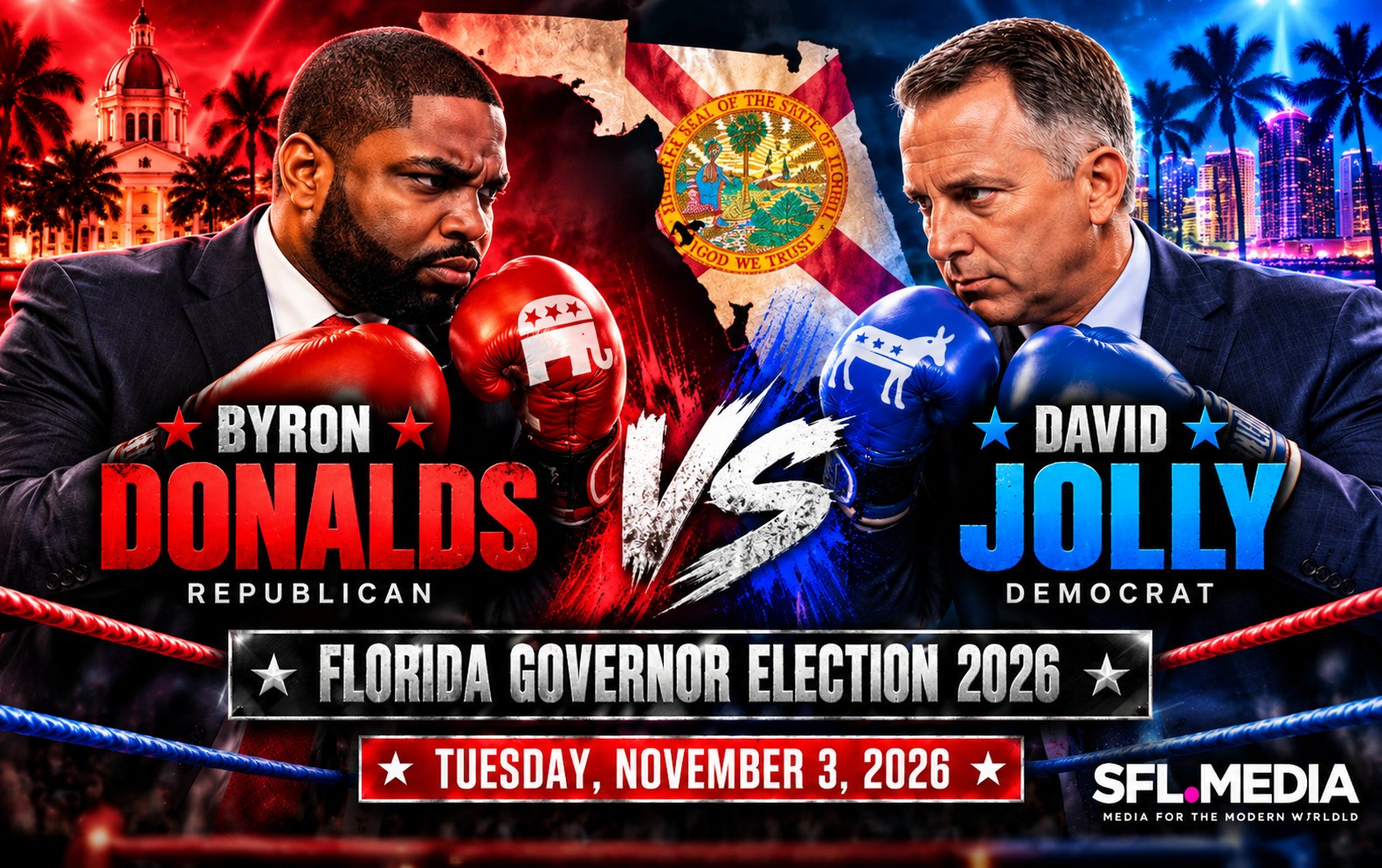
Florida’s next gubernatorial election is shaping up to be one of the state’s most closely watched political contests in years. Republican U.S. Rep. Byron Donalds and former Republican congressman turned Democrat David Jolly are competing to replace term limited Gov. Ron DeSantis, with both candidates offering sharply different visions for the state’s future. Donalds has the backing of President Donald Trump and a massive fundraising advantage, while Jolly is attempting to capitalize on voter frustration over affordability, insurance costs and the direction of state and national Republican leadership.
The election is scheduled for Tuesday, November 3rd, 2026, and the latest polling suggests that, despite Donalds’ financial advantage and Florida’s Republican leaning political environment, the contest is more competitive than some Republicans would prefer. Donalds remains the favorite in several polling averages, but recent surveys have shown a dead heat. Meanwhile, the financial gap between the candidates is enormous, raising an obvious question. Can Jolly overcome the Republican advantage in campaign spending, party registration and statewide political infrastructure?
Meet the Candidates: Republican Byron Donalds

Donalds is a U.S. representative from Southwest Florida, a prominent conservative aligned with Trump and a longtime supporter of the Republican Party’s current direction. He is campaigning on affordability, lower taxes, immigration enforcement, conservative education policies and economic growth. He has also received endorsements from Trump and DeSantis.
Meet the Candidates: Democrat David Jolly

Byron Donalds: Background, Experience and Political Record
Byron Donalds was born and raised in Brooklyn, New York, and grew up in a single parent household. His campaign biography emphasizes the sacrifices his mother made to give him opportunities and describes his political outlook as rooted in personal responsibility, economic opportunity and the American Dream. Before entering politics, Donalds worked in the financial services industry and later became involved in Florida Republican politics. He was elected to the Florida House of Representatives in 2016 and won a seat in the U.S. House of Representatives in 2020, taking office in January 2021. He represents Florida’s 19th Congressional District, which includes parts of Southwest Florida.
Donalds became a nationally recognized Republican figure during the 2023 House speaker election, when he received votes as a candidate for speaker. He subsequently became one of the more visible conservative members of Congress and a vocal supporter of Trump’s political agenda. His gubernatorial campaign benefits from that national profile, along with support from influential Republicans and a donor network capable of funding an enormous statewide advertising operation. Trump and DeSantis have both endorsed him, giving Donalds an advantage in a Republican primary electorate and a ready-made political brand for the general election.
Donalds’ supporters see his background as evidence that he understands the importance of economic opportunity, limited government and conservative principles. His critics, however, argue that his close alignment with Trump makes him an extension of the same political movement that has dominated Florida government under DeSantis. That distinction is central to this election: voters who want continuity with Florida’s current Republican leadership have an obvious choice in Donalds, while voters looking for a change in direction are likely to examine Jolly.
What Donalds Promises to do as Governor
Donalds has branded his agenda around making Florida more affordable, growing the economy and maintaining conservative control of state government. His campaign’s official platform covers several major policy areas. The important distinction is between what he has promised, what he has proposed as a specific policy and what a governor can realistically accomplish without legislative approval.
Property taxes and affordability: One of Donalds’ most consequential proposals is the goal of repealing homestead property taxes. His argument is that homeowners should not have to continue paying the government simply to keep property they already own. That message could resonate with Florida homeowners facing rising housing costs, insurance premiums and property tax bills. However, repealing homestead property taxes would require a workable replacement for the revenue supporting local government services. Florida’s counties, cities and school districts rely on property taxes to fund essential services, so eliminating that revenue would create a substantial fiscal challenge. A campaign promise to repeal a tax is not the same thing as a fully implemented replacement plan.
Health care: Donalds is promoting a proposal called “Your Doctor, Your Price,” which would require licensed medical providers to publish cash prices for their 50 most common services. The goal is to give patients more information before receiving treatment and encourage price competition. Greater price transparency could help patients compare costs, particularly for routine services. The limitation is that publishing prices alone does not guarantee affordable care, lower prescription costs or reasonable insurance premiums. The proposal would address one part of the health care cost problem rather than the entire system.
Immigration and public safety: Donalds supports stronger immigration enforcement, cooperation between state and local authorities and federal immigration agencies, and restrictions on taxpayer funding for entities that refuse to certify cooperation with federal enforcement. His campaign has promoted a proposal called “Zero Tolerance, Zero Dollars.” He also promises support for law enforcement and stronger efforts to combat deadly drugs. Supporters view this as a straightforward public-safety agenda. Critics could question the costs, legal implications and practical consequences of tying public funding to immigration enforcement requirements.
Education and conservative values: Donalds emphasizes reading proficiency by third grade, healthier school meals, school safety and pathways to jobs that do not require students to accumulate large amounts of debt. His platform also promotes conservative cultural priorities. Supporters argue that these priorities reinforce parental involvement, educational standards and accountability. Critics may question whether the emphasis on ideological battles does enough to address teacher recruitment, school funding, classroom performance and the needs of students who require additional support. The details of funding and implementation will matter more than the slogans.
Business, infrastructure and technology: Donalds wants fewer bureaucratic delays for businesses, more predictable permitting, improved roads and power infrastructure, and expanded aerospace and technology investment. He has specifically highlighted Florida’s potential to attract NASA related activity, launch infrastructure and high paying jobs. His campaign also proposes greater transparency in government spending and regular forensic audits of state and local government. These proposals could appeal to businesses and taxpayers frustrated with regulation or unclear spending practices. Their success would depend on execution, budget priorities and whether the promised economic benefits materialize.
The environment: Despite his conservative positioning, Donalds says Florida should protect its natural springs, beaches and the Everglades. That is politically important in a state where clean water, tourism, fishing and coastal property are economically significant. His campaign’s environmental message focuses on conservation and protecting Florida’s natural resources rather than embracing the broader climate policy agenda associated with many Democrats. The key question for voters will be how his administration balances development, energy demand, water quality and long-term environmental risks.
The Positives and Negatives of Donalds’ Candidacy
Donalds’ clearest strengths are his political experience, strong Republican support, national name recognition and access to campaign money. He has a defined policy agenda and a direct connection to the Republican base. His proposals on permitting, price transparency, government audits and property taxes also address issues that matter to many Floridians beyond ideological debates.
The risks are equally important. Some of his largest promises, particularly property tax repeal, involve major questions about funding and implementation. His close identification with Trump could help mobilize Republican voters but could also make him vulnerable among independents and voters unhappy with the national administration. And his record in Congress, including questions raised about his financial disclosures, has created a line of attack for his opponents.
David Jolly: Background, Experience and Political Evolution
David Jolly is also a former congressman, but his political path has been considerably less conventional. He is a fifth generation Floridian, the son of a minister, an attorney and a former Republican representative who served in Congress from 2014 to 2017. He entered Congress after winning a special election in Florida’s 13th Congressional District. During his time as a Republican, he developed a reputation for occasionally breaking with his party and for criticizing Trump’s rise in national politics. Jolly called on Trump to withdraw from the 2016 presidential race and lost his own reelection bid that year. He left the Republican Party in 2018 and later became a Democrat.
Jolly has acknowledged that his views evolved on issues including abortion and guns. He has described his earlier opposition to abortion in terms he now regards as mistaken and has said his former political identity did not fully reflect his views on marriage equality, climate science and gun regulation. For voters who prioritize ideological consistency, these shifts may raise concerns. For voters who believe politicians should reconsider their positions, they may be a selling point.
Jolly is running with Gwen Graham, a former Democratic congresswoman and former Florida education official, as his running mate. His campaign is trying to build a coalition of Democrats, independents, moderate Republicans and voters who are dissatisfied with the current direction of state government. That is an ambitious strategy in a state where Republicans have held the governor’s office since 2011.
What Jolly Promises to do as Governor
Homeowners’ insurance: Jolly has made Florida’s property insurance crisis one of the central issues of his campaign. He argues that homeowners are paying excessive premiums and that the state needs a more effective approach to insurance regulation, market stability and consumer protection. His campaign advertises a plan intended to reduce homeowners’ insurance costs by 60% to 70%. That is a substantial target, not a guaranteed outcome. Premiums depend on storm losses, reinsurance costs, litigation, construction expenses, insurer participation and other factors beyond a governor’s direct control. Voters should examine the plan’s proposed mechanisms and independent cost estimates before treating the promised reduction as a likely result.
Health care: Jolly has emphasized expanding access to primary care and addressing the financial pressures that keep Floridians from getting medical treatment. His broader argument is that health care should be treated as a household affordability issue, not simply as a political or ideological dispute. The practical questions are how an administration would fund expanded services, improve access in underserved communities and reduce costs without creating other budget pressures.
Public schools: Jolly supports investment in community public schools and has made education a central part of his pitch to families. He argues that Florida should prioritize the quality and accessibility of public education. His approach differs from Donalds’ emphasis on conservative education priorities and alternative pathways to careers. The debate will involve not only school choice versus traditional public schools, but also how much money is available, how it is distributed and whether the policies produce better student outcomes.
Abortion and personal freedoms: Jolly’s current Democratic platform places greater emphasis on protecting individual rights and opposing the culture war approach to governing. His changed position on abortion is part of that shift. For voters who oppose Florida’s current abortion restrictions, his candidacy offers a clear alternative. For socially conservative voters, his evolution could be a reason to reject him. Any changes to Florida abortion law would still depend on the legal framework, the state Legislature and applicable constitutional protections.
Moving beyond partisan conflict: Jolly’s campaign argues that state government has devoted too much attention to ideological battles while households struggle with housing, insurance and health care. His promise is to focus on those everyday costs and govern across traditional party lines. That message could appeal to voters tired of political confrontation. The counterargument is that Jolly would face a Republican-controlled political environment and would need legislative support to enact much of his agenda. A governor cannot simply bypass the Legislature because a campaign promises a less partisan style of leadership.
The Positives and Negatives of Jolly’s Candidacy
Jolly’s greatest strength is that he has a clear political opening: affordability. Homeowners’ insurance, housing expenses and health care costs are issues that affect Republicans, Democrats and independents alike. His congressional experience means he is not a political newcomer, and his willingness to criticize his former party gives him a potential path toward voters who would not ordinarily consider a Democrat.
His weaknesses include the challenge of winning statewide in a state that has recently leaned Republican, his history of changing party affiliation and the gap between some of his campaign targets and what a governor can guarantee. His proposed 60% to 70% insurance reduction is an especially important example. It is a promise that should be judged against the actual policy mechanisms and realistic market conditions, not simply repeated as if the savings were already in the bank.
Jolly also has a major practical problem: money. His campaign has raised a fraction of what Donalds and his affiliated political committee have collected. Without a substantial increase in fundraising, effective advertising and strong voter turnout, Jolly could struggle to translate a competitive polling position into an election victory.
The Controversies: What the Voters Should Know
Neither candidate enters the race without political baggage. The important distinction is between documented events, allegations, campaign attacks and unresolved questions. Those are not interchangeable, despite the best efforts of political advertising departments everywhere.
Byron Donalds: Financial Disclosure Questions
One of the most significant recent controversies involving Donalds concerns his federal financial disclosures. On October 5th, 2026, Florida Bulldog reported that Donalds had amended financial disclosure forms to address previously omitted assets and liabilities involving him and his wife, Erika Donalds. The report said the inaccuracies dated back to his initial disclosure as a House candidate in 2020. His campaign responded that Donalds was committed to disclosure and, like other members of Congress, voluntarily updates his filings to maintain compliance.
A separate issue arose in September 2024, when the nonpartisan Campaign Legal Center filed an ethics complaint alleging that Donalds had failed to properly report more than 100 stock transactions made by him and his wife during 2022 and 2023. The transactions were reportedly valued at up to $1.6 million. Federal law requires members of Congress to report certain securities transactions within a specified period. The complaint alleged violations of the STOCK Act, but the filing of a complaint does not establish that a violation occurred. The publicly available reporting cited here does not establish a final finding of wrongdoing in that matter.
These disclosures deserve scrutiny because financial transparency is especially important when a politician seeks executive power over a state with a multibillion dollar budget. Voters are entitled to ask whether a candidate’s financial reporting is complete and whether potential conflicts of interest have been adequately addressed. At the same time, it would be inaccurate to describe the allegations as proof that Donalds engaged in insider trading or committed a crime. The distinction matters, regardless of party.
Donalds’ Political Alignment with Trump
Donalds’ relationship with Trump is both a political asset and a potential liability. Trump endorsed him, and Donalds has consistently supported the president’s political agenda. For Republican voters who want Florida to continue in that direction, the relationship is a major advantage.
For voters who are unhappy with Trump’s policies, however, Donalds’ close association with the president creates an easy line of criticism. His opponents can connect him to the administration’s national record on the economy, immigration and other issues. Donalds, in turn, can argue that alignment with the president will help Florida attract investment and advance conservative priorities. The political question is whether Trump’s endorsement brings more votes than it costs. That answer may vary significantly among Republican voters, independents and suburban voters.
David Jolly: The Party Switch and Changing Positions
Jolly’s biggest vulnerability is his political evolution. He entered Congress as a Republican, criticized Trump, left the Republican Party and eventually became a Democrat. He has also acknowledged changing his views on abortion and guns. Republicans have seized on those changes to argue that Jolly is inconsistent. Their argument is straightforward: if a candidate has changed positions on major issues, voters should question whether his current platform represents deeply held convictions or the political requirements of a gubernatorial campaign.
Jolly’s response is that political growth is legitimate and that he changed because he no longer believed the Republican Party represented his values. Voters must decide whether his evolution reflects principle, political calculation or some combination of the two.
His past professional work has also attracted scrutiny. Reporting by the Tampa Bay Times examined his lobbying and consulting work, including his business relationships and fees earned from clients. Jolly has defended aspects of that record, including explaining that some fees covered work performed by his firm rather than personal income. The reporting raises questions voters can reasonably consider, but the existence of a business relationship is not, by itself, proof of misconduct.
Jolly’s challenge is to convince voters that his current positions are credible and that he can govern effectively, rather than simply serving as the Democratic alternative to Trump and DeSantis.
Who Has Raised More Money?
The campaign finance figures reported through October 9th, 2026
Byron Donalds has raised $146.2M
David Jolly has raised $21.4M
Donalds has raised approximately 6.8 times as much money as Jolly under these reported totals.
The money gap is one of the defining features of this election. The reported $146.2 million for Donalds includes approximately $15.8 million raised by his campaign and $130.4 million by Friends of Byron Donalds PAC, a political committee associated with his campaign. Jolly’s reported $21.4 million includes about $11.1 million for his campaign and $10.3 million for the affiliated Florida 2026 committee. Both totals include state matching funds, so they should not be confused with purely private donations. The figures are also not simply cash remaining in either candidate’s bank account.
So why does the difference matter? A campaign with substantial financial resources can purchase more television advertising, digital ads, mailers and other voter outreach. It can also respond rapidly to attacks, target specific voter groups and maintain a presence across a state as large as Florida.
But money does not automatically win elections. Jolly has demonstrated that he can compete in at least some polling despite his financial disadvantage. If he can sustain his message on insurance costs and household affordability, he may be able to make the race more competitive than the fundraising totals suggest.
The next important question is whether Jolly can attract additional support from national Democratic organizations. Recent reporting indicates that he has publicly pressed national Democrats for more financial assistance. That request itself reflects the challenge facing his campaign: he needs more resources to compete with Donalds’ advertising operation.
Who is Leading in the Polls?
The polling picture is more complicated than a single headline suggests. Some surveys show Donalds with a comfortable lead, while others show a statistical tie.
Selected recent polls available as of October 20, 2026
| Poll and field dates | Donalds | Jolly | Result |
|---|---|---|---|
| Change Research, Oct. 8–10 | 47% | 47% | Tie |
| St. Pete Polls, Oct. 5–7 | 45% | 45% | Tie |
| MDW Communications, Oct. 4–10 | 46% | 44% | Donalds +2 |
| Targoz Market Research, Sept. 28–Oct. 4 | 52% | 42% | Donalds +10 |
| Fabrizio, Lee & Associates, Oct. 8–11 | 46% | 39% | Donalds +7 |
Sources: On Point Politics polling tracker, The Florida Press polling guide and Florida governor poll results.
The surveys should not be treated as interchangeable. They use different sample sizes, field dates, voter screens and polling methods. Some have identifiable partisan sponsors, and the available reporting does not provide a consistent margin of error for every survey. The polling table is a snapshot, not a guarantee of the final result.
One useful summary comes from On Point Politics, whose October 10 average of 26 public polls put Donalds at 47.6% and Jolly at 43.8%, a 3.8-point Republican lead. Another tracker, using the latest surveys from five pollsters, showed Donalds at 48.2% and Jolly at 43.4%, a 4.8-point margin.
The takeaway is that Donalds is leading in the overall polling picture, but Jolly is close enough that the race cannot reasonably be dismissed as settled. The tie polls show that Jolly has a potential path to victory. The larger Donalds leads in other surveys suggest that the Republican nominee also has a credible route to a comfortable win.
Who is Expected to Win?
Donalds remains the more likely winner based on the available evidence, but the forecast deserves a closer look.
Florida has a strong Republican political infrastructure, and Republicans have held the governor’s office since 2011. Donalds also has Trump’s endorsement, DeSantis’ endorsement, a substantial fundraising advantage and an established conservative voter base. Those are real structural advantages, not merely campaign talking points.
However, some election forecasters have adjusted their assessments as the polling has tightened. Decision Desk HQ moved the contest into toss up territory in September, according to Florida reporting. Other election rating organizations have continued to view Donalds as the favorite. A forecast of “toss-up” does not mean both candidates have identical chances of winning; it means the race is competitive enough that the outcome is uncertain.
There are three major factors that could determine the result.
First, turnout. Donalds needs strong participation from Republican voters, while Jolly needs to motivate Democrats and persuade enough independents and moderate Republicans to cross party lines. Florida’s large Republican registration advantage makes that a difficult task for Jolly, although registration figures alone do not determine who actually votes.
Second, the economy and affordability. If voters are primarily concerned about insurance bills, housing costs and household expenses, Jolly has an opening to argue that Florida’s current political leadership has failed to deliver. If voters prioritize conservative governance, immigration enforcement, taxes and continuity with Trump and DeSantis, Donalds has the advantage.
Third, the final weeks of campaigning. Donalds can use his financial resources to sustain a much larger advertising effort, but Jolly’s campaign can still benefit if the election becomes a referendum on affordability or if Donalds suffers a significant political setback. The final polling, turnout patterns and campaign spending will be critical.
What Happens if Either Candidate Wins?
A Donalds victory would likely represent continuity with the conservative direction Florida has followed under DeSantis. Voters could expect an administration focused on tax relief, immigration enforcement, conservative education policy, business growth and alignment with Trump’s agenda. The most consequential questions would be how Donalds handles property tax repeal, the state’s fiscal obligations, infrastructure needs and the controversies surrounding his financial disclosures.
A Jolly victory would represent a major political shift for Florida. His administration would likely prioritize property insurance reform, health care access, public schools and a less confrontational approach to cultural issues. But Jolly would face a challenging governing environment, particularly if Republicans retained control of the state Legislature. Even a governor elected on a promise of change must negotiate with lawmakers to turn many proposals into law.
Neither candidate can guarantee that Florida’s insurance market will suddenly become affordable, that housing costs will fall or that the state’s budget will balance without difficult decisions. The governor has significant influence, but not unlimited power. The Legislature, courts, insurance markets, local governments and economic conditions all affect the results.
Election Day and Final Assessment
The Florida gubernatorial election will take place on Tuesday, November 3rd, 2026. Florida’s mandatory early voting period is October 24th through October 31st, although individual counties may offer additional early voting days. The official election calendar is available through the Florida Department of State’s Division of Elections.
The bottom line is that Byron Donalds enters the final stretch with the stronger overall position. He has raised vastly more money, secured endorsements from Trump and DeSantis, and leads in several polling averages. His campaign is built around conservative priorities, tax relief, immigration enforcement and economic growth.
David Jolly, however, has made the race more competitive than the fundraising gap might suggest. His focus on insurance premiums, health care and the cost of living gives him a message that can reach voters outside the Democratic base. His party switch remains a significant vulnerability, but it also provides the foundation for his pitch to disaffected Republicans and independents.
The current outlook is that Donalds is favored, but a Jolly upset remains possible. The decisive question is whether Florida voters want to continue the political direction established under DeSantis or use this election to demand a different approach to the state’s affordability problems. The answer will determine not only who becomes governor, but also which issues dominate Florida politics for the next four years.
Additional reference from the official Florida candidate tracking system provides candidate qualifications and campaign filings.
Sources for this Article:
On Point Politics – Polling tracking and analysis.
Florida Press Association – News and political polling guides for Florida contests.
Florida Bulldog – Investigative journalism reporting on candidate financial disclosures.
Campaign Legal Center – Nonpartisan government ethics and stock trade disclosure complaint filings.
Tampa Bay Times – Local investigative news coverage regarding consulting and political history.
Decision Desk HQ – Election projections, rating adjustments, and race modeling.
Florida Department of State Division of Elections – Election calendars, voting guidelines, and candidate filing portals.





































Want to join the conversation?
Create an account or sign in to share your thoughts, vote,
and reply to other readers.
Showing 0 of 0 comments
Don't have an account?
Already have an account?