Inside the Kushner family’s extraordinary political rehabilitation, presidential clemency, campaign contributions and the intersection of family loyalty, wealth and government power.
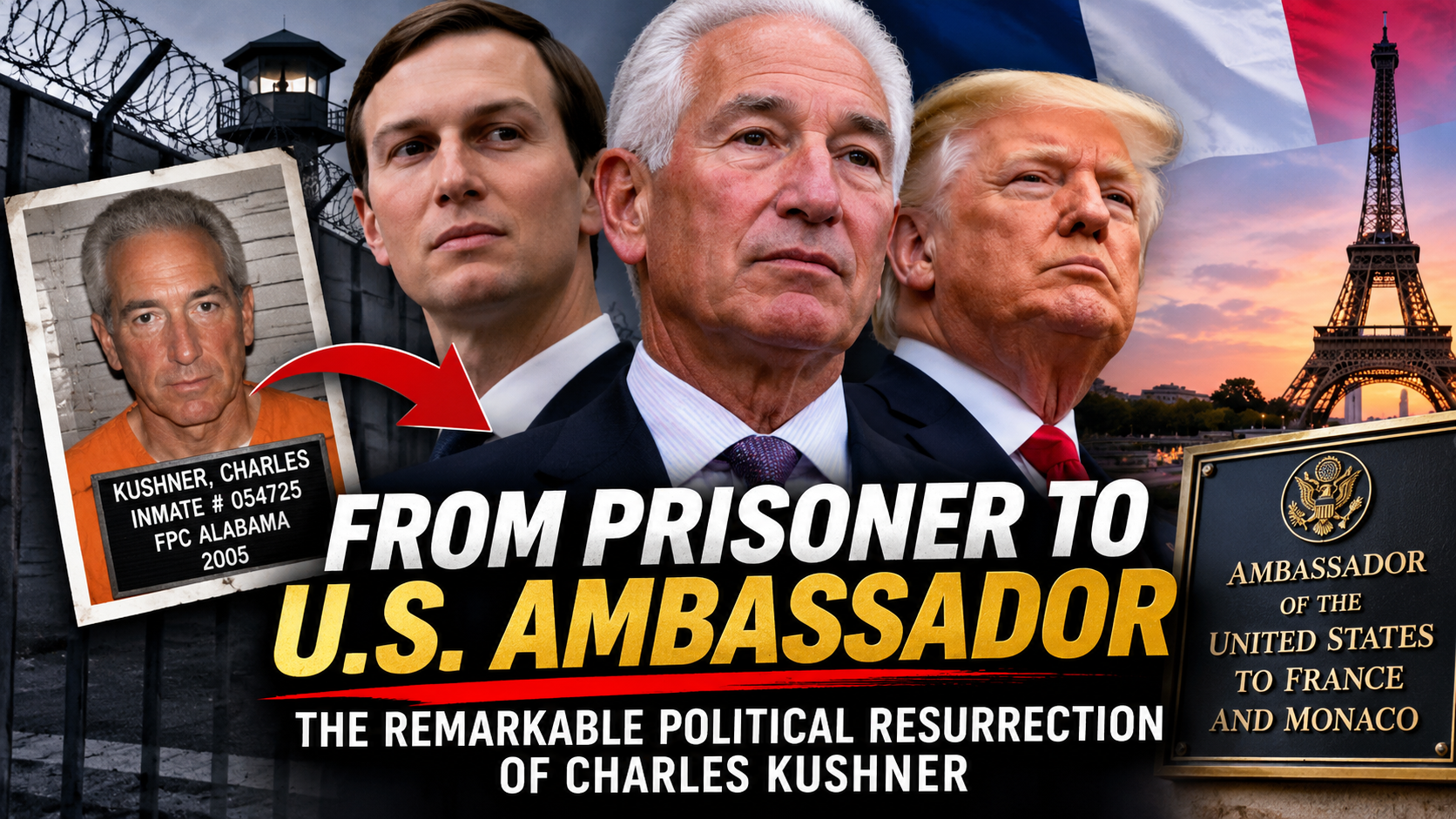
Charles Kushner was once a federally convicted real estate developer whose crimes were described by a sentencing judge as disgraceful and reprehensible. He pleaded guilty to 18 felony counts involving tax fraud, false statements to federal election regulators and an elaborate witness retaliation scheme in which he hired a sex worker to seduce his own brother in law, secretly recorded the encounter and sent the recording to his sister. Two decades later, Kushner was representing the United States in France and presenting his diplomatic credentials to European royalty in Monaco.
Between those extraordinary chapters of his life came the political rise of his eldest son, Jared Kushner, whose marriage to Ivanka Trump in 2009 placed the Kushner family within Donald Trump’s immediate orbit. Jared subsequently became one of the most influential advisers in Trump’s first administration, gaining unprecedented access to presidential decision-making. In December 2020, Trump granted Jared’s father a full and unconditional presidential pardon. Following his 2024 election victory, Trump nominated Charles Kushner for one of America’s most prestigious diplomatic assignments.
The transformation from federal inmate to American ambassador provides a striking case study in political patronage, presidential discretion and the influence that wealthy, well connected families can exercise in Washington. Although the public record does not conclusively establish that Jared personally orchestrated his father’s pardon and diplomatic appointment, the family’s extraordinary proximity to presidential power is central to understanding how that transformation occurred.
The Crimes That Sent Charles Kushner to Federal Prison
Before becoming part of Donald Trump’s extended family, Charles Kushner was already a wealthy and politically influential New Jersey real estate developer. As the founder of Kushner Companies, he built a substantial property empire while cultivating relationships with prominent politicians, charitable organizations and influential business leaders. His financial and political activities, however, eventually attracted the attention of federal investigators.
On August 18, 2004, Kushner pleaded guilty in federal court in Newark, New Jersey, to 18 criminal counts, including 16 counts of assisting in the preparation of fraudulent tax returns, one count of retaliating against a cooperating witness and one count of making false statements to the Federal Election Commission.
According to the U.S. Department of Justice, Kushner admitted to improperly categorizing more than $1 million in charitable contributions as business expenses, producing an estimated loss to the Internal Revenue Service of between $200,000 and $325,000. He also admitted that campaign contributions had been attributed to individuals who had neither authorized the donations nor known that contributions were being made in their names.
A subsequent federal prosecution involving former Kushner Companies executive Richard Stadtmauer exposed the broader scope of the company’s fraudulent accounting practices. Evidence introduced at trial established that participants in the conspiracy had improperly classified more than $6 million in political contributions, charitable donations, gifts, entertainment and other expenditures as deductible business expenses. Multiple executives and financial professionals associated with the company pleaded guilty in related proceedings.
The investigation revealed serious financial misconduct within Kushner’s business empire. However, it was his extraordinary attempt to retaliate against members of his own family that made the prosecution nationally notorious.
Hiring a Sex Worker to Retaliate Against His Own Family
During the federal investigation, Kushner learned that his sister, Esther Schulder, and her husband, William Schulder, were cooperating with authorities. Rather than allowing the investigation to proceed, Kushner devised a scheme intended to retaliate against them through personal humiliation.
According to his admissions in federal court, Kushner paid a private investigator $25,000 to arrange for a sex worker to seduce his brother in law at a New Jersey motel. Kushner admitted personally recruiting the woman and directing that the encounter be secretly recorded. He subsequently instructed that the recording be mailed to his sister, exposing her husband’s infidelity in retaliation for the family’s cooperation with federal prosecutors.
The scheme backfired spectacularly. Instead of insulating Kushner from criminal liability, it became additional evidence against him and resulted in a separate federal felony conviction for witness retaliation. On March 4, 2005, U.S. District Judge Jose L. Linares sentenced Kushner to 24 months in federal prison, the maximum prison term permitted under his plea agreement. He also received a $40,000 fine, two years of supervised release and a $1,800 special assessment. During sentencing, Linares characterized Kushner’s conduct as:
“Disgraceful and reprehensible.”
Kushner served approximately 14 months at a federal prison camp in Alabama before completing the remainder of his custodial sentence through a halfway house in Newark. He was released in 2006, and his convictions also resulted in professional disciplinary consequences, including disbarment. The man overseeing the federal prosecution was Chris Christie, then the U.S. attorney for New Jersey. Christie would later become governor, seek the Republican presidential nomination and find himself competing for influence inside a political organization increasingly shaped by the son of the man he had sent to prison.
Jared Kushner Begins Rebuilding the Family’s Influence
Charles Kushner’s imprisonment forced his eldest son, Jared, to assume greater responsibility within the family’s real estate operations at a relatively young age. Jared subsequently expanded his interests beyond property development, purchasing the New York Observer in 2006 and developing relationships across New York’s business, media and political establishments.
His marriage to Ivanka Trump in October 2009 united two wealthy real estate families and established a relationship that would eventually carry enormous political significance. When Donald Trump entered presidential politics in 2015, Jared became an increasingly important figure within the campaign, helping oversee its digital operations, political strategy and internal decision making.
Following Trump’s election in 2016, Jared entered the White House as a senior adviser. Despite having no previous government experience, he received an expansive portfolio that included Middle East diplomacy, criminal justice reform, international negotiations and domestic policy initiatives. His access to the president was reinforced by his position within the Trump family, making him an unusually influential figure within the administration.
The rise also meant that Charles Kushner, a businessman previously convicted of serious federal offenses, now had a son working directly alongside the one government official constitutionally empowered to pardon those crimes.
Chris Christie Accuses Jared Kushner of Orchestrating His Political Downfall
One of the earliest indications that Charles Kushner’s criminal prosecution could have consequences inside the Trump administration emerged shortly after the 2016 presidential election. Chris Christie had spent months serving as chairman of Trump’s presidential transition team, overseeing preparations for the incoming administration and helping identify potential government personnel. Within days of Trump’s victory, however, Christie was removed from the leadership position and replaced by incoming Vice President Mike Pence.
In his 2019 memoir, Let Me Finish, Christie alleged that Jared Kushner had orchestrated his dismissal as retaliation for prosecuting his father more than a decade earlier. Christie characterized the episode as a politically motivated effort to remove him from influence within the incoming administration and subsequently discussed the severity of Charles Kushner’s crimes during public interviews.
Jared disputed that account, denying that he engineered Christie’s removal in retaliation for his father’s imprisonment. No judicial proceeding has established that Jared was responsible for the decision, and the competing accounts remain unresolved. Nevertheless, the episode demonstrated how a federal criminal prosecution from the early 2000s had become entangled with the personal relationships surrounding an incoming presidential administration. The former prosecutor was sidelined, while the son of the man he prosecuted remained among the president’s closest advisers.
During Trump’s first administration, Jared Kushner became a prominent advocate for federal criminal justice reform, frequently drawing on his personal experience visiting his father in prison. His efforts helped advance the First Step Act, a bipartisan legislative package signed into law by Trump in December 2018 that introduced sentencing reforms, expanded rehabilitation programs and created additional opportunities for eligible federal inmates to earn earlier release.
The legislation attracted support from Republicans, Democrats, civil rights organizations and criminal justice reform advocates. Charles Kushner also participated in reform efforts following his release from prison, working with New Jersey Senator Cory Booker and other advocates. Those contributions represent an important part of the family’s post-conviction history and were subsequently cited by supporters of Charles Kushner’s diplomatic nomination.
However, there is a fundamental distinction between advocating for reforms that benefit thousands of incarcerated Americans and receiving an individualized grant of executive clemency from a president who belongs to one’s extended family.
On December 23, 2020, during the final weeks of his first administration, Donald Trump issued Charles Kushner a full and unconditional presidential pardon. The official executive clemency document, maintained by the Department of Justice, specifically identifies the federal offenses for which Kushner was convicted and the sentence imposed in 2005.
Trump’s pardon came approximately 14 years after Kushner completed his custodial sentence. It was not needed to secure his freedom from prison. Instead, it relieved certain continuing legal consequences of his federal convictions and provided a significant opportunity for political and reputational rehabilitation. A presidential pardon does not establish innocence, expunge the historical record or invalidate the factual admissions made during a guilty plea. Kushner’s crimes remain documented in federal court and Justice Department records, regardless of Trump’s decision to exercise his constitutional clemency authority.
From Democratic Mega-Donor to Republican Political Beneficiary
One of the most revealing aspects of Charles Kushner’s political history is that his extensive network of influence was not originally concentrated within the Republican Party. Throughout the 1990s and early 2000s, Kushner was a significant Democratic political fundraiser, cultivating relationships with prominent national Democrats and influential New Jersey officials.
His political connections extended into the administrations and campaigns of figures associated with Bill and Hillary Clinton, Al Gore and former New Jersey Governor Jim McGreevey. Kushner was also connected to Cory Booker during the early stages of Booker’s political career in Newark, long before Booker entered the United States Senate.
The family’s eventual alignment with Donald Trump represented a substantial shift in partisan allegiance, but not a departure from its longstanding involvement in political fundraising. Following his presidential pardon, Charles Kushner became a significant financial supporter of Trump’s political operation. Campaign finance reporting identified a $1 million contribution to Make America Great Again Inc., a pro-Trump super PAC, in June 2023.
The contribution came between Kushner’s December 2020 pardon and his November 2024 diplomatic nomination. That chronology warrants public scrutiny, particularly given the additional family relationships involved. However, the existence of a political contribution does not independently establish bribery, an illegal exchange or an agreement to provide a government position in return for financial support.
Kushner’s political history illustrates how wealthy donors can maintain access to influential officials across party lines, even as their political affiliations change. It also provides a particularly relevant example of the longstanding debate over whether major political contributors should receive prestigious diplomatic appointments.
Donald Trump Nominates His Son in Law’s Father for Ambassador to France
On November 30, 2024, shortly after winning the presidential election, Donald Trump announced that he would nominate Charles Kushner as the next American ambassador to France. Trump emphasized Kushner’s business accomplishments, philanthropic activities and ability to strengthen relations between the United States and its European allies.
The nomination placed a businessman without a career diplomatic background in line to oversee one of America’s most consequential international relationships. France is a nuclear-armed nation, a permanent member of the United Nations Security Council, a founding member of NATO and a leading European Union power. America’s diplomatic relationship with France encompasses international security, intelligence cooperation, trade, counterterrorism, European defense and policy toward the Middle East.
Political appointments to diplomatic positions are not exclusive to Trump or the Republican Party. Presidents from both major parties have historically nominated wealthy donors, business executives and personal associates to serve as ambassadors. Supporters of such appointments argue that private-sector experience and direct presidential access can provide advantages in international negotiations, while critics question whether political connections are being prioritized over professional diplomatic experience.
Kushner’s nomination added several unusual elements to that familiar debate. The nominee was not simply a wealthy political supporter. He was the recipient of a presidential pardon, had admitted to 18 federal criminal offenses and was the father of the president’s son-in-law and former senior White House adviser.
Charles Kushner Defends His Criminal History Before the Senate
During his May 1, 2025, confirmation hearing before the Senate Foreign Relations Committee, Charles Kushner faced questions about his criminal convictions and whether his previous conduct should affect his suitability for diplomatic service. Rather than denying responsibility, Kushner acknowledged the seriousness of his past actions and argued that his experience with the criminal justice system had contributed to his personal development. Responding to questioning from senators, he stated:
“I made a very, very, very serious mistake, and I paid a very heavy price for that mistake.”
Kushner maintained that experiencing the consequences of his actions had improved his judgment and values. He also discussed his subsequent involvement in criminal justice reform, including mentoring young incarcerated men, and emphasized his family’s history as Holocaust survivors.
On foreign policy, Kushner pledged to strengthen economic and security cooperation between Washington and Paris, encourage greater European defense investment and promote American interests abroad. His supporters presented his business experience, philanthropic record and personal relationship with the president as potential diplomatic assets.
On May 19, 2025, the Senate confirmed Kushner by a vote of 51–45, with four senators not voting. Alaska Senator Lisa Murkowski was the only Republican to oppose his confirmation, while New Jersey Senator Cory Booker was the only Democrat to support it. The confirmation authorized Kushner to serve as ambassador to both France and the Principality of Monaco.
Cory Booker and the Kushner Family’s Bipartisan Political Connections
Booker’s decision to support Kushner deserves particular attention given his longstanding relationship with the family. Their association dates back to Booker’s early political career in Newark, when the Kushners were prominent participants in New Jersey Democratic politics. According to reporting by the New Jersey Globe, Booker also submitted a character reference on Charles Kushner’s behalf during his criminal proceedings.
Following the confirmation vote, Booker issued a public statement explaining that his support was based on Kushner’s involvement in criminal justice reform, particularly the work that contributed to passage of the First Step Act. Booker described Charles Kushner as an important participant in the bipartisan coalition behind the legislation and maintained that his advocacy had helped secure reforms benefiting thousands of incarcerated Americans. The senator also acknowledged substantial political disagreements with Kushner. Booker’s explanation provides an important counterpoint to interpretations that attribute his vote exclusively to the family’s wealth or previous political support. No evidence establishes that campaign contributions dictated his confirmation vote.
Nevertheless, the episode demonstrates the durability of relationships cultivated by wealthy political families. Despite the Kushners’ transition from Democratic fundraising circles to the center of a Republican administration, Charles Kushner retained the support of a prominent Democratic senator who had known him for decades.
Jared Kushner’s Defense of His Father’s Legacy
Throughout his father’s legal difficulties and subsequent political rehabilitation, Jared Kushner has generally emphasized the personal consequences of the prosecution, the experience of visiting his father in prison and the role that experience played in shaping his interest in criminal justice reform.
In his 2022 memoir, Breaking History: A White House Memoir, Jared discussed his father’s imprisonment and disputed Chris Christie’s allegations that personal revenge motivated his removal from Trump’s presidential transition team in 2016.
Jared’s loyalty to his father is not inherently unusual. What makes the relationship a matter of public interest is the extraordinary governmental authority available within the extended Trump-Kushner family. As a senior presidential adviser, Jared possessed direct access to the administration that ultimately granted Charles Kushner clemency. His father subsequently received a diplomatic nomination from that same president.
The precise extent of Jared’s private involvement in those decisions remains unclear. His communications concerning the pardon and subsequent ambassadorship have not been comprehensively disclosed, and the chronology alone does not establish that he personally directed either outcome. That distinction is essential. The documented facts establish family access, presidential clemency and a subsequent political appointment. They do not establish a criminal conspiracy involving Jared Kushner.
Diplomatic Controversy Erupts Within Weeks of Kushner’s Arrival in France
Charles Kushner’s transition from business executive to American diplomat was followed almost immediately by a significant confrontation with French President Emmanuel Macron’s government. In August 2025, Kushner published an open letter to Macron in The Wall Street Journal accusing French authorities of failing to adequately confront antisemitism. He also criticized Macron’s position toward Israel and his government’s plans to recognize Palestinian statehood, arguing that those policies encouraged hostility toward Jewish communities.
Antisemitism in France is a documented and serious problem, and Kushner’s concerns reflected an issue that French authorities themselves have repeatedly acknowledged. The dispute centered substantially on his characterization of the French government’s response and his suggestion that Macron’s foreign policy contributed to antisemitic violence. French officials rejected those accusations, defending the government’s efforts to protect Jewish institutions and combat antisemitism. The Foreign Ministry also objected to what it regarded as inappropriate interference in France’s domestic affairs.
The diplomatic dispute resulted in Kushner being formally summoned to the French Foreign Ministry. Rather than attending personally, he sent another American diplomatic official in his place. The U.S. State Department defended Kushner’s comments, while French officials maintained that his conduct was inconsistent with the expectations of an ambassador. The controversy raised questions surrounding Article 41 of the Vienna Convention on Diplomatic Relations, which establishes an obligation for diplomats to respect the laws and internal affairs of their host countries. France’s criticism did not constitute an international judicial ruling that Kushner violated the convention, but it highlighted growing disagreements over the appropriate boundaries of his diplomatic role. Within six months, Kushner would again find himself at the center of a confrontation with the French government.
February 2026: France Restricts Kushner’s Access to Government Ministers
In February 2026, diplomatic relations deteriorated further following the death of Quentin Deranque, a 23 year old French far right activist who suffered fatal injuries after a confrontation involving alleged far left activists in Lyon. The U.S. State Department’s Bureau of Counterterrorism publicly characterized the incident as evidence of the public safety threat posed by violent left-wing extremism. The American embassy in Paris circulated corresponding statements in French, drawing objections from officials who regarded the comments as foreign interference in an ongoing domestic political controversy.
French Foreign Minister Jean-Noël Barrot summoned Kushner to the Foreign Ministry on February 23, 2026, to discuss the administration’s intervention. For the second time since his appointment, Kushner did not attend personally, reportedly citing prior commitments and dispatching another embassy official. Barrot responded by restricting Kushner’s direct access to French government ministers until the ambassador addressed the matter. The French foreign minister explained that access to government officials was fundamental to an ambassador’s ability to perform his responsibilities and that ignoring an official summons undermined that relationship.
The restriction was not an expulsion, a termination of diplomatic relations or a permanent suspension of Kushner’s duties. It was, however, a significant diplomatic rebuke from one of America’s oldest and most important allies. Kushner subsequently contacted Barrot by telephone and indicated that he would respect France’s domestic political affairs. The confrontation eased, although the episode generated renewed scrutiny of his diplomatic approach and adherence to established international protocols. The dispute was particularly significant because it occurred during preparations to commemorate the 250th anniversary of American independence, an occasion intended in part to celebrate France’s historic role in the founding of the United States.
Kushner’s Diplomatic Approach Continues to Draw Scrutiny in 2026
A November 2026 profile published by The New Yorker documented additional aspects of Kushner’s diplomatic tenure, including the tensions between his relationship with Trump and the practical responsibilities of representing American interests in France. The report revisited Kushner’s confrontations with the French Foreign Ministry while examining how the ambassador navigated subsequent political controversies. It also identified instances in which Kushner declined to repeat Trump’s characterizations of French domestic events.
During demonstrations involving French students in October 2026, Trump attributed the unrest broadly to Islam and mass migration. Kushner declined to endorse that characterization when discussing the situation with The New Yorker, indicating that he would not make such a sweeping generalization.
The episode provides additional context for understanding his tenure. Although Kushner has repeatedly defended administration policies and benefited from close presidential access, his diplomatic conduct has not consisted exclusively of repeating Trump’s public statements. His relationship with the French government has involved both confrontation and efforts to manage differences between Washington and Paris.
From a Federal Prison Camp to the Royal Palace of Monaco
On October 27, 2025, Charles Kushner entered the Prince’s Palace of Monaco to formally present his diplomatic credentials to Prince Albert II. Princess Charlene and other senior Monégasque officials attended the ceremony, which was followed by an official luncheon honoring Kushner and his wife, Seryl. The occasion offered a remarkable visual contrast with the federal prison camp where Kushner had been incarcerated two decades earlier. The businessman whose conduct had been condemned by a federal judge was now formally representing the United States before European royalty.
Unlike his selection as ambassador, however, the inclusion of Monaco was not a privilege created specifically for Kushner. The United States has maintained an arrangement since establishing full ambassador-level diplomatic relations with Monaco in 2006 under which its Paris based ambassador also serves as the American ambassador to the principality. Monaco does not maintain a standalone U.S. embassy, and American diplomatic responsibilities are administered through the embassy in Paris. The Senate confirmation explicitly stipulated that Kushner would receive no additional compensation for concurrently serving as ambassador to Monaco.
Similar arrangements exist elsewhere in Europe, where American ambassadors accredited to larger countries also represent the United States in neighboring microstates. Nevertheless, the Monaco ceremony remains a striking illustration of Kushner’s political rehabilitation and the extraordinary distance between his criminal convictions and his subsequent position in international diplomacy.
Presidential Pardons, Political Donations and the Limits of Government Accountability
The Charles Kushner case brings together three significant areas of American government in which presidents exercise considerable discretion: executive clemency, political appointments and the selection of diplomatic representatives.
Under Article II of the Constitution, presidents possess broad authority to grant pardons for federal criminal offenses, except in cases of impeachment. Department of Justice procedures generally provide an established process for evaluating clemency applications, but presidents are not constitutionally required to follow those recommendations or use the ordinary application process.
Similarly, presidents possess the authority to nominate ambassadors, subject to Senate confirmation. The Foreign Service Act establishes professional competence as an important consideration in ambassadorial appointments and states that campaign contributions should not be a factor in their selection. The law nevertheless permits noncareer appointments, which have long been a feature of American diplomacy.
These legal frameworks explain how Kushner’s pardon and subsequent appointment were possible. They do not resolve every ethical question surrounding the decisions. Advocates for criminal justice reform correctly maintain that individuals who have completed criminal sentences should have opportunities to rebuild their lives. A prior conviction should not necessarily prevent a qualified individual from contributing to society or serving the public. Charles Kushner’s documented involvement in criminal justice reform is relevant to any comprehensive assessment of his post-conviction record.
The additional issue presented by his case is whether wealth, political contributions and personal relationships with the president provided opportunities substantially different from those available to ordinary Americans who have completed federal prison sentences. The public interest in those decisions extends beyond determining whether they were constitutionally permissible. It includes examining the transparency of the process, the qualifications of the recipients and whether government authority was exercised primarily to advance public objectives.
Saving Daddy: When Family Loyalty Intersects With Presidential Power
Charles Kushner’s journey from convicted felon to American ambassador encompasses more than two decades of criminal proceedings, family loyalty, political fundraising, legislative advocacy and presidential decision making.
The underlying events are matters of public record. Kushner pleaded guilty to 18 federal offenses. He admitted arranging a retaliatory scheme against members of his own family. He received a federal prison sentence and subsequently became involved in criminal justice reform. His son married Donald Trump’s daughter, entered the White House as a senior adviser and became an influential participant in the administration that granted his father clemency. Charles Kushner later financially supported Trump’s political operation and received a prestigious diplomatic appointment from the same president.
What has not been established is whether Jared Kushner personally orchestrated each stage of his father’s rehabilitation or whether the political contributions were made in exchange for government favors. Those conclusions would require evidence beyond the documented relationships and sequence of events. The case nevertheless provides an important opportunity to examine the concentration of political access within wealthy American families and the safeguards surrounding the use of presidential power. It also illustrates how criminal justice reform, legitimate rehabilitation and questions about preferential treatment can coexist within the same political history.
In 2005, a federal judge condemned Charles Kushner’s conduct while ordering him to serve the maximum prison sentence available under his plea agreement. In 2020, the president who was also his son’s father in law granted him a full pardon. By October 2025, Kushner was presenting his diplomatic credentials to the sovereign prince of Monaco. The distance between those three events is a significant chapter in the history of American criminal justice, political patronage and presidential authority.
Sources & Further Reading

Federal Court Records and Government Documents
Independent Reporting and Investigative Coverage
Related South Florida Media Coverage









Loading comments…