
Jared Kushner’s Dual Role as U.S. Peace Envoy and Middle East Funded Investor Raises Extraordinary Conflicts
Jared Kushner occupies one of the most unusual positions in modern American diplomacy: he is helping negotiate some of the world’s most consequential conflicts while remaining the founder and owner of a multibillion dollar investment company whose largest financial relationships are concentrated among governments in the same region.
Kushner, President Donald Trump’s son in law and former White House senior adviser, has returned to international diplomacy as a U.S. envoy involved in negotiations concerning Gaza, Israel, Iran, the Gulf states and Russia’s war in Ukraine. At the same time, Kushner remains the founder of Affinity Partners, the investment firm he established after leaving government in 2021 and built largely with capital from Saudi Arabia, Qatar, the United Arab Emirates and other foreign investors.
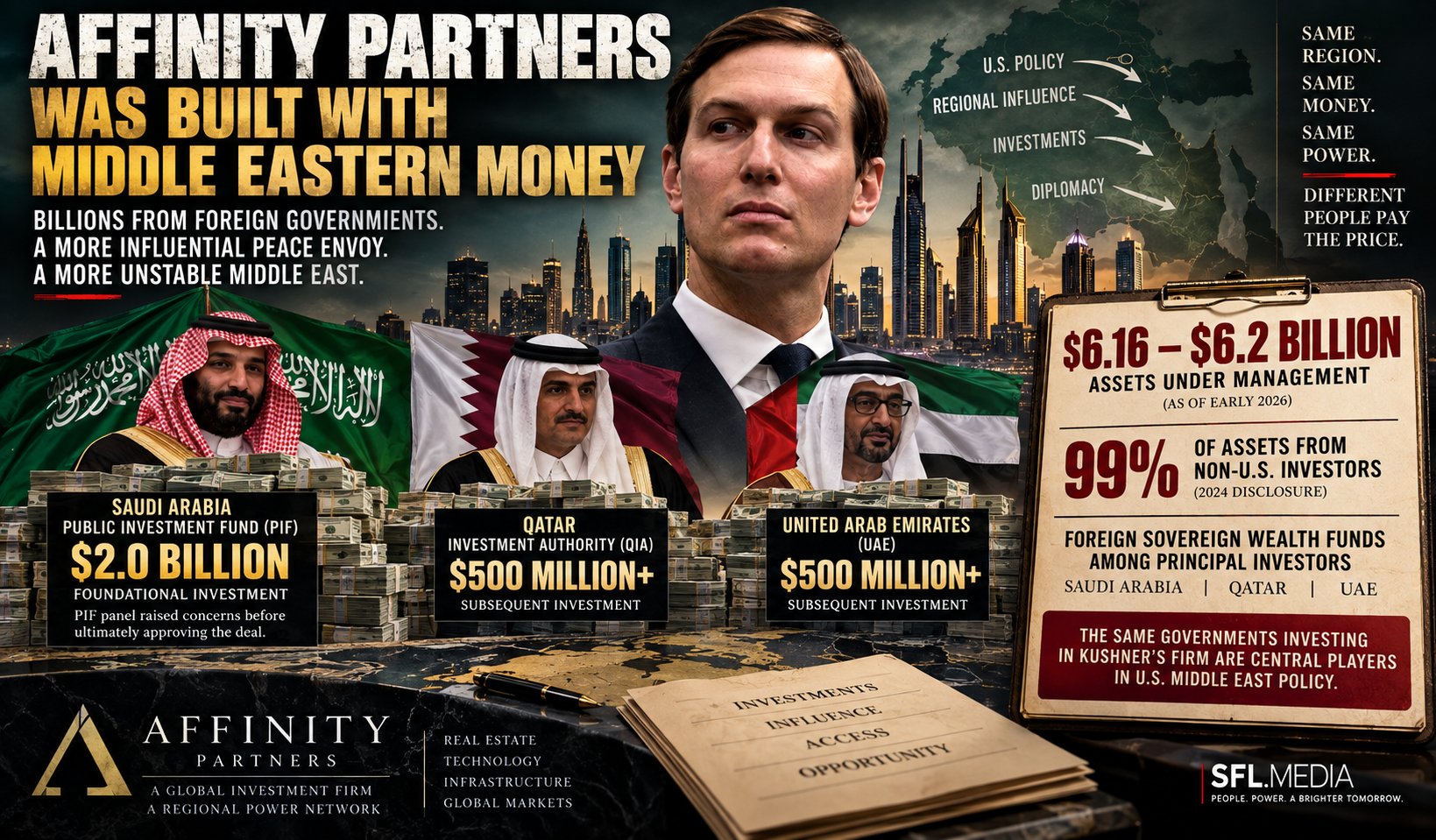
The numbers are extraordinary. Affinity reported approximately $6.16 billion to $6.2 billion in assets under management by early 2026. That money is not Kushner’s personal income; it is capital managed by his investment firm. What makes the figure relevant to American foreign policy is where much of that money originates. Regulatory disclosures examined by congressional investigators showed that approximately 99% of Affinity’s assets under management were attributable to non U.S. investors, with billions connected to sovereign wealth funds from Saudi Arabia, Qatar and the United Arab Emirates. Saudi Arabia’s Public Investment Fund provided the firm’s foundational $2 billion commitment shortly after Kushner left the first Trump administration.
The potential conflict became considerably more significant after Kushner returned to diplomacy. Congressional investigators opened new inquiries in 2026 after reports that Kushner was discussing billions of dollars in additional Middle Eastern investment for Affinity while simultaneously participating in U.S. negotiations in the region. A subsequent New Yorker investigation examined Kushner’s overlapping diplomatic and financial activities, including efforts involving roughly $5 billion in additional capital.
Those facts do not establish that Kushner changed American foreign policy in exchange for investment, and no publicly established evidence demonstrates that a particular U.S. diplomatic, military or reconstruction decision was traded for money flowing into Affinity. Kushner and his company have rejected suggestions that his diplomatic work is improperly intertwined with his business interests. Nevertheless, the overlap creates an unavoidable public-policy question: when an American peace negotiator simultaneously owns an investment company managing billions of dollars associated with governments affected by those negotiations, where does American diplomacy end and private business begin?
Kushner Is No Longer Simply an Informal Trump Adviser
Kushner’s diplomatic responsibilities have expanded considerably since Trump’s return to office. The White House placed him on the executive structure overseeing Trump’s Gaza peace and reconstruction framework alongside Secretary of State Marco Rubio, Steve Witkoff, former British Prime Minister Tony Blair and other political, financial and development figures.
The White House says the Board of Peace is intended to provide strategic oversight for Gaza’s transition from conflict, including reconstruction, investment attraction, governance development, regional relations and capital mobilization. Kushner also sits on the Gaza Executive Board, placing him directly inside the structure intended to influence the territory’s political, humanitarian and economic future.
Kushner has also worked alongside Witkoff on diplomacy involving Iran and Russia’s war against Ukraine, giving him influence across several of the administration’s most sensitive foreign policy portfolios. He is therefore not simply commenting on Middle Eastern policy from outside government. He has become an active American diplomatic intermediary while remaining financially connected to a private investment business whose investor base includes governments with enormous stakes in those same policy decisions.
Kushner has defended the arrangement by arguing that relationships critics describe as conflicts are precisely what make him effective as a negotiator. During a PBS interview examining the Trump family’s business interests, Kushner said that what others call conflicts of interest, he and Witkoff consider experience and trusted relationships, arguing that those relationships helped them negotiate hostage releases and other diplomatic agreements. That argument goes to the center of the controversy. Kushner’s extensive relationships can simultaneously provide unusual diplomatic access and raise unusual questions about financial independence.
Affinity Partners Was Built With Middle Eastern Money
Kushner founded Affinity Partners shortly after leaving the White House in 2021. Its most consequential early investor was Saudi Arabia’s Public Investment Fund, which committed $2 billion. That investment generated controversy from the beginning. Public reporting and congressional investigations found that an internal PIF investment panel raised concerns about Affinity, including its management fees, operations and Kushner’s limited private equity track record, before the Saudi sovereign wealth fund ultimately approved the commitment.
Saudi Arabia was not alone. Affinity subsequently attracted substantial investments associated with Qatar and the United Arab Emirates, transforming Kushner’s relatively young investment firm into a multibillion dollar operation with an exceptionally concentrated foreign investor base. Affinity’s 2024 regulatory disclosures stated that 99% of its assets under management were attributable to non U.S. persons. Congressional investigators identified sovereign wealth funds belonging to Saudi Arabia, Qatar and the UAE among the principal sources of that capital.
The company continued expanding after those disclosures. By early 2026, Affinity reported approximately $6.16 billion to $6.2 billion in assets under management. Those figures become politically important because the governments providing much of that capital are not passive participants in American foreign policy. Saudi Arabia, Qatar and the UAE are among Washington’s most consequential Middle Eastern partners and are deeply involved in questions involving Gaza, Israel, Iran, regional security, energy markets, reconstruction financing and future normalization agreements.
Kushner is therefore conducting diplomacy involving governments that are also directly or indirectly connected to the financial foundation of his investment company.
Then Came the $5 Billion Question
The most consequential new reporting concerns what happened after Kushner returned to diplomacy. Congressional investigators said in March 2026 that Kushner had been soliciting billions of dollars from Middle Eastern sovereign wealth funds while simultaneously co-leading Trump administration negotiations in the region. The New Yorker subsequently published a detailed investigation examining Kushner’s diplomacy alongside efforts involving roughly $5 billion in additional Middle Eastern capital for Affinity.
That does not establish a quid pro quo. There is currently no publicly established evidence showing that Kushner manipulated an American policy decision in exchange for investment in Affinity, and allegations made by political opponents should not be presented as proven misconduct. But the chronology is significant because the potential conflict is unusually direct. Kushner is participating in American diplomacy with and around governments that already invest billions of dollars through his company or could potentially become future investors.
Affinity Says Kushner Is Not Taking New Money While Working for the Government
Kushner and Affinity have offered an important response that belongs prominently in any fair account of the controversy. Affinity has acknowledged preliminary discussions concerning additional investment while maintaining that Kushner’s government work and private business comply with applicable rules. The company has also said it does not intend to accept additional capital while Kushner is volunteering for the U.S. government and has emphasized that Affinity is an SEC registered investment adviser operating under American financial regulations.
That distinction matters. Discussing potential investment is not the same thing as actually accepting billions of dollars while negotiating American foreign policy. It does not, however, eliminate the underlying ethics question because Kushner remains economically connected to Affinity and the billions of dollars the company already manages for foreign investors.
The Existing Financial Relationship Is Already Enormous
The scale of those existing relationships was documented before Kushner’s return to government diplomacy. A 2024 Senate Finance Committee investigation said Affinity had collected approximately $157.5 million in management fees from foreign investors, including roughly $87 million from Saudi Arabia’s Public Investment Fund. According to information Affinity provided to the committee, the Saudi fund was charged an annual management fee of 1.25% on its $2 billion commitment, while other investors were generally charged rates closer to 2%.
The committee said the agreements guaranteed management fees during the five year investment period extending through August 2026 and estimated at the time that Affinity was contractually positioned to collect another approximately $90 million through the end of that period, including roughly $50 million associated with the Saudi investment. Those figures require an important qualification. They describe fees flowing into Affinity Partners, not dollars personally pocketed by Kushner. Kushner is the firm’s founder and sole owner and therefore has a substantial economic interest in the company, but corporate revenue, investment capital, firm valuation and personal income are not interchangeable figures.
The committee also reported that as of July 2024 Affinity had deployed approximately $1.1 billion of its then roughly $3 billion under management and that its private investment funds had not generated or distributed investment returns to clients at that point. Those findings describe Affinity’s position in 2024 and should not be presented as its current 2026 performance. The firm’s assets subsequently increased substantially, and later reporting indicated that investment gains contributed to that growth.
The central financial fact nevertheless remains striking: a former White House official who helped formulate American Middle East policy created an investment business overwhelmingly financed by foreign investors, including sovereign funds from that region, and subsequently returned to American diplomacy while retaining his economic connection to that company.
Congress Has Opened Investigations Into Exactly This Question
Congressional Democrats have explicitly challenged Kushner’s dual role. In March 2026, Sen. Ron Wyden and Rep. Robert Garcia demanded information from the White House and Affinity concerning Kushner’s Middle Eastern fundraising while participating in American diplomacy. The following month, House Judiciary Committee Ranking Member Jamie Raskin announced another investigation focused on Kushner’s foreign financial relationships and government role.
Their descriptions of Kushner’s conduct are partisan congressional allegations and should be identified as such rather than treated as findings of criminal wrongdoing. The underlying financial relationships they are examining, however, are documented through regulatory disclosures, information provided by Affinity and public reporting.
Investigators have requested information concerning Affinity’s investors, Kushner’s compensation, communications involving foreign governments and the safeguards intended to separate his business activities from American diplomacy. The unusual structure of Kushner’s government service adds another layer: he has operated as an unpaid or volunteer adviser rather than through a conventional full-time federal appointment, raising questions among ethics specialists and lawmakers about which disclosure and conflict-of-interest requirements apply.
Meanwhile, Gaza Remains Devastated
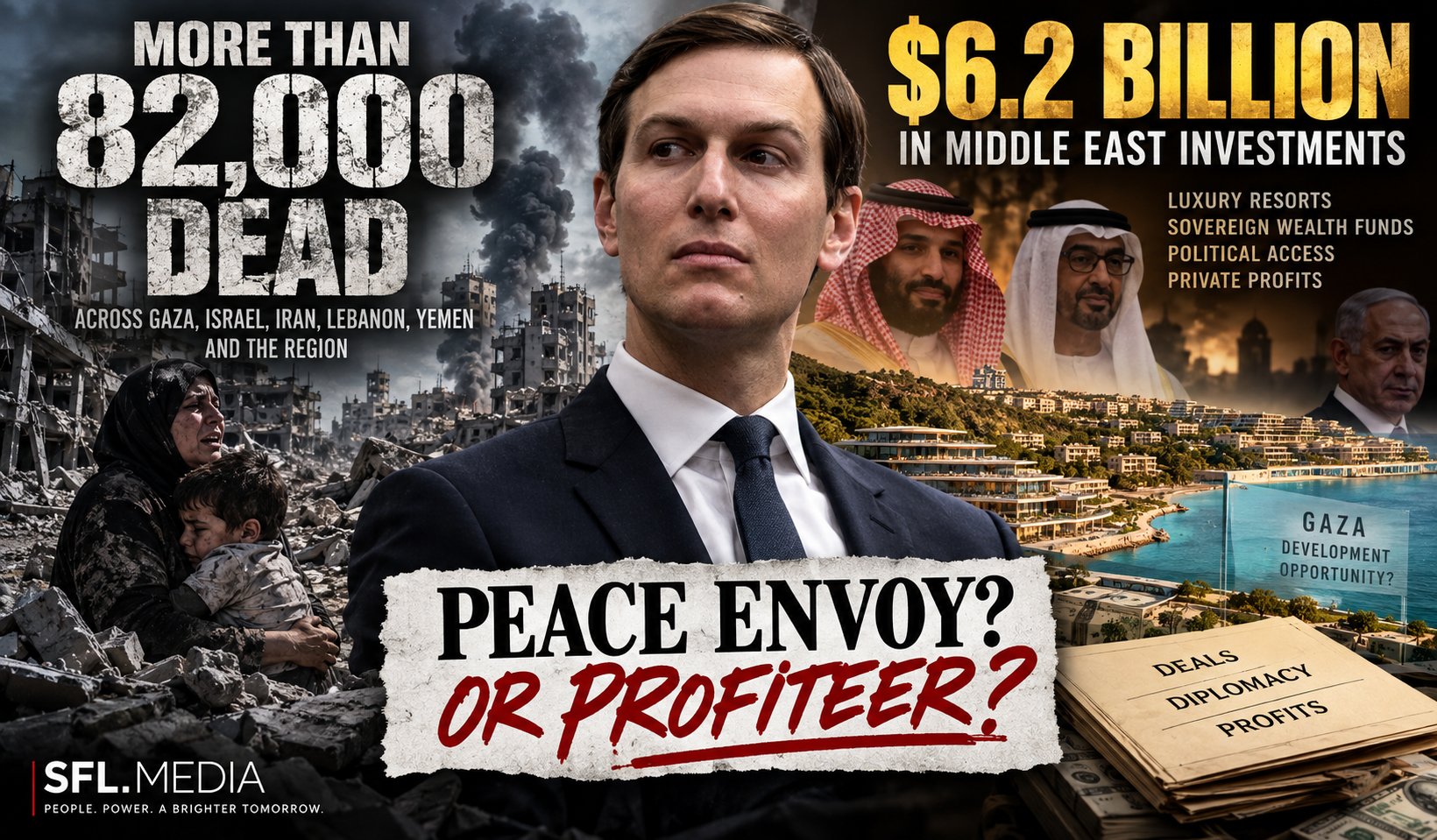
The financial controversy is unfolding against a humanitarian catastrophe that gives the debate considerably greater weight. More than 73,000 Palestinians have been reported killed in Gaza since the October 2023 Hamas led attack and the Israeli military campaign that followed, according to Gaza health authorities cited in international reporting. Hamas led militants killed approximately 1,200 people in Israel on October 7, 2023, and took roughly 250 hostages. The Gaza casualty figures do not distinguish between civilians and combatants, and Israel has disputed aspects of the Palestinian authorities’ accounting while maintaining that its military campaign is directed against Hamas.
Even after subsequent ceasefire arrangements, violence and humanitarian insecurity have continued. The physical destruction is extraordinary. UNICEF reported in 2026 that nearly 98% of Gaza’s school buildings had been damaged, more than 93% required major rehabilitation or complete reconstruction, and approximately 81% had been directly hit. Around 700,000 children had missed formal in person schooling for almost three academic years. By September, hundreds of thousands of children were beginning to return to in-person education, frequently in damaged buildings, temporary facilities and tents.
Water remains another critical problem. United Nations humanitarian monitoring reported in September that approximately 91% of assessed Gaza households were experiencing moderate to high water insecurity. Damage to wells, desalination facilities and other civilian infrastructure has repeatedly disrupted access to clean water, while restrictions involving fuel, replacement parts, machinery and humanitarian supplies have complicated repairs.
The danger extends beyond active military strikes. On September 16, a war-damaged residential building collapsed in Gaza City, reportedly killing 21 people, including 12 children. The incident demonstrated another consequence of prolonged destruction: buildings that remain standing can themselves become lethal while reconstruction equipment and materials remain limited. This is the territory Kushner’s Board of Peace is supposed to help stabilize and reconstruct.

Gaza Is Also Being Discussed as an Investment and Development Opportunity
Kushner’s approach to Gaza has long contained a significant economic development component. During a 2024 appearance at Harvard, Kushner described Gaza’s waterfront property as potentially “very valuable” and discussed the possibility of moving civilians away from combat areas while the territory was cleared and redeveloped. His remarks generated intense criticism because they appeared to discuss Gaza’s real estate potential while Palestinians were being killed and displaced during an ongoing war.
Supporters of development driven diplomacy can reasonably argue that a devastated territory needs enormous private and public investment. Gaza will require housing, hospitals, schools, utilities, transportation, businesses, jobs and international financing if it is ever to recover. The harder questions concern who designs that reconstruction, who owns the resulting assets, who receives contracts, who controls the land and whether Palestinians themselves retain meaningful political and economic authority over what is built.
Those questions become particularly sensitive when one of the American officials helping shape Gaza’s reconstruction is simultaneously the owner of an investment company whose financial foundation is heavily connected to governments that could participate in the region’s postwar economic transformation. There is no publicly established evidence that Affinity Partners has received a Gaza reconstruction contract. The potential conflict lies in the overlapping relationships and incentives, not in a transaction that has been proven.
Kushner’s Relationship With Netanyahu Adds Another Layer
Questions about Kushner’s independence did not begin with Affinity. His family has maintained a longstanding relationship with Israeli Prime Minister Benjamin Netanyahu, who has known the Kushners for decades and has been reported to have stayed at their family home during visits to the United States. Personal familiarity does not automatically prevent someone from conducting diplomacy. International negotiations frequently depend on access, trust and relationships, and Kushner has argued that those relationships allowed him to accomplish things conventional diplomats could not.
His first term record includes helping negotiate the Abraham Accords, which normalized Israel’s relations with the United Arab Emirates and Bahrain before additional agreements involving Morocco and Sudan. His supporters cite those agreements as evidence that his unconventional diplomatic network can produce tangible results. The relationship nevertheless adds another legitimate consideration when evaluating Kushner’s role as an intermediary between Israelis, Palestinians and Arab governments. Close access can be a diplomatic asset while simultaneously raising questions about perceived neutrality.
The most accurate assessment is therefore more complicated than portraying Kushner as simply acting on Netanyahu’s behalf. Kushner has demonstrated unusually close access to Israeli leadership but has also publicly criticized Israeli political decisions when he believed they were obstructing negotiations.
More Weapons Are Still Flowing Toward the Region
The contradiction between peacemaking and militarization extends beyond Kushner. While the administration promotes a Gaza reconstruction and peace framework, it is simultaneously seeking congressional approval for another major weapons package for Israel. In September, the administration presented lawmakers with a proposed approximately $2.8 billion munitions sale that includes 20,000 MK-84 bombs and 20,000 BLU-117 bombs, both 2,000 pound weapons, along with other munitions.
The proposal has generated opposition in Congress. Rep. Gregory Meeks, the ranking Democrat on the House Foreign Affairs Committee, announced that he would withhold approval over concerns about the weapons’ potential use and compliance with American and international law. The administration and Israel argue that continued military assistance is essential for Israeli security and regional deterrence. Critics argue that transferring additional heavy munitions after the enormous civilian toll of recent conflicts risks contributing to further destruction.
That tension illustrates the larger problem confronting the peace effort: American diplomacy is proceeding alongside continuing military assistance, regional arms transfers, Israeli-Palestinian violence and the consequences of broader confrontation involving Iran and other regional actors.
The Middle East Kushner Is Supposed to Help Stabilize Remains Profoundly Unstable
The regional picture extends far beyond Gaza. Iran, Israel and the United States have moved through direct military confrontation and attempted diplomacy. Yemen remains unstable. Lebanon continues confronting political, economic and security pressures. Syria is still dealing with the consequences of years of war, while Gulf governments face threats to energy infrastructure and maritime trade. No serious analysis can attribute this regional death toll or instability to a single American envoy. These conflicts are the product of decades of history, territorial disputes, authoritarian governments, militant organizations, foreign intervention, religious and ethnic divisions, security dilemmas and decisions made by numerous political and military leaders.
Kushner cannot reasonably be assigned responsibility for every death or diplomatic failure across the Middle East. But the extraordinary responsibility attached to his current position makes the financial relationships surrounding that role a legitimate matter of public scrutiny. Kushner is participating in negotiations involving governments whose money helped build his investment business, and the outcomes of those negotiations could affect the economic and strategic interests of those same governments.
The Albania Resort Controversy Shows Why the Business Side Matters
Kushner’s investment activity is not confined to passive financial holdings. He and associated investors have pursued major luxury real estate developments in Albania, including projects connected to Sazan Island and the Zvërnec area along the country’s Mediterranean coastline. The developments have generated protests, environmental concerns and disputes over land ownership.
Reuters reported in June 2026 that villagers around Zvërnec challenged ownership of land included in a proposed luxury development involving Kushner linked investors. CBS News subsequently reported that Albanian American businessman Artur Shehu, who sold land connected to the project, was under investigation by Albanian authorities over allegations involving drug trafficking, money laundering and financial document falsification. Those allegations concern Shehu, not Kushner. Representatives of the development have said they are not parties to the investigation, maintain that the underlying land acquisitions were conducted lawfully and have said they will cooperate with lawful proceedings. Shehu has denied wrongdoing.
The controversy nevertheless demonstrates why Kushner’s private activities matter when evaluating his public role. He is not merely holding publicly traded securities in a passive portfolio. His international investment interests include politically sensitive development projects involving foreign land, regulatory approvals, local governments and enormous amounts of capital.
The Central Issue Is Not Whether Kushner Is Wealthy
American officials are allowed to be wealthy, and successful investors are not automatically disqualified from participating in public service. The central question is whether a person exercising substantial influence over U.S. foreign policy should simultaneously own an investment company whose financial success is heavily connected to foreign governments affected by that policy.
Affinity and Kushner can point to several facts in their defense. The company is registered with the Securities and Exchange Commission. Kushner argues that his international relationships provide valuable diplomatic access. Affinity says it complies with applicable laws and regulations and has said it does not intend to accept additional capital while Kushner is volunteering for the government. There is no publicly established evidence demonstrating that Kushner traded a specific American policy decision for an investment in his company.
The opposing concern is equally concrete. Kushner already owns a firm managing billions of dollars associated with foreign investors. Those relationships generate substantial management fees. He remains economically connected to Affinity while participating in American negotiations affecting governments and regions tied to that capital. Congressional investigators and journalists have documented discussions about additional Middle Eastern fundraising during the same period in which Kushner resumed diplomatic activity. That combination would generate scrutiny around virtually any senior American policymaker.
The $6.2 Billion Question
The most important financial number in this story may therefore be approximately $6.2 billion. That is not the amount Jared Kushner personally made. It represents the assets Affinity Partners reported managing by early 2026, an extraordinary financial enterprise built overwhelmingly with foreign capital after Kushner left the White House. At the same time, Gaza remains physically devastated. Families continue struggling with water insecurity and damaged housing. Nearly every school building has been damaged. Hundreds of thousands of children have lost years of conventional education. Reconstruction remains enormous and politically unresolved, while additional American weapons could soon flow into the region.
None of those realities proves that Kushner’s investments caused these wars, prolonged them or dictated American foreign policy. Nor does the existence of financial relationships prove corruption or a quid pro quo. What they do make indispensable is transparency. The United States has placed significant diplomatic responsibility in the hands of a businessman whose private investment company manages billions of dollars associated overwhelmingly with foreign investors, including governments central to the region in which he is negotiating.
The documented facts make the underlying issue impossible to dismiss: Jared Kushner is helping negotiate the political and economic future of the Middle East while remaining economically connected to a multibillion dollar investment firm built largely with foreign capital from that same region. For American diplomacy, that is not a peripheral ethical question. It is one of the central facts surrounding his role.

Sources & Further Reading
- The New Yorker — “Jared Kushner’s Dollar Diplomacy” — Dexter Filkins’ September 2026 investigation into Kushner’s diplomatic role, Affinity Partners, Middle Eastern fundraising and international investments. (The New Yorker)
- U.S. Senate Finance Committee — Affinity Partners Fee Structure and Foreign Funding Investigation — Congressional findings covering approximately $157 million in foreign-client fees, including $87 million from Saudi Arabia, and Affinity’s investment performance as of July 2024. (Senate Finance Committee)
- U.S. Senate Finance Committee — Wyden/Raskin Kushner Investigation Letter — Primary congressional documentation of Affinity’s Saudi, Qatari and UAE funding, management-fee agreements and Kushner’s ownership of the firm. (Senate Finance Committee)
- U.S. Senate Finance Committee — Wyden and Raskin Request Special Counsel Investigation — October 2024 congressional allegations concerning Kushner, Affinity Partners and potential FARA issues; these are allegations by the lawmakers, not findings of criminal liability. (Senate Finance Committee)
- The White House — Gaza Board of Peace and Executive Board — Official White House description of Kushner’s role in the Gaza peace and reconstruction structure.
- PBS NewsHour — Kushner, Affinity Partners and Trump Family Business Interests — Reporting examining Affinity’s foreign investor base and Kushner’s response to conflict-of-interest concerns.
- United Nations OCHA — Gaza Humanitarian Situation Report, September 18, 2026 — Current UN reporting on casualties, damaged housing, humanitarian access, displacement and infrastructure conditions in Gaza. (UN OCHA OPT)
- United Nations OCHA — Gaza Humanitarian Situation Reports Archive — UN archive containing the September 11 and September 18 reports and earlier humanitarian updates. (UN OCHA OPT)
- UNICEF — Gaza Education Humanitarian Situation Update — Assessment of damage to Gaza’s education system and prolonged disruption of schooling.
- Reuters — “Gaza Students Return to In-Person Schooling for First Time in Three Years” — September 21, 2026 reporting on Gaza’s damaged schools and the return of students to classrooms and temporary facilities. (Reuters)
- Reuters — “Trump Administration Plans $2.8 Billion Munitions Sale to Israel” — Reporting on the proposed package, including 20,000 MK-84 and 20,000 BLU-117 2,000-pound bombs. (Reuters)
- Reuters — Congressional Opposition to Proposed Israel Bomb Sale — Follow-up reporting on congressional scrutiny of the proposed $2.8 billion munitions package. (Reuters)
- Reuters — Kushner-Linked Albania Development and Disputed Land — Reporting on land disputes surrounding the proposed Zvërnec luxury development.
- CBS News — Investigation Involving Land Seller in Kushner-Backed Albania Development — Reporting on Albanian authorities’ investigation involving Artur Shehu and land connected to the development.



















































Want to join the conversation?
Create an account or sign in to share your thoughts, vote,
and reply to other readers.
Showing 0 of 0 comments
Don't have an account?
Already have an account?