
Why Are Crows Illegal to Own When We Can Keep Parrots and Macaws? The Strange Double Standard Behind America’s Bird Laws
They’re not endangered. They’re astonishingly intelligent. They can recognize human faces, solve complicated problems, and remember people who have wronged them. Yet in the United States, taking home a native crow as a pet can land you in legal trouble. Meanwhile, Americans can legally purchase certain parrots and macaws, including species facing serious conservation challenges. So what exactly is going on here?
There is something genuinely strange about America’s relationship with birds. We have no problem turning exotic parrots into household pets, spending thousands of dollars on macaws, and importing birds from halfway around the world. But if you develop a fascination with the common American crow, one of the most intelligent birds on the planet, the law suddenly has a very different opinion about your plans.
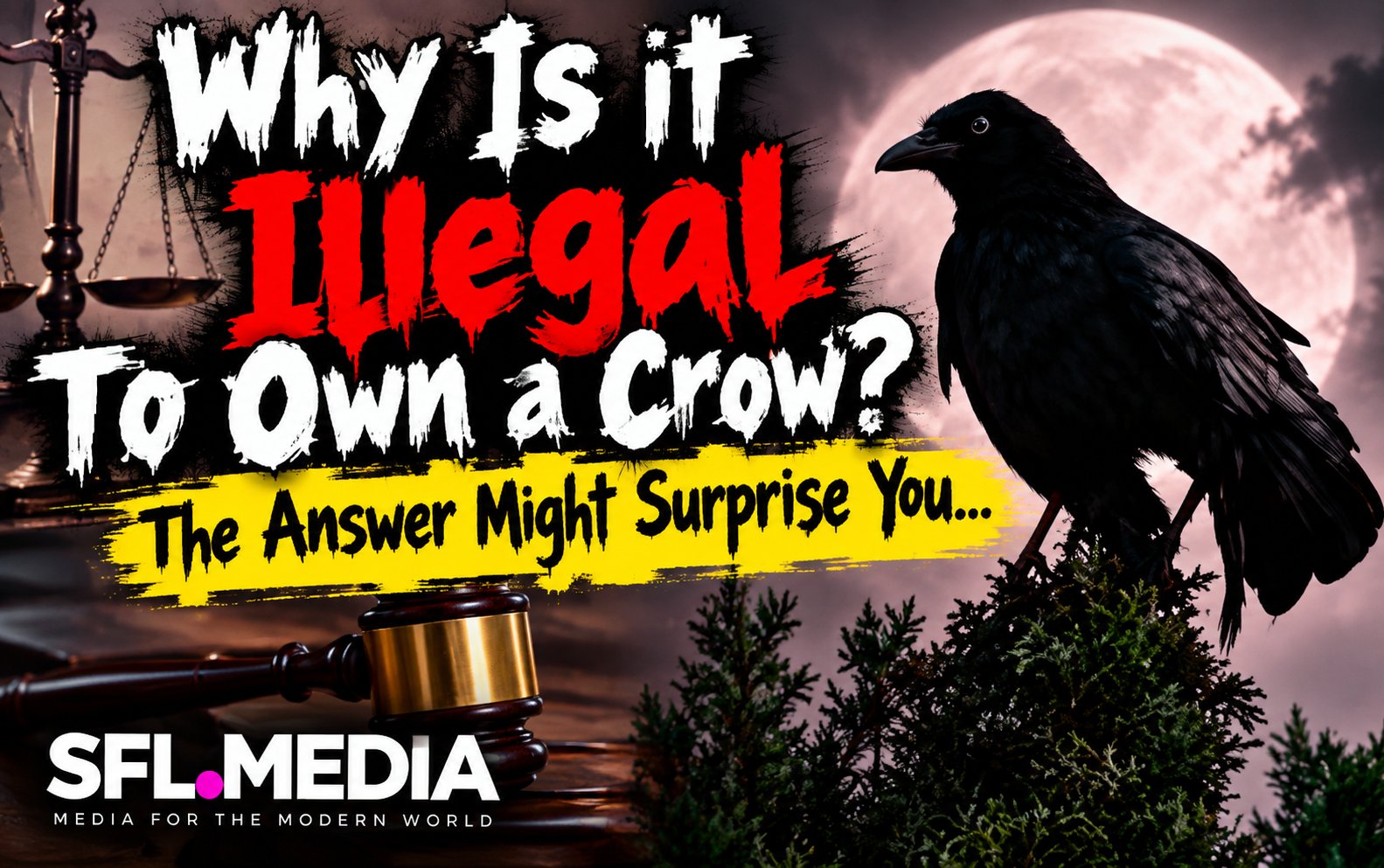
The explanation comes down largely to federal wildlife law, not a determination that crows are too dangerous, too rare, or too intelligent to live with humans. The Migratory Bird Treaty Act of 1918 protects native crows, including American crows and fish crows, from unauthorized capture and possession. The law was designed to protect wild bird populations and implement international conservation agreements. It prohibits capturing, possessing, selling, or transporting protected birds without appropriate authorization.
That explains the legal framework. But it doesn’t entirely settle the question that makes this subject so fascinating: Why does the law treat a common, adaptable crow differently from an exotic bird that might be threatened in its native habitat? And that’s where things get interesting.
Crows Aren’t Endangered, So Why Protect Them This Way?
The American crow is not generally considered an endangered species. It is widespread throughout much of North America and has proved remarkably successful at adapting to human environments. Crows thrive in cities, suburbs, farmland, parks, and forests. They eat a broad variety of foods and can take advantage of opportunities that other animals might miss. In other words, this is not a case of a species teetering on the edge of extinction that needs every individual protected simply to survive.
But there is an important distinction that often gets lost in the debate. A wildlife protection law does not have to be limited to endangered animals. The Migratory Bird Treaty Act protects many species that are abundant today because its purpose is broader than preventing extinction. It also seeks to prevent uncontrolled exploitation and maintain sustainable populations over time. There is a legitimate conservation argument for that approach. A bird can be common today and suffer serious declines tomorrow if millions of people decide they want one as a pet. Protecting wild birds before they become endangered is generally a better strategy than waiting until a population is in crisis.
Still, a reasonable conservation goal does not automatically make every restriction perfectly designed. There is a difference between preventing the mass capture of wild birds for commercial trade and prohibiting an individual from keeping a legally sourced, captive-bred bird under appropriate conditions. That distinction deserves more attention than it typically receives.
Why shouldn’t a qualified person be able to apply for a permit to keep a captive-bred crow, provided the bird’s origin, welfare, and housing can be verified? Federal law already has permit systems for certain wildlife related activities, including scientific research, rehabilitation, education, and other authorized purposes. But those exceptions do not create a general route for ordinary private pet ownership of native crows.
The result is a system in which the average person who wants to own a native crow has very little legal room to maneuver, regardless of how responsible or knowledgeable that person might be.
The Parrot Paradox: Why Can You Own a Macaw but Not an American Crow?
Here is where the apparent double standard becomes harder to ignore.
Macaws, African grey parrots, cockatoos, and other exotic birds can be legally kept as pets in the United States, provided the birds are legally acquired and the applicable federal, state, and local requirements are met. Some species are protected by international trade agreements, and certain endangered birds face substantial restrictions. Nevertheless, captive bred individuals of some protected species can be legally owned under the relevant rules.
The U.S. Department of Agriculture even lists macaws, African greys, and other large parrots among recognized pet bird species. It separately notes that native birds protected under the Migratory Bird Treaty Act are excluded from its definition of pet birds. Read that again. The distinction is not simply whether a bird is endangered, intelligent, exotic, or suitable for captivity. In large part, it is whether the species falls under a particular legal framework.
A scarlet macaw may be legally available from a legitimate breeder, while an American crow raised from an egg in captivity is still subject to federal wildlife protections. Being captive bred does not automatically exempt a native crow from the law. Does that mean the system is necessarily irrational? The United States has a long history of protecting native wildlife from capture and commercial exploitation, while regulating exotic species through a different combination of wildlife, import, and conservation laws.
But it does raise a fair question: Why is the legal system so much more accommodating toward certain exotic birds than toward an intelligent native species that is thriving in our own backyards? The answer is historical and legal, rather than a straightforward scientific judgment about which birds deserve to be pets. And while the rules can be defended on conservation grounds, they can also be criticized for creating a confusing patchwork in which the legal status of an animal depends heavily on its species and origin.
The irony is that some exotic parrots face serious conservation threats in the wild, while American crows are widespread. That doesn’t mean exotic bird ownership is automatically irresponsible, or that every crow should be available at a pet store. It means the distinction deserves a more nuanced public discussion than the simplistic assumption that protected automatically means endangered.
Crows Are Far More Intelligent Than Most People Realize
The most fascinating part of this debate is the bird itself. Crows belong to the corvid family, which also includes ravens, magpies, and jays. Researchers have spent decades studying corvid intelligence, and the findings have challenged old assumptions about the mental abilities of birds.
Their brains are organized differently from mammalian brains, but that has not stopped them from developing impressive cognitive skills. Crows can learn from experience, recognize patterns, solve problems, and adjust their behavior when circumstances change. Think of a crow as having certain problem solving abilities comparable to those of a preschool aged child, roughly 3 to 5 years old.
Here are some of their most remarkable abilities:
They can recognize individual human faces. Research led by University of Washington scientist John Marzluff demonstrated that American crows can recognize people associated with a threatening experience and remember them long after the original encounter. In follow up observations, crows reacted differently to people wearing a particular mask associated with capture, even when those people appeared in different locations. The research also documented how negative reactions could spread among other crows.
Think about what that means in practical terms. A crow may remember the person who frightened or harmed it, recognize that person later, and respond accordingly. That is not merely a reflex to a passing shadow. It involves learning, memory, and the ability to distinguish between individual people.
Some crows manufacture their own tools. New Caledonian crows, a species native to the South Pacific island of New Caledonia, are among the most accomplished tool-using birds known to science. They fashion tools from sticks and plant material, shaping them to extract insects and other food from holes and crevices. In laboratory experiments, researchers have observed these birds combining separate pieces into longer, functional tools.
A 2018 study published in Scientific Reports found that some New Caledonian crows spontaneously assembled multiple components into tools suitable for retrieving food. This is an extraordinary ability because the bird is not simply picking up an object and using it. It is modifying materials to create something more useful. To be precise, these results concern New Caledonian crows, not every crow species. But they demonstrate the remarkable cognitive potential found within the broader crow family.
They can plan for future tasks. A study published in Nature Communications in 2020 tested whether New Caledonian crows could select tools for tasks they would encounter later. Researchers presented the birds with a problem, delayed access to the necessary apparatus, and then offered a choice of objects. The crows selected the appropriate tools for the subsequent task rather than simply choosing whatever had been useful most recently.
Scientists remain careful about exactly what such experiments reveal about animal thought. Demonstrating successful future-oriented behavior does not establish that a crow thinks in precisely the same way a human does. But the research does show that some crows can do considerably more than react to whatever is immediately in front of them.
They learn from one another. Crows are social animals. They observe other birds, learn from experience, and can acquire information about dangers from their social groups. Research on New Caledonian crows has also examined how tool use behaviors are influenced by social learning and individual experience. This matters because intelligence is not just about solving an isolated puzzle. The ability to acquire useful information, retain it, and change behavior based on experience can be just as important for survival.
They are remarkably adaptable. Crows thrive in environments that many other wild animals struggle to navigate. They exploit varied food sources, learn how to access unfamiliar resources, and adjust their behavior to changing conditions. Their success in cities and suburbs is evidence of that flexibility. They have learned to live alongside human beings, taking advantage of everything from discarded food to nesting opportunities in developed areas. Their intelligence is not merely a laboratory curiosity. It helps explain why they are so successful in the real world.
Would a Crow Make For a Good Pet?
This is where the conversation needs a little honesty. An intelligent animal is not automatically an easy animal to keep. Crows are wild birds with complex behavioral needs. They require appropriate space, stimulation, opportunities to forage, and social interaction. Their intelligence can make captivity especially demanding because an understimulated bird may develop serious behavioral problems.
They are also noisy, curious, persistent, and capable of making a considerable mess. Anyone imagining a crow sitting quietly on a perch all day, waiting to provide companionship like a decorative object, has misunderstood the assignment. Parrots have many of these same challenges. Macaws can be loud, destructive, demanding, and extraordinarily long lived. Their legal availability does not mean they are suitable pets for everyone.
There is also an important conservation distinction between a bird bred responsibly in captivity and one taken from the wild. Preventing the removal of wild birds can protect populations, preserve natural behavior, and reduce opportunities for illegal wildlife trafficking. Those are legitimate reasons for regulation. The argument for reconsidering crow ownership is not that every intelligent animal should automatically be available for purchase. It is that responsible captive care and indiscriminate capture are two very different things.
A carefully regulated permit system for qualifying captive bred birds would be a different policy from allowing people to capture wild crows whenever they felt like it. Whether such a system should exist is a reasonable question for lawmakers and wildlife authorities.
Is This Really About Conservation, or Just the Way the Rules Were Written?
The most defensible explanation is that the United States regulates birds according to legal categories established through wildlife legislation and international agreements, not a universal ranking of species by intelligence, rarity, or suitability for captivity.
The Migratory Bird Treaty Act was enacted in 1918, long before modern research revealed the full extent of crow cognition. Its framework reflects a conservation approach built around protecting covered wild bird species from unauthorized exploitation. That history matters. The law was not written because lawmakers discovered that crows were too clever to be trusted around humans. Nor is there evidence that the federal government singled out crows because they are unusually intelligent.
Still, the age of a law does not make it immune to scrutiny. Modern science has changed our understanding of animal cognition, and captive breeding has changed how some species can be acquired without removing individuals from the wild. It is fair to ask whether wildlife policy should better distinguish between taking a bird from nature and keeping a legally bred bird under appropriate conditions. It is equally fair to ask why the public receives such different answers depending on whether the animal in question is a native crow or an exotic parrot.
The counterargument is that creating additional exceptions can complicate enforcement, encourage fraudulent claims about captive breeding, and create markets that increase pressure on wild populations. Those concerns should be taken seriously, not brushed aside. But neither should they end the discussion automatically. A system that distinguishes between responsible ownership, conservation breeding, rehabilitation, and wildlife trafficking would be more nuanced than treating every potential owner as though they intended to raid a nest.
A Crow’s Intelligence Isn’t the Legal Issue, but the Double Standard Is Worth Examining
America’s crow rules are not evidence that the government considers crows too intelligent to own. The central reason is that native crows are covered by federal wildlife protections, while many exotic pet birds fall under different regulatory arrangements. There are sound reasons to protect wild populations, even when a species is abundant. And there are good reasons to be cautious about turning wild animals into pets simply because they fascinate us.
But the comparison with parrots and macaws exposes a genuine policy question. If a bird can be bred legally in captivity, cared for by a qualified owner, and kept without harming wild populations, should its native status automatically close the door to ordinary private ownership? Reasonable people can disagree about the answer. What deserves more scrutiny is the assumption that the existing rules are self evidently the only sensible way to handle the issue.
Crows are intelligent, adaptable, socially sophisticated animals. They recognize individual people, remember past experiences, and, in some species, manufacture tools and select them for future tasks. They are not endangered simply because they are protected, and they are not legally prohibited because someone decided they were too smart for a cage. The real question is whether wildlife laws can protect nature while making more room for responsible, science informed decisions about captive animals.
For now, anyone in the United States who dreams of keeping an American crow should understand the rules before attempting to acquire one. Do not capture a wild crow or assume that raising one from a chick makes it legal to possess. The federal restrictions still apply, and state and local laws may add further limitations. The crow may be smart enough to solve a puzzle, remember your face, and learn from its mistakes. Whether the laws governing it are equally capable of adapting to new information is a question worth asking.
Sources For Article
U.S. Fish & Wildlife Service: fws.gov
. The federal law and its purpose.
U.S. Fish & Wildlife Service: fws.gov
. The types of activities that may be authorized under federal regulations.
U.S. Department of Agriculture: aphis.usda.gov
. How federal regulations categorize pet bird species.
Yale University Press: yalebooks.yale.edu
. Research and observations concerning American crows’ recognition of individual humans.
Scientific Reports: nature.com
. Research on crows assembling tools from multiple components.
Proceedings of the Royal Society B / PubMed Central: pmc.ncbi.nlm.nih.gov
. Experimental research on future-oriented tool selection.














































Want to join the conversation?
Create an account or sign in to share your thoughts, vote,
and reply to other readers.
Showing 0 of 0 comments
Don't have an account?
Already have an account?