
Federal Agents Raid Rep. Ilhan Omar’s Home Weeks Before Midterms, Targeting Immigration Records From Her Childhood
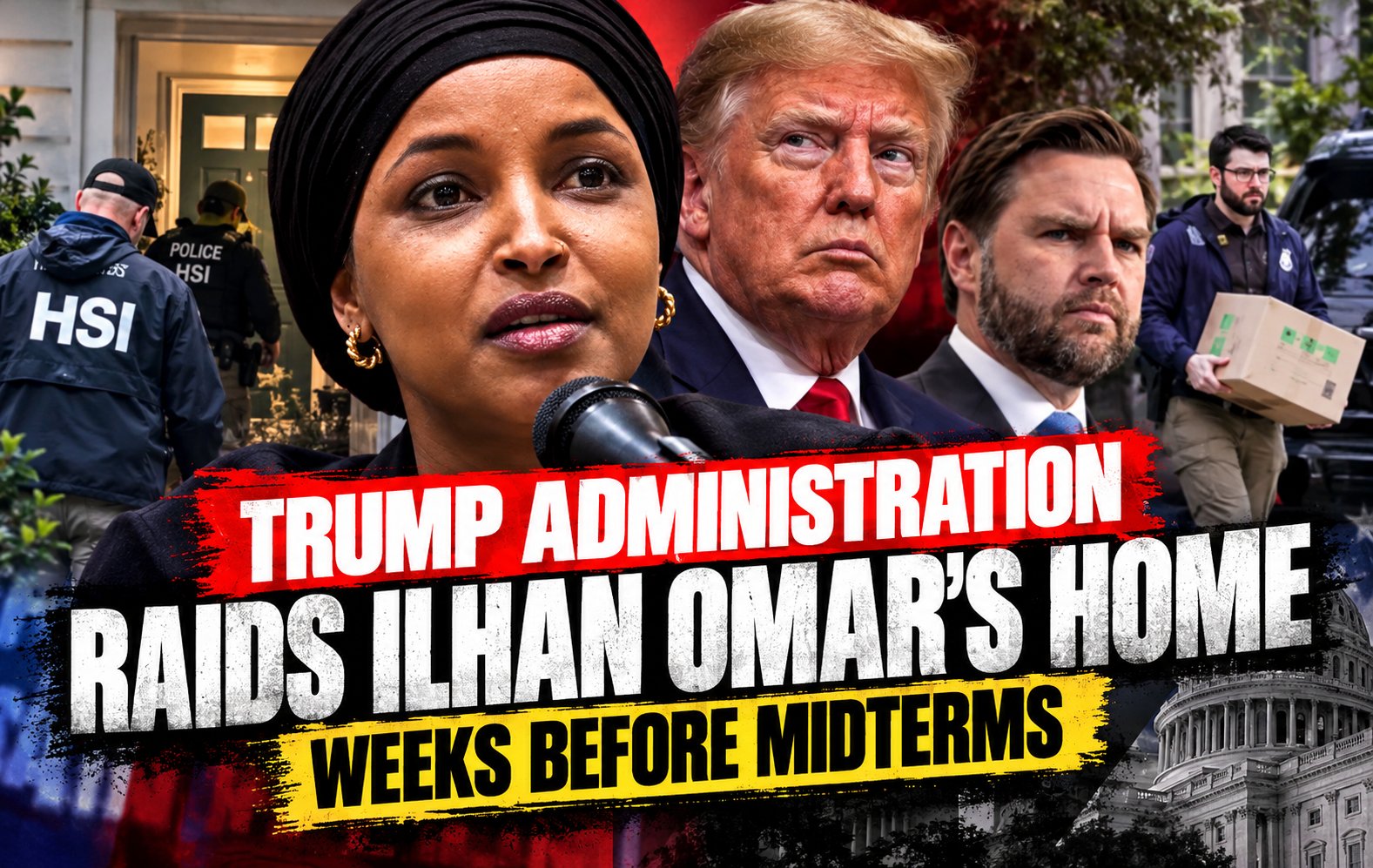
WASHINGTON, D.C. — Federal agents working under President Donald Trump’s administration conducted a predawn raid on the Washington home of Democratic Congresswoman Ilhan Omar on Monday, October 12, in an extraordinary escalation of a federal immigration investigation targeting one of the president’s most outspoken political opponents. The search, carried out just 22 days before the November 3 midterm elections, has ignited accusations of political intimidation, abuse of federal law enforcement powers, and interference in the democratic process. Perhaps most troubling is the reported focus of the investigation: immigration documents prepared more than three decades ago, when Omar was a 12 year old refugee fleeing Somalia with her family.
Agents from Homeland Security Investigations (HSI), the criminal investigative division of Immigration and Customs Enforcement, descended on Omar’s Washington residence with a judicially authorized search warrant secured by the Department of Justice. Federal officials confirmed the operation was connected to an ongoing criminal investigation but have not publicly disclosed the evidence supporting the warrant, identified specific criminal charges, or explained why the investigation required a highly visible search of a sitting member of Congress less than a month before voters head to the polls. Omar, who has repeatedly denied allegations of immigration fraud, immediately condemned the operation as an attempt to intimidate political opposition.
The raid presents an unusually consequential collision between federal law enforcement authority, the constitutional rights of an elected representative, and the political interests of the administration overseeing the investigation. Federal officials maintain that the search was legally authorized, while Democratic leaders argue that its timing, circumstances, and the administration’s longstanding hostility toward Omar raise serious questions about whether the machinery of government is being used against a political adversary.
Federal Agents Search Omar’s Home Over Immigration Records Dating Back to the 1990s
According to reporting by CBS News, Reuters, and The Washington Post, federal investigators are examining possible false statements and immigration fraud involving documentation associated with Omar’s arrival in the United States. The documents reportedly include paperwork completed by her late father when she was a child. Omar was born in Somalia in 1982, fled the country’s civil war with her family, spent several years in a refugee camp in Kenya, and entered the United States in 1995 at approximately 12 years old. She became a naturalized American citizen in 2000, nearly two decades before winning election to Congress in 2018.
The involvement of paperwork prepared during Omar’s childhood is particularly significant because it raises questions about personal responsibility, the passage of time, and the government’s legal theory. Immigration applications can contain statements made by parents or guardians on behalf of minor children, and the existence of an error or misrepresentation in those documents would not automatically establish that a child knowingly participated in fraud. Whether investigators believe Omar personally made false statements, subsequently relied on inaccurate information, or engaged in some other conduct has not been publicly established.
The Justice Department confirmed that HSI agents executed a judicially authorized search warrant in connection with an ongoing criminal investigation. CBS News reported that Attorney General Todd Blanche was personally aware of the operation and that the Justice Department consulted its Public Integrity Section, which handles sensitive matters involving public officials and election-related investigations. The Washington Post further reported, citing a government official, that Blanche approved the search. Those details indicate that the operation received attention at senior levels of the Justice Department, although they do not establish that the White House directed it.
A federal search warrant requires judicial authorization based on probable cause that evidence of a crime is likely to be found at the location being searched. That is an important legal safeguard, but it is not a determination of guilt. Nor does judicial approval resolve the separate question of whether prosecutors exercised appropriate discretion in pursuing an investigative action involving an elected official shortly before an election. As of the latest reporting reviewed for this article, no criminal charge against Omar had been publicly announced in connection with the search.
Why Is the Government Investigating Documents Her Father Prepared When She Was a Child?
The circumstances surrounding Omar’s immigration history create an obvious and consequential question: What evidence would justify investigating a sitting American congresswoman in 2026 over immigration paperwork originating in 1995, particularly when some of that documentation was reportedly prepared by her father?
Federal immigration law distinguishes between criminal immigration offenses, civil denaturalization proceedings, and deportation proceedings, each involving different legal standards and potential time limitations. Contrary to suggestions that immigration fraud can always be prosecuted criminally regardless of how much time has passed, federal criminal offenses generally face statutes of limitations, with certain immigration-related offenses subject to specific exceptions or extended periods. Civil denaturalization proceedings can involve much older conduct, but the government must still establish the applicable legal grounds for revoking citizenship.
The fact that Omar entered the country as a minor does not automatically immunize every aspect of her immigration history from scrutiny. However, it makes the distinction between conduct attributable to her and conduct attributable to adults acting on her behalf especially important. Investigators would need a legally supportable basis for any allegation directed at Omar herself, rather than simply identifying disputed information in documents associated with her family.
The government has not publicly released the warrant affidavit or a detailed explanation of the suspected offenses. Consequently, the public cannot independently evaluate whether investigators have uncovered substantial evidence, whether the inquiry concerns information Omar knew about as an adult, or whether the allegations are rooted in longstanding political accusations that have circulated without substantiation.
That uncertainty matters because a search of this magnitude can inflict political and reputational damage even if it produces no criminal charges. For an elected official seeking reelection, the spectacle of federal agents searching her residence can become a defining campaign event before voters ever learn what evidence investigators actually possess.
The Timing: Just 22 Days Before the 2026 Midterm Elections
The decision to execute the search on October 12 places the operation directly inside a period when the Justice Department has historically exercised particular caution about investigative actions that could influence elections. Omar is seeking reelection in Minnesota’s Fifth Congressional District, and the November 3 midterms will determine control of the House of Representatives and Senate.
Justice Department policies and longstanding prosecutorial practices discourage investigators from taking overt steps for the purpose of affecting an election. The commonly discussed 60-day preelection period is not an absolute statutory prohibition on investigative activity, and federal authorities may pursue legitimate investigations when circumstances warrant. Nevertheless, public searches, indictments, and other highly visible actions involving candidates are especially sensitive because of their potential effect on voters.
The Washington Post reported that Justice Department officials consulted the Public Integrity Section before proceeding, suggesting the administration recognized the political sensitivity of the search. That consultation may satisfy an important procedural requirement, but it does not by itself establish that the timing was necessary or that political considerations played no role in the decision.
The broader concern is not simply that a politician’s home was searched. Elected officials are not above the law, and membership in Congress does not provide blanket immunity from criminal investigation. The concern is whether federal investigative powers are being applied impartially when the subject is a prominent opponent of the president, the underlying allegations concern decades old immigration records, and senior administration officials have spent months publicly discussing efforts to investigate her.
There is currently insufficient public evidence to conclude that the raid was ordered to influence the election. There is also insufficient information to dismiss questions about its timing as irrelevant. Both realities must be acknowledged in evaluating the government’s conduct.
Trump’s Long Campaign Against Ilhan Omar Raises Questions About Political Retaliation
Omar has been a frequent target of Trump’s criticism since his first presidency. A Somali born Muslim woman and prominent progressive Democrat, she has challenged the administration on immigration enforcement, foreign policy, civil rights, and the treatment of minority communities. Trump has repeatedly attacked her personally, questioned her immigration background, and amplified allegations about her family history that Omar has rejected.
In the months preceding the raid, senior administration officials publicly discussed an investigation into Omar’s immigration status. White House border czar Tom Homan acknowledged in September that an inquiry was underway, while Vice President JD Vance had previously spoken about examining allegations involving the congresswoman. Homeland Security Secretary Markwayne Mullin also discussed an investigation concerning Omar’s immigration history, including allegations about her family’s original entry into the country.
Those statements are significant because they establish that Omar’s immigration background was not merely the subject of a confidential law enforcement inquiry. It had already become a topic of public discussion among senior political figures in the administration. The president himself continued attacking Omar shortly before the search, according to reporting by The Washington Post.
When questioned about the raid, Trump denied personal involvement, saying he had nothing to do with the operation and that the matter belonged to the Justice Department. He nevertheless continued criticizing Omar, describing her as a terrible person and suggesting that authorities were examining her closely.
The president’s denial is an important part of the record. No publicly disclosed evidence establishes that Trump personally ordered the raid, directed investigators to pursue Omar, or instructed the Justice Department to execute the search before the election. At the same time, his administration’s repeated public attacks on the congresswoman provide relevant context for evaluating concerns about prosecutorial independence.
The distinction is critical. Political hostility does not automatically invalidate a legitimate criminal investigation. But when federal officials publicly identify a political adversary as a target of scrutiny and investigators subsequently conduct a highly visible search of that adversary’s home, the government faces a heightened obligation to demonstrate that its decisions are grounded in evidence rather than political pressure.
Omar Responds: “I Will Not Be Silenced”
Omar responded to the raid by accusing the administration of attempting to intimidate her and silence political opposition. In a statement posted to social media, she said she was safe and described the search as part of a continuing campaign of political harassment.
“Make no mistake: this is an attempt to target political enemies and weaponize federal law enforcement.”
She added that Trump had targeted her with allegations and personal attacks for years and characterized the search as another escalation. Her office issued a separate statement denying wrongdoing and condemning the operation as an abuse of federal power. The congresswoman’s response reflects the broader political implications of the investigation. Omar is not merely a private citizen whose historical immigration records have attracted federal scrutiny. She is an elected member of the legislative branch, representing hundreds of thousands of constituents who chose her through the democratic process. An investigation targeting her therefore carries consequences extending beyond her personal legal interests.
That does not mean the government is prohibited from investigating members of Congress. It means that the public has a legitimate interest in understanding whether the investigation is being conducted according to neutral legal standards, particularly when the subject is a politician repeatedly singled out by the president.
Omar has also faced threats and harassment throughout her political career. Earlier in 2026, an assailant sprayed her with a liquid during a public town hall meeting in Minneapolis. The incident underscored the security risks surrounding an elected official who has been the subject of intense political hostility. While that attack is separate from the federal investigation, it illustrates the potentially serious consequences of the climate surrounding her public role.
Democratic Leaders Condemn the Search as an Abuse of Federal Power
House Democratic Leader Hakeem Jeffries, Democratic Whip Katherine Clark, and Democratic Caucus Chair Pete Aguilar issued a joint statement condemning the search and questioning the administration’s use of federal law enforcement against its political opponents. They described the operation as deeply disturbing and pledged to seek accountability for what they characterized as an abuse of government power.
Minnesota Governor Tim Walz also criticized the raid, accusing Trump of using his authority to pursue political adversaries shortly before an election. Minnesota Attorney General Keith Ellison and other Democratic officials expressed similar concerns, with critics pointing to the administration’s broader immigration enforcement policies and repeated attacks on Somali Americans.
Republican responses have emphasized the principle that elected officials must remain subject to criminal investigation. Republican Representative Nancy Mace said that if immigration fraud were proven, Omar should face denaturalization and removal from the United States. Her statement, however, was conditional on proof of wrongdoing, something federal investigators have not publicly presented.
The opposing positions expose the central dispute. Republicans defending the investigation argue that a congressional seat cannot shield someone from accountability for immigration fraud. Democrats argue that the administration is using allegations against a political opponent to justify an intrusive investigation at a moment when the political consequences are particularly significant. Both claims ultimately depend on facts that remain unavailable to the public, including the warrant affidavit, the underlying evidence, and the reasoning behind the timing of the operation.
A Broader Pattern of Investigations Into Trump’s Political Adversaries
The search of Omar’s residence comes amid a wider series of federal investigations involving individuals who have publicly opposed Trump. During his second administration, federal authorities have pursued criminal cases or investigations involving former FBI Director James Comey, New York Attorney General Letitia James, former national security adviser John Bolton, and other prominent figures who have clashed with the president.
The legal circumstances of those cases differ substantially, and the existence of multiple investigations does not by itself prove a coordinated campaign of political retaliation. Nevertheless, the pattern has intensified scrutiny of the Justice Department’s independence, particularly when the president has publicly expressed hostility toward individuals subsequently subjected to federal investigative action.
The Omar investigation adds another dimension because it involves a naturalized American citizen serving in Congress and allegations concerning her family’s arrival in the United States more than 30 years ago. It also occurs against a political backdrop in which Trump has repeatedly criticized Somali immigrants and questioned Omar’s place in American public life.
For critics, the concern extends beyond whether any individual investigation produces charges. It is whether the threat of federal scrutiny can discourage elected officials from criticizing the executive branch, particularly when investigators have broad authority to search homes, seize records, and pursue criminal inquiries. For defenders of the administration, the answer remains that allegations of unlawful conduct must be investigated regardless of the political identity of the person involved.
The appropriate standard is the same in either circumstance: investigators must follow the evidence, prosecutors must exercise independent judgment, and government authority must not be deployed for the purpose of punishing political disagreement.
What Happens Next, and What the Government Still Needs to Explain
The investigation now presents several unresolved questions. Federal authorities have not publicly identified the precise offenses under examination, explained how the alleged conduct relates to Omar personally rather than to paperwork prepared by her father, or disclosed what evidence justified searching her home. The public also does not know whether investigators attempted less intrusive methods of obtaining the records, what materials were seized, or whether prosecutors anticipate filing charges.
Some of those details may remain confidential while the investigation continues, and federal authorities are not generally required to disclose the entirety of an active criminal investigation. But the political sensitivity of this case makes eventual transparency especially important. If investigators possess credible evidence of criminal conduct, the government should be able to present that evidence through established legal procedures. If the investigation fails to substantiate the allegations, the public will have reason to scrutinize why such an extraordinary operation was undertaken so close to an election.
The distinction between lawful investigation and political intimidation cannot be resolved by partisan rhetoric alone. It requires examining the evidence, the legal basis for the search, the decisions made by senior Justice Department officials, and whether established safeguards against election interference were meaningfully followed. Omar remains an elected member of Congress, and the search itself does not establish criminal wrongdoing. Her constituents retain the right to evaluate her political positions, criticize her record, and decide whether she deserves reelection. Those democratic rights exist independently of the president’s personal opinions about her.
The larger issue raised by the raid is therefore not whether Ilhan Omar should be immune from investigation. She should not be. It is whether the federal government can demonstrate that a predawn search targeting a sitting opposition lawmaker, based on allegations involving decades-old immigration records, was driven by legitimate investigative necessity rather than political considerations. With the midterm elections approaching and the evidence underlying the investigation still largely concealed from public view, that question remains unanswered. The administration has the authority to investigate suspected crimes. It also has a responsibility to ensure that the extraordinary powers of federal law enforcement are exercised without regard to political allegiance.
In a constitutional democracy, those two obligations must coexist. The raid on Ilhan Omar’s home has made the public’s ability to distinguish between them an urgent question.

Sources and Further Reading
Reuters — October 12, 2026: U.S. Immigration Authorities Raid Home of Democratic Trump Critic Ilhan Omar
CBS News — October 12, 2026: Rep. Ilhan Omar’s D.C. Home Searched by Homeland Security Investigators
The Washington Post — October 12, 2026: Federal Agents Search Rep. Ilhan Omar’s D.C. Home
Associated Press via The Washington Post — October 12, 2026: Agents Search Rep. Omar’s Washington Home in Criminal Probe
Axios — October 12, 2026: Ilhan Omar’s Home Raided by Federal Agents in Immigration Probe
Fox News — October 12, 2026: Immigration Enforcement Officials Search Ilhan Omar’s Home in Predawn Raid
Video provided for this report: Watch the YouTube Discussion














































Want to join the conversation?
Create an account or sign in to share your thoughts, vote,
and reply to other readers.
Showing 0 of 0 comments
Don't have an account?
Already have an account?