
Marten Lou Transforms London’s Natural History Museum Into a Spectacular Underground House Music Experience
German electronic music producer and DJ Marten Lou delivered one of the more visually distinctive performances of London’s 2026 house music calendar, transforming the historic Natural History Museum into an extraordinary dance floor filled with hypnotic Afro house rhythms, atmospheric melodies, and the unmistakable energy of a modern underground club night.
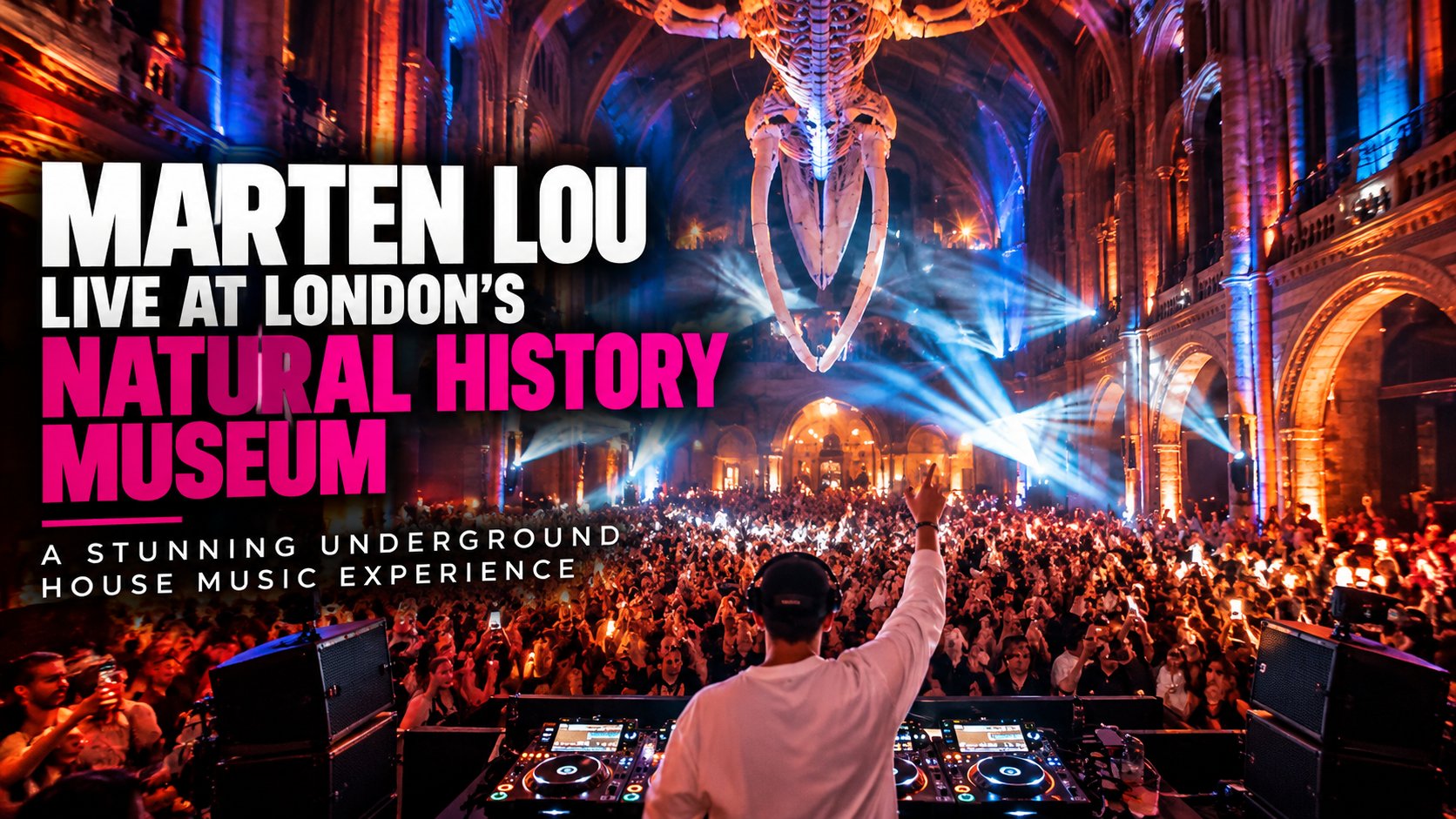
On May 9, 2026, Lou headlined MTRNM’s Night at the Museum inside the museum’s famous Hintze Hall, performing beneath the enormous skeleton of a blue whale suspended above the venue’s main floor. The event brought contemporary electronic music into one of Britain’s most recognizable cultural institutions, combining the grandeur of Victorian architecture with sophisticated lighting, concert grade sound, and an audience of approximately 1,200 people, according to the event’s production company.
The performance, subsequently made available as an approximately 101 minute recording, captures the musical identity that has helped Lou emerge as a rising figure in international house music. His approach moves between deep house, Afro house, and melodic electronic production, combining driving percussion with emotionally expressive vocals and carefully layered synthesizers.
For listeners familiar with the musical worlds of Keinemusik, CamelPhat, and Adriatique, the recording offers a compelling example of the direction contemporary house music has taken. Rather than depending entirely on explosive drops or relentless intensity, Lou creates momentum through groove, atmosphere, and the gradual development of musical tension.
The result is both a DJ performance and an audiovisual experience, demonstrating how electronic music can transform an architectural landmark without losing the intimacy and musical character that define underground club culture.
Who Is Marten Lou? The German Producer Making His Mark on Global House Music
Marten Lou has developed an international following through productions and performances that combine the rhythmic foundations of house music with the emotional accessibility of melodic electronic music. His catalog includes My Love for You (Yebba’s Heartbreak), Your Body, Late Night with Foals, and Save Me with CamelPhat, illustrating his ability to work across vocal-driven house, atmospheric productions, and more club-oriented material.
His musical style draws from several overlapping traditions. Deep house contributes warmth and repetition, Afro house supplies percussion driven energy, and melodic house introduces expansive synthesizers and emotionally resonant arrangements. The combination creates a sound that can work in intimate nightclubs, outdoor venues, and large-scale electronic music events without becoming dependent on a single production formula.
Lou’s growing profile also reflects the international popularity of house music that prioritizes atmosphere and groove. Audiences increasingly encounter these sounds through extended DJ recordings, destination events, and online performances, where an artist’s ability to sustain a musical journey can be just as important as individual hit records.
That emphasis on continuity is especially apparent in Lou’s Natural History Museum performance. The extended format gives his selections room to develop, allowing rhythmic passages and melodic ideas to connect across tracks rather than treating each record as an isolated moment.
From Yebba’s Heartbreak to CamelPhat: The Releases Behind Marten Lou’s Rise
One of the recordings most closely associated with Lou’s early recognition is My Love for You (Yebba’s Heartbreak), which helped establish his reputation for incorporating emotionally expressive vocal material into house music. The track reflects an approach in which the vocal is not merely decoration but a central element around which the rhythm and arrangement develop.
Lou subsequently expanded his catalog through releases that demonstrated his versatility as a producer. Your Body became another recognizable title, while his 2025 collaboration with British alternative rock band Foals brought a different musical influence into his electronic production.
Released in August 2025, Late Night, credited to Marten Lou and Foals, reworks the band’s material for a contemporary electronic setting. The production illustrates how Lou can preserve the emotional identity of a song while giving it a new rhythmic framework suited to DJ performances.
His collaboration with CamelPhat on Save Me further connected him with established names in the melodic house scene. The track also received a remix from Belgian producers Ajna and Samm, whose interpretation introduced a darker, more percussion driven character.
These releases help explain why Lou’s music has attracted attention across different corners of the house music audience. His work is accessible enough to appeal to listeners who appreciate memorable melodies and vocals, while retaining the rhythmic structure and musical progression expected from an extended club set.
London’s Natural History Museum Becomes a Dance Floor Beneath a Blue Whale
The Natural History Museum is one of London’s most prominent cultural institutions, known internationally for its scientific collections, historic architecture, and exhibitions exploring the natural world. Its South Kensington building opened in 1881 and remains one of the city’s most recognizable examples of Victorian Romanesque architecture.
At the center of the building is Hintze Hall, the museum’s monumental entrance space, where the suspended skeleton of a blue whale provides one of its most memorable visual features. The hall’s stone arches, grand staircase, and dramatic proportions create an environment far removed from the industrial warehouses and conventional nightclubs normally associated with underground electronic music.
For MTRNM’s London event, that historic setting became part of the production itself. According to technical production company Kudos AV, the sold out event accommodated approximately 1,200 guests and required a concert-grade sound system, moving head lighting, laser effects, architectural uplighting, and a dedicated DJ stage.
The production presented a particular technical challenge because the venue is a protected historic building. Sound and lighting equipment had to be installed without damaging the building’s architectural fabric, while the hall’s stone and glass surfaces required careful consideration of acoustics. Kudos AV reported that its team designed the audio system specifically for the space and integrated lighting around the museum’s architectural features. The result was a full electronic music production within a building that was never originally designed to accommodate contemporary club events.
That combination of modern technology and historic architecture is central to the performance’s appeal. The museum did not simply provide a background for the music; its scale, design, and visual character became part of the atmosphere.
MTRNM’s Night at the Museum Brings a Los Angeles Concept to London
The May 9 performance was organized by MTRNM as the London edition of its Night at the Museum concept, which the promoter had previously developed in Los Angeles. The London lineup featured Marten Lou alongside OSCAAR and Rahbani, with the event advertised as an evening of deep house and Afro house.
Resident Advisor listed the event as running from 9 p.m. until 2 a.m., placing the performance within the format of a full club night rather than a short promotional recording or a standalone studio session. That distinction matters because the recording represents an actual event with an audience, supporting artists, and a complete technical production. The atmosphere was shaped not only by the venue but also by the energy of people experiencing the music together.
The event also reflects the increasing willingness of cultural institutions and independent promoters to experiment with unconventional programming. Historic buildings, museums, and other architectural landmarks can offer distinctive environments for electronic music, while attracting audiences who may not ordinarily attend conventional nightclub events.
Such productions nevertheless require careful planning. Protected buildings impose restrictions on equipment installation, sound management, and audience movement, while organizers must account for conservation requirements and the operational needs of the venue.
MTRNM’s London event demonstrates how those challenges can be addressed while preserving the essential character of a club night. Rather than replacing underground house music with a purely theatrical presentation, the production used the museum’s architecture to amplify the atmosphere of the performance.
Inside the Set: Melodic House, Afro House Grooves and Emotional Club Anthems
The recording runs approximately one hour and 41 minutes and moves through a selection of contemporary electronic music that reflects Lou’s musical identity. Its combination of percussion driven house, melodic arrangements, and recognizable vocal material creates a performance that feels cohesive despite drawing from multiple producers and styles.
Among the tracks identified in the recording are Hurricane by Tripolism and Kingstarlight, So Good by CamelPhat and Josh Gigante featuring Kuuda, and I See U by HotLap. These selections reflect the rhythmic and atmospheric qualities that have become increasingly prominent in melodic and Afro-influenced house music.
Lou’s collaboration with Foals on Late Night also appears in the independently indexed recording, introducing an alternative rock influence into the electronic framework. Other identified selections include Memoria Bruta by Mike Gannu and Anido, Edge of Desire in its Grigoré and Serve Cold remix, and the Ajna and Samm remix of Save Me by CamelPhat and Marten Lou.
The recording also includes Bringing the Noise by Ajna and Sentin, along with Lou’s remix of Naomi Sharon’s Another Life. The latter provides another example of his interest in combining expressive vocal performances with sophisticated electronic arrangements. An important distinction is that the available third-party track identification covers only part of the performance. The indexing service Djooni identifies approximately 42 minutes of music within the 101-minute recording, leaving substantial portions without confirmed track information. Some identifications also reference release dates after the May 9 event, meaning the versions played may have been unreleased at the time.
Additionally, a longer tracklist circulating online belongs to Lou’s separate 2026 performance at Lisbon’s MAAT museum. Although several selections overlap, that Lisbon tracklist should not be presented as the complete running order for the Natural History Museum performance. In particular, the supplied references to Only Us by Deco (BE), Spotlight by Andrea Oliva, and Your Body cannot be independently confirmed as selections in this London recording.
Even without a definitive complete tracklist, the identified music provides a clear picture of Lou’s approach. The performance favors steady rhythmic development, carefully chosen vocal moments, and transitions between atmospheric passages and more forceful club productions.
Why the Natural History Museum Is Such an Extraordinary Setting for House Music
Part of what makes the performance memorable is the contrast between the music and its surroundings. Electronic house music is built around repetition, rhythm, technology, and the relationship between DJs and audiences. The Natural History Museum, by comparison, is a monument to scientific discovery, natural history, and architectural preservation.
Bringing those worlds together creates an experience that neither setting could produce independently. The museum’s monumental interior gives the music a dramatic visual identity, while the energy of the dance floor temporarily transforms a familiar cultural landmark into a contemporary performance venue. The famous blue whale skeleton is particularly significant to the visual presentation. Suspended above Hintze Hall, it provides an unmistakable sense of scale, emphasizing the extraordinary location in which the event took place.
The building’s architectural features also contribute to the atmosphere. Illuminated arches, the grand staircase, and the surrounding stonework become elements of the production, creating visual depth that conventional stage scenery would struggle to reproduce. For viewers watching the recorded performance, the museum setting provides an additional reason to remain engaged. The experience is not simply about hearing a DJ play a collection of records. It is about seeing electronic music occupy an environment normally associated with an entirely different cultural experience.
That relationship between location and performance has become increasingly important in the digital distribution of electronic music.
From Cercle to Historic Landmarks: Why Destination DJ Sets Have Become a Global Phenomenon
Over the past decade, electronic music performances filmed in distinctive locations have developed into an influential format within the international dance music industry. Platforms such as Cercle have helped popularize the idea that a DJ set can function as both a musical performance and a cinematic presentation of an extraordinary destination.
The concept has expanded beyond remote landscapes and dramatic outdoor locations to include rooftops, historic buildings, architectural landmarks, and cultural institutions. For audiences watching online, the setting becomes an important part of the performance’s identity, distinguishing it from the thousands of conventional club recordings available on streaming platforms.
These performances also create opportunities for artists whose music depends on atmosphere and gradual progression. Melodic house, organic house, and Afro-house can be particularly effective in visually striking environments because their arrangements often leave room for the surroundings to contribute to the emotional experience.
Lou’s Natural History Museum performance fits naturally within that broader movement, although it is important to distinguish the event from an official Cercle production. The London show was organized by MTRNM and produced as a live club event rather than as part of Cercle’s own performance series. The wider trend nevertheless demonstrates how electronic music is evolving beyond traditional nightlife environments. Artists and promoters are finding new ways to present dance music as an experience that combines sound, architecture, visual production, and cultural identity.
For the industry, the format offers another advantage: longevity. A conventional nightclub performance may be remembered primarily by the people who attended, while a professionally recorded landmark set can continue reaching international audiences long after the event has ended.
The Growing Influence of Melodic and Afro House on International Dance Music
Lou’s sound also reflects the expanding influence of melodic and Afro influenced house music across international club culture. These styles have gained visibility through festivals, independent labels, destination events, and influential DJs who emphasize groove and musical progression rather than relying exclusively on dramatic drops. Afro house draws from a broad range of musical traditions and production approaches, with percussion and rhythmic complexity often occupying a central role. Melodic house generally places greater emphasis on sustained harmonies, atmospheric synthesizers, and emotionally driven arrangements. In contemporary DJ performances, these influences frequently overlap.
The result is a musical environment in which producers can combine deep rhythmic foundations with expansive melodic ideas, creating sets that work across different audiences and venues.
Artists and collectives associated with Keinemusik have helped introduce related sounds to a wider international audience, while established acts such as CamelPhat and Adriatique have contributed to the popularity of melodic electronic music on major stages. Lou’s productions occupy a space within this broader movement. His work combines accessible vocal material with rhythmic arrangements that retain their club functionality, allowing his music to connect with both casual listeners and dedicated electronic music audiences.
The Natural History Museum performance demonstrates the versatility of that approach. The music can sustain the energy of a large live audience while also functioning as an extended listening experience for people watching the recording at home.
Marten Lou’s London Performance Shows How Far Electronic Music Culture Has Evolved
There was a time when underground electronic music was largely associated with warehouses, independent clubs, and venues operating outside established cultural institutions. Those environments remain essential to dance music, but the international scene has expanded considerably.
Electronic music now regularly appears in historic landmarks, art spaces, major festivals, and other locations that would once have seemed incompatible with nightclub culture. That expansion has created new opportunities for artists, while also raising questions about how underground music maintains its identity as it reaches increasingly mainstream audiences.
Marten Lou’s performance at the Natural History Museum illustrates both sides of that evolution. The production was sophisticated, the venue was internationally recognizable, and the event was designed to create a memorable audiovisual experience. Yet the music itself remained rooted in the rhythmic and atmospheric qualities of contemporary house.
The success of the evening, as documented by its production team, suggests that an elaborate location does not have to overshadow the music. When the production and musical direction complement one another, the setting can strengthen the experience rather than distract from it. For Lou, the London appearance represents another milestone in a growing international career. His catalog of releases, collaborations, and performances continues to establish his presence within a competitive global electronic music scene.
For listeners, the recording offers something equally valuable: an extended opportunity to experience an artist whose musical identity is built around the connection between rhythm, melody, and atmosphere.
A Night at the Museum That Belonged to the Dance Floor
The most compelling aspect of Marten Lou’s Natural History Museum performance is not simply that an electronic music event took place inside a famous London landmark. It is the way the music and the location worked together to create an experience that would have been difficult to reproduce in a conventional venue.
Beneath the museum’s suspended blue whale skeleton, contemporary house music occupied a space shaped by more than a century of architectural and cultural history. Modern lighting illuminated Victorian stonework, electronic rhythms filled a hall designed for public education, and an audience gathered for an evening that temporarily transformed the institution’s familiar identity.
The performance also illustrates why Lou has attracted attention within the international melodic house scene. His musical approach emphasizes groove, atmosphere, and emotional continuity, qualities that translate particularly well to extended recordings and visually distinctive venues.
As electronic music continues expanding into new cultural spaces, events such as MTRNM’s Night at the Museum demonstrate how the relationship between music and location can become part of the artistic experience. For one night in London, a museum dedicated to the natural world became a showcase for the evolving world of electronic music. Marten Lou supplied the soundtrack, and Hintze Hall provided a setting unlike almost anything found on a conventional dance floor.
Sources & Further Reading

Event Verification and Production
Full Performance and Music
SFL Media Related Electronic Music Coverage














































Want to join the conversation?
Create an account or sign in to share your thoughts, vote,
and reply to other readers.
Showing 0 of 0 comments
Don't have an account?
Already have an account?