
Jared Kushner and the Remarkable Art of Getting Muslim Nations to Invest in the Israeli War Machine
President Donald Trump’s son in law raised billions of dollars from Middle Eastern governments, built a private equity empire with a billion dollar stake in an Israeli financial giant, and returned to the region to negotiate peace. A CNN investigation has now revealed that the Israeli company holds more than $456 million in investments tied to military suppliers, exposing an extraordinary intersection of Arab sovereign wealth, Israeli defense contractors, private profit, and American foreign policy.
The Extraordinary Financial Contradiction Behind Jared Kushner’s Middle East Diplomacy
Jared Kushner has spent much of his political career presenting himself as a businessman uniquely capable of bringing Israel and the Arab world closer together. As President Donald Trump’s son in law, a former senior White House adviser, and one of the principal architects of the Abraham Accords, Kushner developed relationships with some of the Middle East’s most powerful governments. After leaving the White House in 2021, he converted his experience and regional connections into a private investment business that attracted billions of dollars from investors linked to Saudi Arabia, Qatar, and the United Arab Emirates.
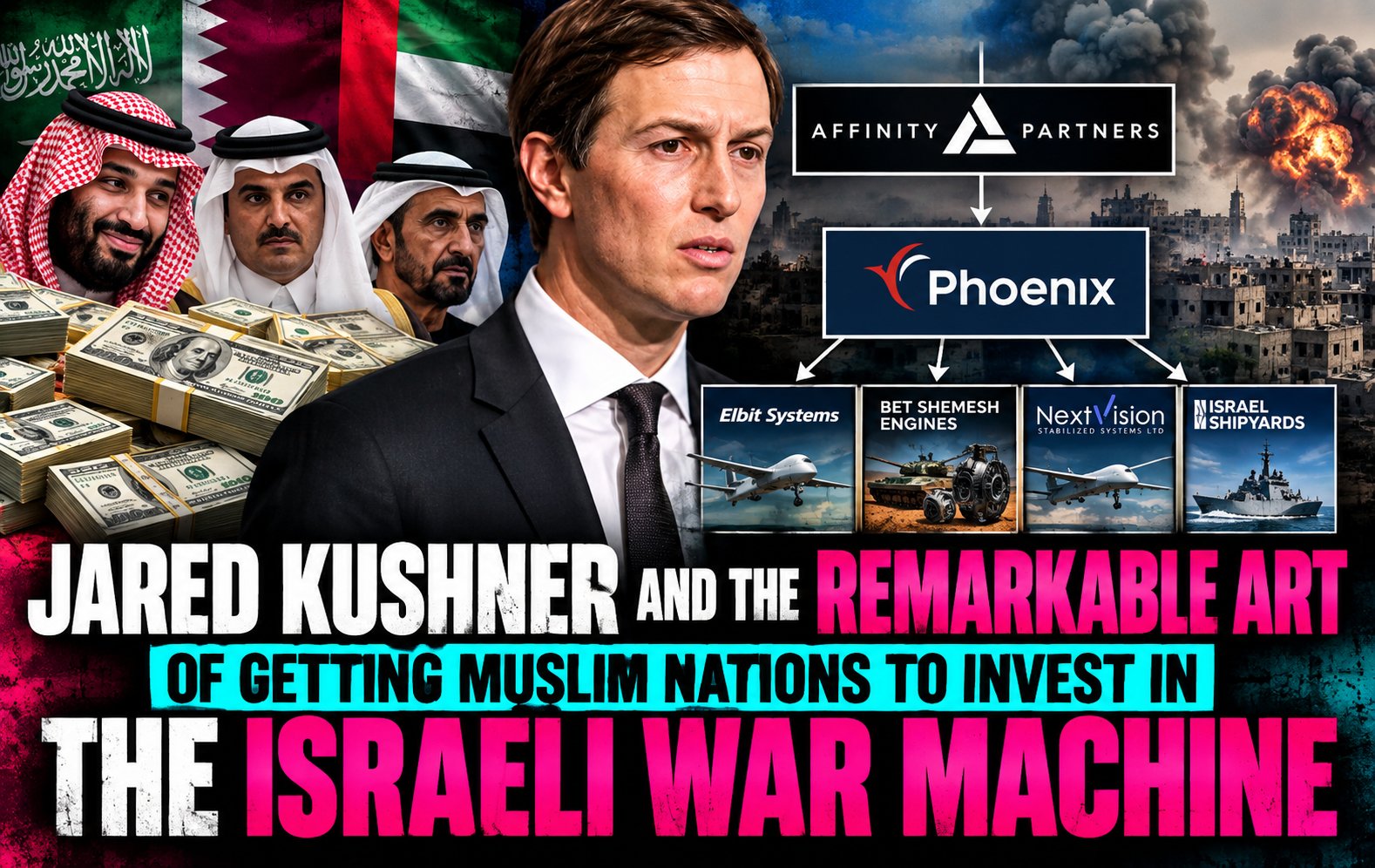
Now, a CNN investigation has exposed a remarkable financial contradiction at the center of that arrangement. Kushner’s private equity firm, Affinity Partners, became the largest shareholder in Phoenix Financial, one of Israel’s major insurance and asset management companies. Phoenix, in turn, held investments worth more than $456 million in at least nine companies supplying weapons, military technology, and other equipment to Israel’s armed forces.
Among those companies are Elbit Systems, Israel’s largest arms manufacturer, and Israel Shipyards, which produces naval vessels for the Israeli military. Other companies identified in CNN’s investigation manufacture military drones, tank components, artillery equipment, and specialized technology used in Israeli military operations. Several have benefited commercially from increased military demand during Israel’s wars in Gaza and elsewhere in the region.
The arrangement is extraordinary because Kushner’s investment firm was substantially financed by sovereign wealth funds from predominantly Muslim countries, including a $2 billion commitment from Saudi Arabia’s Public Investment Fund. His company subsequently acquired a major ownership position in an Israeli financial institution with substantial investments in businesses supplying the Israeli military, even as Kushner returned to Middle East diplomacy and participated in negotiations over the war in Gaza.
The financial connection is indirect, and that distinction matters. Affinity does not directly own the nine defense companies identified by CNN, and the investigation did not establish that Saudi or other Gulf government money was specifically directed into their shares. Nor did CNN find evidence that Kushner’s diplomatic activities directly influenced the investments it examined.
Nevertheless, the documented relationships raise serious questions about conflicts of interest, financial transparency, and the ability of politically connected investors to maintain lucrative business relationships involving the same governments and industries affected by their diplomatic work.
The central controversy is not whether Kushner personally purchased Israeli weapons. It is whether a presidential family member should be negotiating the future of a devastating regional conflict while retaining a substantial financial interest in an institution with exposure to the military industry supplying one of the combatants.
How Kushner Turned Middle East Relationships Into a Multibillion Dollar Investment Business
Kushner established Affinity Partners in 2021, shortly after leaving the White House following Trump’s first presidential term. Although he had experience in real estate through his family’s business, he had not previously operated a private equity firm of comparable scale. His new venture nevertheless attracted extraordinary financial commitments from Middle Eastern investors, many associated with governments whose leaders he had worked with during his years as a senior presidential adviser.
The most controversial investment came from Saudi Arabia’s Public Investment Fund, which committed $2 billion to Affinity. The decision attracted immediate scrutiny after reporting revealed that advisers to the Saudi fund had raised concerns about the firm’s management experience, investment strategy, due diligence, and proposed fees. The investment ultimately proceeded with the backing of Saudi Crown Prince Mohammed bin Salman, with whom Kushner had developed a close working relationship during Trump’s first administration.
Additional financial commitments followed from investors associated with Qatar and the United Arab Emirates, expanding Affinity’s dependence on capital originating in the same region where Kushner had helped shape American foreign policy. Those investments provided the financial foundation for a business that would subsequently pursue opportunities in Israel and other international markets.
The structure is important because sovereign wealth fund investments are not simply personal payments to Kushner. The money belongs to the investors and is managed through investment arrangements that generally allow the fund operator to collect management fees and potentially performance-based compensation. The investors retain economic interests in the fund, while the manager benefits from the fees and investment arrangements established under its contracts.
However, that distinction does not eliminate the ethical questions surrounding the arrangement. Kushner’s business received billions of dollars in commitments from foreign government-linked investors after he had served in a senior diplomatic position involving those same governments. He subsequently returned to Middle East diplomacy while retaining ownership of the investment management company.
The concern is not merely that a former government official entered private business. It is that Kushner’s private financial relationships and continuing political influence involve overlapping foreign governments, strategic industries, and diplomatic negotiations, creating opportunities for real or perceived conflicts between public responsibilities and private financial interests.
The Israeli Investment That Connected Affinity to the Defense Industry
Affinity’s investment in Phoenix Financial began in July 2024, when the firm purchased a 4.95% stake for approximately $128.5 million. Phoenix is a major Israeli financial services group operating in insurance, pensions, asset management, and related financial businesses. It manages and invests substantial sums across a wide range of industries, making it an important institution within Israel’s financial system.
In January 2025, just days before Trump returned to the White House, Affinity received regulatory approval to approximately double its Phoenix position, becoming the company’s largest shareholder. The timing placed Kushner’s investment firm in a powerful financial position within Israel as he prepared to resume an influential, although initially informal, role in the administration’s Middle East diplomacy.
CNN examined thousands of Israeli financial records and identified at least nine companies supplying military equipment to Israel in which Phoenix held investments. Those disclosed holdings were valued at more than $456 million as of June 30, 2026, and included businesses producing drones, artillery components, naval vessels, tank equipment, and other military technology.
The largest identified position was approximately $265.1 million in Elbit Systems, a major international defense manufacturer supplying the Israeli military with weapons, electronics, surveillance technology, and other systems. Phoenix also held approximately $68.3 million in Next Vision, $55.8 million in Bet Shemesh Engines, and $40.2 million in Reshef Technologies, alongside additional holdings in defense-related businesses.
CNN’s findings do not represent Phoenix’s entire investment portfolio. The publicly available records reviewed by reporters covered only part of the institution’s holdings and excluded certain investments held through retirement accounts, mutual funds, corporate bonds, and other financial instruments. The investigation therefore identified a documented minimum rather than a complete accounting of every defense related investment connected to the institution.
For Kushner’s firm, the significance lies in the ownership structure. Affinity holds shares in Phoenix, while Phoenix owns investments in companies that supply Israel’s military. When Phoenix’s overall business performs well, its shareholders can benefit through changes in share value and other potential returns. That relationship creates indirect financial exposure to the defense industry, although the value of Affinity’s investment also depends on Phoenix’s much broader financial operations.
The arrangement does not establish that Kushner personally selected any of the defense investments. His attorneys told CNN that he does not sit on Phoenix’s board and has no role in determining which securities the company purchases. But it does establish that his investment firm became the largest shareholder in an institution with substantial documented exposure to Israeli military suppliers.
The Weapons Manufacturers Behind Phoenix’s $456 Million Defense Portfolio
The companies identified in CNN’s investigation occupy important positions within Israel’s defense industry, supplying equipment used in military operations in Gaza and other regional conflicts. Elbit Systems manufactures a broad range of military technology, including drones, artillery systems, electronic warfare equipment, surveillance systems, and weapons platforms. The company maintains extensive relationships with Israel’s Ministry of Defense and international military customers.
CNN has previously investigated Israeli strikes involving weapons associated with Elbit Systems, including incidents in which civilians were killed. Israel Shipyards, another company identified among Phoenix’s holdings, manufactures naval vessels for Israel’s navy, whose ships have participated in military operations involving Gaza. Other businesses in the portfolio produce specialized equipment, including gearboxes used in tanks and electronic fuses used in artillery ammunition.
These connections matter because Israel’s military operations in Gaza have produced catastrophic civilian casualties and destruction. According to figures cited in CNN’s investigation, Palestinian health authorities reported more than 74,000 people killed during the conflict by October 2026. Israel launched its military campaign following the Hamas led attacks of October 7, 2023, in which approximately 1,200 people were killed in Israel and hundreds were taken hostage.
Israel maintains that its military operations have been directed against Hamas and other armed groups, while international human rights organizations and United Nations investigators have documented extensive civilian harm and raised serious allegations concerning the conduct of the war.
A United Nations independent commission of inquiry concluded in 2025 that Israel had committed genocide in Gaza, a finding Israel rejected. That determination is significant, but it must be distinguished from a final judgment by an international court establishing legal responsibility for genocide. The International Court of Justice proceedings concerning South Africa’s genocide allegations against Israel are a separate legal process.
The genocide allegations provide important context for the public controversy surrounding companies supplying Israel’s military. They do not, by themselves, establish that every defense contractor, investor, or shareholder connected to the Israeli military bears legal responsibility for genocide or other alleged international crimes.
What CNN documented is that Phoenix Financial held substantial investments in companies supplying military equipment to Israel, and that Kushner’s Affinity Partners remained Phoenix’s largest shareholder while Kushner participated in diplomatic efforts involving the same conflict.
The investigation also found that all nine defense related companies identified had experienced increases in their stock market values during 2025. Several reported stronger demand associated with the war, illustrating how military conflict can create commercial opportunities for defense manufacturers even as diplomats work toward a negotiated settlement.
That juxtaposition is the heart of the controversy: a peace negotiator whose investment firm has financial exposure, through a major Israeli institution, to companies operating within the defense industry supporting the war.
Kushner’s Phoenix Investment Produced Hundreds of Millions in Proceeds
The financial importance of Affinity’s Phoenix investment became particularly clear in July 2026, when the firm sold approximately one quarter of its position for more than $340 million. According to CNN, the transaction represented proceeds exceeding five times the original cost of the shares sold, while Affinity retained a 7.4% stake valued at more than $1 billion.
The transaction demonstrated how lucrative the Israeli investment had become for Affinity. The company had established a major position in Phoenix, benefited from the substantial increase in its market value, and realized hundreds of millions of dollars through a partial sale while maintaining its status as the institution’s largest shareholder.
The reported proceeds should not be confused with Kushner’s personal profit. Affinity manages capital belonging to its investors, and the distribution of gains depends on the firm’s investment agreements, fees, expenses, and ownership arrangements. Likewise, a fivefold return on the shares sold does not mean the entire fund achieved the same return. Nevertheless, the size of the transaction demonstrates that Kushner’s relationship with Phoenix was not a minor or incidental investment. His firm held a stake worth more than $1 billion while he was involved in diplomatic negotiations affecting the Middle East.
CNN also reported that Kushner had acknowledged regular discussions with Phoenix management about business strategy and opportunities involving Gulf countries. His attorneys said those discussions did not involve selecting individual investments and that his contact with management had been significantly reduced after he resumed diplomatic responsibilities. That distinction matters when evaluating whether Kushner exercised direct control over Phoenix’s portfolio. However, it does not eliminate the broader financial reality that his investment firm retained a valuable ownership position in a company with substantial defense-industry exposure.
The Peace Negotiator Whose Business Was Exposed to the War Economy
The most troubling aspect of Kushner’s financial arrangement is the overlap between his private investments and his diplomatic responsibilities. Since Trump’s return to office in January 2025, Kushner has served as an influential adviser on Middle East policy, participating in discussions involving Israel, Arab governments, and negotiations over Gaza. His role became particularly visible during the October 2025 ceasefire negotiations, when he worked alongside other American officials and regional intermediaries to help secure an agreement between Israel and Hamas.
At the same time, Affinity retained its substantial investment in Phoenix Financial. That meant Kushner was participating in negotiations concerning a conflict while his privately owned investment firm held shares in a financial institution exposed to companies supplying military equipment used by one side of that conflict. CNN found no evidence that Kushner’s diplomatic activities directly affected the investments it examined, but the overlapping responsibilities present an unusually complicated potential conflict of interest.
Kushner has long argued that economic cooperation between Israel and Arab countries can create incentives for peace. His approach to diplomacy emphasizes investment, development, commercial relationships, and the belief that economic prosperity can help overcome historical political divisions. That philosophy was central to the Abraham Accords and continues to influence his vision for regional integration.
There is a legitimate argument that commercial relationships between previously hostile countries can encourage stability. However, the ethical concerns become more serious when the individual promoting those relationships also owns a business positioned to benefit financially from regional investment opportunities. The question is whether the public can adequately evaluate diplomatic decisions when the negotiator maintains substantial private interests connected to the governments and industries affected by those decisions.
Kushner’s situation is especially sensitive because his financial relationships extend across both sides of the regional divide. Gulf governments helped finance Affinity’s investment business, while the firm acquired a major position in an Israeli institution with investments in military suppliers. Kushner then returned to diplomacy involving those same countries and the war in Gaza.
The arrangement does not prove that Kushner wanted the conflict to continue, that he influenced military procurement, or that he manipulated peace negotiations to protect his investments. Those accusations would require evidence beyond the financial relationships documented by CNN. Nevertheless, the combination of private financial exposure and public diplomatic influence raises legitimate questions about transparency, accountability, and competing incentives.
The Volunteer Envoy Arrangement and the Financial Disclosure Question
Kushner’s unusual diplomatic status adds another layer to the controversy. Rather than returning to government through a conventional senior White House appointment, he has operated as an unpaid adviser or volunteer envoy, participating in important diplomatic negotiations without assuming the same publicly documented role as many formally appointed federal officials.
CNN reported that this arrangement allowed Kushner to avoid the financial disclosure obligations that would ordinarily apply to certain senior government positions. As a result, the public has had less visibility into his private investments while he participated in negotiations involving foreign governments and businesses connected to those financial interests.
The distinction requires legal precision. Unpaid government service does not automatically exempt an individual from federal ethics requirements, and the applicable obligations depend on the person’s formal appointment, legal status, responsibilities, and classification under federal law. However, an outside adviser who is not formally appointed may operate under different disclosure requirements from a federal employee or special government employee.
That difference is significant because financial disclosure rules exist to help identify situations in which government officials may have private interests affected by their public responsibilities. When those disclosures are unavailable, the public must rely more heavily on investigative reporting, corporate filings, congressional inquiries, and voluntary statements from the individuals involved.
The White House has maintained that Kushner’s private business activities are separate from his diplomatic assignments. His attorneys have likewise argued that he does not direct Phoenix’s investments and has reduced his engagement with the company while performing diplomatic work.
Those statements address important aspects of the controversy, but they do not fully resolve the broader transparency issue. A person can lack direct control over an underlying investment and still possess a financial interest whose value may be affected by political or economic developments connected to that person’s government responsibilities.
For an adviser negotiating matters involving war, regional reconstruction, sovereign wealth funds, and diplomatic normalization, the need for meaningful financial transparency is particularly strong.
Congress Was Investigating Kushner’s Foreign Money Long Before CNN’s Revelations
Questions surrounding Affinity Partners’ foreign financing have persisted for years. In September 2024, Sen. Ron Wyden, then chairman of the Senate Finance Committee, disclosed findings from an investigation into Kushner’s investment firm and its financial relationships with foreign governments. According to the committee, Affinity had collected approximately $157 million in management fees from foreign investors, including roughly $87 million from Saudi Arabia’s Public Investment Fund.
The investigation found that Affinity charged the Saudi fund an annual management fee of 1.25% on its $2 billion commitment, equivalent to approximately $25 million annually under the reported arrangement. Other investors were charged fees closer to 2%, according to information provided to the committee. Wyden questioned whether the firm’s compensation structure and dependence on foreign government money created opportunities for political influence or represented an unusually lucrative arrangement for a former senior White House official.
At the time of the committee’s review, Affinity had reportedly made no distributions of investment earnings to its clients as of July 2024, despite collecting substantial management fees. That finding was specific to the period examined and should not be interpreted as a statement about the firm’s subsequent investment performance. The later Phoenix transaction demonstrates that Affinity went on to realize substantial proceeds from at least one investment.
Wyden also raised concerns about the potential application of the Foreign Agents Registration Act and whether investment management arrangements could provide foreign governments with financial relationships involving politically influential Americans without the transparency associated with conventional lobbying or advisory contracts. Those concerns were allegations raised by congressional investigators, not findings that Kushner had violated federal law.
The scrutiny continued during Trump’s second administration. In March 2026, Wyden and Rep. Robert Garcia, the ranking Democrat on the House Oversight Committee, demanded additional information about reports that Kushner was seeking further investment commitments from Middle Eastern sovereign wealth funds while participating in diplomatic negotiations involving the same region.
The lawmakers requested information about safeguards intended to separate Kushner’s government-related work from his fundraising and private investment activities. Their concerns reflected the possibility that foreign governments might possess financial leverage over a politically influential individual who remained involved in shaping American policy.
Kushner has disputed claims concerning his fundraising activities during his volunteer diplomatic service. In an October 2026 response to separate reporting about his business and government roles, he maintained that Affinity had not raised additional capital while he was performing that service and rejected suggestions that his diplomatic work was intended to benefit his investments.
The distinction between lawmakers’ allegations, documented historical fundraising, and Kushner’s account of his more recent activities is important. The existence of congressional scrutiny does not establish wrongdoing, and questions about fundraising during government service require evidence concerning the timing and nature of any solicitations or commitments.
Nevertheless, the congressional investigations establish that concerns about Kushner’s foreign financial relationships preceded CNN’s discovery of Phoenix’s defense-related investments. The new reporting adds another dimension to an already substantial debate about the relationship between presidential family members, foreign government capital, and American diplomacy.
Kushner Calls the Investigation Misleading and Denies Any Conflict
Kushner has strongly rejected the suggestion that his diplomatic activities improperly intersect with his private investments. Following CNN’s investigation, he publicly criticized the reporting as misleading, arguing that it improperly connected his Middle East diplomatic work to investments made by an Israeli financial institution over which he does not exercise direct portfolio control.
His defense centers on the distinction between Affinity’s ownership of Phoenix shares and Phoenix’s investments in individual companies. Kushner has emphasized that Phoenix is a diversified, regulated financial institution with extensive operations beyond its securities holdings, and that he does not personally direct its investment decisions.
His attorneys told CNN that he does not hold a board position at Phoenix, does not participate in selecting the company’s investments, and significantly reduced his communications with management after becoming involved in diplomatic work. The White House similarly maintained that his private business interests are separate from his responsibilities in the Middle East.
These responses are material to the story. A major shareholder does not automatically control every investment made by a diversified financial institution, and an indirect ownership interest is not equivalent to personally purchasing weapons or financing military operations. CNN also reported that it found no indication Kushner’s diplomatic actions directly affected the investments it reviewed. That limitation should remain central to any accurate account of the investigation.
However, the absence of demonstrated misconduct does not eliminate the possibility of a conflict of interest. Ethics concerns can arise when an official or influential adviser retains substantial financial interests in businesses affected by the policies or negotiations in which that individual participates, even when there is no evidence of an improper decision.
Kushner’s response therefore addresses allegations of direct involvement and personal influence over Phoenix’s investments, but the broader debate about disclosure and the appropriateness of his overlapping financial and diplomatic roles remains unresolved.
Did Arab Governments Actually Invest in Their Own Destruction?
The most provocative interpretation of the investigation is that wealthy Arab governments provided capital to Kushner’s investment firm, which then acquired an ownership position in an Israeli financial institution holding investments in companies supplying Israel’s military. At a time when the war in Gaza has generated international allegations of genocide and widespread condemnation over civilian casualties, that financial connection presents a particularly uncomfortable contradiction.
But the available evidence does not establish that Saudi Arabia, Qatar, or the United Arab Emirates knowingly directed money toward Israeli defense contractors through Affinity Partners. Nor does it establish that capital committed by those governments can be traced directly to Phoenix’s purchases of shares in the nine companies identified by CNN.
The financial structure is more complicated. Gulf investors committed capital to Affinity-managed funds. Affinity acquired a substantial ownership stake in Phoenix Financial. Phoenix, through its own investment activities, held shares in Israeli defense related businesses. Those relationships create indirect economic exposure, but they do not demonstrate that sovereign wealth fund money was specifically allocated to particular weapons manufacturers.
It would therefore be inaccurate to report as an established fact that Kushner persuaded Muslim governments to directly finance weapons used against Palestinians or that those governments knowingly invested in genocide. Such conclusions would require additional evidence concerning investment decisions, capital flows, investor knowledge, and legal responsibility.
The documented arrangement is still extraordinary. A politically connected American investor raised billions from governments in the Arab world, built a valuable position in an Israeli financial institution with significant defense-industry holdings, and participated in negotiations over a conflict involving Israel and Palestinians.
The contradiction does not need to be exaggerated to warrant scrutiny. It raises legitimate questions about whether the financial interests of wealthy governments and private investment managers are aligned with the humanitarian and diplomatic priorities publicly associated with regional peace efforts. It also illustrates how modern global finance can connect investors to industries and conflicts through layers of corporate ownership that are not immediately apparent from the names of the investment funds or financial institutions involved.
The Bigger Problem: When American Foreign Policy Becomes Entangled With Private Wealth
The Kushner controversy reflects a larger problem in American government: the movement of politically influential individuals between public office, private investment, and informal advisory roles involving the same foreign governments and commercial interests.
Kushner’s situation is particularly unusual because of the scale of the money involved and his relationship to the president. He developed close ties with Middle Eastern leaders while serving in the White House, attracted billions of dollars from regional investors after leaving government, and subsequently returned to a diplomatic role involving those same countries while retaining ownership of his investment business.
The financial connections are not inherently illegal. Former government officials routinely enter private industry, sovereign wealth funds invest internationally, and diversified financial institutions hold shares across industries that may include defense manufacturing. The concern arises from the cumulative effect of those relationships when combined with substantial political influence and limited public financial disclosure.
For the United States, the issue is whether diplomatic decisions can be evaluated with confidence when the people helping make them possess significant financial interests connected to the countries and industries affected by those decisions. For Middle Eastern governments, the arrangement raises questions about the intersection of strategic investments, access to influential American figures, and regional political priorities. For the public, it creates uncertainty about whether sufficient safeguards exist to distinguish private financial incentives from official diplomatic objectives.
The war in Gaza makes those questions especially consequential. Negotiations involving ceasefires, hostage releases, humanitarian assistance, reconstruction, and the territory’s political future affect millions of people and require decisions of enormous international significance.
The public does not need evidence of a criminal conspiracy to demand transparency about the financial interests of individuals participating in those negotiations. The potential for conflicting incentives is itself a legitimate subject of public scrutiny, particularly when substantial private investments involve companies exposed to industries connected to an ongoing war.
The Bottom Line: Billions in Arab Capital, a Billion Dollar Israeli Investment, and a Seat at the Peace Table
CNN’s investigation has revealed an extraordinary convergence of private investment and American diplomacy. Jared Kushner’s Affinity Partners, backed by billions of dollars in commitments from Middle Eastern investors, became the largest shareholder in Phoenix Financial, an Israeli financial institution with more than $456 million in documented holdings across at least nine companies supplying military equipment to Israel.
The investment proved lucrative. In July 2026, Affinity sold approximately one quarter of its Phoenix stake for more than $340 million while retaining a 7.4% position valued at more than $1 billion. During this period, Kushner remained involved in Middle East diplomacy, including negotiations concerning the war in Gaza.
The investigation does not establish that Kushner personally directed investments into weapons manufacturers, that Gulf governments knowingly financed particular Israeli military operations, or that his diplomatic decisions were influenced by his financial interests. Kushner has denied wrongdoing, and CNN reported finding no direct connection between his diplomatic activities and the investments it examined.
What the reporting does establish is a financial arrangement that deserves serious scrutiny. Kushner’s private investment firm benefited from relationships with Middle Eastern governments, developed substantial exposure to Israel’s financial sector, and maintained an ownership position in an institution invested in military suppliers while he participated in negotiations involving the same region.
The central question is not whether every financial relationship in that arrangement is unlawful. It is whether the American public should accept a system in which an influential presidential family member can simultaneously maintain extraordinary private financial interests and participate in consequential diplomatic negotiations without the transparency expected of senior government officials.
Jared Kushner built a business financed by wealthy Middle Eastern investors, acquired a billion dollar stake in an Israeli financial giant exposed to military suppliers, and helped negotiate peace in a region where those weapons are being used. The documented financial relationships do not prove corruption or complicity in war crimes. They do reveal how closely private profit and American diplomacy can become intertwined when the people negotiating peace are also major investors in the region’s economy.
For an administration that has repeatedly promoted business driven diplomacy as a pathway to peace, the controversy presents an uncomfortable question: Who ultimately benefits when the same individuals are positioned to influence the peace process and profit from the economic relationships surrounding it?

Sources & Further Reading
CNN Investigation — Jared Kushner’s Company Has Large Stake in Firm With Israeli Military Links — October 1, 2026. Primary investigation documenting Affinity’s ownership of Phoenix Financial and Phoenix’s defense-industry holdings.
CNN — Investigative Correspondent Katie Polglase’s Television Report — October 2, 2026. Broadcast transcript covering the financial records, diplomatic overlap, and responses.
CNN — Original Video Investigation — Video report examining Kushner’s business interests and diplomatic activities.
U.S. Senate Finance Committee — Wyden Investigation of Affinity Partners’ Foreign Investment Fees — September 25, 2024. Congressional findings concerning management fees, foreign investors, and potential conflicts.
U.S. Senate Finance Committee — Original Letter to Affinity Partners — Primary documentation detailing the committee’s investigation and Affinity’s reported financial arrangements.
The Daily Beast — Kushner Responds to CNN Investigation — October 2, 2026. Reporting on Kushner’s public denial of the alleged conflict.




















































Want to join the conversation?
Create an account or sign in to share your thoughts, vote,
and reply to other readers.
Showing 0 of 0 comments
Don't have an account?
Already have an account?