
Florida’s Condo Crisis: How Decades of Underfunded Maintenance Turned the Beachfront Dream Into a Six Figure Financial Nightmare
A Fort Lauderdale oceanfront condominium’s repair project has exploded from $1.6 million to $36 million, leaving homeowners facing assessments as high as $320,000. The financial disaster at The Galleon exposes a much larger problem across coastal Florida: aging high rises, inadequate reserves, escalating repair costs, and an ownership model that can leave residents responsible for enormous bills they never anticipated.
The American Dream on the Beach Is Becoming a Financial Nightmare
For generations, owning a beachfront condominium in Florida represented one of the most attractive versions of the American dream. Retirees could spend their golden years overlooking the Atlantic Ocean, professionals could enjoy resort style living without the responsibilities of maintaining a traditional house, and investors could purchase valuable coastal real estate with the expectation that property values would continue climbing. The arrangement seemed simple enough: buy the condominium, pay a monthly association fee, and let the building’s management handle maintenance, insurance, elevators, swimming pools, landscaping, and major repairs.
But beneath that appealing proposition was a financial reality that many condominium associations failed to adequately prepare for. High-rise buildings are extraordinarily expensive structures to maintain, particularly along Florida’s coastline, where salt laden air, humidity, wind driven rain, and constant exposure to moisture can accelerate the deterioration of concrete, reinforcing steel, waterproofing systems, and other critical building components. Unlike a single family home, where an owner can independently manage many repairs, a condominium tower requires collective financial decisions involving dozens or hundreds of individual property owners with different incomes, priorities, and financial capabilities.
For decades, Florida law allowed many condominium associations to reduce or waive contributions to reserve accounts intended to pay for future capital improvements. The practice helped keep monthly maintenance fees affordable, but it also created the potential for enormous financial shortfalls as buildings aged. Repairs that should have been anticipated years earlier could eventually become urgent, leaving current homeowners responsible for expenses that previous owners and association boards had not fully funded.
The consequences are now becoming painfully visible across South Florida, where condominium towers constructed during the development booms of the 1960s, 1970s, and 1980s are entering their fifth, sixth, and seventh decades. Following the deadly 2021 Surfside condominium collapse, Florida lawmakers imposed stronger structural inspection and reserve funding requirements, forcing associations to confront financial obligations that could no longer be postponed as easily.
The result is a reckoning that extends far beyond higher monthly association fees. Some homeowners are confronting extraordinary special assessments, prolonged construction projects, increasingly difficult resale conditions, and the possibility that the property they purchased for financial security could become their greatest financial liability.
The Galleon: A $1.6 Million Repair Project Becomes a $36 Million Disaster
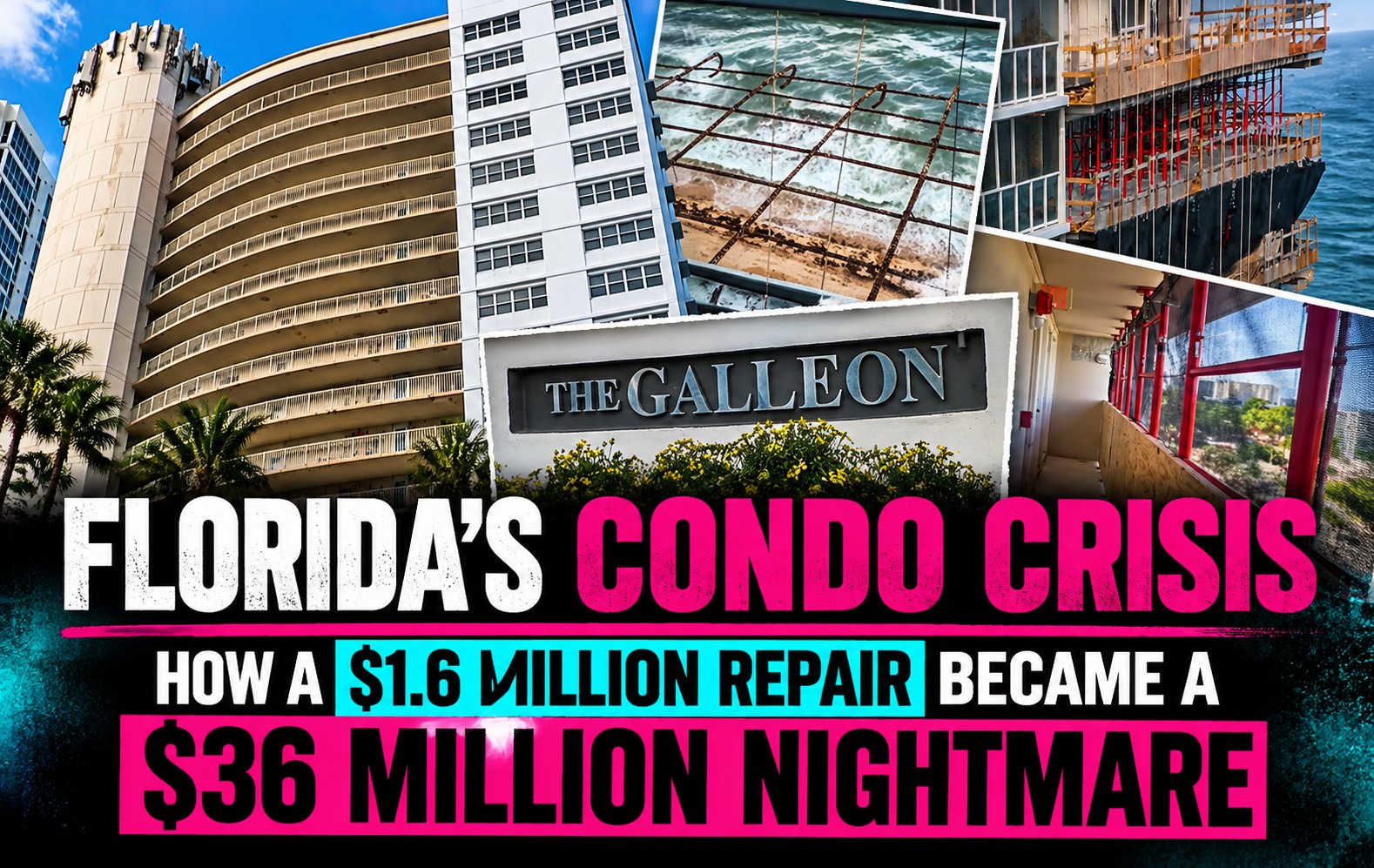
At The Galleon, a beachfront condominium located at 4100 Galt Ocean Drive in Fort Lauderdale, the financial consequences of maintaining an aging coastal high rise have become impossible to ignore. Built in 1967 along the city’s Galt Ocean Mile, the residential tower is now at the center of a construction and financial controversy that illustrates just how dramatically the economics of condominium ownership can change when major restoration projects spiral beyond their original expectations.
According to an October 6, 2026, investigation by CBS News Miami reporter Joan Murray, a concrete restoration project that began with an estimated cost of $1.6 million has expanded into an approximately $36 million undertaking. Construction has continued for five years, leaving portions of the oceanfront property resembling a prolonged construction site rather than the beachfront residential community its owners expected to enjoy. The building’s pool and patio areas have been stripped down to concrete, while restoration work has extended across multiple floors.
The most alarming aspect of the project is the financial burden imposed on individual homeowners. CBS reported that residents have been assessed between $135,000 and $320,000 per unit, with the amounts varying among owners. For retirees living on fixed incomes, homeowners who purchased their properties decades ago, and families who never anticipated such extraordinary expenses, those assessments represent potentially life changing financial obligations.
The escalating costs have also raised serious questions about construction quality, project management, and association oversight. Sergio Cella, a pilot and mechanical engineer who has lived at The Galleon for approximately 30 years, told CBS News Miami that workers had attempted to repair cracking on his 14th floor balcony three separate times without resolving the problem to his satisfaction. His account illustrates the frustration among residents who have watched the project grow dramatically more expensive while questioning whether the work being performed is delivering the results they were promised.
The contractor, Hartzel, defended its work in a written statement to CBS, explaining that the original agreement covered a limited scope of structural restoration and that the condominium association subsequently expanded the project through numerous change orders and additional contracts. That explanation is important because it establishes a significant distinction between an original repair estimate and the cost of a project whose scope was repeatedly expanded. The increase alone does not establish that the contractor improperly inflated prices, that all additional work was unnecessary, or that the building’s deterioration resulted from decades of neglected maintenance.
Nevertheless, the extraordinary escalation has produced a governance crisis within the condominium association. CBS documented board recalls, lawsuits, resignations, and growing frustration among residents who believe the project has moved beyond reasonable financial control. Edward Rumin, an attorney and former board member, described homeowners initially accepting the assessments before the situation became increasingly contentious. The association’s board president also reportedly sold his condominium and resigned after dismissing residents’ complaints during an exchange with CBS.
The Galleon controversy raises questions that extend beyond one Fort Lauderdale building. How can a relatively limited restoration project expand into a $36 million obligation? What financial safeguards should protect homeowners when construction costs escalate? And how much financial exposure should individual condominium owners reasonably be expected to assume when maintaining a shared building that has been standing for nearly 60 years?
The Structural Problem With the Condominium Business Model
The condominium ownership model contains a fundamental division between the people who initially develop and sell a building and the people ultimately responsible for maintaining it over the following decades. Developers generally earn their returns through construction and unit sales, while the condominium association eventually assumes responsibility for common elements, long-term maintenance, insurance, and major capital improvements after control transfers to the owners.
That structure is not inherently defective. Properly managed condominiums can remain financially stable for decades, particularly when associations maintain adequate reserves, commission reliable engineering studies, and invest consistently in preventive maintenance. However, the arrangement becomes vulnerable when the full cost of maintaining a high rise over its useful life is underestimated, inadequately disclosed, or repeatedly postponed.
A newly constructed condominium may require comparatively modest maintenance during its first several years. Its concrete, waterproofing, mechanical systems, plumbing, elevators, and other major components are relatively new, creating an impression that monthly association fees are sufficient to maintain the property indefinitely. But the building’s long term financial obligations are already accumulating, even when the most expensive repairs remain decades away.
As a coastal tower enters its third, fourth, and fifth decades, the economics change considerably. Concrete restoration can become more extensive, waterproofing systems require replacement, elevators need modernization, plumbing deteriorates, and roofs and exterior components approach the end of their expected service lives. In a marine environment, chloride exposure can also accelerate corrosion of reinforcing steel when moisture penetrates the protective concrete, creating deterioration that may remain concealed until repairs become extensive.
The challenge is not simply that these repairs are expensive. It is that the homeowners responsible for paying for them may be entirely different from the homeowners who benefited from lower reserve contributions during the building’s earlier years. A purchaser who acquires a condominium in 2026 may inherit financial obligations created by decisions made in 1995, 2005, or 2015, even though that purchaser had no influence over those decisions.
This creates an intergenerational financing problem in which the costs of maintaining shared infrastructure can be transferred from one generation of owners to the next. When the association fails to accumulate sufficient reserves, the true cost of ownership may remain hidden until major repairs become unavoidable.
The problem becomes especially severe when a building’s apparent affordability depends on monthly association fees that do not adequately reflect its future capital requirements. A condominium with relatively low dues may appear inexpensive to maintain, when in reality the association is simply collecting less money than the building will eventually require.
How Florida’s Reserve Funding System Allowed the Problem to Grow
For years, Florida condominium law permitted associations, through specified voting procedures, to waive or reduce reserve contributions for major repairs and replacements. The system provided flexibility to homeowners who wanted to control their monthly expenses, but it also created a powerful incentive to prioritize immediate affordability over long-term financial preparation.
Condominium boards are typically composed of volunteer homeowners who live in the buildings they govern. These individuals must make decisions about expensive capital improvements while facing the same financial pressures as their neighbors. Retirees on fixed incomes may resist higher fees because they cannot comfortably afford them, investors may prefer lower operating expenses to preserve rental returns, and owners preparing to sell may be reluctant to fund improvements they do not expect to personally enjoy.
Those competing interests can make reserve funding politically difficult, even when the underlying engineering requirements are clear. A board that proposes a substantial increase in monthly maintenance fees may face resistance from residents who believe the building is functioning adequately or who simply cannot afford the additional expense.
The financial consequences become substantial when reserve contributions are repeatedly reduced over many years. Consider a hypothetical 200-unit condominium building that anticipates $10 million in major capital improvements over two decades. Ignoring inflation, investment returns, and unforeseen expenses, the association would need to accumulate an average of $500,000 annually to fully fund those improvements. If it instead collected only $100,000 annually, the resulting shortfall could reach $8 million over that period.
That shortfall does not necessarily reveal itself through the building’s appearance. A property can feature a renovated lobby, attractive landscaping, freshly painted common areas, and valuable ocean views while carrying substantial unfunded obligations for structural restoration, waterproofing, plumbing, or mechanical systems.
The situation becomes more dangerous when delayed maintenance allows relatively manageable problems to grow into much larger repairs. Water intrusion that might initially require localized waterproofing can eventually contribute to corrosion of embedded reinforcing steel. As corrosion products expand, they can crack surrounding concrete and cause spalling, potentially requiring extensive restoration depending on the severity and location of the deterioration.
Not every instance of concrete deterioration indicates an immediate structural danger, and not every expensive restoration project results from improper maintenance. However, the financial principle remains the same: postponing necessary work can increase its eventual cost, while failing to accumulate reserves leaves homeowners with fewer options when repairs become unavoidable.
Florida’s historical reserve funding flexibility did not automatically cause the deterioration of aging buildings, but it allowed some associations to approach major capital expenses without sufficient savings to pay for them.
Surfside Exposed the Dangerous Consequences of Aging Infrastructure
The financial debate surrounding Florida’s aging condominium buildings changed permanently on June 24, 2021, when Champlain Towers South in Surfside partially collapsed, killing 98 people. The disaster exposed serious questions about building design, structural deterioration, maintenance, engineering oversight, and the ability of condominium associations to manage major repairs before dangerous conditions develop.
In June 2026, the National Institute of Standards and Technology released findings identifying critical structural failures that began weeks before the building’s final collapse. Federal investigators concluded that connections between garage columns and the pool deck began failing in early June 2021, creating a progressive sequence of cracking and load redistribution that ultimately overwhelmed other structural elements. The investigation also identified deficiencies in the building’s original design and construction, subsequent modifications that added loads, and deterioration involving reinforcing steel.
Those findings are significant because they demonstrate that Surfside cannot accurately be explained as a disaster caused exclusively by inadequate reserve funding or postponed maintenance. The building contained serious structural vulnerabilities originating in its original design and construction, and those vulnerabilities were compounded by other factors over time. Nevertheless, the catastrophe underscored the importance of rigorous engineering inspections, adequate repair funding, and effective oversight of aging residential buildings.
Florida lawmakers responded in 2022 by passing Senate Bill 4-D, which established new structural inspection and reserve funding requirements for qualifying condominium and cooperative properties. Under the current statutory framework, residential condominium buildings generally must undergo milestone structural inspections when they reach 30 years of age, with subsequent inspections every 10 years. Local enforcement agencies may require inspections beginning at 25 years under specified circumstances, including environmental exposure associated with proximity to salt water.
The legislation also established structural integrity reserve study requirements for qualifying condominium buildings of three habitable stories or more. These studies evaluate designated building components, estimate future repair and replacement expenses, and establish funding recommendations intended to help associations prepare for major capital obligations. Florida law generally restricts the ability of affected associations to waive required structural reserve funding, subject to specific statutory exceptions and alternative financing provisions.
For associations that historically maintained adequate reserves, the new requirements may represent a manageable adjustment. For buildings that entered the post Surfside era with substantial deferred maintenance and insufficient savings, the reforms can expose enormous funding gaps that must be addressed through higher assessments, borrowing, or other financial arrangements.
The legislation did not create the deterioration affecting Florida’s older buildings. It changed the financial and regulatory environment in which associations must confront that deterioration.
Florida’s New Laws Are Forcing Homeowners to Pay the Real Cost of Their Buildings
Florida’s condominium reforms fundamentally changed the relationship between monthly association fees and long term building maintenance. Under the state’s 2026 condominium statutes, qualifying associations must maintain reserve funding plans for designated structural components, with contributions based on the findings of their structural integrity reserve studies. Associations may use regular assessments, special assessments, lines of credit, or loans to satisfy applicable funding obligations, subject to statutory requirements and approval procedures.
The practical consequences can be substantial. A building that spent decades collecting relatively modest reserve contributions may discover that its projected repair and replacement obligations exceed the funds available. Closing that gap can require significant increases in monthly fees, large special assessments, or association borrowing that spreads the expense across future years.
Florida lawmakers recognized the financial pressure created by these requirements and enacted additional reforms in 2025 through House Bill 913. The legislation introduced greater flexibility in reserve funding, including provisions allowing certain associations, with the required owner approval, to temporarily pause or reduce reserve contributions for up to two consecutive annual budgets when funding repairs recommended by a recent milestone inspection. The law also provided additional mechanisms for financing major capital expenses.
These changes offered associations more options for managing the timing of their financial obligations, but they did not eliminate the underlying repair costs. A condominium requiring millions of dollars in concrete restoration still needs the work performed, regardless of whether the association collects the money immediately, borrows it, or spreads the obligation over several years.
For homeowners, this distinction is crucial. Financing an assessment may reduce the immediate cash burden, but it can also introduce interest expenses and additional financial commitments. Temporarily reducing reserve contributions may create breathing room while urgent repairs are completed, but future reserve obligations remain.
Florida’s new regulatory system is forcing a more realistic accounting of what it costs to maintain aging high rise buildings. For some owners, that accounting is revealing that their homes are substantially more expensive to own than their original monthly budgets suggested.
The Six Figure Assessment Trap: When Owners Cannot Afford to Stay or Sell
The most devastating consequence of a major condominium assessment is that homeowners can become financially trapped inside properties they can no longer comfortably afford. Unlike a traditional home repair that an owner may be able to manage independently, a condominium special assessment represents a collective financial obligation imposed under the association’s governing documents and applicable law. Individual owners generally cannot opt out simply because they disagree with the project or cannot afford their share.
At The Galleon, the reported assessments of $135,000 to $320,000 illustrate the magnitude of that exposure. A homeowner who purchased a condominium decades ago, paid off the mortgage, and planned to retire with relatively predictable housing expenses could suddenly confront a bill equivalent to several years of retirement income. Even owners with substantial home equity may lack the liquid savings necessary to satisfy such an obligation without borrowing or selling assets.
The financial pressure becomes even more severe when major assessments coincide with rising monthly association fees, property insurance expenses, and other housing costs. Owners may be forced to choose between drawing down retirement accounts, obtaining financing, selling their properties, or negotiating payment arrangements where available.
Selling, however, is not always a straightforward solution. Mortgage lenders evaluate the financial and structural condition of condominium projects, and buildings with unresolved critical repairs, significant deferred maintenance, inadequate insurance, or certain forms of litigation can face restrictions on conventional financing eligibility. Fannie Mae’s condominium project standards specifically address these risks, although an assessment by itself does not automatically make a property ineligible for financing.
When a building cannot qualify for commonly used mortgage programs, the pool of potential buyers can shrink, leaving sellers more dependent on cash purchasers or alternative financing. Buyers may also demand discounts to account for outstanding assessments, ongoing construction, or uncertainty about future expenses.
The result can be a particularly difficult financial situation: a homeowner facing an extraordinary bill while simultaneously discovering that the property has become harder to sell. Even a successful sale may not resolve the problem if the proceeds are insufficient to cover outstanding mortgage obligations, assessments, transaction expenses, and other liabilities.
This is one of the most serious vulnerabilities in the condominium ownership model. Individual homeowners can maintain their units responsibly, pay their mortgages on time, and comply with every association requirement, yet still face enormous financial consequences arising from decisions involving the building’s shared infrastructure.
Why Coastal High Rises Are Especially Vulnerable
Florida’s coastal condominium towers face a combination of environmental, engineering, and financial challenges that distinguish them from many other forms of residential property ownership. Their locations provide desirable ocean views and access to valuable waterfront real estate, but those same locations expose building materials to moisture, chloride contamination, severe weather, and other conditions that can increase maintenance requirements over time.
Reinforced concrete is durable when properly designed, constructed, and maintained, but it is not immune to deterioration. When chlorides penetrate concrete and reach embedded reinforcing steel, corrosion can develop under favorable conditions. As corrosion products expand, they can generate internal stresses that crack and dislodge surrounding concrete, potentially exposing additional steel and accelerating deterioration. Waterproofing failures, inadequate drainage, construction defects, and delayed repairs can contribute to these problems.
The engineering challenges become more complicated in large buildings because structural components are interconnected. A repair involving balconies, parking garages, exterior walls, or other common elements may require extensive investigation and restoration across multiple floors. Once contractors begin removing deteriorated materials, previously concealed damage can become visible, requiring engineers and association boards to reconsider the original project scope.
That uncertainty is one reason major concrete restoration projects can become financially difficult to predict. Initial engineering assessments may identify known defects, while invasive construction reveals additional conditions that require evaluation and repair. However, the existence of concealed deterioration does not automatically justify every cost increase. Effective project management, competitive procurement, clear contracts, independent engineering oversight, and careful review of change orders remain essential safeguards for homeowners.
The Galleon controversy illustrates why those safeguards matter. Residents have questioned both the quality and cost of the work, while the contractor has attributed the expansion to additional association-authorized contracts and change orders. Determining whether the project’s final costs were reasonable would require detailed examination of construction records, engineering recommendations, project approvals, and payments.
The broader engineering reality is that oceanfront condominium buildings require sustained investment throughout their useful lives. Properly maintained towers can remain serviceable for many decades, but their continued operation depends on a financial structure capable of supporting expensive maintenance and replacement programs.
The Governance Problem: Hundreds of Owners, One Shared Financial Liability
One of the condominium model’s greatest challenges is that expensive engineering decisions must often be made through a residential governance system rather than by a single property owner with centralized financial control. Condominium boards are responsible for overseeing substantial budgets, complex construction projects, insurance arrangements, legal obligations, and professional contractors, even though board members may have limited experience in engineering, construction management, or commercial finance.
That arrangement can function effectively when boards obtain qualified professional advice, maintain transparent financial records, and communicate clearly with homeowners. But major restoration projects can also create disputes over contractor selection, project scope, cost increases, special assessments, and the adequacy of completed work.
The stakes become particularly high when projects involve tens of millions of dollars. Homeowners may disagree about whether proposed repairs are necessary, whether costs are reasonable, or whether the association has adequately investigated alternatives. Board members may face pressure from residents who cannot afford assessments, while engineers and contractors may recommend work that cannot safely be postponed.
At The Galleon, CBS News Miami documented how the escalating construction project coincided with lawsuits, recalls, resignations, and increasingly contentious relationships among residents and association leadership. The controversy demonstrates how financial pressure and disagreements over construction oversight can undermine confidence in a building’s governance.
The underlying problem is not that volunteer condominium boards are inherently incapable of managing complex properties. It is that the responsibilities associated with operating a large coastal high-rise can resemble those of a sophisticated commercial real estate organization, while the governance structure remains dependent on elected homeowners serving limited terms.
When the financial consequences of those decisions reach hundreds of thousands of dollars per unit, transparency and independent oversight become especially important.
Is Florida’s Condominium Business Model Fundamentally Broken?
The crisis facing Florida’s aging condominium inventory raises an uncomfortable question about the long-term economics of shared residential ownership. If maintaining a coastal high-rise requires millions of dollars in recurring capital improvements, and those expenses must ultimately be financed by individual homeowners with widely different financial resources, can the model remain affordable over multiple generations?
The answer depends heavily on how the property is managed. Condominiums are not inherently unsustainable, and many associations successfully maintain their buildings through disciplined reserve funding, professional engineering evaluations, and timely capital improvements. The ownership model can provide efficiencies by spreading expenses across many residents, while professional management can reduce the burden of maintaining complex residential infrastructure.
However, the system becomes vulnerable when the true cost of ownership is separated from the monthly expenses presented to homeowners. A building that consistently collects less money than its long-term maintenance obligations require is not necessarily operating efficiently. It may simply be accumulating future liabilities.
This distinction matters because real estate buyers frequently evaluate affordability based on purchase price, mortgage payments, taxes, insurance, and current association fees. The condition of the building’s reserve accounts, the age of major structural components, and the cost of future capital projects can receive far less attention, even though those factors may ultimately determine whether ownership remains financially sustainable.
For coastal condominium buildings, the true cost of ownership must include not only the current expenses of operating the property but also the long term expense of preserving its structural integrity and replacing major shared components.
If those costs are adequately funded throughout the building’s life, the condominium model can function as intended. If they are repeatedly deferred, the property may appear affordable for decades before confronting a financial crisis that current owners are left to resolve.
The Galleon illustrates the potential consequences of that vulnerability, although the available reporting does not establish that its specific project resulted from historically inadequate reserves. What the documented controversy does establish is that individual homeowners can face extraordinary financial exposure when a major shared construction project expands dramatically beyond its original scope.
The Next Florida Condo Crisis May Be Financial Rather Than Structural
Florida’s post-Surfside legislation was designed to improve building safety and reduce the likelihood that serious structural problems would go undetected or inadequately addressed. But the financial consequences of those reforms have exposed another challenge: the ability of homeowners to afford the true long-term costs of maintaining aging condominium properties.
For some associations, the solution may involve higher monthly contributions, carefully phased restoration programs, responsible borrowing, and more rigorous financial planning. Other buildings may confront more difficult choices as repair expenses rise relative to property values, including collective sales, redevelopment proposals, or condominium termination where legally permitted.
Those outcomes will vary considerably. A well maintained building with strong reserves, sound construction, and desirable real estate may remain financially attractive for decades. A similarly aged property with extensive deterioration, inadequate funding, and governance disputes may face much greater difficulties.
The crucial distinction is that aging alone does not make a condominium financially unviable. The relationship between a building’s physical condition, its future repair obligations, and the financial capacity of its owners determines whether the ownership structure remains sustainable.
For residents of The Galleon, those questions have become painfully immediate. A project that began at an estimated $1.6 million has grown into a reported $36 million undertaking, leaving homeowners facing extraordinary assessments, years of construction disruption, and unresolved disputes over the work and its management.
The situation offers a warning to condominium owners throughout Fort Lauderdale and the rest of coastal Florida. The purchase price of a beachfront condominium may secure a spectacular view, but it also comes with a continuing obligation to maintain the expensive infrastructure supporting that view.
For decades, some condominium associations were able to keep monthly costs lower by postponing reserve contributions or major repairs. Florida’s changing regulatory environment is making that approach increasingly difficult, while the natural aging of coastal buildings continues regardless of how associations choose to finance their obligations.
The fundamental economic reality is unavoidable. Concrete deteriorates, waterproofing systems fail, mechanical equipment wears out, and buildings require expensive maintenance throughout their lives. Those obligations cannot be eliminated through a board vote, a reduced association fee, or a decision to postpone the work.
Florida’s condominium crisis is ultimately a reckoning over the difference between the price of buying beachfront property and the true cost of owning it. For homeowners at The Galleon, that difference has become a six-figure financial nightmare. For thousands of other coastal condominium owners, the question is whether their buildings have been collecting enough money to prevent the same thing from happening to them.













































Want to join the conversation?
Create an account or sign in to share your thoughts, vote,
and reply to other readers.
Showing 0 of 0 comments
Don't have an account?
Already have an account?