
The CIA Tried to Find the Ark of the Covenant Using Psychic Spies, the Declassified Government Files Are Real
In December 1988, a secret U.S. military intelligence program used an alleged psychic to investigate one of the Bible’s greatest mysteries. The declassified report describes a gold covered chest hidden underground, protected by mysterious entities, and containing spiritual knowledge beyond modern human understanding. The experiment was real, but whether the government discovered anything supernatural is an entirely different question.
For more than 2,500 years, the Ark of the Covenant has remained one of the most mysterious objects in religious history. Described in the Hebrew Bible as a sacred, gold covered chest constructed under the direction of Moses, the Ark was believed to contain the stone tablets of the Ten Commandments and symbolize the presence of God among the ancient Israelites. Biblical accounts attributed extraordinary powers to the artifact, including the ability to bring destruction upon enemies, punish those who touched it improperly, and serve as a physical focal point for communication with the divine.
Its disappearance has inspired centuries of archaeological investigations, religious traditions, conspiracy theories, and popular entertainment. Some believe the Ark was destroyed when Babylonian forces conquered Jerusalem. Others maintain that it was secretly removed from the city, hidden beneath an ancient religious site, or transported to Ethiopia, where a religious community continues to claim custody of the sacred object.
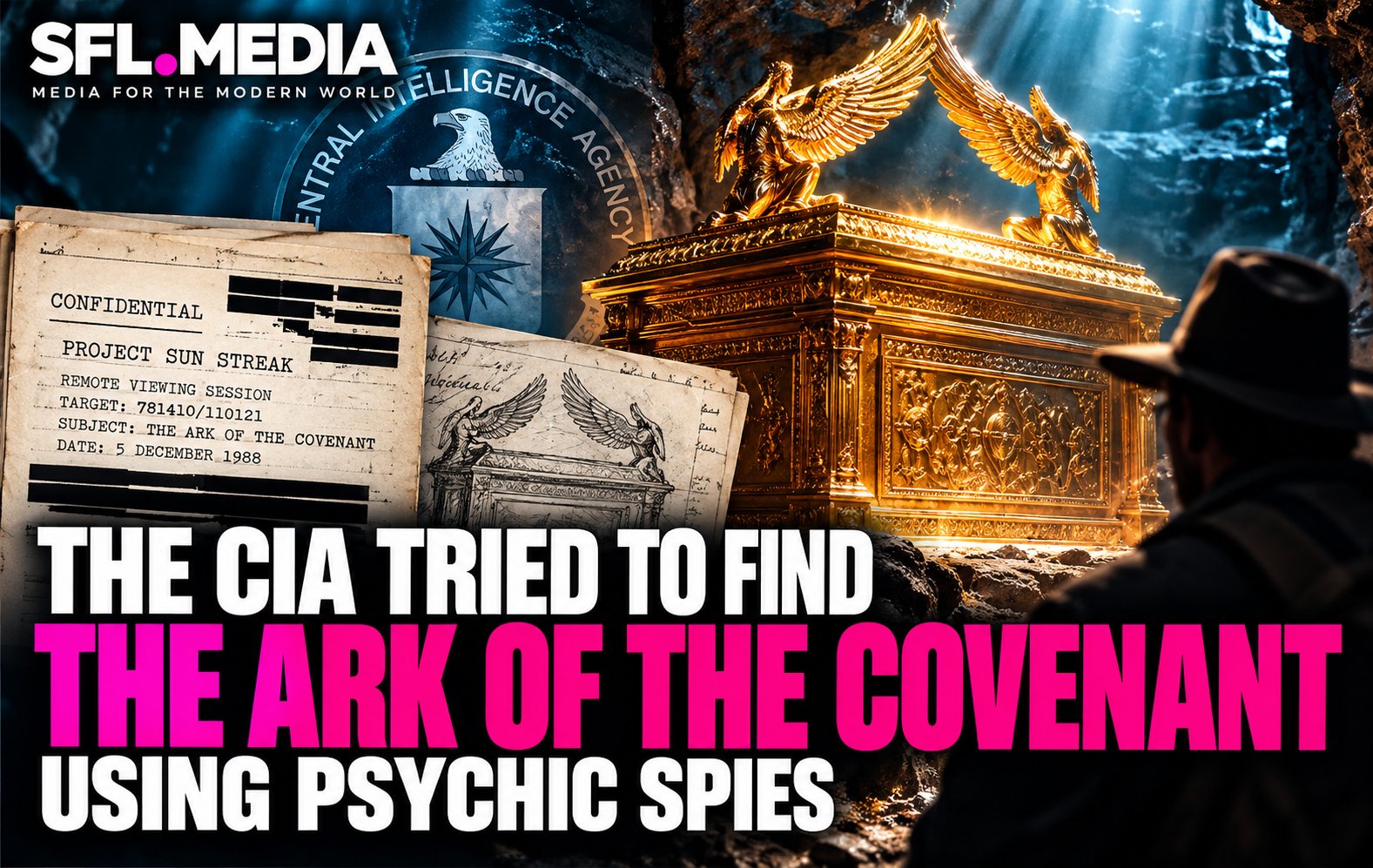
But in December 1988, the search for the Ark took an extraordinary turn inside the American intelligence establishment. A classified U.S. military intelligence program known as Project Sun Streak conducted an experiment in which a purported psychic, identified only as Remote Viewer 032, was tasked with mentally perceiving the legendary artifact without physically visiting its location. The resulting government document described an ancient container made of wood, gold, and silver, decorated with winged figures and concealed in a dark, wet underground chamber. It also included claims about supernatural guardians, mysterious protective forces, and a repository of spiritual knowledge supposedly extending beyond humanity’s present understanding.
The report was produced under a genuine government intelligence program and eventually entered the CIA’s declassified records. Its existence confirms that American intelligence personnel conducted the unusual experiment, although it does not establish that the Ark was actually located, that the participant possessed psychic abilities, or that any supernatural claims were accurate.
What makes the story particularly fascinating is that the Ark session was not an isolated curiosity. It was part of a much larger, decades long American intelligence effort to determine whether the human mind could gather information that conventional espionage methods could not reach. The same government that operated spy satellites, intercepted Soviet communications, and developed sophisticated reconnaissance systems also spent years investigating whether selected individuals could perceive secret locations, military installations, and concealed objects using extrasensory perception.
What Is the Ark of the Covenant, and Why Is It So Important?
The Ark of the Covenant occupies a central place in the religious history of ancient Israel. According to the Book of Exodus, God instructed Moses to construct a sacred chest from acacia wood, overlay it with pure gold, and place a golden cover upon it. The object was to measure approximately two and a half cubits long, one and a half cubits wide, and one and a half cubits high, dimensions often estimated at roughly 45 inches by 27 inches by 27 inches, depending on the length of the ancient cubit.
The chest featured four gold rings through which poles could be inserted, allowing designated members of the Israelite priestly community to transport it without directly touching the sacred object. Two golden cherubim were positioned above its cover, known as the mercy seat, with their wings extending toward one another. The Ark’s principal contents were traditionally understood to be the tablets of the covenant, although the New Testament’s Book of Hebrews also associates it with a golden jar of manna and Aaron’s staff.
In the biblical narrative, the Ark was far more than an ornate religious container. It represented the covenant between God and the Israelites and was associated with divine presence, authority, protection, and judgment. The Book of Joshua connects the Ark with the Israelites’ crossing of the Jordan River and the fall of Jericho, while the First Book of Samuel describes its capture by the Philistines and the misfortunes that followed. In another account, a man named Uzzah dies after reaching out to steady the Ark during its transportation.
These stories helped establish the Ark’s reputation as an object of immense sacred power, one that could bring blessings when handled according to divine instructions and devastating consequences when approached improperly. The Ark eventually became associated with the First Temple in Jerusalem, traditionally attributed to King Solomon. According to biblical accounts, it was placed in the temple’s innermost sanctuary, the Holy of Holies, where access was severely restricted.
Its fate becomes uncertain in the historical record before or around the Babylonian destruction of Jerusalem’s First Temple in 586 BCE. Although ancient texts describe the removal of valuable objects from the temple, there is no universally accepted historical account explaining what happened to the Ark itself. That uncertainty created one of the world’s most enduring archaeological mysteries. Unlike other ancient religious artifacts that have been excavated, cataloged, and studied, no object has been authenticated by modern archaeology as the original Ark of the Covenant.
Project Sun Streak: The Secret Government Program Behind the Ark Experiment
The American government’s involvement began with a much broader Cold War effort to investigate alleged psychic abilities for intelligence gathering. In the early 1970s, the CIA funded research at Stanford Research Institute in California, where investigators examined whether certain individuals could describe distant locations, hidden objects, or classified facilities without receiving information through ordinary sensory channels.
The technique became known as remote viewing. Practitioners claimed that, under controlled conditions, they could focus their attention on a target and report impressions about its appearance, surroundings, or activities without being physically present. The intelligence community’s interest was driven partly by Cold War concerns about Soviet research into paranormal phenomena. American officials wanted to determine whether such abilities existed and, if they did, whether adversaries could exploit them for espionage. A reliable method of perceiving secret military facilities or locating concealed weapons without conventional surveillance would have offered potentially significant strategic advantages.
Over the following decades, the research passed through several government programs and organizational arrangements, including Grill Flame, Center Lane, Sun Streak, and Stargate. The CIA, Defense Intelligence Agency, and Army intelligence organizations participated at different stages, with the Defense Department becoming especially important as the work continued through the 1980s. The experiments were not limited to archaeological curiosities. The programs explored potential applications involving Soviet military installations, intelligence targets, missing persons, hostages, and other matters of national security. Some operational requests sought information that could be compared with conventional intelligence, while training exercises sometimes involved unusual historical or speculative targets.
Project Sun Streak was active during the period when the Ark session took place. The surviving administrative records show that the program was managed within the Defense Intelligence Agency’s intelligence apparatus, rather than being a standalone CIA expedition to recover a biblical relic. That organizational distinction is important. Although the document is commonly described as a CIA file because it appears in the CIA’s declassified collection, the 1988 experiment was conducted under the military intelligence program’s Sun Streak designation. The CIA later inherited and released records from the broader effort.
December 5, 1988: The Government’s Psychic Investigation of the Ark
The declassified document identifies the experiment as Training Target 0209, conducted on December 5, 1988, from approximately 9:15 a.m. until 10:45 a.m. The participant was designated Viewer 032, and the report describes the methodology as Stage IV controlled remote viewing, a structured approach intended to separate initial sensory impressions from conscious interpretation.
The assignment instructed the participant to access and describe a target identified by the numerical designation 781410/110121. The administrative summary explicitly identifies the training target as the Ark of the Covenant. According to the methodology, the viewer was supposed to describe the assigned target without being told what it was. This was intended to reduce the likelihood that ordinary knowledge, expectations, or conscious guessing would influence the resulting descriptions. The surviving report, however, does not independently establish that every aspect of the experiment satisfied modern scientific standards for a rigorously controlled double blind test.
The numerical designation also should not be confused with a geographical discovery. It was a target identifier used during the exercise, not a verified set of coordinates identifying where the Ark was buried. The session produced a written summary and accompanying sketches. Those materials form the basis of the claims that have circulated in subsequent coverage, particularly after the document attracted renewed public attention in March 2025.
A Gold Covered Chest Within Another Container
The most striking part of Viewer 032’s report concerns the object’s physical appearance. The participant described a container holding another container, with materials identified as wood, gold, and silver. Its elongated shape was compared to a coffin, while decorative figures resembling seraphim were reported on its exterior. These details resemble portions of the biblical description of the Ark, particularly the combination of wood and precious metal and the presence of winged figures. However, the comparison is not exact. Exodus describes the Ark as overlaid with gold rather than silver, and the figures on its cover are identified as cherubim, not seraphim. The latter are described elsewhere in biblical literature as celestial beings with six wings.
The report’s sketches add another dimension to the story. They include drawings associated with the viewer’s impressions of the container and its surroundings, offering a visual record of what the participant claimed to perceive during the session. These illustrations were not archaeological drawings based on a recovered artifact, and their accuracy has never been independently established. The resemblance to scripture remains interesting, particularly given the experiment’s stated attempt to conceal the target’s identity. Nevertheless, the Ark’s general appearance had been publicly documented for millennia, and the surviving records do not eliminate the possibility of information leakage, subconscious associations, or ordinary guessing.
The Ark Was Reportedly Hidden Underground in the Middle East
Viewer 032’s account became even more unusual when the participant attempted to describe the location of the object. According to the report, the target was concealed underground in an environment characterized as dark and wet. The surrounding area appeared to contain buildings with domed architecture, while people speaking Arabic and wearing white clothing were reportedly present nearby.
The sketches also included imagery interpreted as mummies or ancient burial-related objects, adding to the impression of an archaeological setting associated with a much older civilization. Taken together, the descriptions suggested a location somewhere in the Middle East, possibly beneath an ancient structure or within a network of underground chambers. Yet the report offered no independently verified geographical coordinates, identifiable excavation site, or evidence that the described surroundings corresponded to a real location containing the Ark.
The distinction is significant because the region contains thousands of archaeological sites, ancient underground structures, religious buildings, and historical burial complexes. Arabic-speaking populations and domed architecture are also widespread across numerous countries, making those observations insufficient to identify a specific location. The viewer’s account therefore cannot establish that the Ark was hidden beneath Jerusalem, in Egypt, elsewhere in the Middle East, or at any other particular site.
Supernatural Guardians and a Warning Against Opening the Ark
The most sensational portion of the declassified report concerns the supposed forces protecting the artifact. Viewer 032 claimed that the container was guarded by entities whose purpose was to prevent unauthorized individuals from accessing it. The participant further described a protective mechanism that could destroy those who attempted to open the container improperly.
The description closely resembles biblical traditions surrounding the Ark, which portray it as an object that could not be handled casually. In the Second Book of Samuel, Uzzah dies after touching the Ark while attempting to steady it during transportation. Other passages associate the artifact with divine punishment, military victory, and extraordinary manifestations of God’s power. The report’s supernatural imagery also bears a striking resemblance to the popular mythology surrounding the Ark in Raiders of the Lost Ark, the 1981 film in which Nazi forces attempt to exploit the artifact’s destructive power, only to be overwhelmed when it is opened.
However, the Sun Streak document provides no evidence that the viewer encountered actual supernatural guardians, that the Ark possesses a destructive energy field, or that the object could physically harm unauthorized individuals. These were reported psychic impressions rather than scientifically established observations. The government recorded the claims as part of an experimental exercise. It did not verify the existence of the alleged entities or their powers.
The Ark’s Alleged Power Extended Beyond Destruction
The viewer’s description of the Ark’s purpose was more complex than the familiar portrayal of a dangerous religious relic. The session associated the object with ceremony, memory, homage, resurrection, and the preservation of spiritual knowledge. It also characterized the artifact as a repository of information and historical understanding supposedly exceeding what humanity currently possesses.
This interpretation presented the Ark not simply as a weapon or ceremonial chest but as an object of extraordinary religious significance, connected with the preservation and transmission of sacred knowledge. That description overlaps with the Ark’s traditional theological role as the container associated with the covenant and divine instruction. Yet it also opens the door to more speculative interpretations, including claims that the Ark functioned as an ancient technological device, an electromagnetic transmitter, or some form of information storage system.
Such interpretations remain speculative. The declassified document does not identify a measurable energy frequency, describe a scientifically demonstrable transmission mechanism, or provide physical evidence of technology beyond the capabilities of ancient civilizations. The report establishes what Viewer 032 claimed to perceive. It does not establish that the Ark possessed any of those properties.
The Government Evaluator Gave the Psychic High Marks
Despite the extraordinary nature of the target, the internal evaluation of Viewer 032 was favorable. The report stated that the participant had achieved excellent site contact and was performing well within the Stage IV controlled remote-viewing structure. The evaluator also praised the participant’s ability to keep Analytical Overlay, or AOL, to a minimum. Within remote viewing methodology, Analytical Overlay refers to the tendency of a participant to interpret initial impressions by assigning them recognizable identities. Practitioners believed that excessive conscious interpretation could contaminate the session, replacing purported extrasensory impressions with ordinary speculation.
The evaluator’s comments therefore indicated that the session was considered successful according to the program’s internal training criteria. However, the assessment did not constitute independent confirmation that the participant had actually perceived the Ark or accurately described its location.
There was also an unavoidable scientific problem: the Ark itself was unavailable for examination. Without a recovered artifact or independently established location, investigators could not determine whether the participant’s descriptions corresponded to reality. The evaluation was a judgment about the session’s performance under the program’s procedures, not proof of paranormal accuracy.
Did the CIA Actually Try to Recover the Ark?
Although the remote viewing session is documented, there is no publicly verified evidence that the CIA or Defense Intelligence Agency subsequently launched a physical recovery operation based on its findings. The December 1988 report explicitly identifies the Ark assignment as a training target, rather than a mission to direct military personnel or archaeologists toward a known excavation site. The viewer’s descriptions were also too geographically imprecise to provide a practical foundation for a recovery operation.
That does not mean the United States government has never studied archaeological information, religious history, or politically sensitive locations associated with the ancient Near East. Intelligence agencies routinely collect information about foreign governments, cultural institutions, territorial disputes, and regions containing important historical sites. Such activities, however, are not evidence of an organized American effort to recover the Ark.
The available documentation supports a narrower conclusion: a U.S. military intelligence program conducted a remote-viewing exercise involving the Ark, but no publicly established record demonstrates that the exercise led to a successful search, excavation, or recovery. Claims that American intelligence officials secretly possess the Ark, discovered it beneath Jerusalem, or removed it from an archaeological site remain unsupported by the evidence examined for this story.
The Other Searches for the Ark: Jerusalem, Ethiopia, and Ancient Traditions
The government’s unusual experiment was only one chapter in a much longer history of attempts to explain the Ark’s disappearance. Over the centuries, religious scholars, historians, archaeologists, explorers, and private researchers have pursued several competing theories about what happened to the sacred object.
One of the oldest traditions suggests that the Ark was concealed before the Babylonian conquest of Jerusalem. The Second Book of Maccabees, a text included in Catholic and Orthodox biblical traditions but not the Jewish biblical canon, describes the prophet Jeremiah hiding the Ark in a cave on the mountain associated with Moses’ view of the Promised Land. According to the account, the hiding place would remain unknown until a future divine revelation. The passage is significant as an ancient religious tradition, but it has not been independently verified as a historical record of the Ark’s location.
Another theory places the Ark beneath or near the ancient Temple Mount in Jerusalem, where the First and Second Temples once stood. The site is now home to the Al-Aqsa Mosque compound and the Dome of the Rock, making it one of the most religiously and politically sensitive locations in the world. Jewish religious traditions have long associated the area with the Ark and the Holy of Holies, but archaeological investigations have not established that the artifact remains hidden beneath the complex.
Some modern researchers have pursued the possibility that the Ark was transported elsewhere before the destruction of the First Temple. One frequently discussed theory involves Elephantine, an island in Egypt’s Nile River that once supported an ancient Jewish community with its own temple. The historical existence of that community is documented, but there is no credible archaeological evidence establishing that the original Ark was transported there.
Perhaps the most famous surviving claim comes from Ethiopia. The Ethiopian Orthodox Tewahedo Church maintains a tradition that the Ark was brought to Ethiopia and is preserved in Axum, associated with the Church of Our Lady Mary of Zion. According to the tradition, access to the sacred object is restricted to a designated guardian, preventing independent examination. The Ethiopian claim has attracted considerable international attention, including investigations by journalists and authors attempting to trace the artifact’s possible journey from ancient Israel. However, the claimed relic has not been authenticated through modern archaeological or scientific methods.
These theories demonstrate why the Ark remains such a compelling historical mystery. Multiple religious traditions preserve accounts of its survival, but none has produced an artifact that can be conclusively identified as the original biblical chest.
Why Remote Viewing Appealed to Cold War Intelligence Agencies
The Ark experiment becomes more understandable when viewed against the broader history of American and Soviet intelligence competition. During the Cold War, both superpowers explored unconventional scientific and technological possibilities, sometimes investing in research that later proved ineffective or impossible to operationalize.
For American intelligence officials, the potential value of remote viewing was considerable. A person capable of accurately describing a concealed Soviet submarine, a secret military installation, or a hostage’s location without traveling there could theoretically bypass many of the obstacles associated with conventional espionage. The programs therefore explored whether alleged psychic abilities could be standardized, tested, and converted into usable intelligence. Controlled remote viewing attempted to introduce procedural discipline into an activity that had traditionally been associated with mysticism and paranormal belief.
The Ark session illustrates how those procedures could be applied to subjects far removed from conventional military intelligence. Historical and religious targets offered opportunities for training, but they also created an obvious verification problem when the target’s actual condition or location was unknown. Other declassified records from the broader Stargate collection include similarly extraordinary subjects, including a remote viewing exercise concerning Mars in the distant past. The existence of such assignments demonstrates the range of topics explored by the program, not that the government verified the claims generated during those sessions.
Joe McMoneagle, One of Stargate’s Most Famous Viewers, Rejected the Ark Claims
The Ark document attracted renewed public attention in March 2025, when reports highlighted its unusual contents and the fact that it originated from a genuine U.S. intelligence program. The coverage also prompted criticism from Joe McMoneagle, one of the best known former military remote viewers, who was identified within the program as Remote Viewer 001. McMoneagle questioned the value of conducting remote viewing sessions against targets for which independent verification was unavailable. He argued that historical artifacts whose locations remain unknown cannot provide meaningful confirmation of a participant’s accuracy unless the objects are subsequently recovered.
His criticism went directly to the central weakness of the Ark experiment. A description resembling a biblical account may appear impressive, but it cannot demonstrate successful psychic perception without physical evidence connecting the description to the actual object. McMoneagle characterized the Ark assignment as a training exercise lacking the necessary verification to support claims of success. His objections were particularly noteworthy because they came from someone closely associated with the military’s remote viewing history rather than from an outside critic unfamiliar with the program.
The implication was clear: even accepting the remote-viewing framework for the sake of argument, the Ark session did not establish that the participant had located anything.
The Stargate Program Was Shut Down After a Major Scientific Review
The American government’s remote viewing research continued through several organizational changes before facing a comprehensive review in 1995. That year, the CIA commissioned the American Institutes for Research to evaluate the scientific evidence and practical intelligence value of the program. The review included assessments by statistician Jessica Utts and psychologist Ray Hyman, who reached different conclusions about the significance of laboratory findings. Utts argued that some statistical results supported the existence of an anomalous effect, while Hyman questioned whether the experiments had adequately established a genuine paranormal phenomenon.
The broader evaluation drew an important distinction between statistical results obtained under laboratory conditions and the practical requirements of intelligence operations. Even if certain experiments produced results that appeared statistically unusual, the information generated during operational remote viewing was frequently too vague, inconsistent, and unreliable to support meaningful decisions. Government intelligence users needed specific, verifiable information about locations, personnel, military equipment, and activities. Remote viewing reports often supplied broad descriptions that could be interpreted in multiple ways or matched to a target only after additional information became available.
The American Institutes for Research concluded that continued use of remote viewing for intelligence gathering was not warranted. The CIA subsequently decided against restoring the program, bringing the government sponsored effort to an end in 1995. The agency later acknowledged its involvement in psychic research and released extensive collections of related documents through its public archives. Those records remain valuable historical evidence of what intelligence officials investigated, but they do not establish that paranormal abilities were successfully demonstrated or that the government developed a reliable psychic intelligence capability.
What the Declassified Documents Actually Prove
The distinction between an authentic government record and a verified scientific discovery is essential to understanding the Ark story. The December 1988 document is genuine, identifies a specific intelligence program and participant, and preserves the descriptions generated during an officially documented training exercise. It confirms that government personnel were willing to investigate the Ark of the Covenant through remote viewing and that the resulting account included remarkable claims about the artifact’s appearance, location, spiritual significance, and alleged supernatural protection.
What it does not confirm is equally important. The document does not establish that the Ark survives, that its location was discovered, that its physical characteristics were accurately perceived, or that the viewer encountered supernatural forces. It also provides no evidence of a subsequent American recovery operation or possession of the artifact.
The broader Stargate archive demonstrates that the U.S. intelligence community spent years investigating unconventional methods of information gathering. The program’s existence is historically significant, particularly because it operated within the same national security establishment responsible for conventional intelligence collection during the Cold War. But the Ark session remains an unverified experiment involving a target whose actual whereabouts are unknown.
Nearly Four Decades Later, the Mystery Remains
The Ark of the Covenant continues to occupy an unusual position between ancient history, religious faith, and modern fascination with the unexplained. Its biblical descriptions are detailed enough to inspire reconstructions and theories about its construction, yet its disappearance leaves fundamental questions unanswered.
The 1988 Sun Streak session added an unexpected American intelligence dimension to that mystery. Rather than approaching the Ark exclusively through scripture, archaeology, or historical research, a government program attempted to investigate it through a method based on alleged extrasensory perception. The resulting document described a sacred container hidden beneath the earth, surrounded by mysterious guardians and associated with knowledge supposedly beyond modern human understanding. Its internal evaluator praised the participant’s performance, and the report eventually became part of the publicly accessible record of America’s Cold War psychic experiments.
Yet no authenticated Ark has emerged from the location described by Viewer 032. No archaeological discovery has independently confirmed the session’s claims, and no scientific evidence has established that the participant accessed information through paranormal means. The remarkable story is therefore not that the CIA found the Ark of the Covenant. It is that the United States government supported an intelligence program willing to investigate one of humanity’s oldest religious mysteries using techniques that mainstream science has never established as reliable.
The experiment was real. The declassified document is real. The alleged psychic discovery remains unproven. And the Ark of the Covenant, wherever it may have gone, remains missing.

Sources & Further Reading
1. CIA — Original Declassified Ark of the Covenant Report (December 5, 1988)
https://www.cia.gov/readingroom/docs/CIA-RDP96-00789R001300180002-7.pdf
2. CIA — Official History of Government Psychic Research
https://www.cia.gov/stories/story/ask-molly-did-cia-really-study-psychic-powers
3. American Institutes for Research — 1995 Remote Viewing Evaluation
https://irp.fas.org/program/collect/air1995.pdf
4. The Black Vault — CIA Stargate Evaluation Documents
https://documents3.theblackvault.com/documents/stargate/pdfs/CIA-RDP96-00791R000200180006-4.pdf
5. New York Post — CIA Ark of the Covenant Investigation (March 26, 2025)
6. Jason Colavito — CIA Search for the Ark of the Covenant
https://www.jasoncolavito.com/cia-search-for-the-ark-of-the-covenant.html
7. Bible Gateway — Exodus 25:10–22, Description of the Ark
https://www.biblegateway.com/passage/?search=Exodus%2025%3A10-22&version=NRSVUE
8. Bible Gateway — 2 Samuel 6, The Death of Uzzah
https://www.biblegateway.com/passage/?search=2%20Samuel%206&version=NRSVUE
9. Bible Gateway — 2 Maccabees 2:4–8, Jeremiah Hides the Ark
https://www.biblegateway.com/passage/?search=2%20Maccabees%202%3A4-8&version=NRSVUE

















































Want to join the conversation?
Create an account or sign in to share your thoughts, vote,
and reply to other readers.
Showing 0 of 0 comments
Don't have an account?
Already have an account?