

SNL’s John Mulaney Teaches Tech Billionaires How to Spot Chinese Spies in Hilarious CIA Cold Open
Saturday Night Live turned the alleged Nvidia espionage scandal into a brutal comedy sketch, with John Mulaney playing a CIA officer tasked with teaching Elon Musk, Mark Zuckerberg, Sam Altman, Peter Thiel, and other tech billionaires one apparently difficult lesson: not every beautiful woman who finds them fascinating is genuinely interested in them.
Saturday Night Live opened its November 14, 2026, episode with a biting satire of Silicon Valley’s most powerful executives, transforming concerns about corporate espionage and alleged romantic intelligence operations into an absurd national security training session. Hosted by comedian John Mulaney, the sketch imagined the Central Intelligence Agency gathering America’s leading technology billionaires for an emergency briefing on how to recognize a potential foreign spy before falling in love, revealing sensitive information, or inadvertently compromising the country’s technological advantages.
The premise drew on allegations surrounding former Nvidia CEO Jensen Huang and a suspected Chinese intelligence connection, but the comedy quickly expanded into a broader attack on the personalities, egos, and questionable social instincts of America’s technology elite. With cast members impersonating Elon Musk, Mark Zuckerberg, Sam Altman, Peter Thiel, and Anthropic CEO Dario Amodei, the sketch portrayed some of the world’s most influential men as remarkably intelligent when building technology but astonishingly vulnerable when confronted with the possibility of romantic attention.
John Mulaney’s CIA Officer Has One Simple Mission: Stop Billionaires From Dating Spies
Mulaney opened the sketch as an exasperated CIA intelligence officer conducting what appeared to be a mandatory national security intervention. Rather than explaining sophisticated espionage tactics, cyberwarfare, or the complexities of Chinese intelligence operations, the officer introduced a much more basic lesson about the difference between genuine romantic attraction and an obvious attempt to manipulate a wealthy technology executive.
“America needs you to learn the difference between a woman who would actually want to have sex with you and a woman who is clearly a spy.”
The line established the sketch’s central joke: the country’s technological future might depend on a collection of extraordinarily wealthy men developing enough self-awareness to recognize when someone is flattering them for ulterior motives. Mulaney’s character treated the billionaires less like corporate leaders entrusted with sensitive technology and more like socially inexperienced students who had somehow missed the most obvious warning signs of a romantic scam.
The class included Jeremy Culhane portraying Elon Musk, Ben Marshall as OpenAI CEO Sam Altman, James Austin Johnson as investor Peter Thiel, Andrew Dismukes as Meta CEO Mark Zuckerberg, and Jane Wickline as Anthropic CEO Dario Amodei. Together, the performers created a collection of exaggerated Silicon Valley personalities whose confidence in their own intelligence was matched only by their inability to recognize the absurdity of their romantic assumptions.
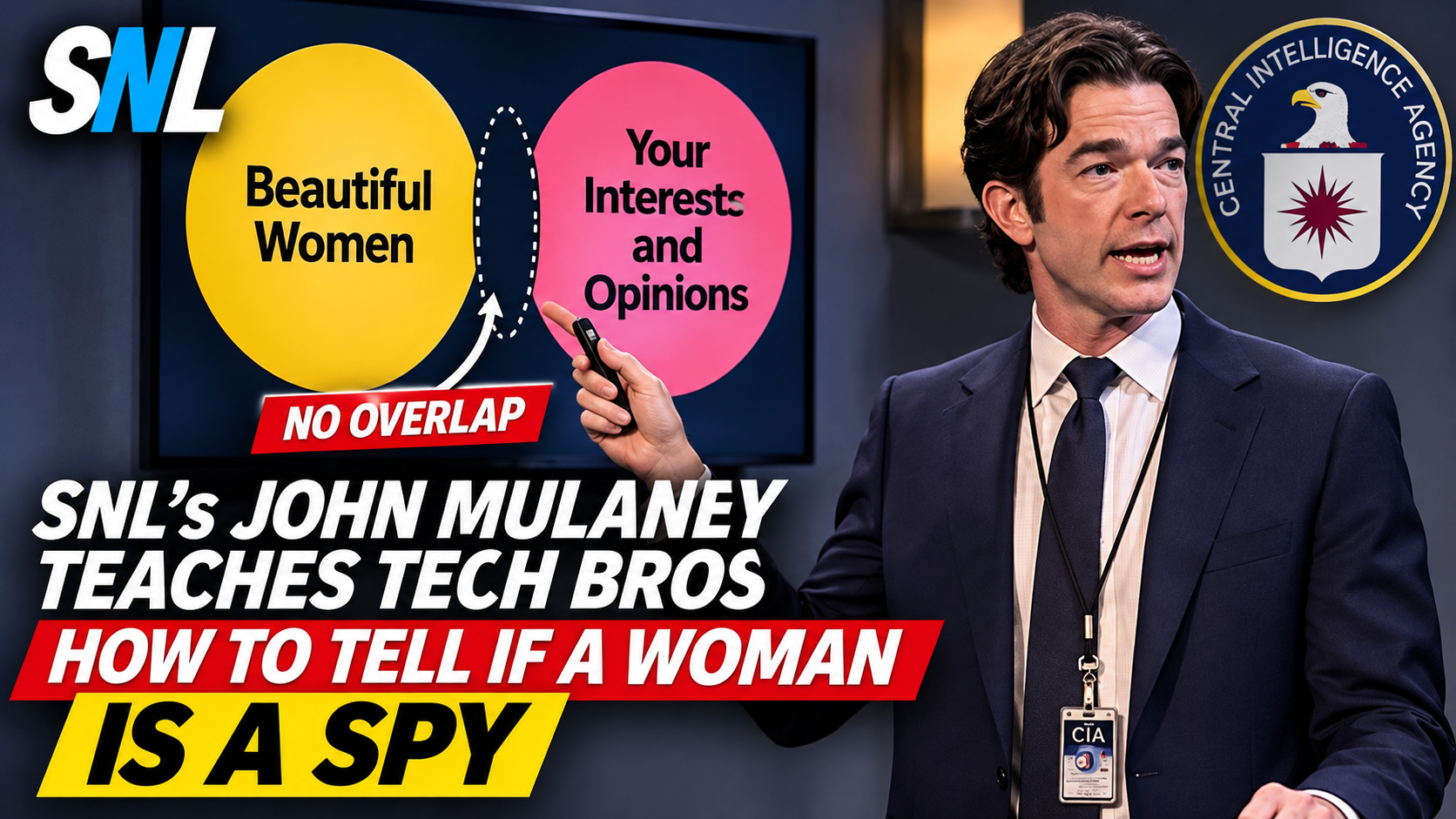
The CIA’s Venn Diagram Delivers the Sketch’s Most Devastating Lesson
One of the strongest jokes came when Mulaney introduced an instructional Venn diagram intended to explain the romantic realities facing America’s technology billionaires. The graphic divided the world into two categories: beautiful women and people who genuinely enjoy discussing the interests and opinions of Silicon Valley executives. According to the CIA officer, the two groups had absolutely nothing in common.
“On this side we have beautiful women, and on this side we have people who would be interested in your shared opinions and interests. I cannot stress this enough: there is no overlap.”
The joke worked because it attacked the fundamental assumption that wealth, technological achievement, and professional influence automatically translate into personal charisma. Mulaney’s character was not questioning whether the executives were intelligent or successful. He was suggesting that their enormous financial resources had created a distorted understanding of how ordinary human relationships function, making them particularly susceptible to anyone willing to flatter their egos.
The sketch also offered a broader critique of Silicon Valley culture, where powerful executives frequently surround themselves with admirers, investors, employees, and online followers who reinforce their sense of exceptionalism. In the fictional CIA classroom, that environment had become a national security vulnerability because the billionaires could no longer distinguish authentic attraction from calculated manipulation.
Mark Zuckerberg Thinks Constant Surveillance Makes Him More Attractive
Andrew Dismukes’ portrayal of Mark Zuckerberg provided another memorable moment when the fictional Meta CEO attempted to explain why a woman might genuinely find him appealing. Rather than pointing to conventional romantic qualities, Zuckerberg suggested that a potential partner could feel reassured by his Meta smart glasses constantly recording her activities.
Mulaney’s CIA officer immediately rejected the explanation, reinforcing the lesson that intrusive technology and relentless surveillance are not generally considered romantic selling points. The exchange turned Zuckerberg’s public association with data collection, social media tracking, and wearable technology into a personal character flaw, imagining a man so immersed in the logic of his own products that he could no longer understand why someone might object to being recorded.
The joke was particularly effective because it connected the espionage premise to the broader privacy concerns surrounding major technology companies. In a sketch ostensibly about preventing foreign intelligence operations, Zuckerberg’s fictional response suggested that some Silicon Valley executives had already normalized surveillance to such an extent that they struggled to recognize its invasive implications.
Peter Thiel’s Antichrist Obsession Takes the Class Completely Off Track
James Austin Johnson’s portrayal of billionaire investor Peter Thiel pushed the sketch into even stranger territory, with the fictional Thiel offering warnings about romantic relationships that quickly became entangled with religious and apocalyptic rhetoric. Rather than simply advising his fellow executives to avoid suspicious relationships, Thiel suggested that dating itself could present existential dangers, repeatedly invoking the Antichrist and the possibility that technology might play a role in humanity’s downfall.
Mulaney’s character attempted to redirect the discussion toward practical intelligence precautions, but Thiel challenged him to identify a single occasion when technology had failed society. The CIA officer immediately pointed to recent aviation disruptions and a Microsoft Outlook outage, citing two examples of technological systems malfunctioning in ways that affected millions of people.
Thiel’s response was characteristically unmoved: he demanded another example.
The exchange turned the technology industry’s reputation for overconfidence into an escalating joke, suggesting that even obvious evidence of systemic failure would not persuade some of its most powerful advocates to reconsider their assumptions. The sketch also satirized Thiel’s real-world interest in religious and philosophical questions about technology, power, and the Antichrist, exaggerating those interests into an almost comically impractical approach to national security.
Bowen Yang Returns as Jensen Huang to Warn Silicon Valley About Honey Traps
The sketch reached its climax with a surprise appearance by former SNL cast member Bowen Yang, who returned wearing Jensen Huang’s signature black leather jacket to portray the Nvidia executive at the center of the controversy inspiring the sketch. Yang’s entrance transformed the fictional CIA training session into a cautionary tale, with his character presenting himself as an example of what could happen when a powerful technology executive failed to recognize the warning signs of a potentially compromising relationship.
Yang’s version of Huang warned the assembled billionaires against making the same mistakes, delivering a line that neatly summarized the sketch’s central argument about the relationship between technological ambition and social insecurity.
“Fellas, don’t be like me. Remember, women don’t like guys like us. That’s how we became guys like us.”
The punchline suggested that the same insecurities and social difficulties that supposedly drove these men to become technology obsessives could also leave them vulnerable after achieving extraordinary wealth and influence. The joke reduced the psychological complexity of Silicon Valley’s billionaire class to a deliberately cruel observation: their professional success had not necessarily resolved the personal insecurities that helped motivate it.
Yang followed with another joke about his character’s supposed interest in BDSM, redefining the acronym as “Breaking Da Stock Market.” The punchline connected the alleged espionage controversy to Nvidia’s financial significance, using the company’s enormous influence over the artificial intelligence industry to suggest that one executive’s personal decisions could have consequences extending far beyond his private life.
The appearance gave the sketch an effective conclusion by bringing the audience back to the controversy that inspired the fictional intelligence briefing. Rather than allowing the other billionaires to learn from Huang’s alleged experience, the sketch implied that Silicon Valley’s most powerful executives might remain convinced that their wealth and intelligence made them immune to the most obvious forms of manipulation.
Behind the Comedy Is a Serious Question About Espionage and America’s AI Industry
Although the sketch relied heavily on exaggerated personalities and sexual humor, its central premise touched on a legitimate national security concern: the vulnerability of powerful corporate executives to foreign intelligence operations. Intelligence agencies have long recognized that romantic relationships, financial incentives, personal embarrassment, and emotional manipulation can be used to cultivate sources or obtain access to sensitive information. Such operations are commonly described as honey traps, although the term itself does not establish that any particular relationship involves espionage.
The issue carries particular significance in the artificial intelligence industry, where companies such as Nvidia, OpenAI, Anthropic, and Meta operate at the intersection of enormous financial interests, advanced computing technology, and increasingly intense geopolitical competition. Nvidia’s semiconductor technology is especially important because advanced AI chips have become a central component of the technological rivalry between the United States and China, prompting export restrictions, congressional scrutiny, and continuing debates about the protection of American intellectual property.
The allegations involving Huang provided the immediate inspiration for SNL’s comedy, but the sketch should not be confused with evidence that a foreign intelligence operation occurred. Claims about an individual’s romantic relationships, alleged intelligence connections, or disclosure of corporate secrets require independent verification. The fictional portrayals of Musk, Altman, Thiel, Zuckerberg, and Amodei likewise should not be interpreted as accusations that those executives have participated in espionage-related relationships.
What made the sketch effective was its ability to transform a complex national security issue into an accessible critique of power and ego. Rather than explaining intelligence tradecraft, Mulaney’s CIA officer suggested that America’s technological leadership might be threatened by something far more embarrassing than sophisticated hacking: executives who simply cannot believe that someone might pretend to find them attractive.
SNL Turns Silicon Valley’s Biggest Egos Into a National Security Liability
The cold open demonstrated Saturday Night Live’s ability to combine topical political satire with recognizable celebrity impersonations, using the alleged Nvidia controversy as a foundation for a broader examination of Silicon Valley’s cultural influence. Mulaney’s increasingly frustrated intelligence officer served as the audience’s representative, confronting a group of fictional billionaires whose technological brilliance appeared to have left them with remarkably little common sense.
The performances also allowed the sketch to target different aspects of the technology industry without abandoning its central premise. Zuckerberg represented the normalization of surveillance, Thiel embodied philosophical grandiosity, Musk and Altman contributed to the broader portrait of billionaire exceptionalism, and Yang’s Huang supplied the cautionary example around which the entire fictional intervention revolved.
Ultimately, the sketch’s sharpest criticism was not that America’s technology executives lack intelligence, but that their extraordinary professional success may encourage a dangerous level of personal overconfidence. By presenting the CIA as an agency forced to teach billionaires the most elementary lessons about romantic manipulation, SNL turned the threat of corporate espionage into a comedy about vanity, insecurity, and the limits of technological genius.
For an industry built around the promise that artificial intelligence can solve humanity’s most complicated problems, Saturday Night Live offered a considerably simpler challenge: perhaps the people building the future should first learn how to recognize when someone is lying to them.








Loading comments…