
U.S. Intelligence Built a UFO “Honeypot” to Lure in UFOs, Missouri Congressman Says It Worked
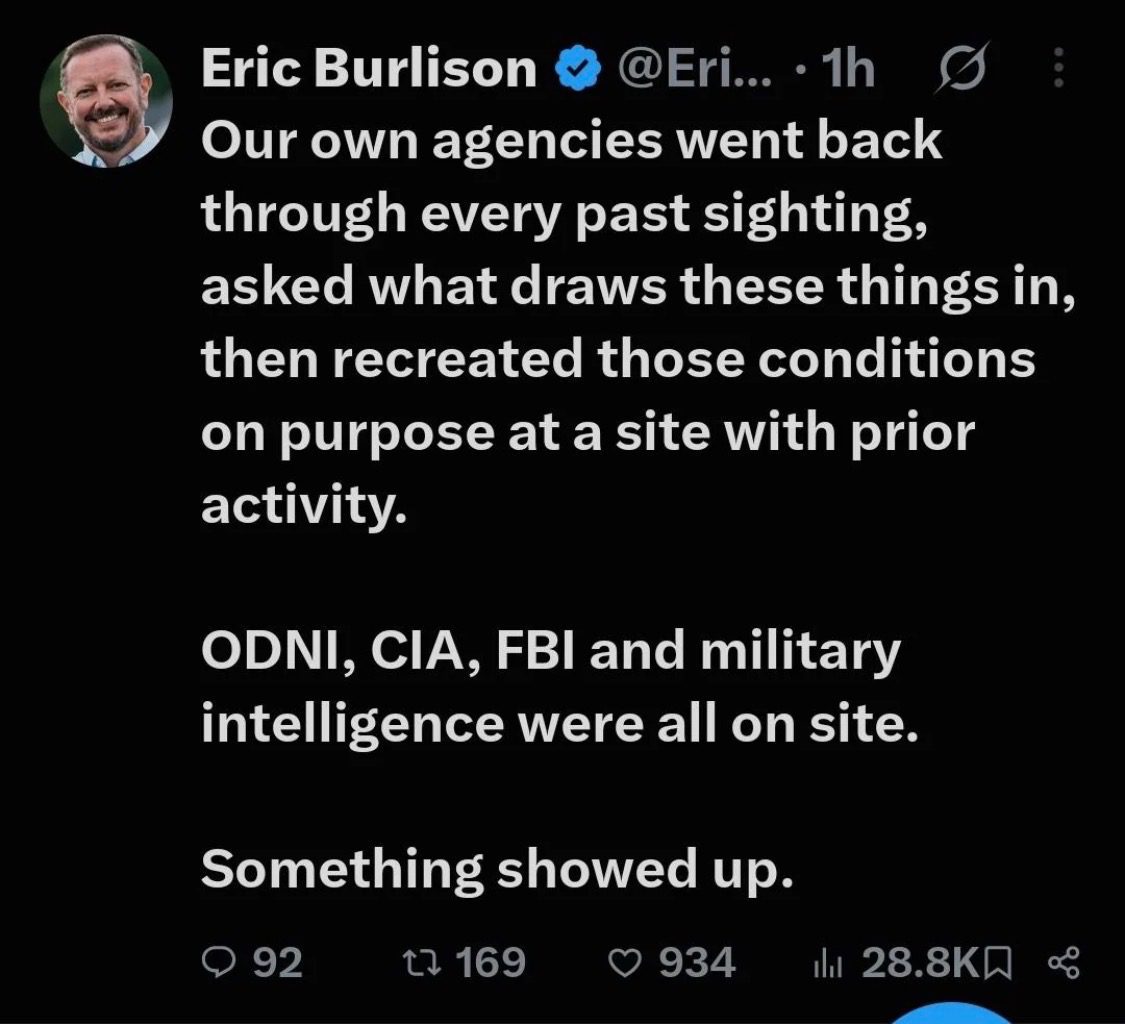
A sitting United States congressman involved in the government’s UAP investigation has made an extraordinary disclosure: American intelligence agencies allegedly studied decades of unidentified anomalous phenomena encounters, identified conditions that appeared to draw the objects into an area, deliberately recreated those conditions at a location with previous UAP activity, and something showed up.
Rep. Eric Burlison, a Missouri Republican serving on the House Oversight Committee and the Task Force on the Declassification of Federal Secrets, publicly described what amounts to a government UAP “honeypot.” Rather than waiting for another unpredictable encounter, Burlison says federal agencies worked backward through historical sightings, attempted to determine what attracted the phenomenon and then intentionally reproduced those conditions while intelligence personnel were positioned to observe what happened. His Aug. 19 statement is remarkable not only because of what he says happened, but because of the agencies he says were there.
“Our own agencies went back through every past sighting, asked what draws these things in, then recreated those conditions on purpose at a site with prior activity. ODNI, CIA, FBI and military intelligence were all on site. Something showed up.” — Rep. Eric Burlison
The statement dramatically advances one of the most important questions surrounding the modern UAP investigation. If Burlison’s account is accurate, elements of the United States intelligence community are no longer simply documenting unexpected UAP encounters. They have accumulated enough information about the phenomenon to formulate hypotheses about when and why it appears and apparently considered those hypotheses credible enough to test them in the field. That is a fundamentally different story from another unexplained light in the sky.
The Government Allegedly Went From Watching UAPs to Trying to Trigger Them
For most of the modern UAP era, the public has encountered the phenomenon through surprise military incidents. Fighter pilots encounter something during training. Radar operators detect unusual tracks. Objects appear around restricted airspace or military installations. Sensors capture an anomaly, and investigators attempt to reconstruct what happened afterward. Burlison is describing the reverse. According to his statement, government investigators examined previous encounters first, searched for common characteristics and then intentionally recreated those conditions at a location already associated with UAP activity. Personnel from ODNI, the CIA, FBI and military intelligence were allegedly present when the experiment took place.
In intelligence terminology, the concept resembles a honeypot: create conditions attractive to a target, control the environment and observe what responds. In scientific terms, the logic is equally significant. Researchers identify a pattern, develop a hypothesis from that pattern, reproduce the suspected variables and determine whether the phenomenon returns. According to Burlison, it did. That does not tell us what appeared, but it potentially tells us something equally important: the government may believe UAP behavior contains patterns that can be studied, anticipated and perhaps reproduced.

Something Showed Up
Burlison’s wording is strikingly careful. He did not identify the object as extraterrestrial. He did not publicly describe its shape, origin or technology. Instead, he delivered three words that may ultimately prove more consequential:
“Something showed up.”
Burlison has separately described what he says officials briefing him have reported about UAP performance.
“They hover in place. Then they go from a dead stop to Mach speed instantly. I’m not going to tell you what they are. I’m telling you the people briefing me say they don’t know either. That is the problem.”
That second statement provides important context for the first. Burlison is not claiming publicly to know what intelligence officials believe these objects are. He is saying that people briefing a member of Congress are describing objects displaying extraordinary behavior while simultaneously telling him they cannot identify them. Burlison has also made clear that he did not enter the UAP debate as a believer. In another public statement, he said he approached the subject “as a complete skeptic” and still considers himself one, but argued that military incursions, testimony from service members and allegations that Congress is being kept in the dark create an obligation for lawmakers to investigate.
That makes his honeypot statement harder to dismiss as casual speculation. It comes from a congressman actively engaged in UAP oversight who says he has been receiving information from people inside the government.
The Real Breakthrough May Be Repeatability
The most important implication of Burlison’s disclosure is not simply that another unidentified object appeared. The United States military has accumulated reports of unidentified objects for decades, and the Pentagon itself now openly acknowledges UAP as a legitimate category of defense and intelligence investigation. What changes the equation is the possibility of repeatability. If intelligence analysts examined historical encounters, isolated recurring variables, deliberately recreated those variables and subsequently observed another anomalous object, UAP research potentially moves from passive observation toward experimental science.
A spontaneous encounter is difficult to study because investigators arrive after the event. A planned operation is entirely different. Sensors can be positioned beforehand. Radar can be calibrated. Infrared and electro-optical cameras can continuously record. Environmental conditions can be measured. Signals intelligence can monitor the electromagnetic environment. Investigators know precisely when each experimental variable is introduced and can compare that timeline against whatever subsequently occurs. Most importantly, the experiment can theoretically be repeated.
If the same conditions repeatedly produce anomalous observations, researchers can begin separating coincidence from correlation and eventually correlation from causation. That would represent a profound shift in the UAP investigation regardless of the ultimate origin of the objects. The question would no longer simply be, “What are people seeing?”
It would become: What makes them appear?
The Pentagon Already Built an Infrastructure for Targeted UAP Collection
The idea that the government would position specialized sensors around areas of recurring UAP activity is not speculation. Department of Defense records show that the government has developed procedures for targeted collection of anomalous phenomena. Documents released through the Pentagon’s All-domain Anomaly Resolution Office describe enabling the deployment of specialized sensors for the “detection, observation, and identification” of UAP around sensitive locations and during the testing or deployment of special capabilities. Government documentation also discusses UAP trend analysis, technical exploitation and counterintelligence.
AARO publicly maintains military imagery collected by infrared and electro-optical systems, while the broader intelligence apparatus has access to radar, satellites, signals intelligence and sensor platforms vastly more capable than anything available to civilian researchers. The importance of Burlison’s statement is that it potentially connects two previously separate pieces of the puzzle: the government’s ability to collect sophisticated UAP data and its apparent understanding of historical conditions associated with UAP activity. If investigators know where anomalous objects have repeatedly appeared, possess specialized equipment capable of observing them and believe they have identified conditions that increase the likelihood of another appearance, a controlled attraction experiment becomes a logical next step. Burlison says that step was taken.
The Nuclear Connection Is Impossible to Ignore
One of the longest-running patterns in the UAP record is the repeated appearance of unidentified objects around nuclear weapons facilities, strategic military installations and high energy military operations. Reports involving Malmstrom Air Force Base, Minot Air Force Base and other nuclear infrastructure have fueled decades of concern among military personnel and researchers that UAP activity may disproportionately cluster around humanity’s most powerful weapons systems.
Former Pentagon official Luis Elizondo has repeatedly raised the nuclear connection publicly and before Congress. In written testimony submitted to the House Oversight Committee, Elizondo alleged that advanced technologies of unknown origin have monitored sensitive military installations around the world. Congressional hearings have also heard testimony concerning UAP activity around American military and nuclear facilities. The nuclear pattern matters enormously to the alleged honeypot because investigators attempting to determine “what draws these things in” would naturally examine the characteristics shared by the strongest historical encounters. Nuclear material, high powered radar, electromagnetic emissions, military exercises, weapons testing and concentrated sensor activity would all represent variables worth examining if the underlying encounter data repeatedly pointed in those directions.
Burlison has not disclosed which variables were used in the operation. But his statement suggests the government believes at least some historical correlations were strong enough to reproduce deliberately. That may be the most consequential part of the entire disclosure.
Malmstrom and the Nuclear Missile Mystery
Few historical incidents illustrate the nuclear connection more dramatically than the events reported around Malmstrom Air Force Base in Montana in 1967. Former Air Force personnel have long alleged that unidentified aerial objects were observed near nuclear missile facilities around the same period that multiple Minuteman missiles became temporarily unavailable. The precise relationship between the reported objects and the missile failures remains disputed, but the episode has persisted in the UAP record because of testimony from military personnel directly responsible for America’s nuclear deterrent.
For intelligence analysts studying patterns across decades of UAP reports, cases involving strategic weapons facilities would be difficult to ignore. Even without assuming a particular origin for the objects, repeated anomalous activity around nuclear infrastructure would represent a serious counterintelligence and national-security problem. If those historical events eventually became part of the dataset used to design active UAP collection experiments, Burlison’s disclosure may provide a glimpse into how the intelligence community has attempted to turn decades of scattered encounters into an operational model.
The 1976 Tehran Encounter Added Another Piece to the Pattern
A declassified U.S. military intelligence report concerning a September 1976 encounter over Tehran provides another important historical example. Iranian authorities scrambled an F-4 Phantom fighter after civilians and military personnel reported a luminous unidentified object over the city. According to the intelligence report, when one F-4 approached the object, the aircraft experienced instrumentation and communications failures. The systems reportedly returned after the pilot broke off the intercept. A second aircraft was subsequently dispatched and reported additional unusual activity.
The Tehran incident became significant not simply because pilots reported an unidentified object, but because the encounter allegedly involved measurable interactions with sophisticated military systems. That distinction matters when examining the honeypot concept. Intelligence analysts are not limited to eyewitness testimony. Historical military encounters can contain radar records, communications data, weapons-system behavior, aircraft telemetry and other measurable variables that can be compared across incidents.
Over decades, those datasets can reveal patterns invisible within any single encounter. Burlison’s statement suggests someone inside the government may have done exactly that.
The FBI’s Famous Radar Memo Shows How Far Back the Question Goes
The idea that electromagnetic or radar activity could interact with unidentified craft has circulated inside government files since at least the early Cold War. One of the most famous examples is the FBI’s 1950 Guy Hottel memo, which recorded a source claiming that three flying saucers had been recovered in New Mexico and that high powered radar had interfered with their control mechanisms.
The FBI has emphasized that the information was unverified and that the memo itself does not establish that recovered spacecraft existed. But the document remains historically significant because it demonstrates how early the relationship between unidentified craft and electromagnetic systems entered government reporting. More than seven decades later, the United States possesses phased-array radar, space based surveillance, infrared satellites, electronic intelligence platforms and military sensor networks that investigators in 1950 could barely have imagined. If recurring signatures exist, today’s intelligence community is exceptionally well equipped to find them.
The Government Has Decades of Data the Public Has Never Seen
This is where Burlison’s allegation becomes larger than a single experiment. The American public sees only a fraction of the sensor environment surrounding the U.S. military. Modern warships, fighter aircraft, missile warning satellites, intelligence satellites, ground-based radar, airborne early warning aircraft and signals intelligence systems continuously collect enormous quantities of information. UAP appearing inside that environment can potentially be observed simultaneously across multiple sensor domains.
That matters because the strongest UAP cases are not simply stories told by witnesses. They are cases in which trained observers and multiple independent sensors appear to record the same phenomenon. If intelligence agencies have been accumulating those encounters for decades, they may possess a dataset far larger and more sophisticated than anything publicly available. Burlison’s statement implies that government analysts may already be extracting behavioral patterns from that classified record.
Burlison Is Positioned to Ask Questions Most Americans Cannot
Burlison is not an outside researcher attempting to reconstruct government activity from leaked documents. He serves on the House Oversight Committee and the Task Force on the Declassification of Federal Secrets, which has jurisdiction over UAP records and broader questions surrounding government secrecy.
He has repeatedly pursued information about alleged UAP programs, including records involving government contractors, intelligence agencies and historical incidents. He has pressed MITRE for answers concerning UAP records and possible connections to alleged retrieval or reverse engineering programs, requested CIA and FBI material concerning the 1996 Varginha incident in Brazil and pushed legislation designed to establish a more systematic framework for UAP disclosure.
His office also brought former intelligence official and UAP whistleblower David Grusch aboard as a special adviser. Grusch became a central figure in the disclosure movement after testifying before Congress that he had been informed of a long-running crash-retrieval and reverse engineering program involving material allegedly connected to non-human intelligence. Those allegations remain at the center of an escalating dispute between congressional investigators, whistleblowers and elements of the national-security establishment over how much UAP information remains classified and who inside government has access to it.
Burlison’s latest statement moves that fight into new territory because he is no longer discussing only historical programs or alleged recovered material. He is describing an operation in which government agencies apparently attempted to interact with the phenomenon in real time.
If Four Intelligence Organizations Were There, There Should Be Tons of Data
The alleged presence of ODNI, CIA, FBI and military intelligence is crucial. A coordinated operation involving personnel from multiple federal intelligence organizations would require planning, authorization, logistics, security and collection protocols. Those activities create records. If sophisticated sensors were deployed, they create data. There should be an operational footprint. Depending on what equipment was involved, that footprint could include radar tracks, infrared imagery, electro-optical video, signals intelligence, satellite observations, environmental measurements, communications logs, witness reports and post-operation intelligence assessments. And unlike a surprise military encounter, investigators would have known exactly where to point their equipment. That could make the evidence collected during a controlled UAP attraction experiment substantially more valuable than almost anything currently available to the public. Congress should demand it.
The Question Is No Longer Whether the Government Takes UAP Seriously
For years, one of the central questions surrounding UFOs was whether the United States government actually considered them real enough to investigate. That question has largely been answered. The Pentagon established AARO. Congress has held public UAP hearings. Military personnel have testified. Intelligence officials have provided classified briefings. Lawmakers have introduced disclosure legislation. Federal agencies maintain UAP reporting mechanisms, and the Department of Defense has released authentic military footage of unidentified objects. The fight has moved beyond whether the subject exists inside government. The real questions now concern what the government has learned, what remains classified and whether Congress itself has received the full picture. Burlison’s allegation raises an even more provocative possibility: parts of the intelligence community may understand enough about recurring UAP behavior to design experiments around it. That is a radically different level of knowledge from simply admitting that pilots occasionally encounter unidentified objects.
A Successful Honeypot Would Change the Scientific Equation
Extraordinary claims ultimately become scientifically meaningful when they produce testable predictions. If a particular combination of environmental conditions, military activity, electromagnetic signatures or other variables consistently increases the probability of UAP appearing, investigators can test that relationship repeatedly. Different teams can conduct the experiment. Different sensors can measure the event. Variables can be changed individually. Conventional explanations can be systematically eliminated. That is how an unpredictable mystery begins becoming an observable phenomenon.
A single successful operation would not answer every question. But it could establish the foundation for something far more important: repeatability. And if the United States government has already reached that stage privately, the public UAP debate may be years, perhaps decades, behind the classified investigation.
The Most Important Question Is What the Government Already Knows
The implications of Burlison’s statement extend far beyond another UFO sighting.
If intelligence agencies really examined historical encounters closely enough to identify what appears to attract UAP, then the government has already developed some form of behavioral model. If officials trusted that model enough to organize a multi-agency field operation, they apparently believed the pattern was more than random noise. And if something subsequently appeared under those deliberately recreated conditions, investigators obtained a result that demands further examination.
The central question therefore changes. It is no longer simply whether unexplained objects are operating around American military assets. The government has spent years publicly acknowledging that UAP incidents occur. The deeper question is how much the classified national-security apparatus has already learned about them. There is an enormous difference between knowing that a phenomenon exists and knowing how to make it appear. Burlison’s statement suggests someone inside the United States government may have crossed that line.
Congress Needs the Honeypot Files
If this operation happened as Burlison described, Congress should demand the complete intelligence record surrounding it. Not another summary. Not another heavily qualified public statement. The underlying records. Lawmakers should seek the authorization for the operation, the agencies involved, the historical data used to construct the experiment, the conditions investigators reproduced, the sensors deployed, the raw telemetry collected, the after-action reports and the intelligence assessment explaining what officials believe occurred.
Legitimate intelligence sources and methods can be protected without concealing the fundamental findings from Congress or the American public indefinitely. Because if the government’s own intelligence agencies have discovered a repeatable method for attracting unidentified anomalous phenomena, this is no longer merely a debate about unexplained sightings. It is evidence of an organized government effort to understand and potentially interact with a phenomenon that remains unexplained publicly. And the person now telling Americans that this happened is not an anonymous source, a retired official speaking through intermediaries or someone posting an unverified story online.
He is a sitting United States congressman involved in the investigation. His statement is remarkably simple:
“Our own agencies went back through every past sighting, asked what draws these things in, then recreated those conditions on purpose at a site with prior activity. ODNI, CIA, FBI and military intelligence were all on site. Something showed up.”
If that account is accurate, the most important question in the UAP debate may no longer be whether the government believes these objects are real. It may be whether the government already knows how to bring them back.

- The United States Government May Be Using Nuclear Lures To Attract and Study UAPs
- “They Won’t Allow Nuclear War” – Former Missile Guard Shares UFO Encounter
- If UFOs Are Intelligent, Peaceful, and Opposed to Nuclear War, Why Is the Pentagon Allegedly Trying to Shoot Them Down?
- Former Military Personnel Claim UFOs Interfered With Nuclear Missile Tests and Shut Down Warheads in Flight

Sources
- Rep. Eric Burlison — Official Congressional Website
- House Oversight — Task Force on the Declassification of Federal Secrets — Confirms Burlison’s membership on the congressional task force examining UAP records.
- Burlison Presses MITRE for UAP Records and Legacy Program Information — Burlison’s May 2026 congressional records demand concerning UAP data, recovered materials and alleged crash-retrieval or reverse-engineering programs. (Representative Burlison)
- Burlison Presses CIA and FBI for Records on the 1996 Brazil UAP Incident — Official July 2026 request to CIA and FBI for UAP-related records. (Representative Burlison)
- House Adopts Burlison’s UAP Disclosure Framework — The House adopted Burlison’s UAP Disclosure Act amendment in July 2026, including a proposed permanent National Archives UAP collection and independent review board. (Representative Burlison)
- Luis Elizondo — Written Testimony to Congress — Elizondo’s November 2024 sworn congressional submission states that UAP are real and alleges that technologies of unknown origin are monitoring sensitive military installations. (House Oversight Committee)
- House Oversight — Luna’s UAP Transparency Investigation — Official 2026 congressional request for additional UAP videos and records held by the government. (House Oversight Committee)
- AARO — Official UAP Imagery and Case Records — Pentagon repository containing military UAP imagery and case assessments, including unresolved cases. (AARO)
- AARO — UAP Report Documents and 2026 Military Imagery — Includes newly released 2026 material from U.S. military sensors, including CENTCOM reports. (AARO)
- AARO — Historical Record Report on U.S. Government UAP Investigations — Pentagon’s official historical review of U.S. government involvement with UAP.
- Defense Intelligence Agency — 1976 Tehran UFO Intelligence Report — Declassified military report documenting the Iranian F-4 intercept and reported anomalous encounter. (Defense Intelligence Agency)
- FBI — Guy Hottel UFO Memo and Radar Claim — The FBI’s explanation of the authentic 1950 memo recording an unverified allegation that high-powered radar interfered with the control mechanism of alleged flying saucers. (FBI)


















































Want to join the conversation?
Create an account or sign in to share your thoughts, vote,
and reply to other readers.
Showing 0 of 0 comments
Don't have an account?
Already have an account?