
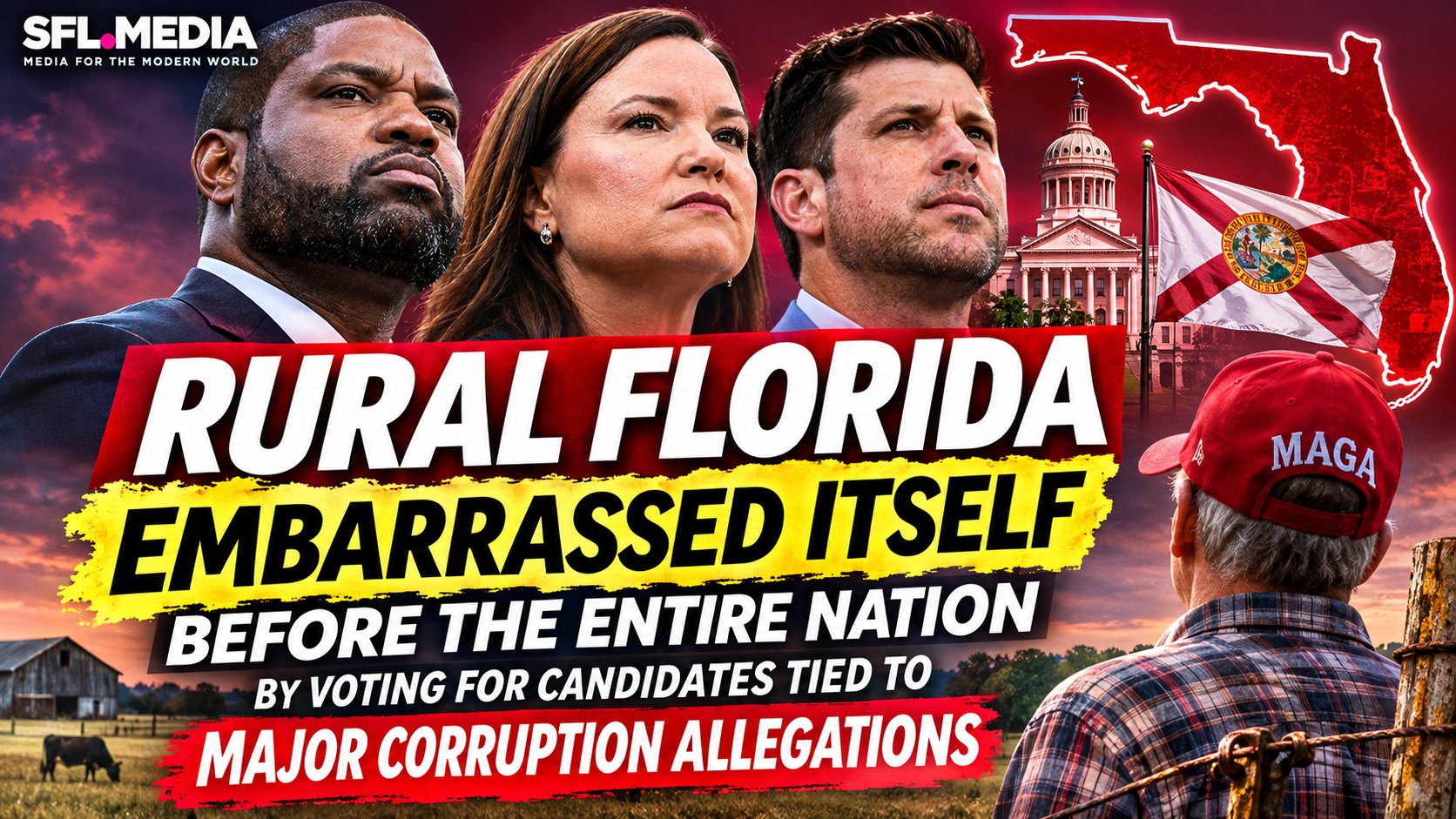
America Turned Blue, but Florida Stayed Red: Democrats Break the GOP Supermajority as Voters Reelect Officials Tied to Hope Florida Controversy
TALLAHASSEE, Fla. — While voters across the United States delivered a sweeping rebuke to President Donald Trump and the Republican Party in Tuesday’s midterm elections, Florida once again proved itself an exception to the national political trend. Democrats scored major victories in traditionally Republican territory and made significant gains in Congress, but Florida voters returned Republicans to every major statewide office, including two officials whose roles in the controversial Hope Florida settlement became the subject of extensive investigative reporting.
Republican Byron Donalds narrowly defeated Democrat David Jolly in the governor’s race, U.S. Sen. Ashley Moody survived a challenge from Democratic state Rep. Angie Nixon, and Attorney General James Uthmeier defeated Democrat José Javier Rodríguez. Republicans also retained the offices of chief financial officer and agriculture commissioner, extending their control over Florida’s executive branch even as the party suffered substantial setbacks elsewhere.
Yet the Republican victories concealed an important political shift. Democrats gained approximately 15 seats in the Florida House of Representatives, ending the Republican supermajority that had given GOP leaders extraordinary legislative power. The state Senate’s supermajority was also in jeopardy as competitive races continued to determine the chamber’s final composition. Republicans retained control of Tallahassee, but their ability to govern without meaningful opposition was significantly weakened.
South Florida provided another important Democratic victory. Congressman Jared Moskowitz defeated Republican Scott Singer in Florida’s newly redrawn 25th Congressional District, overcoming boundaries designed to improve Republican electoral prospects. His victory demonstrated that even aggressive partisan redistricting cannot guarantee an election outcome when voters move decisively against the party controlling the map.
The results leave Florida with a political contradiction. Republican candidates won every major statewide office during an election that otherwise produced remarkable Democratic successes, yet their margins narrowed dramatically, their legislative dominance weakened, and their congressional redistricting strategy failed to unseat at least one prominent Democratic incumbent.
For Florida Democrats, the election also revived difficult questions about candidate recruitment, statewide organizing, and the party’s repeated decision to nominate former Republicans for governor. For voters, the reelection of Moody and Uthmeier raised another question: How should allegations involving government settlements, nonprofit organizations, and political spending affect the public’s judgment of elected officials?
Republicans Sweep Florida’s Statewide Elections, but Their Margins Collapse
The Republican statewide sweep was unmistakable, but the margins revealed a much more competitive political environment than Florida experienced during the 2022 and 2024 elections. Donalds defeated Jolly with approximately 50.0% of the vote to Jolly’s 48.7%, a difference of roughly 108,000 votes in the unofficial returns. Moody defeated Nixon with approximately 50.9% to 48.0%, while Uthmeier defeated Rodríguez by approximately 51% to 49%.
The victories were considerably narrower than the Republican landslides of 2022, when Gov. Ron DeSantis defeated Democrat Charlie Crist by nearly 19 percentage points and Sen. Marco Rubio won reelection by more than 16 points. Trump subsequently carried Florida by approximately 13 percentage points in the 2024 presidential election, reinforcing the state’s transformation from a presidential battleground into a Republican stronghold.
Tuesday’s results suggested that Florida’s Republican advantage had weakened substantially. Democrats recovered ground in metropolitan areas and competitive suburbs, while Republican candidates survived by margins that would have seemed unusually close only two years earlier. Nevertheless, those gains were insufficient to overcome the Republican Party’s statewide organizational strength, voter registration advantage, and continued support across smaller counties and rural communities.
The results also underscored the difference between national political momentum and state level organization. While Democratic candidates elsewhere assembled winning coalitions in traditionally conservative states, Florida Republicans retained enough support to withstand a difficult national environment. Democrats made significant progress, but the party remained unable to convert that progress into statewide executive power.
Florida Democrats Ran Another Former Republican for Governor, and Lost Again
One of the most consequential strategic decisions of the election involved the Democratic Party’s nomination of David Jolly, a former Republican congressman who represented Florida’s 13th Congressional District before leaving the GOP and eventually joining the Democratic Party.
Jolly campaigned as a moderate alternative to the state’s Republican leadership, emphasizing affordability, property insurance, housing costs, and the need to move beyond partisan confrontation. His Republican background was intended, in part, to appeal to independent voters and conservatives dissatisfied with Trump but reluctant to support a traditionally progressive Democrat.
The strategy produced a much more competitive election than Democrats had managed in recent years, but it still ended in defeat. Four years earlier, the party nominated Charlie Crist, another former Republican congressman and governor who had switched parties. Crist lost to DeSantis by nearly 19 percentage points. In 2026, Democrats again turned to a former Republican congressman and again failed to capture the governor’s office.
The comparison requires context. Jolly performed dramatically better than Crist, and his narrow defeat suggests that he successfully attracted voters who had previously supported Republicans. There is no reliable evidence that a more progressive candidate would necessarily have won. Nevertheless, the recurring strategy raises a legitimate question about the Florida Democratic Party’s ability to develop a statewide bench of candidates whose political careers and identities are rooted in the party itself.
Florida has Democratic mayors, legislators, county officials, and organizers throughout South Florida, Orlando, Tampa Bay, and Jacksonville. Yet the party has repeatedly struggled to translate those regional strengths into a statewide political operation capable of matching Republican fundraising, candidate development, voter registration, and turnout infrastructure.
Jolly’s defeat should therefore be understood as both a missed opportunity and evidence of renewed competitiveness. Democrats came close to winning the governorship in a state where Republicans entered the election with a substantial structural advantage. But they still failed to capture an office the party has not won since 1994.
Donalds, meanwhile, made history as Florida’s first Black governor and the first Black Republican elected governor in the United States. A close Trump ally, he campaigned on continuing the state’s conservative political direction and will succeed the term limited DeSantis.
Ashley Moody Wins Despite Questions Surrounding the Hope Florida Settlement
Among the most controversial statewide results was Sen. Ashley Moody’s victory over Democrat Angie Nixon, which returned Moody to Washington despite extensive reporting about her involvement in the Hope Florida settlement controversy.
Moody, Florida’s former attorney general, was appointed to the U.S. Senate after Marco Rubio became secretary of state. She defeated Nixon with approximately 50.9% of the vote, benefiting from the Republican Party’s statewide advantage even as the Democratic challenger narrowed the race considerably.
The Hope Florida controversy originated in a $67 million settlement involving Centene Corporation and allegations that the company had overcharged Florida’s Medicaid program. Under the settlement arrangement, Centene paid $57 million to the state and made a separate $10 million payment directly to the Hope Florida Foundation, a nonprofit associated with a social services initiative championed by First Lady Casey DeSantis.
The foundation subsequently approved two $5 million grants to nonprofit organizations that donated money to a political committee opposing Florida’s 2024 recreational marijuana legalization amendment. Those transactions prompted investigative reporting and legal scrutiny over whether the settlement structure had been used to direct money toward political activity.
A grand jury report obtained by journalists in August 2026 accused participants in the arrangement of improperly directing the money into political spending. The report discussed the roles of Moody, Uthmeier, and other officials involved in the settlement process. However, the grand jury issued no indictments, acknowledging that it lacked sufficient evidence to bring criminal charges.
In October, Florida’s First District Court of Appeal ordered the report expunged, finding that the grand jury exceeded its authority by accusing individuals of wrongdoing without indicting them. The court also rejected the grand jury’s legal conclusion that the $10 million constituted misappropriated public money, determining that the payment went directly from Centene to the foundation and never became state property.
Those findings are essential to any fair account of the controversy. The court’s ruling substantially undermined the grand jury’s legal conclusions, and neither Moody nor Uthmeier was charged with a crime arising from the settlement. The disputed allegations cannot be presented as established criminal misconduct.
Nevertheless, the documented movement of money from a healthcare settlement to a politically connected foundation and ultimately to organizations that financed political activity remains a legitimate subject of public scrutiny. The appellate court itself acknowledged that questions about the propriety of third-party settlement payments could be raised, even while finding that the grand jury’s legal accusations were unsupported.
Moody’s reelection demonstrated that the controversy was not enough to defeat her. Whether voters rejected the allegations, considered other issues more important, or were unfamiliar with the details cannot be determined from the election results alone.
James Uthmeier Wins Attorney General Race After Hope Florida Controversy
Attorney General James Uthmeier also survived the election, defeating Democrat José Javier Rodríguez with approximately 51% of the vote. His victory was particularly notable because Uthmeier had served as DeSantis’ chief of staff during the period examined in reporting about the Hope Florida settlement.
Uthmeier was among the officials whose conduct was criticized in the subsequently expunged grand jury report. The controversy prompted calls for additional scrutiny from Democratic lawmakers and intensified political debate over the relationship between the governor’s administration, the Hope Florida Foundation, and organizations involved in the marijuana amendment campaign.
Uthmeier and other administration officials disputed accusations of wrongdoing, and the appellate court’s ruling rejected the grand jury’s legal characterization of the settlement payment. His election does not establish that every decision surrounding the transaction was appropriate, just as the existence of an investigation does not establish criminal guilt.
The distinction matters because Florida’s attorney general is the state’s chief legal officer, responsible for representing government interests, enforcing various state laws, and overseeing significant legal proceedings. Public confidence in that office depends on transparency, consistent legal standards, and the perception that government decisions are made independently of political considerations.
Uthmeier’s victory means that voters chose to retain an attorney general whose conduct had become the subject of political controversy, despite the national environment favoring Democrats. For critics of the Republican establishment, the result illustrates the party’s ability to survive damaging scrutiny. For Uthmeier’s supporters, it represents a rejection of allegations they consider politically motivated or legally unsupported.
The broader public interest extends beyond those competing interpretations. Florida residents have a legitimate interest in understanding how government settlements are structured, why payments are directed to third parties, and whether adequate safeguards exist to prevent conflicts between public responsibilities and political activity.
Democrats Break the Republican Supermajority in the Florida House
The most consequential Democratic victory in Florida may have occurred in the state Legislature, where the party made substantial gains and ended the Republican supermajority in the House of Representatives. Unofficial results indicated that Republicans were poised to lose approximately 15 House seats, a major reversal from the overwhelming legislative dominance they enjoyed before the election. Republicans will continue controlling the chamber, but they will no longer possess the two-thirds majority required for certain extraordinary legislative actions.
That distinction has practical consequences. A two thirds majority can allow lawmakers to override a governor’s veto without assistance from the minority party. It can also be necessary for particular procedural actions. Losing that advantage does not prevent Republicans from passing ordinary legislation, but it reduces their ability to exercise certain powers without Democratic cooperation.
The Senate’s final balance was less certain in the immediate aftermath of Election Day, with competitive contests threatening the Republican supermajority there as well. Those races will determine whether the party retains its two thirds advantage in the upper chamber, although Republicans are expected to remain in control regardless.
The legislative results complicate any suggestion that Florida voters uniformly endorsed continued Republican dominance. While Republicans retained every major statewide executive office, voters also elected enough Democrats to significantly weaken the GOP’s control of the House.
For Democrats, the gains create opportunities for stronger opposition, additional legislative scrutiny, and a more credible statewide rebuilding effort. For Republicans, they represent a warning that the party’s organizational advantages do not guarantee permanent control.
Jared Moskowitz Defeats Republican Redistricting Strategy in South Florida
One of Florida’s clearest Democratic victories came from Congressman Jared Moskowitz, who defeated Republican Scott Singer in the newly redrawn 25th Congressional District despite changes to the congressional map intended to improve Republican electoral prospects.
Florida Republicans adopted new congressional boundaries in 2026 as part of a broader national struggle over mid-decade redistricting. The changes reshaped several districts, including Moskowitz’s, and created a new coastal constituency stretching through portions of Palm Beach, Broward, and Miami-Dade counties.
The district included communities around Delray Beach, Boca Raton, Deerfield Beach, Fort Lauderdale, Hollywood, and Miami Beach. Its redesigned boundaries produced a more Republican-friendly electorate than the one Moskowitz had previously represented, making the contest a major target for GOP efforts to expand or preserve congressional power.
Singer, a former Boca Raton mayor, campaigned as a Republican aligned with Trump. Moskowitz emphasized his record in Congress, South Florida issues, public safety, and his willingness to challenge political extremism.
Despite the new map, Moskowitz defeated Singer by approximately five percentage points, with unofficial returns placing him around 51% of the vote compared with Singer’s roughly 47%. The Associated Press called the race for Moskowitz on election night, confirming that the incumbent would return to Congress for another term.
The victory was politically significant because it demonstrated the limits of partisan redistricting. Republican lawmakers could alter district boundaries to create a more favorable electoral environment, but they could not guarantee that voters would elect their preferred candidate.
Moskowitz’s victory does not establish that the district was unlawfully drawn. Partisan advantage and a judicial finding of illegal gerrymandering are distinct issues. Nevertheless, the political intent of the map changes and the outcome of the election make the race an important example of a Democratic candidate overcoming a Republican favoring redistricting strategy.
For South Florida, the result also demonstrated the importance of candidate recognition, local relationships, and the ability to appeal beyond traditional partisan voting patterns. Moskowitz won a district designed to be more difficult for him, showing that competitive Democratic campaigns remain possible even as Republicans continue controlling statewide offices.

Rural Florida Remains the Republican Party’s Electoral Firewall
Florida’s geographic political divide was another defining feature of the election. Democrats made gains in metropolitan areas and competitive suburbs, but Republicans continued receiving overwhelming support across much of rural North Florida, the Panhandle, and the state’s agricultural interior.
Those communities have become central to Republican statewide victories because large conservative margins across smaller counties can offset Democratic advantages in more populous urban areas. Even when Democrats perform strongly in Broward, Orange, and portions of Palm Beach and Miami-Dade counties, Republican candidates can remain competitive by building substantial leads elsewhere.
That pattern was visible again in 2026. Donalds, Moody, and Uthmeier benefited from Republican strength outside the state’s major Democratic population centers, helping them survive a national political environment that proved damaging to Republicans in several other states.
The results raise legitimate questions about how rural voters evaluate government performance, particularly on issues such as property insurance, healthcare access, infrastructure, housing affordability, and political accountability. Many rural Florida communities face significant economic pressures, yet their voters continue supporting the party that has controlled state government for decades.
However, election results alone cannot establish that rural voters were uninformed or indifferent to those problems. Some may have prioritized taxes, immigration, cultural issues, or other policy concerns. Others may have been dissatisfied with Republican leadership but remained unconvinced that Democratic candidates offered a better alternative.
The political responsibility therefore extends beyond individual voters. Florida Democrats must explain why their policies would improve conditions in rural communities and build the local organizations necessary to compete there. Criticizing Republican dominance without offering a sustained alternative has repeatedly failed to produce statewide victories.
Florida Democrats Have an Organizational Problem That Candidate Recruitment Alone Cannot Fix
Florida’s election results cannot be explained entirely by voter ideology or individual candidate popularity. The Democratic Party continues facing organizational disadvantages that have weakened its ability to compete statewide.
Republicans entered the election with a voter registration advantage of approximately 1.5 million, reflecting years of sustained registration drives, local organizing, candidate recruitment, and fundraising. Democrats, meanwhile, have struggled with inconsistent statewide coordination, leadership disputes, and difficulty maintaining political operations between major election cycles.
The repeated nomination of former Republicans for governor illustrates the party’s broader challenge. Although both Crist and Jolly brought statewide recognition and experience, neither was able to overcome the Republican Party’s structural advantages. Jolly’s narrow defeat was a major improvement over Crist’s performance, but it did not end the Democratic losing streak.
The 2026 legislative gains offer a more encouraging model. Democrats succeeded in competitive districts, increased their representation in Tallahassee, and demonstrated that the Republican advantage can be reduced when strong candidates, local organizing, and favorable political conditions align.
Turning those gains into statewide victories will require more than finding another prominent candidate. It will require sustained investment in voter registration, rural outreach, local leadership, fundraising, and an organization capable of competing throughout Florida rather than concentrating almost exclusively on a handful of metropolitan counties.
The National Democratic Wave Exposes Florida’s Political Contradiction
The broader significance of Florida’s results becomes clearer when compared with the national election. Democrats achieved major victories across the country, including gubernatorial wins in states that had long been difficult territory for the party. Those results demonstrated that Republican statewide dominance could be overcome even in conservative electorates.
Florida, by contrast, retained Republican control of its governorship, U.S. Senate seat, and major Cabinet offices. The state was not immune to the Democratic wave, as its legislative results and narrow statewide margins demonstrated, but it remained outside the group of Republican led states where Democrats achieved their most consequential executive victories.
That divergence matters because Florida was once among the nation’s most competitive presidential battlegrounds. Barack Obama carried the state in 2008 and 2012, while Republican and Democratic candidates routinely fought close statewide contests. Over the past decade, Republican registration gains, political organization, and demographic changes shifted the state decisively toward the GOP.
The 2026 election suggests that the state’s political trajectory may be changing again, but it does not establish a complete realignment. Republicans suffered significant legislative losses and survived statewide contests by relatively narrow margins. Democrats showed renewed competitiveness without capturing the offices necessary to direct state government.
The election therefore delivered two distinct messages. Nationally, voters were willing to replace Republican leadership on a historic scale. In Florida, enough voters remained loyal to the GOP to preserve its statewide executive establishment, even while reducing its legislative power.
Florida Voters Sent Two Very Different Messages
The results of the 2026 midterms should force a serious reassessment of Florida politics.
For Republicans, the election delivered victories accompanied by unmistakable warnings. Donalds, Moody, and Uthmeier will hold office, but their party lost its House supermajority, faced the possible loss of its Senate supermajority, and watched Democratic candidates become competitive in races that might have been considered safely Republican only a few years earlier.
For Democrats, the results were simultaneously encouraging and frustrating. The party made substantial legislative gains, defended an important South Florida congressional seat against Republican-favoring redistricting, and narrowed statewide margins. Yet it failed to capture the governorship, U.S. Senate seat, or attorney general’s office during an election that otherwise produced extraordinary Democratic success.
The party must now confront difficult questions about its leadership, candidate recruitment, rural organizing, voter registration, and recurring reliance on former Republican politicians. Repeating unsuccessful strategies without addressing those structural problems risks squandering the opportunities created by this election.
The Hope Florida controversy adds another dimension to the results. Voters returned two officials connected to a disputed settlement arrangement to office, but the public’s interest in understanding the handling of that money remains. The appellate court’s rejection of the grand jury’s legal findings must be respected, just as the documented transactions and legitimate questions about government transparency deserve continued examination.
The Democratic victories in the Legislature and Moskowitz’s congressional district also demonstrate that Florida’s political future is not predetermined. Even a carefully constructed congressional map cannot guarantee victory, and even a dominant state party can lose important institutional advantages when voters change their preferences.
The rest of the country delivered a historic Democratic wave. Florida delivered something more complicated: another Republican statewide sweep, the collapse of the GOP’s House supermajority, a serious challenge to its Senate supermajority, and evidence that the state’s political establishment is considerably more vulnerable than its election night victories might suggest.
The question now is whether Florida Democrats can turn that vulnerability into a credible statewide movement, and whether Republican leaders will recognize that retaining office does not eliminate their responsibility to answer difficult questions about how government operates.
Sources & Further Reading

Official election results and statewide races
Florida Legislature and supermajority
Hope Florida controversy and court ruling
Jared Moskowitz and redistricting
Additional Florida reporting
SFL Media — Florida Politics, Investigations and National News
















































Want to join the conversation?
Create an account or sign in to share your thoughts, vote,
and reply to other readers.
Showing 0 of 0 comments
Don't have an account?
Already have an account?