
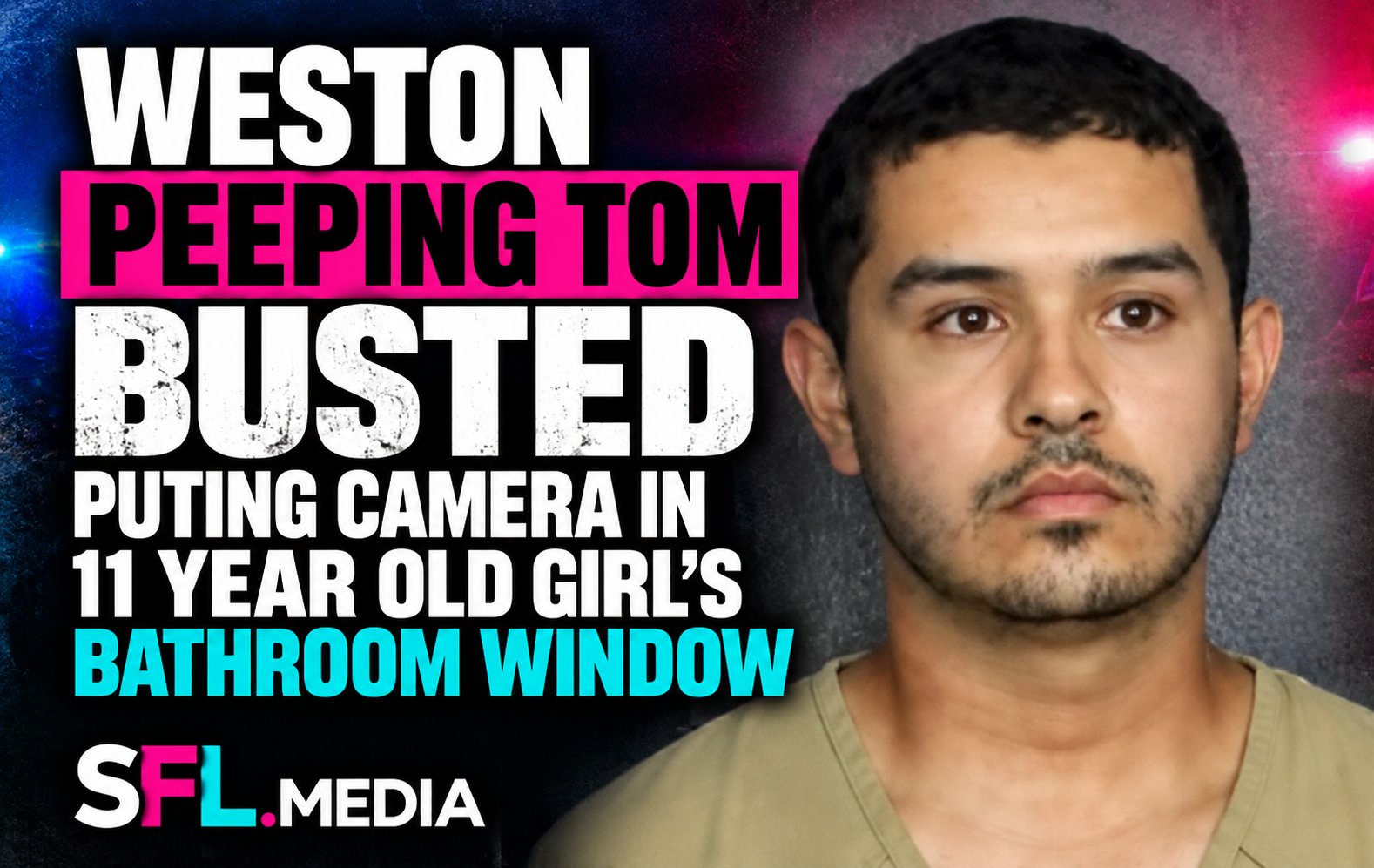
Weston Man Arrested After Allegedly Trying to Record 11 Year Old Girl Through Bathroom Window, Broward Deputies Say
WESTON, FLORIDA — A 27 year old Broward County man has been arrested after investigators say he attempted to secretly record an 11 year old girl through her bathroom window as she prepared to take a shower inside her Weston home. The disturbing allegations have raised concerns about child safety, residential privacy, and the use of smartphones to commit invasive crimes against minors.
Joel Luis Rivera was arrested following an investigation by the Broward Sheriff’s Office (BSO), which reportedly relied on the child’s account, surveillance footage from neighboring properties, and evidence involving a cellphone to identify the suspect and reconstruct his movements near the residence.
According to reporting from CBS News Miami, NBC 6 South Florida, and Local 10 News, investigators allege Rivera approached the girl’s home and positioned his cellphone outside a bathroom window, apparently intending to record the child without her knowledge or consent. The girl discovered the device before showering and began screaming, setting off a sequence of events that ultimately led deputies to Rivera.
The allegations are especially troubling because the incident reportedly occurred inside a private residence, where a child should reasonably expect to be protected from unwanted observation. Rivera has been charged in connection with the incident but remains presumed innocent unless proven guilty in court.
11 Year Old Discovers Cellphone Outside Bathroom Window
The investigation began after an 11 year old girl noticed what appeared to be a recording cellphone positioned outside her bathroom window while she was preparing to shower. According to the CBS News Miami report, the child had entered the bathroom and was about to turn on the shower when she spotted the suspicious device outside the window.
Realizing that someone might be attempting to record her, the girl immediately began screaming, alerting others inside the residence. The discovery prompted a law enforcement investigation into what authorities believed could be an attempted invasion of the child’s privacy.
The precise time of the incident remains unclear in the available reporting. CBS News Miami’s account places the discovery at approximately 9 p.m., while another local report references a different time. The discrepancy does not change the central allegation, but the exact timeline should be established through the official arrest affidavit before being treated as confirmed.
Authorities have not publicly established whether the cellphone successfully captured images or video of the child, how long it may have been positioned outside the window, or whether the suspect had previously attempted to record anyone at the property. Those questions remain significant because they could help determine the scope of the alleged offense and whether additional criminal conduct occurred.
Neighbor’s Surveillance Camera Provides Crucial Evidence
One of the most important developments in the investigation came from surveillance footage recorded by a neighboring property. According to CBS News Miami, Broward Sheriff’s Office deputies reviewed video showing Rivera walking toward the girl’s residence while carrying a cellphone that investigators believed matched the device discovered outside the bathroom window.
The footage reportedly allowed investigators to track Rivera’s movements near the property and helped establish a connection between the suspect and the location where the alleged recording attempt occurred. Deputies subsequently identified Rivera and took him into custody.
Additional local reporting indicates that investigators examined surveillance footage from multiple cameras in the surrounding neighborhood. Those recordings reportedly captured Rivera approaching the residence and later leaving the area, providing detectives with a more complete account of his movements before and after the girl began screaming.
The use of neighborhood surveillance footage became a central part of the investigation because the alleged conduct occurred outside the residence, where there may not have been a direct eyewitness to every action. By comparing the child’s description with recorded movements, investigators were able to develop evidence supporting the arrest.
However, surveillance footage showing a person approaching a residence does not, by itself, establish that an unlawful recording occurred. Prosecutors must still demonstrate that the evidence satisfies the elements of the criminal offenses charged.
Suspect Reportedly Claimed He Was Walking Toward a Lake
According to reporting from NBC 6 South Florida and Local 10 News, Rivera acknowledged during questioning that he was the individual seen in surveillance footage but offered investigators a different explanation for why he had entered the area behind the residence.
Rivera reportedly told deputies that he had been walking toward a nearby lake when he heard someone screaming inside the home. He allegedly claimed that the screaming frightened him and caused him to run away.
Investigators reportedly compared that explanation with surveillance recordings documenting his movements near the property. Video evidence was also described as showing Rivera leaving the area on a bicycle after the incident.
Deputies reportedly examined information involving Rivera’s cellphone and determined that the device was consistent with the description provided by the child. The combination of the girl’s statements, surveillance recordings, and cellphone evidence contributed to investigators’ determination that there was probable cause to arrest him.
Rivera’s reported explanation remains part of the investigative record and should not be interpreted as an admission that he attempted to record the girl. The allegations will ultimately have to be evaluated through the criminal justice process.
Investigators Examine Possible Previous Visits to the Property
The investigation reportedly expanded beyond the initial encounter after detectives reviewed additional surveillance footage from dates preceding the incident.
According to NBC 6 South Florida, investigators identified earlier recordings that appeared to show an individual matching Rivera’s description approaching the same residence while carrying a cellphone. The recordings reportedly showed the individual moving toward the property and later returning, prompting questions about whether the incident involving the 11 year old was an isolated occurrence.
Those findings could become significant if investigators determine that Rivera had previously approached the home for similar purposes. Establishing a pattern of behavior may help prosecutors evaluate intent, although the relevance and admissibility of any prior incident evidence would ultimately be determined through the legal process.
Importantly, the existence of earlier surveillance footage does not establish that additional recordings were made or that separate crimes occurred. Investigators would need further evidence to substantiate any additional allegations, and no conclusion about other potential victims should be drawn from the reported footage alone.
The possibility of previous visits nevertheless raises serious questions about how long the suspicious activity may have been occurring and whether residents had any reason to suspect that someone was approaching the property before the girl discovered the cellphone.
Rivera Faces Digital Voyeurism and Trespassing Charges
Rivera faces criminal charges involving digital voyeurism and trespassing, according to local news reports citing Broward County jail and court information.
During a reported Wednesday court appearance, a Broward County judge set Rivera’s bond at $10,000 and ordered GPS monitoring. The judge also reportedly prohibited him from contacting the child or returning to her residence, restrictions intended to protect the alleged victim while the criminal proceedings continue.
As of the reporting published October 28, Rivera was described as remaining in custody. His subsequent custody status, any additional court proceedings, and the final disposition of the case have not been independently verified.
Florida’s video voyeurism statute, Section 810.145 of the Florida Statutes, addresses certain circumstances involving the intentional use of imaging devices to secretly view, broadcast, or record individuals in locations where they have a reasonable expectation of privacy. The statute contains provisions addressing offenses involving minors, although the precise charges and potential penalties in Rivera’s case depend on the specific allegations and statutory subsections filed by prosecutors.
A bathroom inside a private residence is a setting in which individuals ordinarily possess a particularly strong expectation of privacy. When an alleged recording attempt involves a child, the circumstances can create additional legal and investigative concerns.
Nevertheless, an arrest is not a conviction. Prosecutors bear the burden of proving the charged offenses beyond a reasonable doubt, and Rivera retains the constitutional protections afforded to criminal defendants.
The Growing Threat of Smartphone Voyeurism
The Weston investigation illustrates how modern consumer technology can allegedly be used to invade privacy without requiring sophisticated surveillance equipment. Smartphones equipped with high resolution cameras, video recording capabilities, and compact designs can be misused to observe or record individuals who have no knowledge that they are being watched.
Unlike traditional surveillance equipment, smartphones are widely available and can be carried without attracting attention. Their ordinary appearance can make suspicious activity difficult to recognize until someone notices a device positioned in an unusual location or discovers evidence of an attempted recording.
Cases involving alleged voyeurism are particularly concerning when they occur near bedrooms, bathrooms, changing areas, or other spaces where individuals reasonably expect privacy. When children are involved, the potential consequences extend beyond the immediate alleged offense and may include emotional distress, fear, and lasting concerns about personal safety.
The Weston case also highlights the importance of physical security around residential windows and exterior areas that may be accessible from neighboring properties, yards, or public spaces. Privacy coverings, appropriate exterior lighting, and strategically placed security cameras can help reduce opportunities for unwanted observation and assist investigators when suspicious activity occurs.
Those precautions, however, should not shift responsibility onto victims or their families. The obligation to respect another person’s privacy rests with the individual whose conduct is being investigated.
Neighborhood Surveillance Plays an Increasingly Important Role in Criminal Investigations
Another significant aspect of the case is the reported role of privately owned surveillance cameras in helping Broward Sheriff’s Office deputies identify the suspect.
Residential security cameras have become an increasingly common source of evidence in criminal investigations, particularly when an alleged offense occurs outdoors or in an area not directly visible to witnesses. Recordings from neighboring homes can sometimes document a suspect’s arrival, departure, direction of travel, clothing, or possession of objects relevant to an investigation.
In the Weston case, surveillance footage reportedly helped investigators establish Rivera’s presence near the girl’s residence and compare his movements with the sequence of events described by the child. Additional footage allegedly showing previous approaches to the property gave detectives further information to examine.
The investigation demonstrates how multiple recordings from different locations can contribute to reconstructing events that might otherwise depend heavily on conflicting eyewitness accounts. At the same time, surveillance evidence must be authenticated, interpreted in context, and evaluated alongside other information before it can establish criminal responsibility.
The fact that neighbors possessed potentially useful video evidence underscores the value of community cooperation with law enforcement, particularly in cases involving allegations of threats to children or invasions of residential privacy.
What Happens Next in the Broward County Criminal Case?
The criminal proceedings against Rivera are expected to focus on the evidence gathered by Broward Sheriff’s Office investigators, including the child’s statements, surveillance recordings, Rivera’s reported explanation for being near the property, and any forensic examination of the cellphone associated with the incident.
Among the most important unanswered questions is whether investigators recovered actual images or recordings from the device. Such evidence could help establish what the cellphone was being used for, whether the alleged recording attempt was successful, and whether additional conduct may have occurred before the child discovered it.
The reported surveillance footage from earlier dates may also receive further scrutiny as investigators determine whether those visits were connected to the alleged offense. Prosecutors could consider additional evidence if it becomes available, but no further criminal activity should be presumed without supporting findings.
For the 11 year old girl and her family, the case began with an alarming discovery inside what should have been one of the most private areas of their home. Her immediate reaction reportedly alerted others to the suspicious activity and initiated the investigation that led to Rivera’s arrest.
The case now moves through the Broward County criminal justice system, where prosecutors will be responsible for establishing the allegations through admissible evidence. Rivera is presumed innocent unless and until proven guilty.
The child’s identity is being withheld to protect her privacy.
Sources & Further Reading

Primary Local News Reporting
- CBS News Miami — South Florida News and Broward County Crime Coverage
- NBC 6 South Florida — Man Accused of Digital Voyeurism Involving 11-Year-Old Girl in Weston
- Local 10 News — Weston Man Accused of Secretly Recording 11-Year-Old Girl Through Bathroom Window
Official Legal and Law Enforcement Resources
- Broward Sheriff’s Office — Official Website
- Broward County Clerk of Courts — Court Records
- Florida Legislature — Section 810.145, Video Voyeurism
Related SFL Media Coverage

















































Want to join the conversation?
Create an account or sign in to share your thoughts, vote,
and reply to other readers.
Showing 0 of 0 comments
Don't have an account?
Already have an account?