

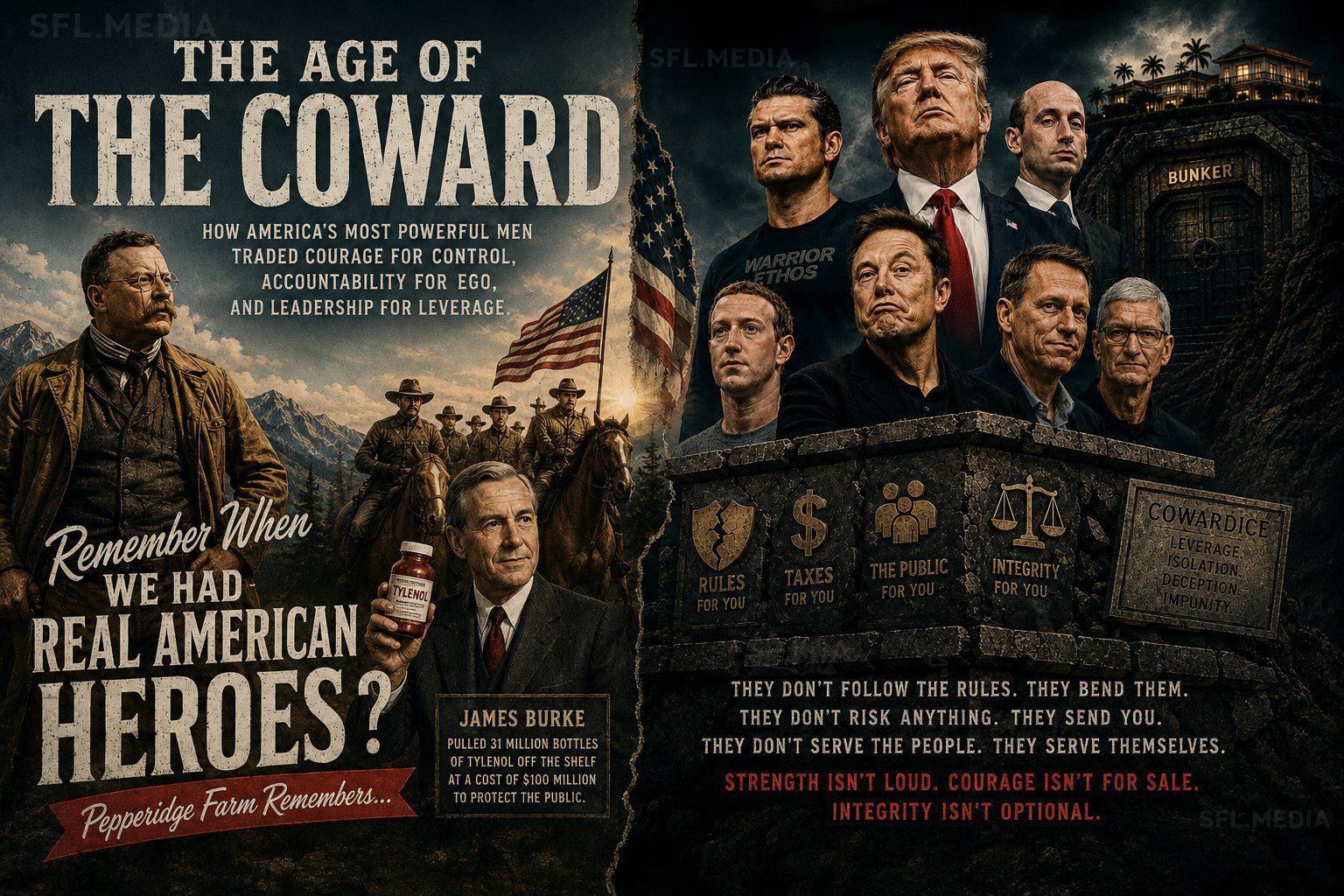
The Age of the Coward: America’s Toughest Talking Men Have Built a Culture Terrified of Accountability
There is something deeply strange happening to the American definition of strength. The country is surrounded by powerful men constantly telling everyone how tough they are. Donald Trump built an entire political movement around dominance. Pete Hegseth has made restoring the military’s “warrior ethos” a central theme of his leadership at the Pentagon. Elon Musk presents himself as an industrial superman capable of simultaneously transforming rockets, automobiles, artificial intelligence and social media. Mark Zuckerberg transformed himself from hoodie wearing programmer into combat-sports enthusiast while controlling some of the most powerful communications platforms ever constructed. Peter Thiel lectures audiences about technological stagnation, civilization and existential threats. Silicon Valley billionaires routinely describe themselves as disruptors, risk takers and rebels fighting complacent institutions.
They look, sound and market themselves like the hardest men in the room, but perhaps America is measuring strength backward. Because underneath the masculine branding, private compounds, armies of lawyers, government contracts, algorithms, security details and carefully controlled media ecosystems is another possibility: America has entered the Age of the Coward.
This is not cowardice in the childish sense of being afraid of physical confrontation. It is cowardice in a far more consequential sense: demanding risks from other people that you would never accept yourself, demanding rules for everyone else while searching for exemptions for yourself, demanding accountability from enemies while resisting it personally, confusing domination with courage and accumulating enough money, political influence and institutional protection that meaningful failure becomes increasingly difficult. That is not strength. It is insulation.
The modern ruling class increasingly resembles the classic Biff Tannen bully: swaggering when surrounded by advantages, humiliating weaker opponents, obsessing over status and becoming extraordinarily agitated when someone capable of fighting back refuses to cooperate. Actual courage begins where control ends.
Donald Trump and the Biff Theory of American Politics
Donald Trump may be the purest political expression of the phenomenon because toughness is not merely part of his brand. Toughness is the brand. Opponents receive insulting nicknames. Political disagreements become contests of humiliation. Negotiations are framed as victories or capitulations. Foreign policy is routinely described through the language of dominance, punishment and overwhelming American force. Trump has spent years cultivating the image of the leader nobody can push around.
It works because human beings have always been susceptible to the aesthetics of power. Speak loudly enough, insult enough opponents, surround yourself with flags, soldiers and wealthy allies, and aggression can begin to resemble courage. But aggression and courage are not synonyms. A schoolyard bully can be extremely aggressive when he believes the fight is rigged. The revealing question is therefore not how aggressively a politician treats people with less power. It is how that politician behaves when confronted by people, institutions or events he cannot simply dominate.
The distinction becomes especially important in war. The United States and Israel launched strikes against Iran on February 28, beginning a conflict that Trump initially presented as relatively limited. Six months later, Iran has not surrendered, the Strait of Hormuz remains badly disrupted, American military families are enduring repeated deployments, energy markets have been shaken and there is still no clearly defined political endpoint. Reuters described the conflict in late August as a deeply unpopular stalemate. Trump had previously predicted it would be over within weeks. Instead, 83% of Americans now expect it to continue for an extended period, while only 31% supported U.S. military action against Iran in the latest Reuters/Ipsos polling.
On August 31, the United States and Iran exchanged direct attacks again. Trump responded by promising to “hit them hard.” That is precisely where the mythology of political toughness deserves scrutiny. Ordering another strike is not inherently courageous. Presidents do not fly the bombers, clear buildings, intercept missiles, patrol contested waterways or tell children that their parents were killed overseas. Those risks belong overwhelmingly to other Americans.
The people exercising military power therefore carry a greater obligation to demonstrate restraint, strategic competence and accountability. Sending someone else into danger while presenting yourself as the warrior is one of the oldest political tricks in human history. The real measure of strength is not whether a president can start or escalate a war. It is whether he knows how to end one.
Pete Hegseth and the Performance of the Warrior Ethos
Defense Secretary Pete Hegseth provides an almost laboratory quality example of the difference between image and substance. Hegseth has repeatedly emphasized physical fitness, lethality, discipline and restoration of the military’s “warrior ethos.” The Pentagon has promoted his participation in public fitness challenges involving push ups and pull ups alongside service members. There is nothing inherently wrong with a defense secretary exercising with troops. In isolation, it may even be admirable. The issue begins when fitness standards become part of a larger morality play in which senior leaders publicly lecture everyone beneath them about toughness, discipline and standards. At that point, the standards have to flow upward too.
Military fitness experts who reviewed Hegseth’s public workout videos have criticized portions of his push up and pull up technique, arguing that repetitions shown in those videos would not satisfy the strict form expected in some military fitness environments. The important point is not whether Pete Hegseth can physically perform a pull up. He obviously can. The point is consistency. If your public identity is built around uncompromising standards, you should expect those standards to be applied to you.
That contradiction becomes more serious when the subject changes from gym videos to war. Hegseth is now helping direct a conflict with Iran that has continued for six months without producing the decisive outcome Americans were initially led to expect. The warrior ethos should not mean looking tough on camera. It should mean taking responsibility when strategy fails to produce the promised result.
Theodore Roosevelt Represented a Different Kind of Strength
The contrast with Theodore Roosevelt is almost absurd. Roosevelt was far from a flawless president. His imperialism, racial views and enthusiasm for military power deserve serious historical scrutiny. Courage does not erase those failures. But Roosevelt’s conception of masculinity contained something conspicuously absent from much of today’s performative strongman culture: personal exposure.
Roosevelt was born into wealth but suffered severe asthma as a child. Encouraged by his father to “make his body,” he deliberately pursued strenuous physical activity and later embraced what he famously called the strenuous life. He went west and lived as a rancher in the Dakota Territory. When the Spanish American War began in 1898, Roosevelt resigned his position as assistant secretary of the Navy and helped organize the First U.S. Volunteer Cavalry, better known as the Rough Riders. He went to Cuba with them and personally participated in the fighting at San Juan Heights. He did not simply lecture somebody else about warrior culture. He went to war.
The same physical intensity followed him into public life. French Ambassador Jean Jules Jusserand later described Roosevelt’s idea of a walk as effectively a nonstop race through mud and thorns. Roosevelt dragged diplomats, officials and friends on brutal excursions through Rock Creek Park that became legendary in Washington. Roosevelt’s version of toughness said: follow me. Modern performative toughness too often says: go for me. That distinction is everything.
The Billionaire Who Cannot Afford to Lose
The same contradiction has infected American capitalism. The mythology of Silicon Valley is built around risk. Founders are supposed to be adventurers. They leave comfortable careers, build companies from nothing, challenge incumbents, survive near-bankruptcies and create products nobody thought possible. That entrepreneurial courage is real.
But something peculiar often happens after the entrepreneur wins. Once fortunes reach tens or hundreds of billions of dollars, some of the most celebrated risk takers in America become obsessed with reducing personal and corporate risk. They acquire competitors. They accumulate enormous legal operations. They lobby governments. They seek favorable tax structures. Their companies obtain enormous public contracts. Their products become infrastructure. Their political influence grows. Their personal wealth becomes sufficiently enormous that normal financial consequences largely disappear.
The disruptor becomes the institution. Then the institution becomes terrified of disruption.
Mark Zuckerberg and the Fear of Losing Attention
Mark Zuckerberg controls Meta, one of the most consequential communications companies in human history. Facebook, Instagram, WhatsApp and Threads collectively provide Meta with extraordinary influence over global communication and information. Yet Meta’s history also demonstrates a recurring willingness to respond defensively when competitors discover successful new formats.
Snapchat popularized disappearing visual content and Stories. Instagram developed its own Stories format. TikTok exploded through short form algorithmic video and Instagram aggressively expanded Reels. Twitter became vulnerable after Elon Musk’s takeover and Meta rapidly launched Threads. Copying successful ideas is neither illegal nor unusual. Every technology company does it. But viewed together, the pattern raises a larger question about what innovation becomes once a corporation reaches enormous scale. Is the objective still creating something transformational, or does the objective gradually become ensuring nobody else creates something transformational enough to threaten you?
The stakes become considerably more serious when children enter the equation. In August 2026, Meta agreed to pay up to roughly $18 billion to resolve sprawling litigation brought by states alleging that Facebook and Instagram harmed young users, including claims that platform features were deliberately designed to encourage compulsive use among children. Meta admitted no wrongdoing. The settlement requires major changes, including stronger age verification, limits on teen usage and restrictions on nighttime notifications.
Whatever one thinks about the underlying allegations, the scale of the settlement illustrates the central contradiction of modern platform capitalism: a company worth hundreds of billions of dollars can behave as though losing even a fraction of user engagement represents an existential danger. Imagine possessing almost everything and remaining terrified of losing attention. That is not corporate confidence. It is corporate anxiety operating at planetary scale.
Elon Musk and the Myth of the Lone Superhuman
Elon Musk represents another version of the phenomenon. There is no serious argument that Musk has not taken extraordinary business risks. SpaceX transformed commercial spaceflight and reusable rocket technology. Tesla helped force the global automobile industry to take electric vehicles seriously. Those accomplishments are real and should not be erased simply because Musk became politically polarizing. But neither should those accomplishments be transformed into mythology.
SpaceX is not Elon Musk personally designing and assembling rockets in a garage. It is an enormous organization employing thousands of engineers, technicians, scientists and operators. It is also deeply intertwined with the American government. By early 2025, SpaceX had secured approximately $22 billion in U.S. government contracts, including roughly $15 billion from NASA. Its work for the Pentagon and intelligence agencies includes national security launches, Starlink connectivity and the classified-oriented Starshield network.
That does not diminish SpaceX’s technological achievements. Governments contract with private companies precisely because private companies can build valuable things. But it does complicate the mythology of the completely independent billionaire genius triumphing outside the state. The modern technology oligarch can be fiercely anti-government rhetorically while simultaneously operating businesses whose growth and strategic importance are inseparable from government contracts. Private enterprise and public money coexist quite comfortably. The rebel eventually becomes a contractor.
Peter Thiel and the Apocalypse of the Extremely Comfortable
Peter Thiel represents perhaps the most philosophically revealing version of elite anxiety. Thiel has spent years discussing technological stagnation, social decline, political philosophy and existential dangers. He has cultivated the image of a contrarian intellectual willing to explore ideas other people refuse to discuss. There is legitimate value in challenging consensus.
But Thiel’s financial history also illustrates how differently the ultrawealthy can experience the rules governing everyone else. Reporting based on confidential tax records found that Thiel turned a Roth IRA initially worth less than $2,000 into an account valued at roughly $5 billion by 2019, potentially allowing enormous future gains to be withdrawn tax free if legal requirements are satisfied. Thiel also acquired New Zealand citizenship after investing there and has owned property in the country, which has long attracted wealthy people interested in geographic and political insulation.
None of this is evidence of criminal wrongdoing. It is evidence of asymmetry. A retirement vehicle originally designed to help ordinary Americans save modest amounts can, under sufficiently unusual circumstances, become a multibillion dollar tax shelter for someone whose resources already exceed those of entire communities. That is the central argument of the Age of the Coward. The people preaching competition frequently live in circumstances where competition can barely reach them.
The Billionaire Bunker Is a Monument to Elite Anxiety
The bunker culture surrounding parts of the ultrawealthy class deserves attention for the same reason. It would be absurd to argue that possessing security or preparing for emergencies automatically makes somebody cowardly. High profile wealthy people face genuine security threats. The symbolism is nevertheless difficult to ignore.
After accumulating levels of wealth almost unimaginable across previous human history, some members of the global elite have invested heavily in remote estates, secure compounds, multiple citizenship options, private security systems and contingency planning for social breakdown. Think about what that means psychologically. After winning capitalism, parts of the billionaire class are preparing escape routes from the society capitalism produced.
The bunker becomes an almost perfect monument to elite anxiety: a fortress built by somebody powerful enough to influence civilization but sufficiently worried about civilization that he wants an emergency exit unavailable to almost everyone else.
Tim Cook and the Courage to Make Another iPhone
Apple represents a less sinister but equally revealing version of institutional risk aversion. Tim Cook took over Apple in 2011 and transformed an already extraordinary company into a financial juggernaut worth roughly $4 trillion before preparing to leave the CEO position in 2026. Cook’s mastery of operations, supply chains, margins and shareholder returns is undeniable.
But Apple’s enormous financial success also demonstrates how easily corporate excellence can become corporate conservatism. The iPhone remains extraordinary technology, but much of the smartphone industry now advances through incremental improvements rather than the category defining revolutions that characterized earlier eras. Faster processors arrive. Cameras improve. Screens change. Artificial intelligence features are added. Devices become thinner, larger or foldable. Then another iPhone arrives.
Apple also spent roughly a decade developing an automobile project before abandoning it, while the company was later forced to accelerate artificial intelligence investment after falling behind competitors in one of the most important technological shifts of the decade. From a shareholder perspective, caution can be rational. From the perspective of technological courage, however, Apple presents an interesting question: What does a corporation with virtually unlimited resources dare to attempt when failure could threaten the machine that produces those resources? Sometimes the answer appears to be less than you would expect.
James Burke and the $100 Million Decision
There is another model of corporate leadership. In 1982, seven people in the Chicago area died after taking Extra Strength Tylenol capsules contaminated with cyanide. Johnson & Johnson faced a corporate nightmare. Investigators concluded that the contamination occurred after the product left the factory. The company therefore could have tried to narrowly define its responsibility, minimize its legal exposure and wait for authorities to finish investigating. Instead, Johnson & Johnson recalled more than 31 million bottles of Tylenol capsules nationwide. The recall cost the company approximately $100 million at the time.
CEO James Burke became closely associated with the response, which remains one of the most famous examples of crisis management in corporate history. The company later introduced tamper resistant packaging and helped change the way over the counter medicines were sold across the United States. The lesson was simple. Sometimes leadership means voluntarily accepting a massive loss, not because a judge ordered it, not because a social-media campaign became uncomfortable and not because a consultant calculated that it would maximize quarterly earnings, but because protecting the public is part of the responsibility that comes with selling products to the public. That is corporate courage.
The Great American Privatization of Reward
America’s billionaire class frequently presents itself as proof that capitalism rewards courage. Sometimes it does. But the modern system contains an increasingly obvious contradiction. Corporations can receive government contracts, public infrastructure, taxpayer funded research, tax incentives and favorable regulatory treatment while their owners simultaneously present themselves as rugged individualists who succeeded independently of society. The public frequently absorbs portions of the underlying risk. The upside remains overwhelmingly private.
Then, once personal wealth reaches astronomical levels, money purchases something even more valuable than luxury: distance from consequences. Ordinary Americans cannot surround themselves with private security infrastructures. They cannot employ teams of lawyers capable of fighting government agencies for years. They cannot call senators, governors or presidents. They cannot restructure enormous fortunes across jurisdictions. They cannot buy major communications platforms if they dislike the way existing platforms operate. Billionaires can. The issue is therefore larger than inequality. It is asymmetrical accountability.
Money Has Become Armor
America traditionally imagined equality before the law as one of the central principles distinguishing democracy from aristocracy. Reality has always fallen far short of that ideal. But extreme concentrations of wealth create a particularly dangerous distortion because sufficient money does not merely purchase nicer possessions. It purchases insulation.
A parking fine becomes meaningless. A lawsuit becomes another expense. A regulatory investigation becomes a multiyear negotiation. A public-relations disaster becomes a communications problem. A political threat becomes a lobbying campaign. A tax burden becomes a planning exercise. A competitor can become an acquisition target. Failure itself becomes something that can sometimes be financed away. When a human being spends enough years in an environment where almost nobody can meaningfully fire, bankrupt, contradict, punish or inconvenience him, something fundamental changes. Power stops testing character. Power begins protecting character from tests.
The Elvis Question
There is another uncomfortable dimension to extreme wealth. What exactly is it for?
Elvis Presley was hardly a model of responsible financial planning, but his spontaneous generosity became part of his legend. He donated repeatedly to charities and community organizations, helped pay medical bills and became famous for unexpectedly buying automobiles for friends, relatives and even strangers. Graceland’s historical archives document numerous examples of this behavior. There was something almost childishly human about it. He had money. Somebody needed something. So sometimes he simply gave it to them.
Modern billionaires often donate enormous amounts through foundations, charities, medical research programs and philanthropic organizations. It would therefore be inaccurate and unfair to say they never help people. Some have funded projects capable of benefiting millions. But the larger question remains: How much wealth does one human being need before accumulation itself becomes irrational? A billionaire could walk through an ordinary American neighborhood and transform lives without meaningfully changing his own standard of living. Pay off a mortgage. Eliminate medical debt. Buy a family a reliable vehicle. Save a small business. Fund a classroom. Repair a park. Keep a local newspaper alive. Then do it again the next day. The fact that society considers that behavior eccentric while considering the accumulation of another billion dollars completely normal tells us something strange about the culture we have built.
The Toughest Men in America Are Terrified of Vulnerability
That may ultimately be what connects Trump, Hegseth and parts of the billionaire class despite their enormous differences: control. Control the narrative, the platform, the corporation, the political party, the algorithm, the audience, the employees, the regulators, the battlefield, the market, the information, the risk and, whenever possible, what happens when you lose. But courage requires surrendering some control. You cannot meaningfully demonstrate courage in a situation where nothing important can hurt you. The firefighter enters the building. The soldier goes up the hill. The whistleblower signs his name. The CEO recalls the product. The journalist publishes the investigation. The politician tells supporters something they do not want to hear. The billionaire admits his company failed. The leader accepts responsibility. Those actions contain risk. That is why they mean something.
America Does Not Need More Strongmen
The great political mistake of this era may be our confusion of aggression with strength. The loudest person is not necessarily the strongest. The richest person is not necessarily the bravest. The cruelest policy is not necessarily the toughest. The person most willing to threaten others is not necessarily the person most willing to sacrifice himself. The man surrounded by the largest fortress may not be demonstrating how powerful he is. He may be revealing how frightened he has become.
America has enough leaders telling everybody beneath them to toughen up while constructing increasingly elaborate protections for themselves. If you demand discipline, live by your standards. If you demand sacrifice, sacrifice something. If you preach free markets, compete without demanding special protection when competition becomes uncomfortable. If you preach personal responsibility, accept responsibility when your institution fails. If you send Americans into battle, explain what victory means and accept responsibility if your strategy does not achieve it. If you possess enough wealth to influence governments, communications networks, wars and elections, stop pretending that having obligations only to yourself is a form of courage.
Real strength does not require everyone else to be weak. Real courage does not require the fight to be rigged. Real leadership does not require total control, and real leaders do not spend their lives building barriers between themselves and the consequences of their decisions.
The Age of the Coward is not defined by frightened people. It is defined by extraordinarily powerful people who have accumulated enough money, influence and institutional protection that they no longer have to be brave. That may be the great irony of modern American power: the men who talk about strength the most have constructed a world in which they personally have to risk almost nothing.

Sources
Reuters: Six Consequences After Six Months of War in Iran
Reuters: Trump Approval at 33% as Iran War Support Erodes
Reuters: Trump Vows to “Hit Iran Hard” as Direct Hostilities Resume
National Park Service: Theodore Roosevelt Biography
National Park Service: Theodore Roosevelt, the Rough Riders and the Spanish-American War
National Park Service: Jean Jules Jusserand and Roosevelt’s Legendary Walks
U.S. Department of Defense: Pete Hegseth Fitness Challenge and Warrior Ethos
The Atlantic: Pete Hegseth, You Call That a Pull-Up?
Reuters: Meta Reaches $16.68 Billion Settlement Over Alleged Social Media Harms to Children
Reuters: Meta Settlement Requires Stronger Age Verification and Youth Protections
Reuters: Elon Musk’s U.S. Defense and Government Contracts
Reuters: NASA Spending Review Highlights SpaceX’s $15 Billion Relationship With the Agency
ProPublica: How Peter Thiel Turned a Roth IRA Into a $5 Billion Tax-Free Fortune
Reuters: Apple Turns to John Ternus as Tim Cook’s Successor in the AI Era
PBS: Inside the Tylenol Murders and Johnson & Johnson’s 31 Million-Bottle Recall
Graceland: Elvis Presley’s Record of Charitable Giving
Graceland: Elvis Presley’s Tradition of Generosity and Community Service







































Want to join the conversation?
Create an account or sign in to share your thoughts, vote,
and reply to other readers.
Showing 0 of 0 comments
Don't have an account?
Already have an account?