
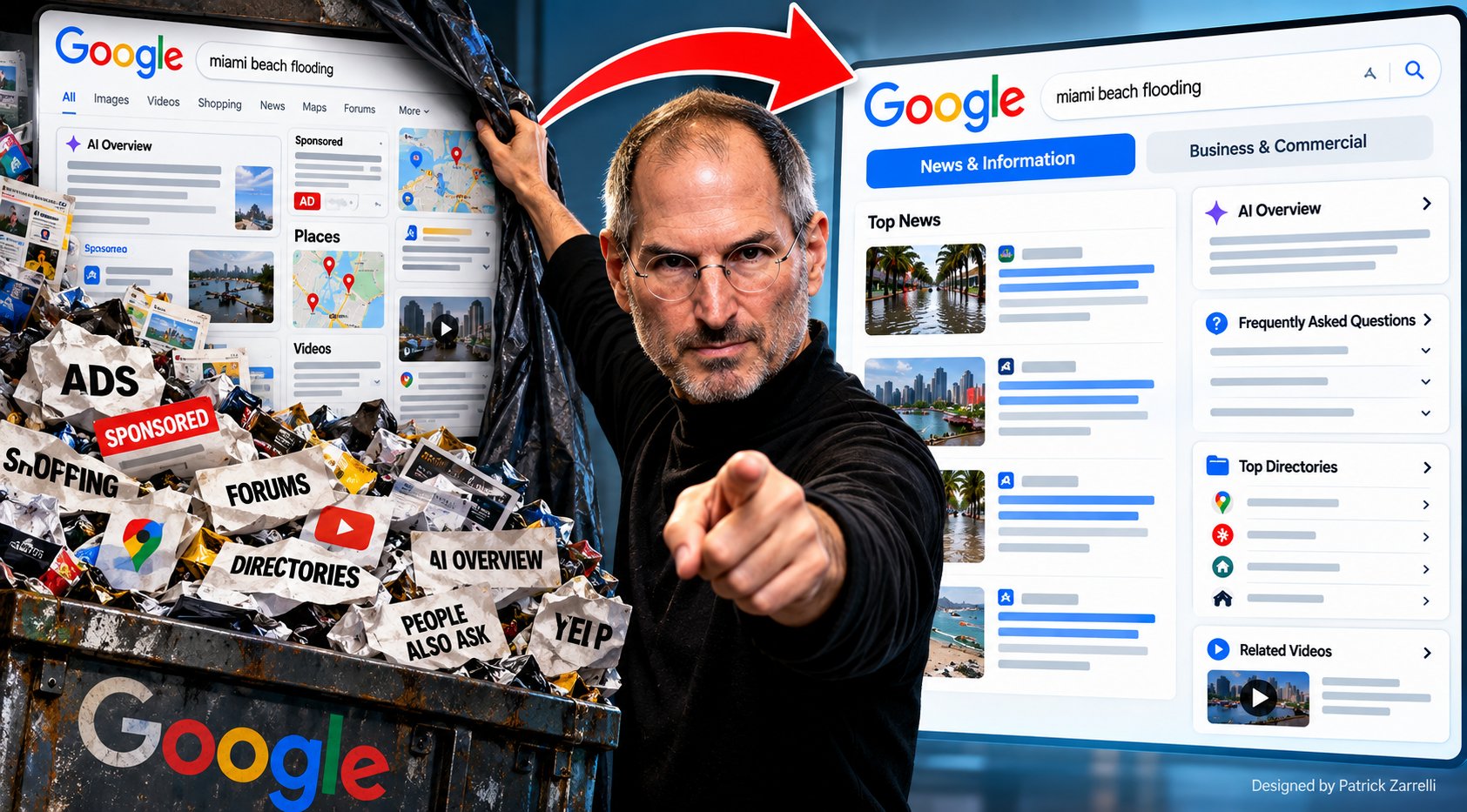
Google Search Is Becoming a Bloated Mess and the Entire Web Is Paying for It
Google Search Has Become a Bloated Mess: Terrible Results, Piss Poor Writing Standards That Dumb Everything Down, Commercial Clutter, Childlike Features Everywhere, and Lazy Bots That Don’t Even Crawl the Entire Web. I Grew Up on Google. That Is Exactly Why This Lazy Online Garage Sale They Have Created Is So Frustrating. If They Need an Experienced Designer to Take Control of the Homepage, I’m Only a Phone Call Away!
I am not writing this as someone who hates Google. Quite the opposite. I grew up professionally on Google Search. I built websites for it, optimized businesses around it, watched companies live or die by it and spent much of my career studying how information moved through its results. For most of the modern internet era, Google Search was one of the best products ever built: brutally simple, incredibly fast, and almost magically good at taking a few words typed into an empty box and connecting a human being with the information they wanted.
That history is exactly why the current state of Google Search is so frustrating. The product increasingly feels overloaded, visually confused and less capable of performing the basic function that made Google indispensable in the first place: finding the best page on the internet and getting the user there. AI Overviews compete with traditional links. “People Also Ask” boxes interrupt the results. Videos, shopping modules, forums, knowledge panels, advertisements and other features compete for attention inside what was once one of the cleanest interfaces in technology. Google is simultaneously trying to be a search engine, answer engine, AI assistant, shopping platform, local directory, video discovery service and advertising marketplace and the result can feel less like the elegant Google many of us grew up with and more like a corporate committee trying to squeeze six products onto one screen.
Google will tell you this transformation is working. In 2026, the company said AI Overviews had surpassed 2.5 billion monthly active users and AI Mode had surpassed one billion, while Search queries reached an all time high. Google also says its AI features are increasing search activity and user satisfaction. Those are enormous numbers and should not simply be dismissed. But Google measuring increased engagement inside Google is not the same thing as demonstrating that the open web is healthier because of it. There is now significant evidence that the relationship between Google Search and the websites it indexes is changing dramatically.
Google Is Increasingly Answering the Question Instead of Sending You to the Answer
Pew Research Center analyzed 68,879 Google searches performed by 900 American adults and found a remarkable difference in what happened when an AI generated summary appeared. Users clicked a traditional search result during just 8% of visits containing an AI summary, compared with 15% of visits without one. Even more striking, users clicked a source directly inside an AI summary during only 1% of visits.
That is potentially transformative for the economic architecture of the internet. For roughly two decades, the bargain between Google and publishers was relatively straightforward. Websites allowed Google to crawl and organize their information. Google displayed excerpts and links, and users clicked through to the websites that actually produced the material. Publishers received readers, readers received information and Google sold advertising around the process.
AI search begins changing that transaction. Google can crawl information produced elsewhere, synthesize it into an answer and potentially satisfy the user’s query without requiring the user to visit the publisher at all. Google argues that its AI products create new discovery opportunities and has introduced additional links, article recommendations, website previews and publisher controls. But whatever Google’s intentions, the behavioral data should concern anyone whose business depends on creating information for the open web.
The Reuters Institute’s 2026 Digital News Report cites Chartbeat data showing organic Google search traffic to more than 2,500 publisher sites declined 33% globally between November 2024 and November 2025 and 38% in the United States. Publishers surveyed by the Reuters Institute expected search referrals to fall another 43% over the following three years. Reuters appropriately cautions that it is not clear how much of the existing decline can be attributed specifically to AI Overviews, particularly because hard-news searches have been less exposed to them than lifestyle and utility queries. Even with that qualification, the broader trend is difficult to ignore. This is not some obscure SEO complaint. It is a potential restructuring of how journalism and independent publishing are financed.
Google Search Has a Serious Interface Problem
There is also a simpler criticism that requires no algorithmic speculation: Google Search increasingly looks cluttered. The original genius of Google was restraint. Search was not supposed to be the destination. The web was the destination. Google was the exceptionally efficient map that got you there.
Modern Google Search increasingly behaves as though Google itself should be the destination. The company has spent years layering additional products into the search experience: featured snippets, Knowledge Panels, local packs, shopping modules, videos, discussion forums, “People Also Ask,” AI Overviews and now a conversational AI Mode capable of handling follow up questions. Individually, many of these features are useful. Collectively, they can create a page with no obvious visual hierarchy.
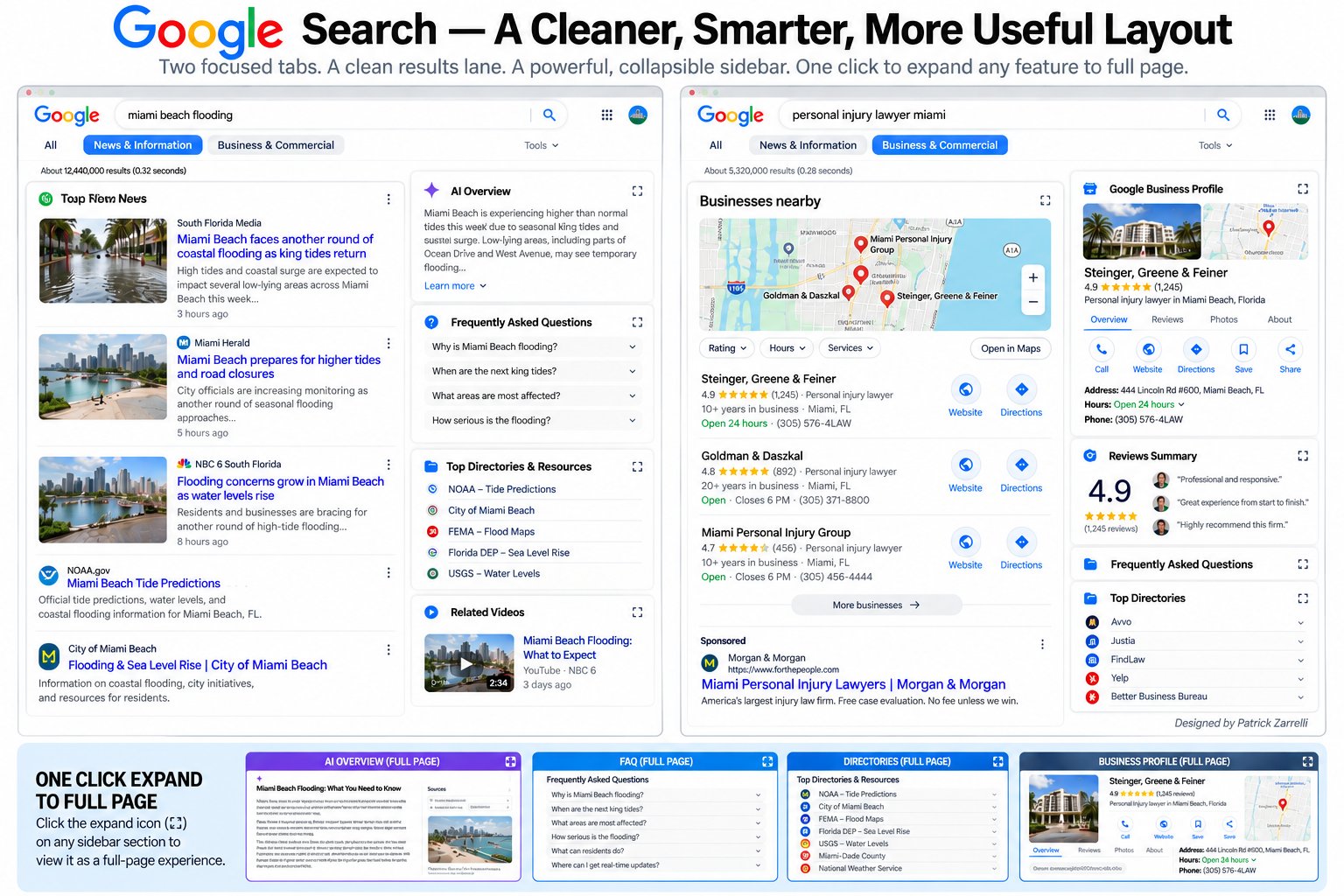
The problem is not that Google uses artificial intelligence. AI belongs in search. The problem is where everything lives. Google should consider returning the primary results column to something close to sacred territory: a clean, continuously ranked stream of the best websites available for the query. AI Overviews, related questions, contextual information and other intelligence features could occupy a dedicated expandable panel alongside those results on desktop, with an equivalent collapsible interface on mobile. Want the AI answer? Expand it. Want videos? Open them. Want related questions? Pull them out. Want the web? The web remains directly in front of you.
Search does not need fewer capabilities. It needs better information architecture. For a company with some of the world’s most sophisticated engineers and designers, it is remarkable that the central search experience can still feel simultaneously futuristic and visually antiquated. Google is building frontier artificial intelligence while the basic presentation of web results can resemble a decades old directory onto which increasingly sophisticated widgets have simply been bolted. Google does not need another module. It needs somebody willing to clean the room.
The Commercial Takeover: Why Are Law Firms and Medical Clinics Running the Main Page?
The interface problem becomes even more obvious when informational search collides with commercial search. Depending on the query, Google can resemble an enormous business directory, mixing traditional organic links with advertisements, map packs, business profiles, shopping results, directories and transactional features before users reach the conventional web results they were trying to find.
Anyone who works in highly competitive local industries understands the economics behind this ecosystem. Legal services, healthcare, home services, insurance and other high value categories can generate extraordinarily valuable leads, producing fierce competition in both paid search and organic SEO. Law firms and medical practices can spend heavily competing for visibility because a single new client or patient can potentially justify substantial acquisition costs. From Google’s perspective, these are valuable commercial searches. From the user’s perspective, however, the collision between commercial and informational intent can produce an increasingly confusing experience.
Search for a legal issue, medical question, local controversy or subject that happens to overlap with a valuable commercial keyword and the distinction between “I want to understand this” and “I want to hire somebody” can begin to disappear. A person looking for reporting about a serious automobile accident is not necessarily looking for a personal injury attorney. Someone researching a medical issue is not necessarily shopping for a clinic. Someone searching for information about a local business dispute may want journalism, government records or firsthand discussion rather than another directory page. Yet all of those possible intentions can be forced to compete on essentially the same screen.
That is the fragmented intent problem at the center of modern Google Search. Journalism competes with service businesses. Primary documents compete with directories. Reddit conversations compete with local listings. Maps compete with articles. Advertisements compete with everything. Google is attempting to infer what the user wants while simultaneously presenting multiple competing interpretations of that intent, and the result can be a search page trying to answer several different questions at once.
The SEO Arms Race Makes the Problem Worse
The underlying commercial web is also extraordinarily unstable. Competitive law firms, medical practices and other service businesses routinely add, rewrite, consolidate and optimize landing pages as they compete for search visibility. There is nothing inherently illegitimate about that, businesses have every right to explain their services and compete for customers. South Florida Media itself works in digital publishing and marketing, so pretending commercial SEO has no legitimate purpose would be hypocritical.
The problem arises when the incentives of the ranking system encourage an arms race in which enormous volumes of commercially optimized material compete with journalism and genuinely informational sources for the same limited search real estate.
A local newsroom might spend days reporting an accident, court case, medical controversy or government investigation. A commercial website can publish an adjacent page optimized around the same underlying search terms because those terms potentially generate customers. Both pages may be legitimate, but they serve fundamentally different purposes. One exists primarily to inform the public. The other exists primarily to convert a visitor into a customer.
A sophisticated search engine should understand that distinction.
Google increasingly has the artificial intelligence capability to interpret complicated questions, summarize multiple sources and understand natural language. If it can do all of that, it should also be capable of giving users far more explicit control over what kind of internet they are trying to search.
Google Should Separate Information From Commerce
The solution does not require banning businesses, eliminating advertisements or pretending commercial search is somehow illegitimate. Google Maps and local business discovery are enormously useful products. Someone who types “personal injury lawyer near me” obviously wants attorneys, not a 2,000 word newspaper investigation into Florida tort law. Someone searching “cardiologist near me” needs doctors, locations, reviews and appointment information. Give them exactly that.
But someone researching “Florida medical malpractice law changes” may be looking for legislation, government documents, legal analysis and journalism. Someone searching the name of a public official involved in a controversy may want current reporting rather than a collection of businesses that happen to have optimized pages around adjacent keywords.
Google should make those distinctions visible instead of burying them inside an algorithm. A modern Search interface could separate results into clearly defined experiences. A News & Information view could prioritize journalism, primary sources, government records, research, reference material and genuinely informational websites. A Business & Commercial view could prioritize Maps, local businesses, professional services, shopping, reviews, hours, directions and other transactional results. The traditional web index could remain the default broad search experience, but users would finally have explicit control over the intent Google is trying to infer on their behalf.
That same philosophy should extend across the entire interface. Community discussions from Reddit and other forums could occupy a clearly labeled community panel. Local business information and Maps results could live inside a commercial panel. AI Overviews could occupy an expandable intelligence panel. Videos and visual results could become a dynamic media layer.
On desktop, those modules could exist in a collapsible right-hand sidebar rather than repeatedly interrupting the central stream of organic results. On mobile, the same categories could become expandable cards or horizontal tabs. One click could expand any category into the dominant interface, allowing users to move between the open web, AI answers, community discussion, video and commercial results without forcing every information source into the same vertical pile.
The important principle is not the precise interface. Google employs enough talented designers to solve that problem. The principle is separation of intent.
News is not a law firm advertisement. A Reddit discussion is not a medical directory. A Google Maps listing is not investigative journalism. An AI generated summary is not a primary source. A business review is not a news report. All of those things can be useful. They simply do not need to pretend they are the same thing.
Google’s challenge is no longer finding enough information to fill a search results page. It has the opposite problem: it possesses an almost incomprehensible amount of information and an expanding collection of products competing to present it. The next great innovation in Google Search may therefore be surprisingly simple: stop putting everything in the same place.
Google Deliberately Put More Forums Into Search
The proliferation of forums is not imaginary. It was partly a deliberate product decision. Google announced in 2022 that it was introducing a “Discussions and forums” feature to surface material from online communities. It subsequently expanded its effort to surface what it describes as authentic human perspectives, reflecting the reality that useful information can exist in forum comments, small blogs and other difficult to find corners of the internet. The basic idea was defensible. People had become frustrated with SEO generated articles that took 1,500 words to answer a question that somebody on Reddit could answer in three sentences.
Reddit itself can be extraordinarily useful because large communities frequently contain genuine specialists, eyewitnesses and people with years of practical experience. Google recognized that demand, and in 2024 it expanded its partnership with Reddit, gaining structured access to Reddit’s Data API. Google said the arrangement would provide fresher information and better signals for understanding Reddit content.
But recognizing the value of human discussion does not mean every forum deserves prominent placement. A forum post can contain extraordinary firsthand expertise. It can also contain a confidently written falsehood from an anonymous person who has absolutely no idea what he is talking about. The challenge for Google is not merely surfacing “human perspectives.” It is distinguishing expertise from noise.
That problem becomes particularly obvious when established publishers, original reporting, professional reviews and specialized independent sites compete against massive domains whose principal advantage may be that Google already understands and trusts their enormous footprint. Google wanted to find the hidden gems of the web. Sometimes it feels as though it simply found more giant platforms.
Then There Is Yelp
Yelp deserves special attention because it represents the broader problem with legacy authority on Google Search. Yelp can contain useful consumer information. Millions of people use it, and dismissing every review or business listing on the platform would be ridiculous. But anyone who operates a local business also understands how controversial this particular review platform can become when anonymous complaints, outdated information, and the commercial interests of the directory itself collide with a company’s reputation.
The editorial question is not whether Yelp should disappear from Google. It is why enormous directory platforms should so frequently occupy valuable search real estate when Google has access to the business itself, its website, maps data, local journalism, professional reviewers, customer communities and potentially thousands of other sources. A search engine worthy of 2026 should be capable of dynamically determining which source is genuinely best for a particular question rather than repeatedly defaulting to familiar, historically powerful domains.
That is the larger frustration with modern Search: too many queries can feel frozen. The web changes every second. Search results should feel alive.
Google Says It Wants Original Journalism. Publishers Can Experience Something Very Different.
This is where my criticism becomes personal. At South Florida Media, we publish professional news articles written in traditional journalism paragraphs. We produce original analysis, local reporting, national coverage and long form work designed for human beings who actually want to read. Our readers find those stories through Reddit, social platforms, newsletters, direct visits and other referral channels. People arrive, read the articles and share them.
Yet our experience with Google can be radically different. Pages we believe should be indexed are not always indexed. Search visibility can disappear or fluctuate. Google Search Console can provide technical classifications without giving publishers a satisfying explanation for why substantial pieces of journalism cannot consistently earn visibility.
To be clear, our experience with South Florida Media does not prove that Google is deliberately suppressing professional journalism, nor does a page failing to rank prove that Google’s crawler is technically defective. There are numerous reasons a URL may not be crawled, indexed or ranked, including site architecture, duplication, internal linking, technical configuration, perceived quality, competition and Google’s own algorithmic assessment. But the disconnect is still worth examining because Google’s published philosophy sounds remarkably similar to what professional newsrooms are already trying to produce.
Google tells publishers to create “helpful, reliable, people first content.” Its Search Central guidance asks whether material provides original information, reporting, research or analysis; whether it offers a substantial and comprehensive treatment of its subject; and whether it provides meaningful value beyond competing pages. Google even explicitly rejects the idea that writers should target a preferred word count.
In other words, Google does not officially tell journalists to write dumbed down two paragraph fragments. And yet the modern SEO ecosystem constantly pressures publishers toward precisely that aesthetic: endless subheads, snippets, question and answer structures, bite size passages and copy engineered to satisfy machines before human readers. Something has gone wrong when a professional newsroom has to wonder whether writing like a professional newsroom is an SEO disadvantage.
Googlebot Cannot Crawl Everything, Because Google Says So…
There is another uncomfortable reality underneath the interface: Google does not crawl the entire web. Google’s own documentation acknowledges that the web exceeds its ability to explore every publicly accessible URL and that there are limits to how much time and computing resources its crawling infrastructure can devote to individual sites. Google determines crawl capacity and crawl demand algorithmically, and even after a page is crawled, there is no guarantee it will be indexed.
That distinction matters. It would be inaccurate to simply declare Googlebot “weak.” Google operates one of the largest information-retrieval infrastructures ever constructed. But from the publisher’s side, the practical result can feel remarkably similar: you can create a legitimate article, publish it on a functioning website, submit it through a sitemap, make it accessible to Googlebot and still receive no guarantee that Google will index it.
Google’s documentation is unusually blunt about this. Even satisfying the company’s technical requirements does not guarantee inclusion. That might be understandable when Google is merely one search engine among many. It becomes considerably more consequential when one company remains overwhelmingly dominant in American search.
Statcounter estimated Google’s U.S. search engine market share at 86.1% in August 2026. Separately, a federal court found in 2024 that Google unlawfully maintained a monopoly in general search services and general search text advertising, and in 2025 the court imposed remedies intended to increase competition in the search ecosystem. When one company controls that much of the pathway between publishers and readers, its indexing decisions stop feeling like ordinary product choices. They become infrastructure decisions.
The Internet Should Not Have to Rewrite Itself for Google
This may be the fundamental philosophical problem. For years, publishers have reorganized themselves around what they believe Google wants. Headlines changed. Page structures changed. Metadata changed. Article formats changed. Websites rebuilt themselves around Core Web Vitals, structured data, schema, mobile requirements, page experience, search intent and an expanding universe of ranking signals.
Some of those changes unquestionably improved the web. Faster websites are better. Mobile-friendly websites are better. Accurate metadata is useful. Spam reduction is essential. But there has to be a limit.
The world’s journalists should not have to make journalism look less like journalism because they are afraid a search algorithm will misunderstand it. Writers should not have to turn sophisticated arguments into children’s flash cards. Independent publishers should not have to reverse-engineer every algorithmic tremor simply to remain discoverable.
The purpose of a search engine should be to understand the web.
The purpose of the web should not be to make itself understandable to one search engine.
Google Needs a Product Leader Willing to Say No
Google’s deepest Search problem may ultimately be organizational rather than technological. The company does not lack engineers. It does not lack artificial intelligence researchers. It does not lack data, money, infrastructure or users. Alphabet remains one of the most technologically capable corporations in human history. What Google Search appears to lack is ruthless product restraint.
Steve Jobs became famous not simply because Apple invented things but because he was willing to remove things. Great product leadership requires somebody with enough authority to walk into a meeting, look at 15 individually defensible features competing on the same screen and say: no.
Google Search increasingly looks like nobody can say no. The advertising organization has priorities. The AI organization has priorities. Shopping has priorities. YouTube has priorities. Maps has priorities. Local search has priorities. Publishers have needs. Regulators have demands. Investors expect growth. Every team can make a rational argument for why its feature deserves another piece of the world’s most valuable search page. The aggregate result can still be a worse product.
Google does not literally need Steve Jobs, and an authoritarian executive culture carries obvious problems of its own. What Search needs is the quality Jobs represented at his best: obsessive attention to the user experience, aesthetic coherence, willingness to kill clutter and the institutional authority to protect the core product from every internal constituency trying to occupy it.
Google Is Still Great Enough to Fix This
The frustrating thing is that none of this requires abandoning Google. I do not want Google Search to fail. I want the opposite. I want the Google Search I built my career around to remember why it became one of the greatest products ever created. Search should feel fast. Search should feel alive. Search should surprise you. A query should expose you to a genuinely dynamic cross-section of the web: breaking journalism, established authorities, independent experts, useful Reddit conversations, videos, photographs, academic research and obscure websites containing exactly the information you were trying to find.
AI should make that process better, not swallow it.
Google has already begun acknowledging pieces of this problem. In 2026 it announced additional direct links, website previews and article suggestions in its generative search products, along with new tools and controls for website owners. Those are meaningful improvements. They also underscore the stakes as Google attempts to combine generative answers with the open web that supplies much of the information people are searching for.
Because there is a fundamental difference between answering a question and searching the internet. Sometimes I do not want Google’s answer. Sometimes I want Google to get out of the way and show me the web. That simple distinction built one of the most powerful companies in history. Google should be very careful not to lose it.

Sources & Further Reading
Google Search Central — Creating Helpful, Reliable, People-First Content
https://developers.google.com/search/docs/fundamentals/creating-helpful-content
Google Search Central — How Google Search Works
https://developers.google.com/search/docs/fundamentals/how-search-works
Google Search Central — Google Search Ranking Systems
https://developers.google.com/search/docs/appearance/ranking-systems-guide
Google Crawling Infrastructure — Crawl Budget Management
https://developers.google.com/crawling/docs/crawl-budget
Pew Research Center — Google Users Are Less Likely to Click Links When an AI Summary Appears
https://www.pewresearch.org/short-reads/2025/07/22/google-users-are-less-likely-to-click-on-links-when-an-ai-summary-appears-in-the-results/
Reuters Institute — Digital News Report 2026
https://reutersinstitute.politics.ox.ac.uk/digital-news-report/2026/dnr-executive-summary
Reuters Institute — Journalism, Media and Technology Trends and Predictions 2026
https://reutersinstitute.politics.ox.ac.uk/journalism-media-and-technology-trends-and-predictions-2026
Google — New Opportunities, Control and Insights for Website Owners
https://blog.google/products-and-platforms/products/search/new-controls-website-owners/
Google — Five New Ways to Explore the Web With Generative AI in Search
https://blog.google/products-and-platforms/products/search/explore-web-generative-ai-search/
Google — How AI Mode Is Changing the Way People Search
https://blog.google/products-and-platforms/products/search/ai-mode-us-insights/
Google — Expanded Partnership With Reddit
https://blog.google/inside-google/company-announcements/expanded-reddit-partnership/
U.S. Department of Justice — Remedies in Google Search Monopoly Case
https://www.justice.gov/opa/pr/department-justice-wins-significant-remedies-against-google
Statcounter — U.S. Search Engine Market Share
https://gs.statcounter.com/search-engine-market-share/all/united-states-of-america

















































Want to join the conversation?
Create an account or sign in to share your thoughts, vote,
and reply to other readers.
Showing 0 of 0 comments
Don't have an account?
Already have an account?