
U.S. Air Force Officer Shot Down Over Iran Reveals Extraordinary 50 Hour Fight to Survive Behind Enemy Lines
The badly injured F-15E weapons systems officer survived a partially failed parachute, broken bones, freezing temperatures and Iranian search teams before a massive U.S. combat search and rescue operation brought him home.
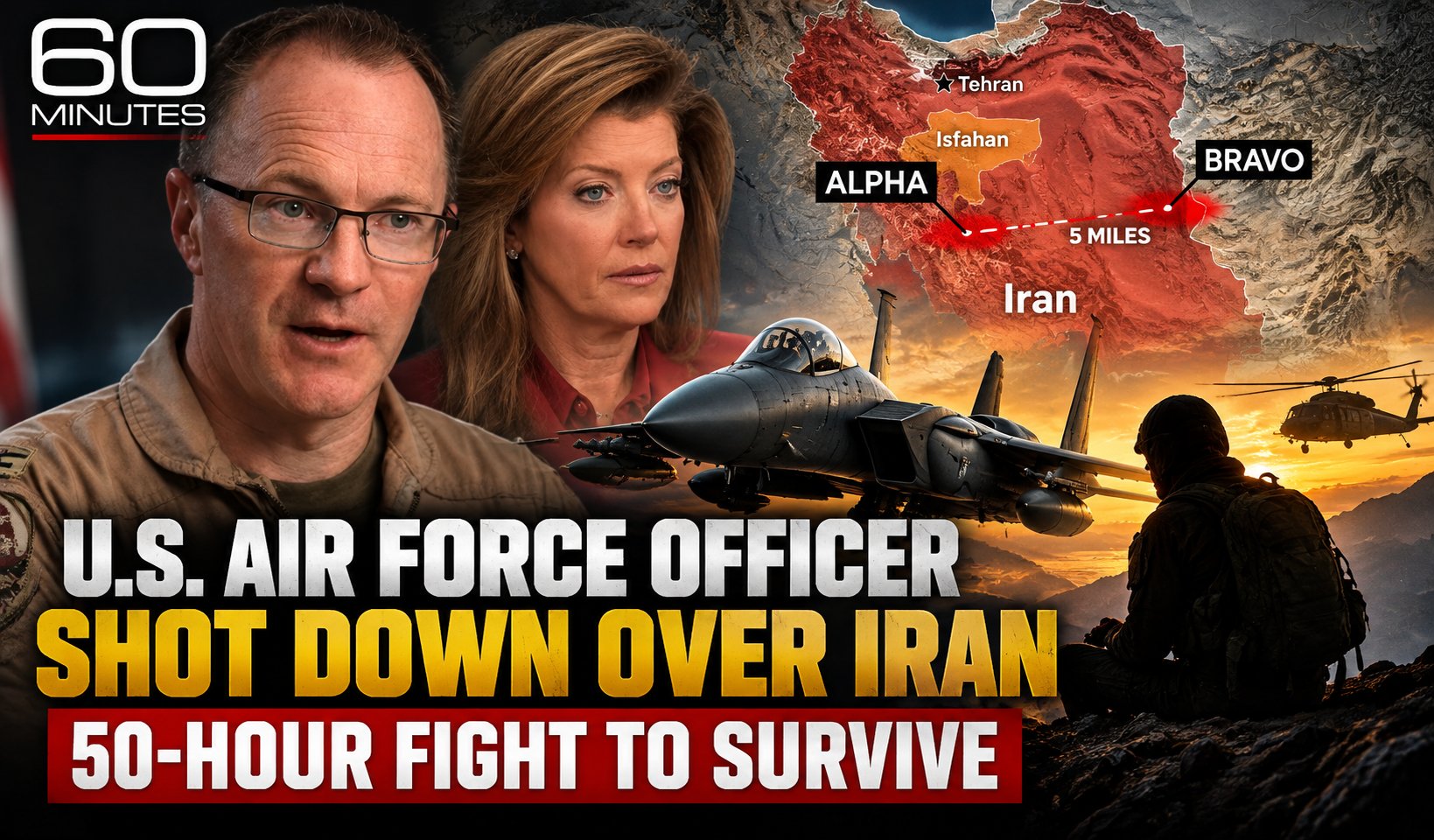
A U.S. Air Force officer whose F-15E Strike Eagle was shot down deep inside Iran has publicly described how he survived approximately 50 hours behind enemy lines while seriously injured, evading Iranian forces and waiting for an enormous American rescue operation to reach him.
The officer, identified publicly only as “Bravo” for operational security reasons, spoke with 60 Minutes correspondent Norah O’Donnell about the April mission and the extraordinary sequence of events that followed. Bravo was the weapons systems officer aboard an F-15E operating as part of a four-ship formation over central Iran when the aircraft was struck by an Iranian shoulder fired surface to air missile south of Isfahan. His pilot, identified as “Alpha,” was flying the aircraft when it was hit. The two officers had never flown together before the mission, but within seconds of the missile strike they were forced to eject as catastrophic damage made saving the aircraft impossible.
A Damaged Parachute Turned the Ejection Into a Near Death Fall
Bravo’s problems were only beginning. The missile strike and ejection damaged his parachute system, preventing the canopy from fully deploying as he desperately attempted to untangle it while falling toward the ground. The exact speed of his descent cannot be established, but Bravo said medical and military specialists later estimated from his injuries and description of the fall that he may have struck the ground traveling between 70 and 100 mph.
The impact left him with a broken back, broken arm, broken shoulder, a badly sprained ankle and significant injuries to his head and face, yet he remained conscious and mobile. Bravo described surviving the impact as a “modern day miracle” and credited his faith with helping him endure what came next. There was little time to process his injuries because he had landed inside Iran during an active war, Iranian forces knew an American aircraft had been brought down and a search for the missing crew was already underway.
Seriously Injured, Bravo Began Climbing
Bravo’s survival equipment presented another major problem. His ejection seat survival kit had been lost during the descent, leaving him with little more than the equipment contained in his survival vest. He had almost no water, no food and only limited signaling and communications equipment as temperatures dropped across the mountainous desert.
Despite multiple fractures, Bravo began moving toward higher terrain and eventually climbed along a roughly 7,000 foot ridgeline, searching for concealment and a position from which his communications equipment could establish contact with American forces. Remaining near the location where he landed carried enormous danger, with Iranian forces actively searching for the downed airmen and reportedly coming within several hundred meters of his position.
As darkness arrived on his first day behind enemy lines, American commanders finally received confirmation that Bravo was alive and moving. His communications included three simple messages that summarized his condition: “I’m hurt,” “I’m moving” and “God is good.” For U.S. commanders attempting to locate him, the transmission fundamentally changed the situation. Bravo had survived the shootdown and catastrophic landing and, despite his injuries, was still capable of moving.
Alpha Was Rescued After Six Hours, Bravo Was Still Missing
American forces located Alpha first. Approximately six hours after the F-15E was shot down, two U.S. helicopters participated in a dangerous daytime operation to recover the pilot while encountering enemy fire. Bravo, positioned elsewhere in the mountains, could see portions of the operation unfolding from his location and described watching his pilot being rescued as “the proudest dad moment of my life.”
The force attempting to recover Alpha could not locate Bravo, however, and with Iranian forces in the area and the rescue team exposed to substantial danger, the Americans eventually withdrew with Alpha while Bravo remained alone inside Iran. The successful recovery of one crew member immediately became the beginning of a far larger effort to retrieve the second.
The CIA Joined an Enormous Operation to Find Bravo
Behind the scenes, the United States began assembling an extraordinary rescue operation involving intelligence agencies, aircraft, special operations forces and thousands of personnel supporting the mission. According to 60 Minutes, the CIA played a pivotal role, conducting a multipronged deception campaign intended to confuse Iranian forces while using classified technology to help determine Bravo’s location. U.S. bombers and drones also struck nearby Iranian Revolutionary Guard forces as commanders attempted to create the conditions necessary for a rescue.
The scale of the operation eventually extended far beyond the personnel who would physically enter Iran. U.S. officials have described thousands of military personnel as participating in or supporting the broader mission, while roughly 90 special operations personnel ultimately entered Iranian territory as part of the extraction. For Bravo, however, none of that activity changed the immediate reality on the mountain: he remained badly injured, with virtually no food and little water, exposed to the wind and cold while Iranian forces continued searching the region.
Two Rescue Aircraft Landed Inside Iran
The final extraction required American forces to physically penetrate Iranian territory. Two large U.S. Air Force search and rescue aircraft flew into Iran and landed on an improvised desert strip, carrying special operations personnel and small helicopters capable of moving from the landing area toward the mountainous terrain where Bravo was hiding.
Air Force Pararescue specialists, commonly known as PJs, were among the personnel involved in reaching and recovering the stranded officer. The mission represented precisely the type of combat search and rescue operation for which the teams train: entering hostile territory to recover an isolated American service member before enemy forces can capture him.
The operation encountered another major complication when one of the American aircraft became stuck in the desert terrain. With Iranian forces nearby and sensitive American military technology at risk of falling into enemy hands, U.S. forces ultimately abandoned the aircraft after extracting Bravo and the rescue personnel. The stranded plane was subsequently destroyed by American forces, preventing Iran from recovering it intact.
Fifty Hours After Being Shot Down, Bravo Was Coming Home
Approximately 50 hours after the F-15E was hit, Bravo was finally back in American hands as the sun rose on Easter Sunday. The operation had required aircraft, intelligence assets, special operations forces, rescue specialists, air crews and thousands of supporting personnel to recover one badly wounded American officer stranded inside hostile territory.
Bravo credited his survival to a combination of faith, military training and the extraordinary commitment of the personnel sent to bring him home. His Survival, Evasion, Resistance and Escape training, better known as SERE, became particularly important once he found himself injured and isolated inside enemy territory with Iranian forces searching for him. His pilot, Alpha, has since returned to flying for the Air Force and expressed his gratitude to the combat search-and-rescue personnel responsible for recovering both crew members, while Bravo told 60 Minutes that despite the severe injuries he suffered, he intends to continue serving in the U.S. military.
The story provides a rare public look at what happens after an American combat aircraft goes down deep inside hostile territory. The loss of the F-15E triggered far more than a search for two missing airmen, mobilizing intelligence agencies, special operations forces, rescue aircraft, strike aircraft and thousands of Americans working across multiple commands toward a single objective: bringing the crew home. For Bravo, the mission ultimately came down to surviving long enough for them to get there.

Sources & Further Reading
- CBS News / 60 Minutes — Badly Wounded U.S. Air Force Officer Climbed 7,000-Foot Iranian Ridgeline After Being Shot Down
- CBS News / 60 Minutes — U.S. Air Force Officer Shot Down in Iran Describes Surviving Behind Enemy Lines
- CBS News / 60 Minutes — Six Takeaways From the Interview With the Air Force Officer Shot Down in Iran
- ABC News Australia — How Bravo Escaped Enemy Territory Alive After Iranian Forces Downed Jet
- 60 Minutes — Extended Interview: Air Force Officer Shot Down in Iran on Surviving Behind Enemy Lines















































Want to join the conversation?
Create an account or sign in to share your thoughts, vote,
and reply to other readers.
Showing 0 of 0 comments
Don't have an account?
Already have an account?