
Vivek Ramaswamy’s $4 Million Attack Ad Against Amy Acton Sparks Bipartisan Outrage Over Childhood Sexual Abuse
Republican gubernatorial candidate Vivek Ramaswamy faces growing criticism after his campaign produced an attack advertisement featuring the estranged biological mother of Democratic opponent Amy Acton, reopening a decades old family history involving allegations of childhood sexual abuse, neglect and abandonment.
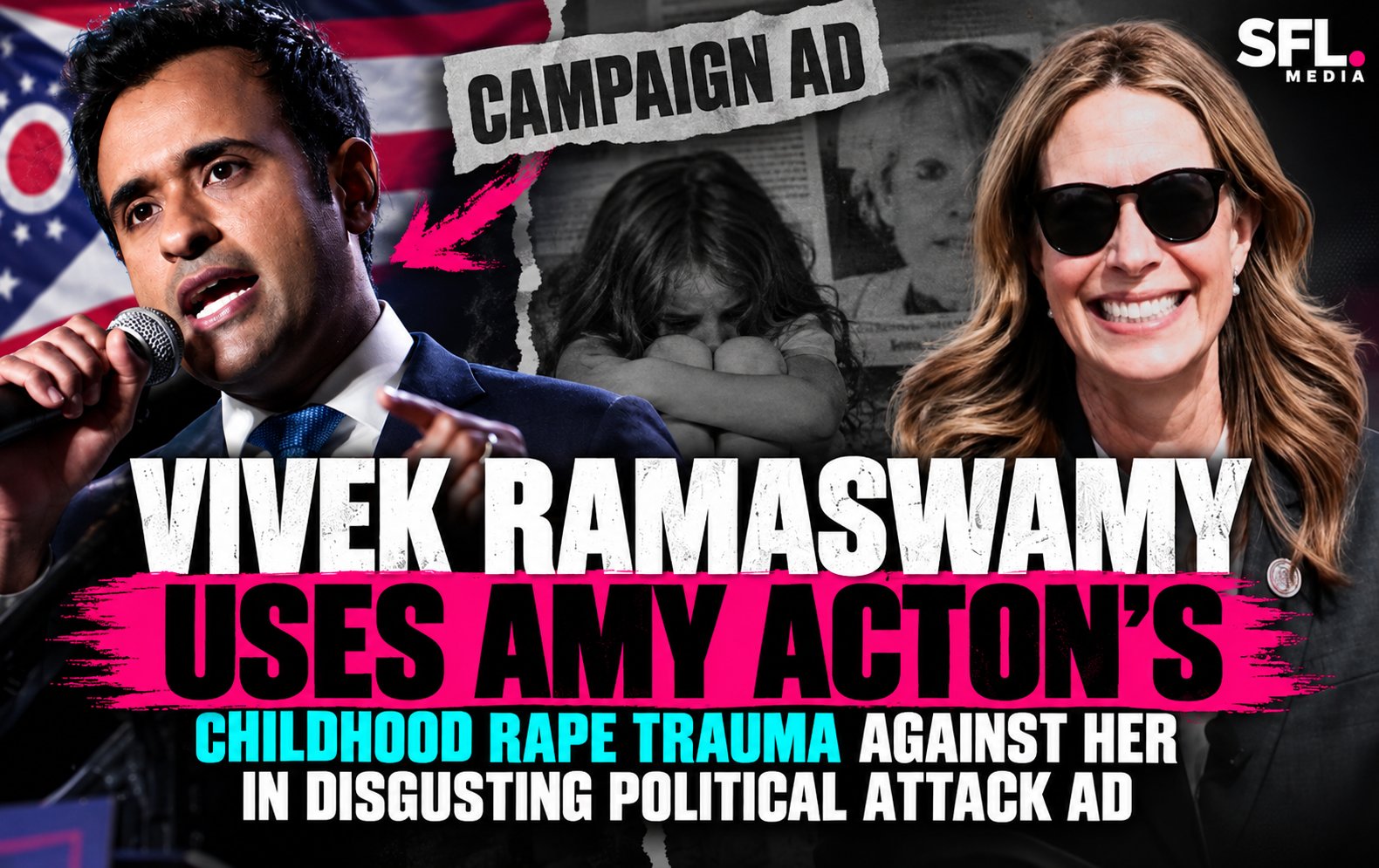
COLUMBUS, Ohio — Republican gubernatorial candidate Vivek Ramaswamy’s campaign has confirmed plans to spend $4 million promoting a controversial political advertisement featuring the estranged biological mother of his Democratic opponent, Dr. Amy Acton. The commercial, which accuses Acton of dishonesty and challenges her account of a traumatic childhood, has generated bipartisan criticism in the closing weeks of Ohio’s gubernatorial election.
The one minute advertisement features Donna Arthur, Acton’s biological mother, accusing her daughter of lying about her upbringing, including her account of experiencing homelessness and living in a tent as a child. However, the commercial omits a central part of their family history: Acton and her younger brother were removed from their mother’s custody after Acton’s stepfather was charged with raping her when she was 12 years old. Acton has said she has not seen her mother since 1978.
The advertisement initially circulated online without identifying its sponsor, prompting questions about its origin. Ramaswamy’s campaign subsequently acknowledged producing the commercial and confirmed plans for a multimillion dollar statewide advertising campaign despite criticism from Democrats, Republicans and political commentators.
A Political Attack Reopens Nearly 50 Years of Family Trauma
At the center of the controversy is Arthur, who appears in the commercial to challenge her daughter’s credibility and urge Ohio voters not to support her candidacy. Arthur describes Acton as a liar, disputes her account of growing up in poverty and suggests that her daughter has personal problems that would interfere with her ability to govern. Those accusations conflict with years of public statements from Acton, corroborating accounts from her brother and historical records documenting the circumstances surrounding their childhood. Acton, a physician who previously served as Ohio’s public health director, has spoken openly about growing up in unstable housing, experiencing neglect and surviving sexual abuse.
According to police and court records obtained by the Associated Press, Acton’s stepfather, Cledith Arthur, was arrested and charged in 1978 with raping his then 12 year old stepdaughter. The alleged abuse occurred between December 1976 and April 1978, and the investigation began after Acton’s biological father reported the allegations to authorities. Cledith Arthur pleaded not guilty and was subsequently indicted by a grand jury. However, he failed to appear for court proceedings and remained a fugitive for years. He died in 2004 without standing trial, meaning the criminal allegations were never resolved through a conviction or acquittal.
Acton and her brother were eventually removed from their mother’s custody and placed with their father. According to her brother, their mother remained married to Cledith Arthur until his death, despite the allegations involving her daughter. Acton has described a final encounter with her mother at a courthouse in 1978, when she attempted to kiss her goodbye and her mother turned away. She has said the two have not seen each other since that encounter, nearly five decades before the current political controversy.
Historical Records Support Key Elements of Acton’s Childhood Account
The family history presented by Acton did not originate during the 2026 election campaign. In 2019, years before announcing her candidacy for governor, Acton discussed her upbringing in an interview with the Youngstown Vindicator, describing a childhood marked by frequent moves, unstable living arrangements, poverty and abuse. Acton recalled living in approximately 18 different homes during her first 12 years, including an unfinished basement and a tent at a campground outside Youngstown. She also described periods when her mother struggled to provide stable housing and care for her children.
Those accounts have received additional scrutiny following the release of Ramaswamy’s advertisement. Reporting by ABC 6 in Columbus and other news organizations has examined historical police reports, court documents and newspaper archives that support significant elements of Acton’s account, particularly the criminal proceedings involving her stepfather. The records do not independently establish every detail of Acton’s childhood, but they provide substantial documentary support for the abuse allegations that form the background of the family estrangement. Her brother has also corroborated the family’s experiences with neglect, hunger and unstable housing.
Arthur’s claims in the advertisement remain disputed. Her status as Acton’s biological mother does not, by itself, establish the accuracy of her statements, particularly given the documented history of estrangement and the conflicting evidence surrounding the family’s past.
Acton’s Brother Releases Rebuttal Advertisement Condemning the Campaign
Acton’s campaign responded by releasing a separate advertisement titled Abuse, featuring her younger brother, Philip Stearns, who describes their childhood experiences and challenges Ramaswamy’s decision to involve their mother in the election. Stearns says both children experienced mistreatment, but that Acton endured more severe abuse while attempting to protect him. He describes his sister as someone who absorbed additional suffering to shield her younger brother from harm, directly contradicting the suggestion that her accounts of childhood trauma were fabricated.
In a statement released by Acton’s campaign, Stearns condemned the decision to turn his sister’s childhood experiences into a political argument. He also reiterated that their mother remained married to the man accused of sexually abusing Acton after the children were removed from her custody. The response advertisement adds a second firsthand family account to the controversy. Unlike the original commercial, which centers on Arthur’s allegations about her daughter, the rebuttal focuses on the siblings’ shared experiences and the circumstances that led to their separation from their mother.
Acton has also publicly criticized Ramaswamy for the advertisement, arguing that her opponent has repeatedly used personal attacks against her and her family rather than focusing on the issues confronting Ohio voters.
Ramaswamy’s Campaign Confirms $4 Million Advertising Strategy
Despite the criticism, Ramaswamy’s campaign has defended its decision to produce and distribute the commercial. Campaign spokesperson Connie Luck confirmed that Arthur was not paid to participate in the advertisement and said the campaign intended to promote the video through television and online streaming. According to Axios, sources close to Ramaswamy’s campaign said the commercial had performed well in testing among persuadable voters, contributing to the decision to invest approximately $4 million in statewide distribution. The reported expenditure represents the campaign’s planned promotional commitment, not a verified total of money already spent.
The campaign maintains that questions about Acton’s credibility and public statements are legitimate matters for voters to consider. Luck has accused Acton of dishonesty and argued that people familiar with the Democratic candidate have raised concerns about her fitness for office. Those arguments, however, have drawn criticism because the advertisement presents Arthur’s allegations without explaining the history of abuse allegations, custody proceedings and decades of estrangement that would help viewers evaluate her statements.
The commercial’s initial circulation also raised questions about transparency. The version first shared online did not identify the campaign responsible for producing it. Television political advertisements are subject to sponsorship identification requirements, although the absence of a disclosure in a leaked or preliminary online video does not, by itself, establish that an advertisement aired illegally.
Republicans and Democrats Criticize the Advertisement
The controversy has produced criticism from across the political spectrum, including Republicans who have previously supported Ramaswamy or share his broader political positions. Former Republican presidential candidate Nikki Haley criticized Ramaswamy over the advertisement, while Meghan McCain and other conservative commentators publicly condemned the decision to feature Acton’s estranged mother. Casey Putsch, who previously challenged Ramaswamy for the Republican gubernatorial nomination, also denounced the commercial and expressed support for Acton.
On CNN, Anderson Cooper and conservative political commentator Alyssa Farah Griffin discussed the advertisement and questioned the campaign’s decision to use a family member associated with Acton’s traumatic childhood as a political messenger.
Other prominent Republicans have taken a different position. Donald Trump Jr. helped circulate the advertisement online, while Vice President JD Vance criticized Republicans who publicly attacked Ramaswamy over the controversy. During a campaign appearance in Ohio on Wednesday, Vance urged Republicans to concentrate on defeating Democrats rather than criticizing their own gubernatorial nominee.
The competing reactions demonstrate a disagreement over the boundaries of political advertising. Critics argue that the commercial exploits a survivor’s childhood trauma and excludes essential historical context, while Ramaswamy’s defenders maintain that candidates’ personal credibility is a legitimate subject of electoral scrutiny.
Ohio Governor’s Race Remains Competitive as Election Day Approaches
The controversy comes during the final two weeks of a closely contested gubernatorial election in a state that has increasingly favored Republicans in recent statewide races. Ramaswamy, a biotechnology entrepreneur and former Republican presidential candidate, is seeking his first elected office. Acton, a physician and former Ohio Department of Health director, became widely known for her role in the state’s response to the COVID-19 pandemic under Republican Gov. Mike DeWine.
Recent public polling has shown a competitive race, with some surveys placing Acton slightly ahead of Ramaswamy. Those reported margins have often been within the surveys’ margins of error, making it inappropriate to treat the polling as a definitive indication of the election’s outcome. The race has also attracted substantial campaign spending and national political attention. Both candidates have faced criticism over their professional backgrounds, public statements and political records, while their campaigns have debated issues including the economy, education, public health and government accountability.
According to the Associated Press, more than 676,000 Ohio voters had already cast ballots when the advertising controversy emerged. With Election Day scheduled for November 3, the dispute has unfolded during a period when many voters are making or finalizing their decisions. There is currently insufficient evidence to determine whether the controversial advertisement will improve or damage either candidate’s electoral standing. Its political effects will depend on how voters interpret the allegations, the documented family history and the candidates’ responses.
The Ethical Questions Surrounding Childhood Abuse in Political Advertising
Political campaigns have long investigated opponents’ personal histories, professional decisions and public statements. Questions about honesty, judgment and character can be relevant to voters evaluating candidates for public office, particularly when allegations are supported by reliable evidence.
The controversy involving Acton presents a more complicated question because the advertisement relies on accusations from a family member who has been estranged from the candidate for nearly 50 years following serious allegations of abuse within their household. The historical record provides important context. Acton’s stepfather faced criminal charges involving her alleged sexual abuse, the children were removed from their mother’s custody, and Acton has consistently described the circumstances of her upbringing in public interviews dating back years before her gubernatorial campaign.
Those facts do not automatically resolve every disagreement between Acton and her mother. They do, however, materially affect how the mother’s accusations should be understood and evaluated. The distinction is especially important because the commercial questions Acton’s personal credibility while leaving viewers without information about the history of the relationship between the two women.
For journalists covering the controversy, the relevant questions extend beyond whether the advertisement is politically effective. They include whether its allegations are supported by evidence, whether essential context has been omitted and whether viewers are being given sufficient information to distinguish disputed personal accusations from documented historical events.
A Family’s Painful History Becomes a National Political Controversy
As Ohio approaches Election Day, Ramaswamy’s campaign continues to defend its decision to promote the advertisement, while Acton and her brother challenge its portrayal of their childhood. The available evidence establishes that Ramaswamy’s campaign produced the commercial, confirmed a planned $4 million promotional effort and proceeded despite criticism from prominent figures in both political parties. Historical court records also establish that Acton’s stepfather faced criminal charges involving her alleged sexual abuse, although those charges never resulted in a trial or conviction.
The advertisement has transformed a deeply personal family history into a central controversy in one of the country’s most closely watched gubernatorial elections. It has also brought renewed attention to the responsibilities of political campaigns when using disputed family testimony, particularly when the underlying events involve allegations of childhood sexual violence.
For Ohio voters, the controversy presents competing questions about a candidate’s credibility, the relevance of personal history and the standards that should govern political advertising. Whether the dispute influences the election remains unknown. What is already evident is that a painful chapter of Acton’s childhood, documented long before she entered the race for governor, has become a prominent feature of the campaign’s final weeks.

Sources & Further Reading
- Associated Press — October 21, 2026. Ramaswamy Takes Responsibility for Ad With Amy Acton’s Mother and Will Spend Millions to Promote It
- Associated Press — October 20, 2026. Democrat in Ohio Governor’s Race Pushes Back Against Unattributed Ad Featuring Her Estranged Mother
- WOSU Public Media — October 20, 2026. Amy Acton Responds to Viral Video Where Her Estranged Mother Accuses Her of Lying
- ABC 6 Columbus — October 21, 2026. Court Records Back Acton’s Childhood Abuse Claims After Mom Calls Her a Liar in Ad
- Axios — October 21, 2026. Ramaswamy Doubles Down on Ad Featuring Rival’s Mother, Despite Backlash
- The Statehouse News Bureau — October 20, 2026. Ad Featuring Mother of Ohio Democratic Governor Candidate Sparks Controversy and Backlash
- Amy Acton for Governor — October 20, 2026. Acton Campaign Releases Response Ad: Abuse
- CNN — October 2026. Video Report: Ohio Governor’s Race and the Controversial Advertisement











































Want to join the conversation?
Create an account or sign in to share your thoughts, vote,
and reply to other readers.
Showing 0 of 0 comments
Don't have an account?
Already have an account?