
Trump Administration Redirects $20 Million in Taxpayer Funds for Campaign Style Ads Promoting the President
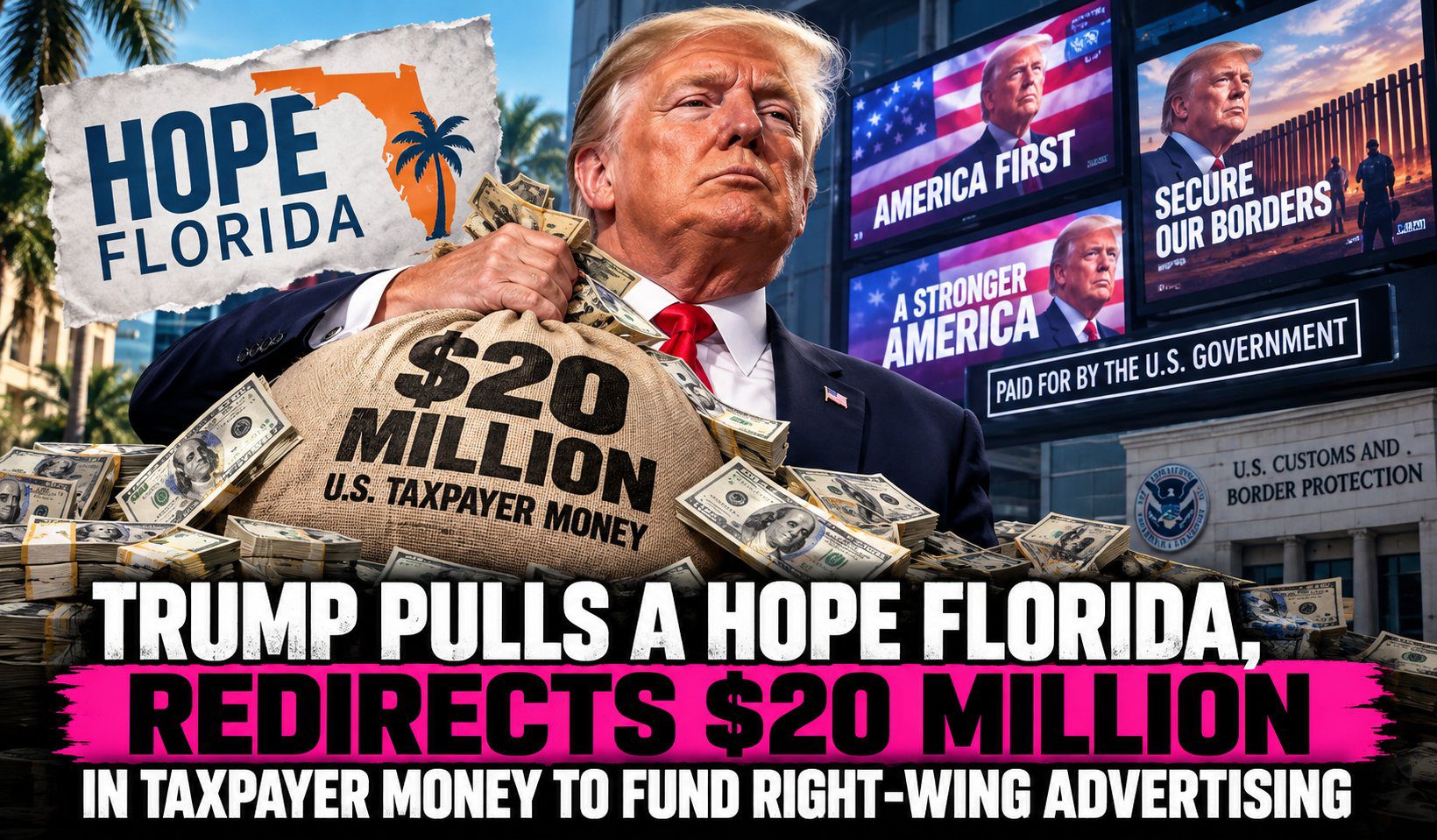
Federal money routed through U.S. Customs and Border Protection is paying for a $20 million national advertising campaign featuring Donald Trump, triggering bipartisan criticism, congressional demands for investigations and questions about whether the government crossed the line between legitimate public information and taxpayer-funded political promotion.
$20 Million in Federal Money Is Paying for Trump Focused Advertising
The Trump administration redirected $20 million in federal taxpayer money into a national advertising campaign featuring President Donald Trump and messaging strikingly similar to his political campaigns, setting off bipartisan criticism in Washington and raising questions about whether federal agencies are being used to finance political promotion ahead of the 2026 midterm elections.
Federal contracting records show that U.S. Customs and Border Protection awarded a $20 million contract to Maryland based LMD Agency Inc. on Sept. 20 for what the government described as a “National Media Campaign.” Federal budget records reviewed by ABC News showed money had been moved into a CBP account for “commemorative events” one day earlier, on Sept. 19. The funding originated from the massive immigration and border security package Congress approved as part of Trump’s 2025 tax and spending law.
The resulting television and digital advertisements prominently feature Trump, praise his administration and recycle themes familiar from his political campaigns. The commercials end with an unusually revealing disclosure for advertisements centered on a sitting president: “Paid for by the U.S. Government.” The White House insists the advertisements are legitimate public service announcements intended to promote patriotism and educate Americans. Critics, including Democratic lawmakers, government watchdogs and several Republicans, argue that they look far more like political advertising financed by taxpayers.
The dispute has quickly become a larger question about the boundary between presidential communications and government propaganda: How far can an administration go in spending public money to promote the president himself?
The $20 Million Paper Trail
The financial trail behind the campaign is now relatively clear. Federal contract records identify a $20 million U.S. Customs and Border Protection contract issued to LMD Agency Inc. on Sept. 20, 2026. The contract is categorized under advertising services, carries the description “National Media Campaign” and extends through September 2027.
ABC News subsequently reported that federal budget records showed money had been moved into a CBP account for “commemorative events” on Sept. 19. The advertising contract was awarded the following day, and the Trump-centered advertisements began appearing shortly afterward. The Associated Press later confirmed that the Department of Homeland Security had committed $20 million from taxpayer funding provided for CBP to finance the campaign.
That sequence has become central to the controversy because Congress appropriates federal money for specific government purposes. Executive agencies have some authority to move money within appropriated accounts, but that discretion is constrained by federal appropriations law and longstanding restrictions on the use of public money for unauthorized publicity or propaganda.
The existence of the $20 million contract does not mean the entire amount has already been spent on television airtime. It represents the amount committed to the campaign. AdImpact, which tracks political advertising across television and other platforms, estimated that more than $2.5 million had already been spent airing three of the advertisements within approximately one week as the controversy intensified.
The Ads Look Remarkably Like Political Commercials
The content is what transformed an obscure federal advertising contract into a national political controversy. One 30 second advertisement features Trump declaring that the United States “will never be a communist country” while images from his presidency flash across the screen and JMSN’s “Love Me” plays in the background.
Another advertisement combines imagery of Mount Rushmore with Trump promoting what he calls a “golden age of America.” A third goes even further into Trump’s established political rhetoric, describing a “final battle” against the “deep state,” “globalists” and the “sick political class.” Reuters reported that the third advertisement closely resembles material used by Trump’s 2024 presidential campaign.
Those are unusual subjects for a conventional government public service announcement. Traditional federal PSAs generally communicate a specific public service or government program, such as disaster preparedness, military recruitment, public health information, tax deadlines or access to federal benefits. Critics and ethics experts argue that the Trump advertisements are fundamentally different because their central subject is the president, his accomplishments and his political worldview rather than instructions directing Americans toward a particular government service.
Each commercial ultimately arrives at the same disclosure: “Paid for by the U.S. Government.”
Taxpayers Are Paying to Put Trump on Television
The advertisements have appeared across national television, cable and streaming platforms, including during popular programming and major sporting events. Reporting from the Associated Press and ABC News documented placements across network and cable television, including Fox News and Newsmax, while the broader campaign expanded across additional outlets and streaming services.
The timing has intensified scrutiny. The advertisements began running only weeks before the November 2026 midterm elections, when control of Congress is at stake and Trump remains the central political figure in the Republican Party. Trump himself is not on the ballot in 2026, an argument he has invoked in defending the advertisements. Critics contend that this distinction does not resolve the underlying issue because the commercials promote themes closely associated with Trump and Republican campaigns during an active federal election season.
Even Republicans Are Questioning the Spending
Criticism has not been limited to Democrats. Republican senators have publicly questioned the propriety of using taxpayer money for advertisements centered on Trump, giving the controversy a bipartisan dimension.
Senate Majority Leader John Thune said he liked the message of the advertisements but objected to taxpayers financing them, saying they “shouldn’t be paid for with taxpayer dollars.” Sen. Thom Tillis of North Carolina went considerably further, comparing the advertisements to government propaganda associated with Hungarian Prime Minister Viktor Orbán.
That bipartisan discomfort matters because the central issue is broader than whether someone supports or opposes Trump. The question is whether any president should be permitted to use federal agencies and congressionally appropriated money to purchase advertising that closely resembles political campaign material. A precedent established for one administration would theoretically be available to the next.
Democrats Demand Investigations
Sen. Patty Murray of Washington and Sen. Chris Murphy of Connecticut demanded detailed information from the Department of Homeland Security about the spending, contracts and legal authority behind the advertisements. The senators accused DHS of using taxpayer money to finance political advertisements celebrating Trump and demanded that the administration stop airing them.
Murray and Murphy said DHS appeared to have dedicated $20 million to the campaign using money provided to CBP for commemorative events related to border security. They requested contracting information, details about who authorized the spending and information about whether additional taxpayer money would be used for future advertisements.
The controversy expanded further on Oct. 1 when Democratic Reps. Jamie Raskin and George Whitesides formally asked the Government Accountability Office and Office of Special Counsel to investigate whether the advertisements violate federal law. Public Citizen also filed a complaint with the Federal Communications Commission challenging the use of public resources for the campaign.
Murray and other Senate appropriators separately introduced the Penalties for Propaganda Act, legislation that would reduce the Office of Management and Budget’s funding by $20 million each time federal money is determined to have been used for prohibited propaganda. Those accusations remain allegations. No court has ruled that the $20 million advertising campaign is illegal, and the administration disputes that characterization.
The White House Says They Are Public Service Announcements
The Trump administration has defended the commercials as legitimate government communications. The White House has described the advertisements as “educational” and “not political,” arguing that they constitute public service announcements rather than campaign advertisements. Trump has also personally defended the campaign, emphasizing that he is not currently running for office. Responding to questions about the controversy, Trump said he was not promoting a candidate and argued that the advertisements were intended to promote the country.
He also said that if it were ultimately determined that using the money was wrong, he would “gladly pay the money.” That distinction could become important in determining whether the advertisements violate federal law. Government officials, including presidents, are not prohibited from appearing in legitimate government communications merely because those communications may produce an incidental political benefit.
The legal issue is more complicated: whether appropriated government funds were used for legitimate governmental communication or effectively converted into publicly financed political promotion.
Federal Law Already Restricts Government Propaganda
Congress has long imposed restrictions on federal agencies using appropriated money for unauthorized “publicity or propaganda.” Federal employees are also subject to restrictions on partisan political activity through laws including the Hatch Act, although the president himself is generally exempt from the Hatch Act and its application to executive branch communications can be legally complicated.
The Government Accountability Office has repeatedly examined government communications under appropriations law, distinguishing legitimate dissemination of public information from covert propaganda, self aggrandizement and purely partisan communications.
That makes the substance, purpose, funding source and authorization behind the Trump advertisements critical. Calling something a “public service announcement” does not automatically make it one. At the same time, an advertisement praising administration policies is not automatically illegal simply because it produces a political benefit.
Determining whether the government crossed the legal line will require examining the appropriations language, the movement of the money, the contract, the government’s role in developing the advertisements and the political content of the final products. As of publication, no court or federal watchdog has issued a final determination that the campaign violated federal law.
The Hope Florida Comparison Is Hard to Ignore, But the Cases Are Different
For Floridians, the controversy carries an obvious echo of the Hope Florida scandal, although the two cases are not legally identical. A Florida grand jury concluded in 2026 that the DeSantis administration had “misappropriated” $10 million connected to a Medicaid settlement by directing the money through the Hope Florida Foundation before the funds ultimately reached political committees and the Republican Party of Florida.
According to the grand jury report obtained by CBS News Miami, the $10 million originated from a larger $67 million Medicaid settlement with Centene Corp. The grand jury concluded that the transfer was “part of a sophisticated scheme to fund political activities.” Investigators nevertheless found insufficient evidence to pursue criminal charges against any individual.
The Trump advertising controversy involves a different funding mechanism, different federal laws and a far more transparent advertising contract. Here, the administration openly awarded a government advertising contract, and the resulting commercials explicitly disclose that they were paid for by the U.S. government. But the underlying public-policy question has a recognizable similarity: whether government officials can take money appropriated or obtained for a governmental purpose and redirect it into activity that also advances their political interests.
In Florida, a grand jury ultimately concluded that the Hope Florida money had been misappropriated. No equivalent legal finding has been made in the Trump advertising case.
The Musician in One Trump Ad Wants Out
The controversy has expanded beyond Washington. Christian Berishaj, the musician professionally known as JMSN, objected after his song “Love Me” appeared in one of the taxpayer-funded Trump advertisements. His attorneys reportedly sent a cease and desist letter demanding that the administration stop using the song and saying the artist did not want his music associated with Trump or his administration. That created the unusual spectacle of a musician fighting to remove his work not from a conventional political campaign advertisement, but from a commercial purchased with federal taxpayer money.
The Larger Question Is Bigger Than Trump
The most consequential issue may ultimately have little to do with the $20 million price tag. If an administration can classify advertisements celebrating a president’s achievements as public service announcements and purchase them using federal appropriations, future presidents could attempt the same strategy.
A Democratic administration could conceivably purchase advertisements promoting its president’s record on health care, abortion rights, climate policy or gun legislation. A future Republican administration could finance advertisements promoting immigration enforcement, tax cuts or conservative social policies. That is precisely why the distinction between official government communications and partisan political activity matters. Government has a legitimate need to communicate with the public. Presidents also have an obvious political interest in convincing Americans that their administrations are successful.
When taxpayers are paying the media bill, the line between those two functions matters. For now, several central facts are established: DHS committed $20 million to the national media campaign, the funding was routed through U.S. Customs and Border Protection, LMD Agency received the $20 million advertising contract, and Americans are paying for advertisements prominently featuring and promoting the sitting president. Whether that campaign is ultimately determined to be a lawful public-information effort or an unlawful use of federal money for political propaganda is now a question facing Congress and federal watchdogs and one that could eventually reach the courts.

Sources & Further Reading
Associated Press — Homeland Security Taps $20 Million in Taxpayer Funds for Pro-Trump Ads
https://apnews.com/article/b869294503c8454db4109ae175ee9e5c
Reuters — Democratic Lawmakers Seek Probe of U.S. Government Ads Featuring Trump
https://www.reuters.com/legal/government/democratic-lawmakers-seek-probe-us-government-ads-featuring-trump-2026-10-01/
ABC News — Pro-Trump Ad Campaign Was Financed by DHS
https://abcnews.com/Politics/pro-trump-ad-campaign-financed-dhs-sources/story?id=136861250
ABC News — Administration’s Pro-Trump TV Ad Is Taxpayer-Funded
https://abcnews.com/Politics/trump-administrations-campaign-style-ad-fox-news-taxpayer/story?id=136723829
ABC News — White House Airs More Taxpayer-Funded Ads Promoting Trump
https://abcnews.com/Politics/white-house-airs-taxpayer-funded-ads-promoting-trump/story?id=136824779
U.S. Senate Committee on Appropriations — Murray and Murphy Demand Answers on DHS Spending Tax Dollars to Air Trump Campaign Ads
https://www.appropriations.senate.gov/news/minority/murray-murphy-demand-answers-on-dhs-spending-tax-dollars-to-air-trump-campaign-ads
U.S. Senate Committee on Appropriations — Penalties for Propaganda Act
https://www.appropriations.senate.gov/news/minority/murray-top-appropriators-introduce-bill-to-impose-significant-penalties-on-trump-admin-for-using-taxpayer-dollars-to-air-political-propaganda
CBS News Miami — Grand Jury Finds DeSantis Administration “Misappropriated” $10 Million in Hope Florida Case
https://www.cbsnews.com/miami/news/grand-jury-report-hope-florida/
Central Florida Public Media — Leaked Hope Florida Grand Jury Report Finds State “Misappropriated” Funds
https://www.cfpublic.org/politics/2026-08-27/leaked-hope-florida-grand-jury-report-state-misappropriated-funds














































Want to join the conversation?
Create an account or sign in to share your thoughts, vote,
and reply to other readers.
Showing 0 of 0 comments
Don't have an account?
Already have an account?