
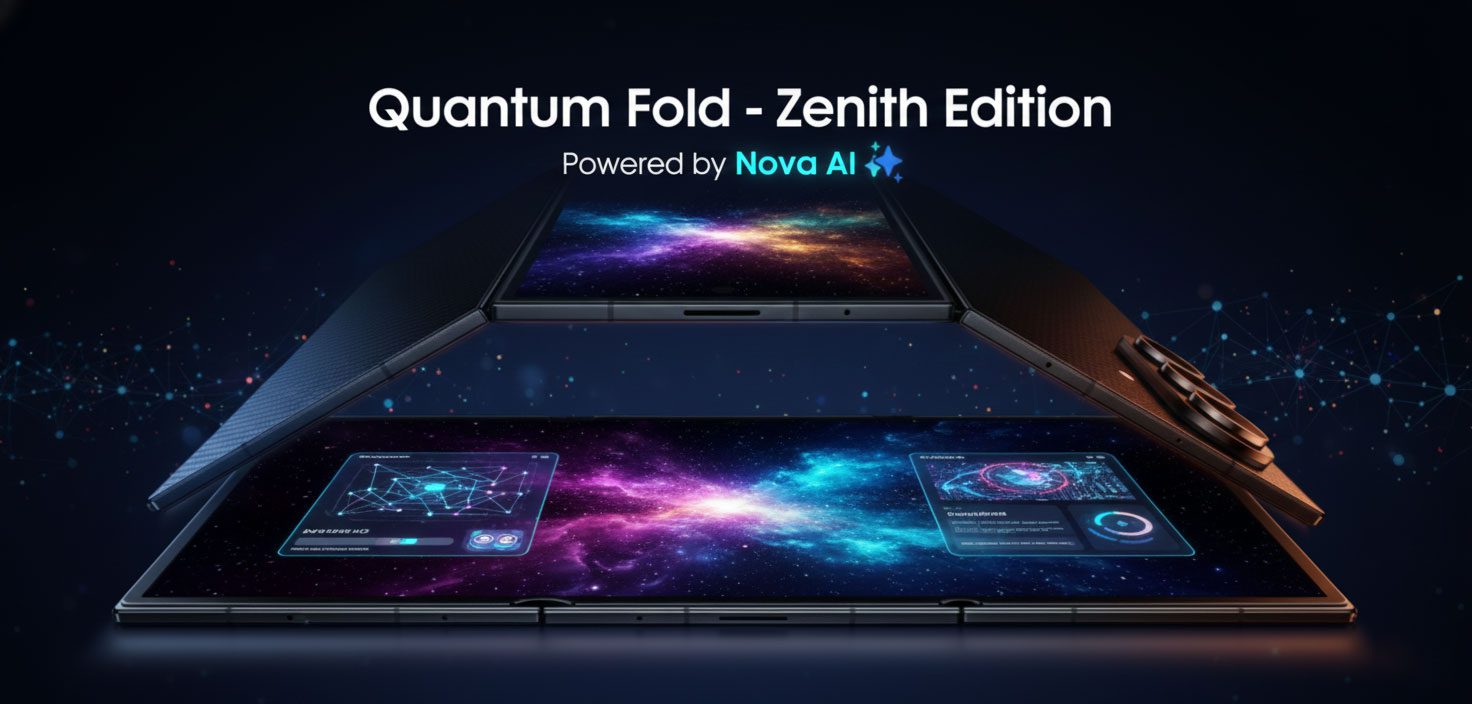
The TriFold Revolution: How Samsung Just Wiped the Slate Clean on the Future of Mobile Technology
The relentless pace of innovation in the mobile world often feels incremental, delivering marginally better cameras or faster processors. But every few years, a device emerges that doesn’t just improve the formula—it fundamentally redefines the hardware canvas. Today, that moment has arrived.
Samsung, the undisputed pioneer of the foldable segment, has officially launched its boldest, most ambitious experiment yet: the Galaxy Z TriFold. This device is not merely the next iteration of the popular Galaxy Z Fold series; it is a declaration of war against stagnation and a potent message to competitors, most notably the aggressive Chinese brands like Huawei and Honor, and the ever-looming threat of an Apple foldable. By integrating two distinct hinges and three independent display panels into a single, cohesive unit, Samsung has engineered the first true pocketable computer, blurring the lines between phone, tablet, and desktop workstation.
The Engineering Marvel: Double Hinges, Zero Compromise
The key to the Galaxy Z TriFold’s existence lies in its intricate, dual-hinge architecture, which allows the device to fold twice, creating three stacked segments when closed. This inward-folding design is a stark departure from some outward-folding concepts seen from competitors, adhering to Samsung’s philosophy of protecting the vulnerable main screen when the device is not in use.
When folded, the TriFold is surprisingly sleek for a multi-layered device, measuring just 12.9mm thick, thanks to its use of advanced materials. The exterior components boast a titanium hinge housing for superior wear resistance and an Advanced Armor Aluminum frame, which provides necessary rigidity without adding excessive bulk. Samsung has also implemented a clever auto-alarm system—a small, but crucial innovation—that alerts users via on-screen notifications and subtle vibrations if the device is being folded incorrectly, mitigating potential damage to the complex mechanism.
But the real magic happens when the device is fully unfurled.
A Workspace That Fits in Your Pocket
The moment the Galaxy Z TriFold opens, it reveals a breathtaking 10-inch QXGA+ Dynamic AMOLED 2X display (2160 x 1584 pixels). This is the largest screen real estate ever offered on a Galaxy foldable, designed explicitly to facilitate professional-grade multitasking. This huge canvas essentially behaves like three separate 6.5-inch smartphone screens seamlessly stitched together, enabling workflows previously confined to laptops or large tablets.
The software experience, powered by Android 16-based One UI 8, is optimized to leverage this massive display. Users can effortlessly run three full-sized apps side-by-side in portrait mode—imagine having a video call, a shared document, and an email client all open and fully functional simultaneously.
More profoundly, the Z TriFold is the first Galaxy phone to support standalone Samsung DeX. This revolutionary feature allows the user to switch the device into a full, desktop-style interface directly from the Quick Settings panel, without needing an external monitor. It transforms the TriFold into a genuine mobile workstation, supporting up to four simultaneous workspaces, each capable of running multiple resizable app windows. For those who require ultimate portability combined with desktop-level power, this feature alone justifies the premium price tag.
AI Mastery Meets Cutting-Edge Hardware
To flawlessly power this complex, dynamic, and heavily multitasking environment, Samsung has engineered the Z TriFold with an absolute powerhouse of components. At its core is the Qualcomm Snapdragon 8 Elite Mobile Platform for Galaxy, a customized chipset that ensures blistering, lag-free performance. This silicon prowess is complemented by a substantial 16GB of LPDDR5X RAM, guaranteeing seamless performance whether you’re dominating intensive mobile games or fluidly juggling demanding productivity applications.
The camera array is equally state-of-the-art, directly inheriting the flagship optics from the Z Fold 7 lineage. It features a robust triple-rear camera setup headlined by a staggering 200-megapixel main sensor, paired with a 12MP ultrawide lens and a 10MP telephoto lens offering 3x optical zoom. With dual 10MP selfie cameras—one elegantly integrated into the cover screen and another for the massive inner display—the device is primed for high-quality visuals in any orientation.
Crucially, the large 10-inch display serves as the ultimate canvas for the latest advancements in Artificial Intelligence. The TriFold fully leverages the deep integration of Google’s foundational AI models, enhancing Samsung’s proprietary Galaxy AI features. Capabilities like advanced Generative Edit and intelligent Sketch to Image tools are scaled up, allowing users to view intricate before-and-after comparisons and contextual results in full, high-definition detail. The tight integration of Google services and advanced on-device Artificial Intelligence means the TriFold transcends being merely a bigger screen—it is a fundamentally smarter, contextually aware workspace, optimized for instantaneous creation and complex data processing.
Finally, managing this intense power draw and massive screen real estate is Samsung’s largest-ever foldable battery: a robust 5,600mAh three-cell system. This capacity is meticulously and strategically distributed across the device’s three panels for optimal weight balance and sustained power delivery, supported by 45W super-fast wired charging and 15W fast wireless charging.
The Strategic Context: Beyond Sales Volume
While the specifications are unquestionably flagship-tier, the Z TriFold’s launch reveals more about Samsung’s strategy than its sales forecast. Industry analysts understand that this inaugural device is a strategic marker.
To put this into perspective, we must heed the words of industry experts. Liz Lee, Associate Director at Counterpoint Research, perfectly encapsulated this strategy when she stated:
“The Galaxy Z TriFold is not designed to ship at mass scale. Instead, it acts as a pilot device, allowing Samsung to refine hinge durability, test new UI modes, and observe how different markets respond before committing to wider production. The objective isn’t high-volume sales—it’s data gathering.”
This insight confirms that the TriFold is Samsung playing the long game. It’s a premium, limited-release device, likely priced around $2,449 to $2,500, positioning it above the current Fold line. It is designed to capture the attention of high-end consumers and corporations looking for the absolute cutting edge in mobile hardware.
In the face of competition, particularly from rivals like Huawei, which adopted a different Z-fold design, the TriFold is a statement of defiance and continued leadership. It signals that Samsung is not merely reacting to the market but actively creating the next generation of mobile form factors. For the vast majority of consumers, the more polished successors expected in late 2026 or 2027 may be the devices worth waiting for. But for now, the Galaxy Z TriFold represents the stunning, tangible future of the smartphone—a future where a phone truly becomes a computer that fits in your pocket, pushing rivals like Apple and others to rapidly accelerate their own next-generation foldable plans or risk being left permanently behind.

















































Want to join the conversation?
Create an account or sign in to share your thoughts, vote,
and reply to other readers.
Showing 0 of 0 comments
Don't have an account?
Already have an account?