
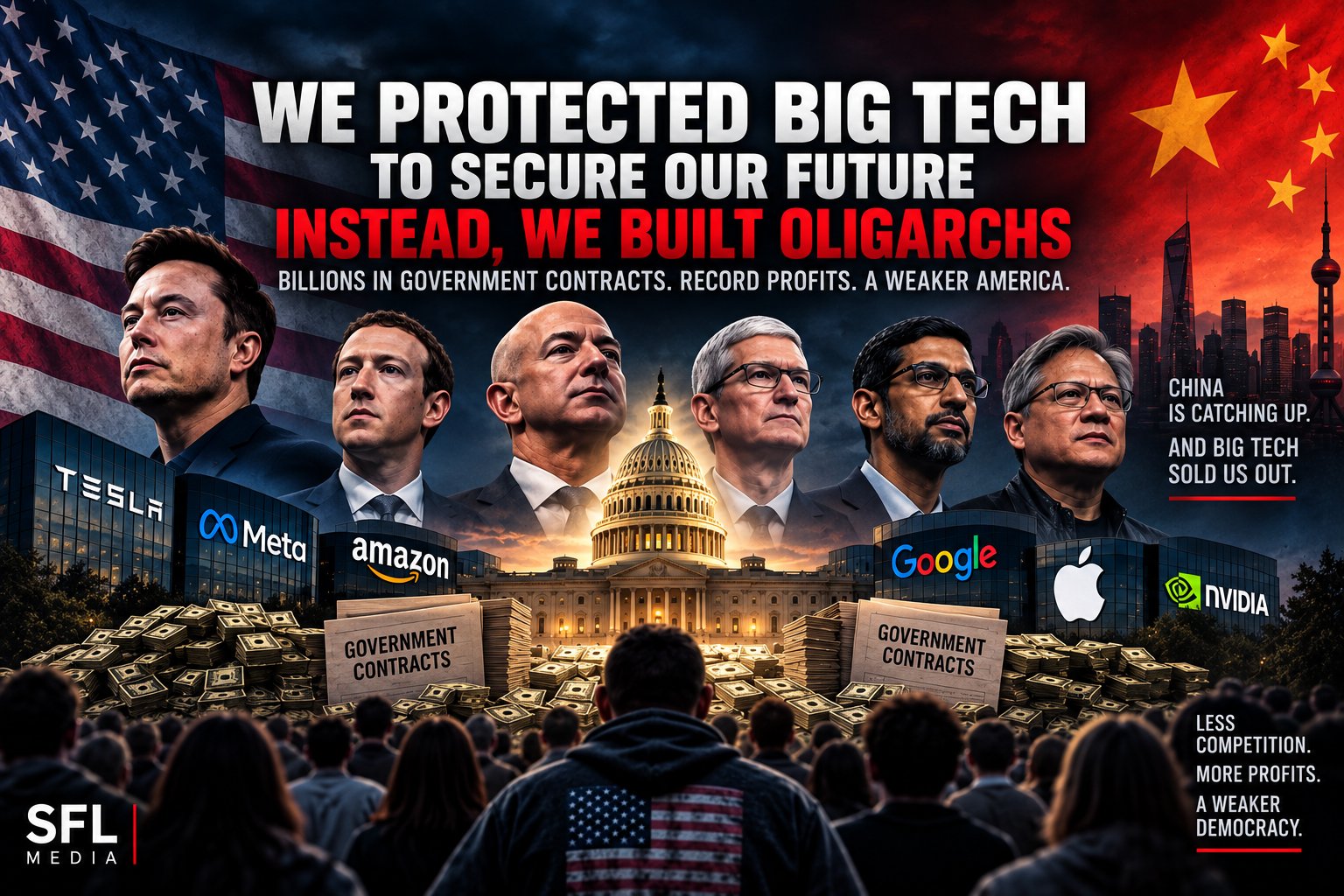
America Built Big Tech to Beat China. Instead, It Built Oligarchs With More Money, Power and Access Than Ever
For more than two decades, the United States made an extraordinary bet on its technology industry. Washington largely accepted the emergence of enormous, vertically integrated technology corporations because scale was increasingly treated as a national asset. Google needed global infrastructure, Apple needed an ecosystem, Amazon needed logistics and cloud computing, Nvidia needed enormous research budgets, Meta needed networks connecting billions of people, Tesla needed manufacturing capacity and SpaceX needed billions of dollars to challenge an aerospace industry dominated by governments and legacy contractors. As strategic competition with China intensified, the argument became even more compelling: America needed national technology champions powerful enough to dominate the industries that would determine the economic and military future.
Parts of that strategy worked spectacularly. American companies built dominant mobile platforms, cloud networks, advanced AI processors, social networks, digital advertising systems and commercial launch businesses. They created enormous shareholder wealth, employed hundreds of thousands of people and developed technologies used across the world. The United States remains extraordinarily powerful in artificial intelligence, advanced computing, software, aerospace and other strategically important industries, and any serious discussion of Big Tech has to acknowledge that these companies produced genuine technological achievements rather than simply accumulating wealth.
But the bargain produced something else. A relatively small collection of corporations and billionaires accumulated extraordinary control over digital infrastructure, communications, artificial intelligence, advertising, cloud computing, government software and access to space. Some became major federal contractors. Others were found to have violated antitrust law or remain defendants in major monopolization cases. Several of the industry’s most powerful executives and companies have also dramatically expanded their political engagement as decisions made in Washington have become increasingly important to their businesses. The original promise was that America needed powerful technology companies to help protect its future. The question now is whether some of those companies have become so economically, politically and strategically important that the country itself is becoming reluctant to challenge them.
The National Champions Bargain Has Reached Its Limit
The national champions theory was never irrational. Semiconductor fabrication plants can cost tens of billions of dollars, frontier artificial intelligence requires immense computing infrastructure, reusable rockets can consume enormous amounts of capital before producing reliable returns, and global cloud and manufacturing networks benefit from scale. America cannot compete in those industries by pretending that every successful company should remain a small business.
The danger begins when scale stops being merely productive and becomes protective. Competitive markets work because companies know customers can leave, employees can leave, investors can finance rivals and tomorrow’s startup can make today’s market leader irrelevant. Network effects, exclusive contracts, control over distribution, vertical integration and repeated acquisitions of emerging competitors can weaken those pressures until a corporation is no longer simply winning the competition but helping determine the conditions under which its competitors are allowed to compete.
That distinction should be at the center of American technology policy. The country does not need weak technology companies, nor should government punish corporations simply for becoming successful. America needs powerful companies that remain vulnerable to competition, because a market in which even the largest corporation can still lose is fundamentally different from one in which today’s winners become tomorrow’s permanent institutions.
America Has Already Seen What Antitrust Can Do for Technology
The United States has confronted this problem before. Federal antitrust authorities challenged Microsoft’s conduct surrounding Windows and the emerging internet economy more than two decades ago, arguing that the company was using control of the dominant personal computer operating system to protect itself from technologies that could weaken that control. Microsoft survived the case and remains one of the most valuable and technologically important companies in the world, but the intervention reinforced the principle that dominance over one critical layer of technology should not automatically provide permanent control over the next.
That history matters because some of the companies that later flourished in the more open internet economy eventually became dominant enough to face major antitrust scrutiny themselves. When the Justice Department brought its Google search case, federal officials explicitly invoked the Microsoft precedent and argued that previous antitrust enforcement had helped create opportunities for companies including Google.
The irony is significant: the challengers that benefited from competition eventually became incumbents powerful enough that government again had to ask whether the market remained genuinely open. That is not evidence that antitrust failed. It is evidence that competitive markets require continual maintenance.
Google Shows What Happens When a Technology Company Becomes Infrastructure
Google provides the clearest modern example because the debate over its market power is no longer hypothetical. A federal court concluded in 2024 that Google unlawfully maintained monopoly power in general search services and general search text advertising through exclusionary distribution agreements. The Justice Department said Google had accounted for approximately 90 percent of U.S. search queries and had used its enormous financial resources to secure default placement across devices, browsers and other critical gateways to the internet.
The government subsequently sought sweeping remedies, including a possible divestiture of Chrome, but the court chose a less drastic approach. The final judgment prohibited certain exclusive distribution arrangements and required Google to make specified search-index and user interaction data available to eligible competitors while also providing certain search and search ad syndication services. Google separately lost another federal antitrust case in 2025 when a court found that it had unlawfully monopolized important parts of the open-web digital advertising technology market. These cases do not establish that every Google product or business practice is anticompetitive, but they do establish that concerns about the company’s market power are based on more than political rhetoric.
The larger problem is the extraordinary number of critical positions one corporation can occupy simultaneously. Search, browsers, advertising technology, publisher tools, video distribution, mobile software, cloud computing and artificial intelligence increasingly overlap within the same corporate ecosystem. When competitors depend on infrastructure controlled by the company they are attempting to challenge, ordinary competition becomes more complicated. The answer does not necessarily require dismantling everything Google built, but dominance in one market should not become an automatic pathway to protecting dominance in another. Search should compete on search quality, advertising technology on price and performance, browsers on user preference and AI products on their capabilities rather than their relationship with an incumbent gatekeeper.
Apple Shows How a Great Product Can Become a Fortress
Apple presents a different legal situation. The Justice Department has accused the company of unlawfully maintaining monopoly power in smartphone markets, but Apple has not been found liable in that case. The government’s allegations focus partly on Apple’s restrictions involving messaging, digital wallets, cloud applications, smartwatches and so called super apps that could potentially reduce consumer dependence on the iPhone. Apple disputes those allegations and argues that its integrated model produces better security, privacy, reliability and consumer experiences.
Those defenses cannot simply be dismissed. Apple remains capable of significant technological innovation, particularly in custom processors and the integration of hardware and software. The stronger competition question concerns what happens after an enormously successful product becomes the gateway to an entire commercial ecosystem. Apple generated more than $416 billion in fiscal 2025 net sales, including more than $109 billion from Services, meaning its economic relationship with customers increasingly extends beyond the original sale of an iPhone, Mac or iPad into software distribution, subscriptions, storage, payments and other recurring services.
There is nothing inherently anticompetitive about building that ecosystem or making enormous profits from it. The question is whether Apple continues winning those transactions because consumers prefer its services in genuinely contestable markets or because ownership of the underlying platform makes competing alternatives unnecessarily difficult. Antitrust policy should not punish Apple for building successful products or earning enormous profits. It should ensure that yesterday’s success does not become tomorrow’s protection from competition.
Meta Shows the Extraordinary Power of an Entrenched Platform
Meta demonstrates what an immensely profitable platform can afford once its core businesses reach enormous scale. Reality Labs generated approximately $2.2 billion in revenue during 2025 while recording an operating loss of roughly $19.2 billion, following operating losses of approximately $17.7 billion in 2024 and $16.1 billion in 2023. Meta therefore absorbed more than $50 billion in Reality Labs operating losses over three years while continuing to operate one of the world’s most profitable advertising businesses.
Those losses do not prove that Mark Zuckerberg’s strategy was foolish or that Meta’s investments will ultimately fail. Transformative technologies can require years of expensive experimentation, and some of Meta’s investments in artificial intelligence, augmented reality and wearable devices may eventually become important businesses. The economic issue is that few independent companies could finance comparable experimentation while simultaneously attempting to challenge platforms backed by billions of users and enormous existing cash flows.
Meta’s acquisition history makes that concentration debate even more consequential. Facebook acquired Instagram in 2012 and WhatsApp in 2014, and the Federal Trade Commission later alleged that the company had purchased significant competitive threats instead of allowing them to develop independently. Meta won that case at the district court level in November 2025, and the FTC appealed in January 2026, so the government’s monopolization theory remains contested rather than established fact. The unanswered economic question nevertheless remains important: Instagram might have become an independent advertising, messaging, marketplace and video giant, while WhatsApp might have evolved into another major platform. Nobody knows what those companies would have become because the competitive experiments ended when Facebook bought them.
America Cannot Become an Economy of Startups Built to Be Acquired
The United States became the world’s technology leader partly because disruptive companies repeatedly replaced comfortable incumbents. IBM did not permanently control computing, Microsoft did not permanently control the internet, Yahoo did not permanently control search and MySpace did not permanently control social networking. The possibility that today’s dominant company could be displaced by something built in a garage, university laboratory or startup office has been one of the defining strengths of American capitalism.
That process becomes more difficult when dominant platforms control the infrastructure startups need to reach customers. Entrepreneurs and investors must consider whether an incumbent can copy their product, bundle a competing service at little additional cost, change platform rules, restrict interoperability, control distribution or simply acquire the startup before it becomes large enough to threaten the existing business. Economists, investors and antitrust scholars have described these areas surrounding dominant platforms as startup “kill zones” because the expected response from an incumbent can discourage investment in companies designed to compete directly against it.
Acquisitions are not inherently harmful. They can reward founders, return capital to investors and give promising technology access to much larger markets. But a technology economy becomes less dynamic if the most realistic definition of startup success changes from becoming the next Google to becoming something Google, Meta, Amazon, Microsoft or another incumbent eventually purchases. America needs entrepreneurs who believe they can replace today’s giants, not merely entrepreneurs hoping to sell themselves to them.
China’s EV Industry Shows What Relentless Competition Can Produce
Tesla belongs in this discussion for a different reason because it does not possess the same kind of digital platform monopoly at issue in the Google cases. Instead, Tesla demonstrates what happens when a once disruptive American company begins facing extraordinarily aggressive competition. Tesla helped accelerate the global automotive industry’s transition toward electric vehicles and forced established manufacturers to take EVs seriously, but it is now experiencing the same competitive pressure it once applied to legacy automakers.
Tesla sold 86,166 China made Model 3 and Model Y vehicles in August 2026, including exports, while its share of China’s battery electric vehicle market has declined substantially from earlier peaks. BYD, meanwhile, sold more than 440,000 new energy vehicles globally during the same month, while overseas shipments increased by more than 130 percent from a year earlier. Those figures do not prove that every Chinese vehicle is technologically superior to every Tesla, but they demonstrate that Chinese manufacturers are competing intensely across batteries, manufacturing, software, charging, design, features, model variety and price.
That competitive pressure matters because market leadership is supposed to be temporary unless a company continues earning it. Tesla’s enormous brand recognition, capital resources and technological accomplishments have not prevented competitors from attacking its position. Rather than demonstrating the danger of competition, the Chinese EV market demonstrates exactly what competition is supposed to accomplish: force even an industry pioneer to keep moving because rivals are constantly trying to take its customers.
China’s AI Rise Should End American Complacency
Artificial intelligence makes the same point on a much larger strategic scale. The United States retains extraordinary advantages, including massive private investment, extensive data-center infrastructure, major frontier AI developers and Nvidia’s powerful position in advanced AI computing. American technology is not collapsing, and claims that China has simply surpassed the United States across AI or advanced semiconductors would overstate the evidence.
What has changed is the speed at which Chinese developers have narrowed important gaps. Stanford University’s 2026 AI Index reported that the performance difference between leading American and Chinese AI models had effectively closed on major benchmarks, even while the United States continued producing more notable models and attracting dramatically more private investment. China simultaneously holds major positions in AI publications, citations, patents and industrial robot installations, demonstrating that technological competition extends far beyond a single model leaderboard.
The implications are uncomfortable for a country accustomed to assuming that superior capital automatically produces permanent technological leadership. America can spend more money, build more data centers and host more valuable corporations while determined competitors still become more efficient and technologically capable. Capital matters enormously, but engineering, efficiency, talent and competitive pressure matter too. A company or country that believes its existing lead guarantees the future is already creating an opportunity for somebody else to take it.
Restricting China Also Gave China a Reason to Become More Independent
American semiconductor export controls have imposed genuine costs by restricting Chinese access to some advanced processors and manufacturing technology. Those controls can serve legitimate national security purposes, particularly where advanced computing technology could contribute to military capability, and their effectiveness cannot be measured solely by whether China continues developing technology.
Restrictions nevertheless create incentives alongside constraints. Huawei and other Chinese companies have accelerated investments in domestic processors, artificial intelligence and software ecosystems because dependence on American technology became an obvious strategic vulnerability. Huawei spent approximately 121 billion yuan on research and development during the first half of 2026, an increase of roughly 25 percent from the previous year, as it continued investing heavily in chips, AI, devices and other technologies intended to reduce reliance on foreign suppliers.
The lesson is not that export controls necessarily failed. They can restrict access, impose costs and buy strategically valuable time. The lesson is that restrictions cannot substitute for innovation at home. America cannot preserve technological leadership indefinitely by preventing competitors from purchasing its best technology; it must continue producing technology those competitors cannot match.
Government Contracts Create a Different Kind of Technology Concentration
The concentration problem becomes more complicated when private technology companies move beyond consumer markets and become deeply embedded in government operations. Palantir has developed an important position providing software, data integration and AI capabilities to the U.S. military and other agencies. In July 2025, the Army announced an enterprise agreement consolidating 75 Palantir related contracts, including 15 prime contracts and 60 related contracts, into a purchasing framework lasting as long as ten years with a maximum potential value of $10 billion.
That figure is a contract ceiling, not a guaranteed $10 billion payment. The Army says the agreement allows agencies to purchase Palantir products as needed while obtaining volume discounts, reducing reseller fees and shortening procurement timelines. Those efficiencies are legitimate, but so is the strategic concern created when essential government operations become deeply integrated with proprietary technology that may be difficult or expensive to replace.
The solution is not automatically rejecting the strongest contractor or deliberately purchasing inferior technology in the name of competition. Government should instead preserve interoperability, competitive procurement and credible alternatives whenever national security permits. The better and more indispensable a contractor becomes, the more important those safeguards become, because no government should intentionally make itself technologically incapable of changing vendors.
SpaceX Shows Why Competition Does Not Mean Punishing Success
SpaceX demonstrates why serious competition policy cannot simply become an ideological campaign against corporate size. The company transformed commercial launch through reusable rockets, built the Starlink satellite network and became deeply important to NASA and national-security missions. Weakening those capabilities merely because SpaceX became extraordinarily successful would make little strategic sense and could leave the United States less capable rather than more competitive.
The better answer is to cultivate more capable competitors. The U.S. Space Force has expanded the pool of companies eligible to compete for national-security launch work, increasing the possibility that additional providers can challenge incumbents while giving the government redundancy if one company experiences a technical failure, cyberattack, supply-chain disruption or other operational crisis. In strategic infrastructure, redundancy is not necessarily waste; it can be insurance against dependence.
That principle captures the distinction this entire debate requires. America benefits enormously from SpaceX, but it also benefits from companies determined to outperform SpaceX. The country should want Nvidia to remain brilliant while simultaneously wanting competitors capable of replacing Nvidia. The objective is not to weaken winners. It is to prevent winning from becoming permanent immunity from competition.
Political Access Has Become Part of the Big Tech Power Equation
The relationship between America’s largest technology companies and Washington has become increasingly important because the federal government simultaneously regulates those corporations, buys their products, reviews their mergers, enforces antitrust law and writes rules affecting artificial intelligence, privacy, communications and national security. That gives companies worth hundreds of billions or trillions of dollars powerful incentives to build relationships with whichever administration controls federal policy.
After Donald Trump’s return to the White House in 2025, several major technology companies and executives made highly visible efforts to strengthen relations with the incoming administration. Amazon, Google, Meta and Microsoft each contributed $1 million to Trump’s inaugural fund, while other prominent executives made personal contributions or appeared at inauguration events. Elon Musk’s involvement went substantially further through significant political spending and his role supporting Trump’s election before their relationship later experienced highly publicized conflicts. These activities were legal, corporate participation in presidential inaugurations is not new, and political engagement does not by itself establish corruption, improper influence or a quid pro quo.
It would also be inaccurate to claim that the entire technology industry simply “went Trump.” Technology employees, investors and executives hold diverse political views, and major corporations routinely engage with both parties because federal decisions can profoundly affect their businesses. The institutional concern is broader than partisan allegiance: companies with extraordinary economic power increasingly have extraordinary reasons to seek political access because government decisions can determine the rules governing their platforms, contracts, acquisitions and competitors. When enormous corporate power and enormous political access begin reinforcing one another, democratic accountability deserves scrutiny regardless of which party controls Washington.
The Problem Is Not That Billionaires Have Political Opinions
Technology executives have the same constitutional right to participate in American politics as everyone else, and democratic accountability cannot mean excluding wealthy citizens from political debate simply because they are wealthy. The structural concern emerges when personal fortunes, corporate control, essential infrastructure, government contracts, communications systems and political access become concentrated in the same small group of people and companies.
A century ago, policymakers worried about concentrated power in railroads, banking, steel and oil because those industries had become essential to the functioning of American society. The modern equivalents increasingly include search engines, cloud computing, social networks, artificial intelligence, satellite communications, defense software and orbital launch systems. The relevant question is therefore not whether a particular billionaire supports Republicans or Democrats but whether any private individual or corporation becomes so economically indispensable that elected governments become reluctant to challenge that power.
This is also why accusations that technology companies have simply “sold out America” should be treated carefully. Corporations are not governments and do not have the same obligations governments have to citizens. Their executives have fiduciary duties, commercial objectives and shareholders, while government has constitutional responsibilities and a public interest to protect. Those interests can overlap enormously, but they are not identical, and public policy becomes dangerous when policymakers begin assuming that what is best for a dominant American corporation is automatically what is best for America.
Big Tech’s Boom and Bust Employment Cycles Concentrate Economic Risk
Technology concentration also affects workers because giant corporations can hire tens of thousands of engineers, programmers, designers, researchers and sales employees during expansion periods and eliminate thousands of those positions when strategies change. Companies must remain capable of reducing unnecessary costs, and layoffs are not inherently evidence of misconduct, but concentration can magnify the economic consequences of executive decisions.
When highly skilled workers are distributed across hundreds of independent employers, one corporation’s strategic mistake primarily damages that corporation. When a relatively small group of firms employs an enormous share of specialized technical talent, failed projects, hiring mistakes and strategic pivots can reverberate through professional communities, regional housing markets and local economies. More independent employers also mean more companies competing for workers, potentially giving engineers and researchers greater bargaining power and more opportunities to leave a company whose compensation, culture or strategy they dislike.
The same principle that benefits consumers therefore applies to labor. Competition distributes economic power and economic risk across more institutions, while concentration places more consequential decisions in fewer executive suites.
Size Is Not the Problem. Entrenchment Is
A serious technology policy must distinguish between companies that become enormous because they continue outperforming competitors and companies that use control over markets or infrastructure to prevent competitors from emerging. Those situations are not equivalent, and treating every large corporation as inherently harmful would risk destroying legitimate economies of scale that contribute to American technological leadership.
Semiconductor manufacturing can require extraordinary capital, frontier AI depends on enormous computing resources, rocket development requires sustained investment and global cloud infrastructure benefits from interconnected networks. Breaking businesses apart simply because they are large could weaken capabilities the United States genuinely needs. Structural remedies should therefore be targeted at demonstrated market power and situations in which vertical integration, exclusionary conduct or acquisitions allow dominance in one market to suppress competition in another.
Competition policy also should not be marketed as an economic cure-all. Breaking up Google would not automatically stop inflation, separating businesses inside Meta would not eliminate technology layoffs and preventing acquisitions would not guarantee that American companies defeat Chinese competitors. Antitrust has a narrower but critically important purpose: preserving a competitive process in which consumers have alternatives, workers have multiple employers, entrepreneurs can reach markets and dominant companies must continue improving because failure remains possible.
America Needs Industries, Not Indispensable Companies
The United States should build resilient industries rather than irreplaceable corporations. It needs advanced semiconductor companies, but it benefits from having several of them. It needs powerful AI laboratories, but it also needs challengers capable of replacing today’s leaders. It needs commercial launch providers, cloud infrastructure, defense software, electric vehicle manufacturers and communications networks, but national policy should not intentionally make the country dependent on a single corporation or billionaire.
That principle does not diminish America’s strongest companies; it strengthens the country around them. Corporations can fail, founders can make catastrophic strategic mistakes, leadership can change, technologies can become obsolete, supply chains can break and cyberattacks can disrupt essential services. A resilient national economy plans for those possibilities by maintaining alternatives rather than assuming today’s dominant provider will remain competent, aligned with national interests and technologically superior forever.
The distinction is especially important when taxpayer money is involved. Government contracts can legitimately help companies develop capabilities the country needs, and federal procurement has played a major role in American technological development for generations. But public money should purchase public capability rather than create unnecessary permanent dependency. A government contract should not become a guarantee that the same company will remain the only realistic supplier indefinitely.
Structural Separation Should Remain a Real Option
When courts establish that a corporation has unlawfully maintained monopoly power, structural separation should remain available alongside behavioral remedies. Search does not inherently need to share ownership with every advertising technology business, a dominant mobile operating system does not automatically need control over every pathway through which software reaches consumers, and a social network should not automatically receive permission to purchase every emerging communications platform capable of becoming a competitor.
Structural separation is an extraordinary remedy and should not be used casually. It can create transition costs, destroy legitimate efficiencies and produce unintended consequences if regulators attempt to redesign complex businesses without understanding how their components interact. But the remedy also should not become effectively unavailable simply because a corporation has grown so enormous, strategically important or politically connected that government becomes afraid of the consequences of challenging it.
That would create a dangerous paradox in competition policy: the more powerful a corporation became, the safer it would become from the strongest remedies available under antitrust law. Size should not create immunity from accountability.
America’s Competitive Advantage Was Never Permanent Corporate Power
The most important American technology companies began as challengers. Google emerged from a university research project while established search companies controlled the market. Apple once fought much larger computer manufacturers. Facebook began in a college dormitory. Amazon began by selling books online. Nvidia spent years as a comparatively specialized graphics chip company, and SpaceX entered an aerospace industry dominated by established contractors with far deeper relationships and resources.
Their rise does not prove that America needs permanent technology oligarchs. It demonstrates the extraordinary value of an economic system in which outsiders can become giants. The next generation of American technology policy should therefore protect strategically important technology from espionage, strengthen domestic semiconductor production, invest aggressively in science and engineering, maintain justified national-security controls and support companies capable of competing globally while simultaneously enforcing antitrust law, scrutinizing acquisitions that can eliminate emerging competitors, preserving interoperability and maintaining multiple suppliers for essential public technology.
The United States does not need weaker technology companies. It needs more strong ones. It needs Nvidia and companies trying to replace Nvidia, SpaceX and companies trying to outperform SpaceX, successful AI laboratories and startups determined to make today’s models obsolete, social networks competing for users, cloud providers competing for developers, employers competing for engineers and government contractors competing for taxpayer dollars. That is fundamentally different from choosing a handful of national champions and assuming that their interests will permanently remain identical to America’s.
The original bargain was that extraordinary scale would help American technology companies protect the country’s future. The challenge now is ensuring that America’s future does not become dependent on protecting those companies. Corporate success should not become permanent market power, government contracts should not create unnecessary dependency, political access should not substitute for competition, and no corporation should become so strategically important that the United States becomes afraid to make it compete. America’s technological advantage was never simply that it produced enormous companies; it was that its economic system could produce the next company capable of replacing them.

Sources & Further Reading
Google and Federal Antitrust Enforcement
U.S. Department of Justice — United States and Plaintiff States v. Google
U.S. Department of Justice — Remedies in Google Search Monopolization Case
U.S. Department of Justice — Google Advertising Technology Antitrust Case
Apple and Smartphone Competition
U.S. Department of Justice — United States and Plaintiff States v. Apple
U.S. Securities and Exchange Commission — Apple 2025 Form 10-K
Meta, Instagram and WhatsApp
Federal Trade Commission — FTC v. Meta Platforms
Federal Trade Commission — FTC Appeals Meta Monopolization Ruling
U.S. Securities and Exchange Commission — Meta 2025 Form 10-K
Tesla, BYD and Chinese EV Competition
Reuters — Tesla Faces Intensifying Competition in China
Reuters — BYD Overseas Sales Continue Rapid Growth
Artificial Intelligence and China
Stanford Institute for Human-Centered AI — 2026 AI Index Report
Stanford HAI — Technical Performance
Reuters — Huawei Accelerates R&D Spending
Government Technology and Palantir
U.S. Army — Palantir Enterprise Agreement
National-Security Launch Competition
U.S. Space Force — Expansion of National Security Space Launch Competition
Technology Industry and Political Access
Associated Press — Trump’s Inaugural Committee and Major Corporate Donations


















































Want to join the conversation?
Create an account or sign in to share your thoughts, vote,
and reply to other readers.
Showing 0 of 0 comments
Don't have an account?
Already have an account?