
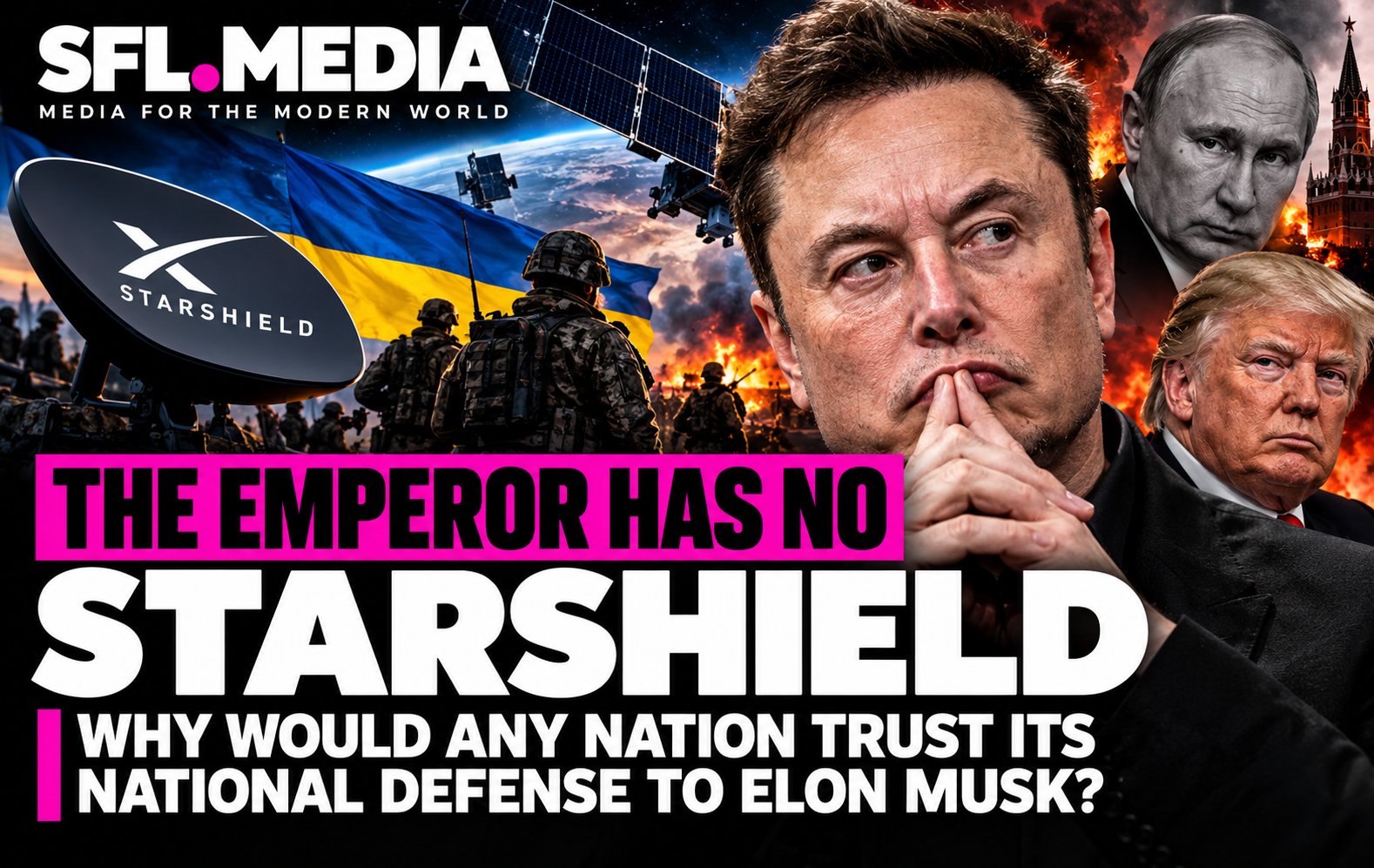
Ukraine’s Starshield Crisis Exposes the Danger of Entrusting Critical Military Communications to an Unaccountable Billionaire and a System That Can Be Restricted When a Nation Needs It Most
A military communications network is supposed to protect a country from its enemies. But what happens when the government or corporation controlling that network can suddenly restrict it during an invasion? Ukraine’s Starshield controversy exposes a fundamental weakness in the privatization of national defense: a satellite system can be technologically extraordinary and strategically unreliable at the same time.
FORT LAUDERDALE, Florida — Imagine spending millions of dollars on a military communications system designed to protect your country from an invading nuclear power. Your soldiers depend on it, your drones depend on it, and your ability to intercept incoming weapons depends on it. Then, in the middle of a war, the system’s operating limits change, and equipment that worked yesterday can no longer perform the missions for which it was deployed. Now imagine discovering that the decision may have originated thousands of miles away, inside the government of an allied country, with allegations that one of the world’s richest businessmen helped initiate it.
That is the national security problem exposed by the controversy surrounding Elon Musk’s SpaceX, its Starshield military satellite service, and the restrictions that Ukrainian officials say disrupted their ability to intercept Russian attack drones. The immediate question is who authorized the restrictions. The larger question is considerably more disturbing: What good is a military communications system if the people who control it can restrict its critical capabilities precisely when a country needs them most?
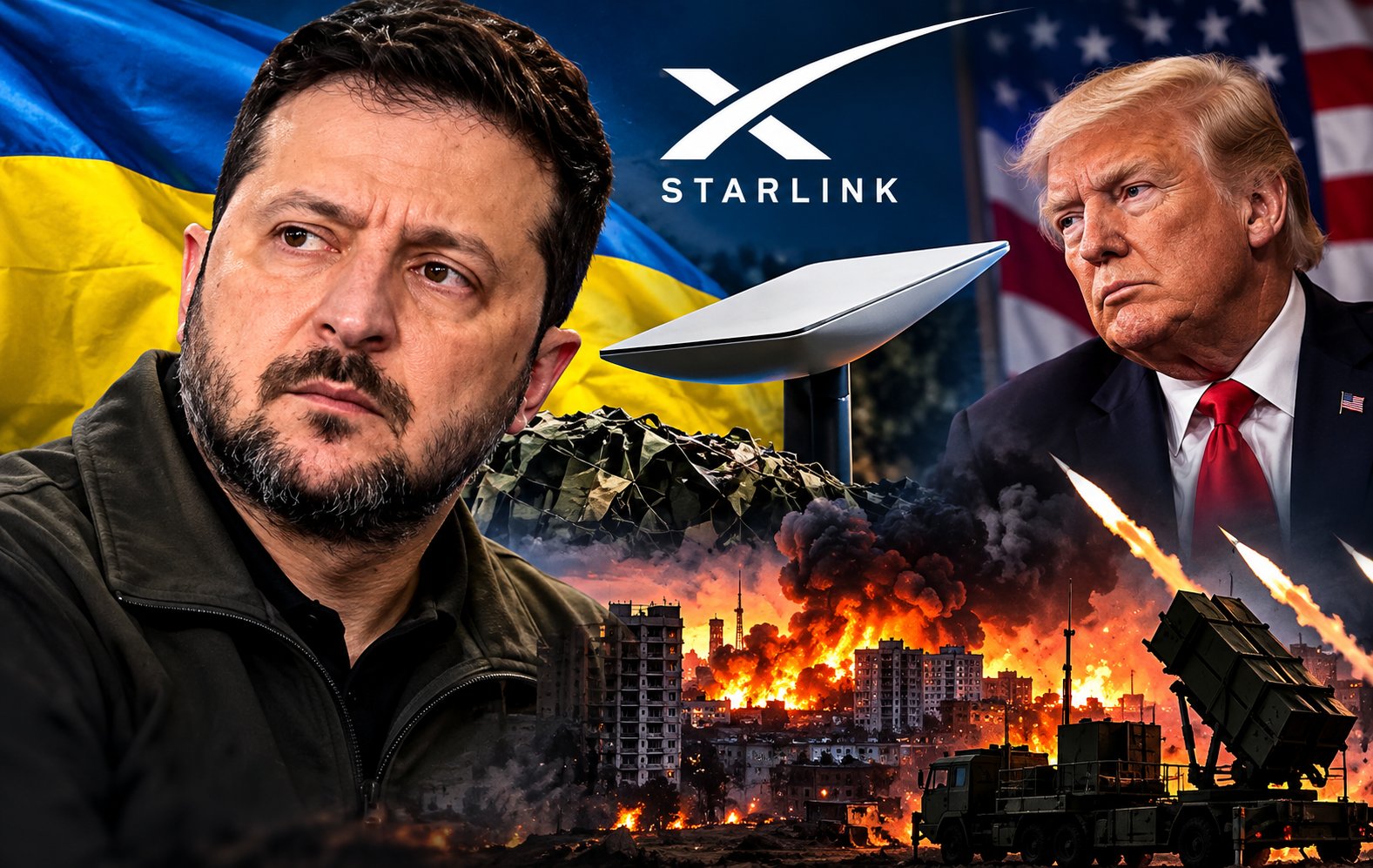
Reuters reported on October 15 that the directive to restrict Ukraine’s Starshield service originated inside the White House. The Telegraph subsequently reported that Musk had proposed the limitations to President Donald Trump, who allegedly agreed. Trump has denied responsibility, and the precise chain of authorization remains unresolved. Ukrainian President Volodymyr Zelenskyy, meanwhile, has publicly described the consequences for his country’s defensive operations.
The available reporting does not establish that Musk personally shut down Ukraine’s communications, that he acted out of personal affection for Vladimir Putin, or that the restrictions were intended to help Russia. But those unresolved questions should not obscure the institutional vulnerability already visible: a country defending itself against invasion discovered that essential capabilities supplied through a foreign controlled satellite network could be changed in ways that interfered with its military operations. That is not merely a problem for Ukraine. It is a warning to every government considering making a private satellite provider indispensable to its national defense.
The Product Worked. Then Someone Changed the Rules.
SpaceX markets Starshield as a secure satellite network developed specifically for government and national security customers. Its official description promises assured global communications, advanced encryption, and capabilities designed to support demanding government missions. Unlike ordinary consumer internet, Starshield is explicitly intended for applications in which reliable connectivity can be essential to military operations.
The Pentagon has spent billions of dollars on Starlink and Starshield services and related capabilities, according to Reuters. SpaceX also advertises procurement arrangements through American defense contracts and a NATO purchasing framework for international militaries. These are not merely consumer subscriptions or complimentary services offered by a technology billionaire. They are components of a growing military communications industry supported by government procurement, public funding, and national security requirements.
That makes the events in Ukraine especially troubling. According to the Associated Press, Ukrainian forces experienced a sudden restriction that disconnected satellite terminals when they moved faster than approximately 100 miles per hour. The limit affected drones using Starshield connectivity, including interceptor aircraft designed to pursue incoming Russian weapons. Ukrainian presidential adviser Serhii Beskrestnov said the restrictions were imposed without warning and forced some drones to operate at lower speeds, making them less effective against Russian threats.
Consider what that means in practical military terms. A defense system may possess the aircraft, operators, sensors, and weapons necessary to intercept an incoming threat, yet still be unable to complete its mission because the communications network has imposed a new operating limit. Nothing about the drone’s underlying hardware necessarily needs to fail. The vulnerability can be introduced remotely, through the service on which the equipment depends.
That is the difference between owning military hardware and controlling the infrastructure that makes it operational. A country can purchase equipment, train personnel, develop tactics, and integrate systems into its defensive strategy, only to discover that a critical capability remains subject to decisions made outside its military command. If a satellite service can become unusable for an essential defensive mission through a remote policy change, its technical sophistication offers no guarantee of operational independence.
The problem is not that every satellite provider must promise unlimited service under every imaginable circumstance. Military networks require security restrictions, spectrum management, access controls, and operational rules. The problem is that changes affecting essential wartime capabilities require clear authority, advance coordination where feasible, and safeguards against avoidable disruption. Ukraine’s experience raises questions about whether those safeguards existed, whether they were followed, and whether the government officials responsible understood the consequences of the restrictions.
The Billionaire Problem: When One Private Empire Becomes National Security Infrastructure
Elon Musk did not invent the relationship between private industry and military power. Defense contractors have supplied governments with weapons, aircraft, communications equipment, and intelligence technology for generations. American national security depends heavily on private companies, including manufacturers whose products are indispensable to military operations. But there is an important distinction between selling a government a physical weapons system and operating a network that must remain continuously available for that system to function.
A fighter jet does not ordinarily require its manufacturer to approve every mission. A tank does not normally depend on a civilian executive maintaining a live commercial connection before its crew can move across a battlefield. Modern connected weapons and software dependent systems complicate those comparisons, but the underlying issue remains: the more operational control a contractor retains, the more consequential its decisions become.
SpaceX occupies an unusually influential position because it combines satellite manufacturing, launch capabilities, global communications infrastructure, and extensive government contracts within one corporate enterprise. Musk’s public prominence and involvement in political controversies add another layer of concern, but the concentration of technological and contractual power would be significant regardless of who occupied the chief executive’s office.
That distinction matters because the central problem is institutional, not psychological. There is no need to speculate about Musk’s need for attention, his personal feelings toward Putin, or his attitude toward humanity to identify the danger. The relevant questions are whether a private executive can influence decisions affecting active military operations, whether government customers possess enforceable protections, and whether any single company has become so indispensable that governments cannot realistically replace it.
Musk has stated that Starshield systems are owned and controlled by the American government and that decisions about restrictions are made by the military or the president. If that account accurately describes the arrangement affecting Ukraine, the immediate responsibility for the restriction may lie with American government officials rather than a unilateral corporate decision. Reuters’ reporting that the directive originated inside the White House reinforces the need to investigate that possibility.
But it does not eliminate the larger concern about dependence on a single provider. Whether a restriction originates with a president, a defense official, a corporate executive, or some combination of them, the operational vulnerability remains when the affected country lacks independent control over the service. The uncomfortable conclusion is that private-sector concentration and government discretion can create overlapping risks. A system may be vulnerable both to corporate decisions and to political pressure from the state controlling the contract.
The Emperor Has No Clothes and the Satellite Has an Off Switch
There is a peculiar contradiction in the way modern technology executives are presented to the public. Their companies are frequently celebrated for extraordinary engineering achievements, while their leaders are treated as visionaries whose commercial success somehow qualifies them to make decisions across almost every field of public policy. Musk has built and led companies associated with major advances in reusable rockets, electric vehicles, and satellite internet. Those accomplishments are real. They do not, however, establish that his personal judgment should substitute for democratic oversight, military accountability, or the national security interests of governments purchasing critical services.
That is where the emperor has no clothes analogy becomes relevant. The public spectacle surrounding a powerful executive can distract from the much less glamorous question of whether the systems under his control are governed by adequate rules. A communications network can be revolutionary and still create dangerous dependencies. Its satellites can perform exceptionally well while its contractual arrangements leave customers exposed. Its encryption can be sophisticated while the political decisions governing its availability remain opaque.
Security is not simply the ability to prevent an enemy from hacking a network. It is also the ability to ensure that authorized users can continue accessing essential capabilities when they need them. For a military customer, that distinction is fundamental. A network protected against hostile cyberattacks but vulnerable to sudden restrictions imposed by an allied government may be secure against one category of threat while exposed to another.
Ukraine’s experience illustrates the difference between technical security and strategic reliability. The Starshield controversy does not demonstrate that the technology is worthless. It demonstrates that technological performance alone cannot establish whether a system is suitable for a mission on which national survival may depend. When that mission involves intercepting incoming Russian weapons, the distinction is not academic.
This Is Not the First Time Musk’s Personal Decisions Have Intersected With Ukraine’s War
The current controversy is especially significant because questions about Musk’s control over Ukrainian military communications did not begin in October 2026. In September 2023, Musk publicly acknowledged that he had refused a Ukrainian request to activate Starlink coverage near the Russian occupied Crimean port of Sevastopol during a planned operation against Russia’s Black Sea Fleet. Musk said he feared that enabling the operation could make SpaceX complicit in a major escalation of the war. His explanation followed controversy over an account in a biography that initially suggested he had ordered coverage switched off during the operation.
The distinction between refusing to activate coverage and disabling an existing service is important. The available evidence supports Musk’s acknowledgment that he declined Ukraine’s request; it does not establish that he remotely shut down an active connection during the attack. But the incident still demonstrated how consequential a private provider’s decisions could become when its technology was integrated into military planning.
Three years later, the latest Starshield restrictions have revived that concern under different circumstances. This time, the reported decision originated within the American government, while The Telegraph alleges that Musk proposed it. According to the newspaper’s October 16 investigation, four sources familiar with the discussions described Musk approaching Trump with the proposal, and one said the president agreed. Trump has denied responsibility.
These episodes do not prove a consistent personal motive. They do, however, demonstrate why military planners should distinguish a company’s technical capabilities from the political and operational conditions under which those capabilities will remain available. Musk may believe that certain Ukrainian military operations create unacceptable escalation risks, while American officials may have their own reasons for restricting particular uses of U.S.-controlled technology. Those positions can be debated on their merits, but decisions affecting a country’s military capabilities should not be obscured by uncertainty about who made them or whether they were consistent with existing agreements.
If the United States intends to restrict how military satellite systems can be used, it should establish those limitations through accountable government policy. If SpaceX is exercising independent discretion, customers and oversight authorities need to know the boundaries of that discretion. What cannot be treated as an acceptable long-term arrangement is a system in which essential capabilities can disappear while the parties involved publicly dispute responsibility.
What Happens When the Customer Is NATO?
The implications extend beyond Ukraine because SpaceX actively markets Starshield to government customers, including international militaries purchasing through NATO procurement arrangements. A European defense ministry considering Starshield must now evaluate more than coverage, bandwidth, encryption, and price. It must also examine whether the service could be restricted during a confrontation involving American diplomatic interests, whether its contract guarantees the capabilities required for particular missions, and what remedies would exist if those capabilities were unexpectedly withdrawn.
Those questions apply equally to countries in Asia, the Middle East, and elsewhere that depend on American military technology. They are especially important for nations whose security interests may not always align perfectly with the priorities of the government controlling the service.
Consider a hypothetical NATO member facing a military emergency while Washington seeks to prevent escalation with the opposing power. If that country’s defensive operations rely on satellite capabilities controlled by the United States, American officials may possess significant leverage over what its military can accomplish. That does not mean Washington would necessarily exercise such leverage. It means the possibility must be considered when evaluating operational independence.
The same concern applies to a private contractor capable of influencing service decisions. Even if the government retains final authority, concentrated corporate control can make switching providers difficult, expensive, or impossible during an emergency. Military procurement is supposed to reduce strategic vulnerability, not replace one form of dependence with another.
The question for NATO governments is therefore not simply whether Starshield works. It is whether they can guarantee continued access to the capabilities they need when their political interests diverge from those of Washington or the company providing the service.
Europe’s Answer Is Already Under Construction, but It Cannot Arrive Fast Enough
Europe has recognized the strategic dangers of relying too heavily on foreign-controlled satellite infrastructure. The European Union’s IRIS² program is intended to establish a secure, multi-orbit satellite communications system serving European government and commercial customers. In August 2026, the European Commission announced an expanded implementation agreement for a constellation of 348 satellites, moving the project toward full deployment. The initiative involves European satellite operators and defense technology companies and is intended to strengthen Europe’s control over critical communications infrastructure.
The program is not scheduled to provide its full capabilities until 2030, however, leaving European governments with difficult near-term choices about how to reduce dependence on existing providers. IRIS² also illustrates an important distinction: the answer to excessive reliance on SpaceX is not necessarily eliminating private companies from military communications. Europe’s proposed system itself involves a public-private partnership. The difference lies in the governance structure, contractual protections, and degree of control exercised by the governments depending on it.
A credible alternative must provide more than another constellation of satellites. It must offer operational resilience, transparent rules governing access, multiple layers of redundancy, and enforceable arrangements that prevent sudden interruptions from disabling essential missions. For Ukraine, waiting until 2030 is not a viable defense strategy. Kyiv needs working systems now, including additional satellite providers, terrestrial communications backups, and military equipment designed to continue operating when satellite connections become unavailable.
Ukraine’s presidential adviser Beskrestnov has already discussed alternatives, including other commercial satellite networks, while acknowledging that replacing Starshield’s capabilities would be difficult and potentially expensive. That difficulty is precisely why dependence on a single dominant provider can become dangerous. Once military doctrine, equipment, training, and procurement have been built around one network, changing providers is no longer a simple commercial decision. It can require redesigning systems, modifying software, replacing terminals, and retraining personnel while an adversary continues attacking.
The ability to change suppliers must therefore be established before a crisis, not improvised after essential capabilities are restricted.
Congress Should Demand the Contracts, the Orders, and the Names
The controversy now warrants more than competing statements from Musk, Trump, the Pentagon, and Ukrainian officials. It requires an examination of the decisions that changed Ukraine’s access to military satellite communications and the agreements governing those services. Republican Senator Thom Tillis has called for scrutiny of the restrictions, while a Washington Post opinion analysis published October 17 described growing concern over the consequences for American allies. The issue crosses traditional partisan boundaries because it concerns the reliability of American defense technology and the credibility of the United States as a security partner.
Congressional oversight should establish who first proposed the restrictions, who authorized them, what instructions were transmitted to the Pentagon, and whether SpaceX participated in developing or implementing the decision. Investigators should also determine whether Ukrainian officials were notified, what contractual provisions governed the service, and whether American military personnel assessed the potential consequences for Ukrainian air defense operations.
Those inquiries must distinguish between Starlink’s commercial service and Starshield’s government-controlled capabilities. They must also establish which government or organization paid for the affected equipment and services, who held the relevant contracts, and what performance guarantees applied. Public reporting that the Pentagon spends billions on SpaceX services does not establish that Ukraine held an unrestricted direct contract for every affected terminal or capability. That distinction is essential to evaluating whether the restrictions constituted a contractual breach, a permitted government policy decision, or an action taken outside established procedures.
The financial questions matter as well. If taxpayers fund military communications systems whose operational availability can be altered for diplomatic purposes, Congress should determine whether those limitations were disclosed when the capabilities were purchased and whether the contracts adequately protect American and allied military interests. If Musk proposed the restrictions, as The Telegraph reports, investigators should establish what role he played in the subsequent decision-making process. If he did not, the government should explain why multiple officials described a directive originating inside the White House and why the affected Ukrainian forces received no adequate explanation. The public should not have to choose between contradictory accounts from powerful officials when the underlying records could establish what happened.
A Defense Contractor Cannot Be Allowed to Become a Substitute for National Security Policy
The most important lesson from the Starshield controversy is not that Elon Musk is uniquely capable of creating problems for governments. It is that governments have allowed essential military functions to become dependent on commercial technologies without always resolving the question of who ultimately controls their availability.
There are legitimate reasons for governments to purchase military technology from private companies. Commercial innovation can produce capabilities more quickly and affordably than traditional defense procurement, and SpaceX has demonstrated the value of that model through its launch systems and satellite communications network. But the advantages of private innovation do not eliminate the responsibilities of public oversight. A company providing technology essential to military operations must operate within clearly defined contractual and governmental frameworks, and those frameworks must protect the interests of the nations relying on them.
The same principle should apply whether the contractor is SpaceX, Boeing, Lockheed Martin, or a future satellite communications company. A government should never discover during an emergency that its critical military systems are dependent on access rules it cannot enforce, political decisions it cannot anticipate, or technical restrictions it cannot overcome.
For systems used in active combat, governments should require mission-specific service guarantees, transparent procedures for imposing restrictions, independent auditing where appropriate, and contingency arrangements capable of preserving essential operations. Those safeguards cannot eliminate every risk. A government may still lawfully restrict military assistance, and national security considerations may sometimes require withholding particular capabilities. But such decisions should be made through accountable institutions rather than an opaque process in which military customers cannot determine who changed the rules or why.
The Real Scandal Is That Ukraine Had to Find Out During a War
There is something extraordinary about the fact that this debate is taking place while Ukraine is defending itself against a Russian invasion. Ukrainian engineers have developed increasingly sophisticated drones to intercept incoming weapons, soldiers have adapted commercial technologies to meet military needs, and European and American taxpayers have helped finance equipment intended to protect Ukrainian forces and civilians. Yet the effectiveness of some of those systems was suddenly reduced because the satellite communications infrastructure supporting them became subject to new restrictions.
This was not a theoretical vulnerability identified during a procurement review. It was a problem Ukrainian forces encountered during active military operations, while Russian attacks continued and the country’s electrical infrastructure remained under threat.
Zelenskyy has said the restrictions interfered with Ukraine’s ability to intercept Russian drones. Reuters has traced the directive to the White House, while The Telegraph has alleged that Musk proposed the restrictions to Trump. The president has denied responsibility. Meanwhile, Ukrainian officials have been left negotiating to restore capabilities their forces had already incorporated into their defenses.
The competing accounts still require investigation, particularly concerning who made the decision and why. But the consequences for military planning are already apparent. A nation fighting for its survival cannot afford to discover that its defensive systems depend on permissions that may change without warning, nor can governments purchasing these technologies assume that technical superiority automatically guarantees strategic reliability.
The Emperor Has No Starshield
For years, the public has been encouraged to marvel at the extraordinary capabilities of SpaceX: rockets that return to Earth, satellites providing internet across continents, and communications networks reaching places traditional infrastructure cannot serve. Those accomplishments deserve recognition, but technological achievement is not a substitute for institutional accountability. The controversy in Ukraine has exposed a weakness that no amount of engineering brilliance can resolve on its own: a military communications system is only as dependable as the rules governing who can restrict it.
If Musk personally proposed limiting Ukraine’s access, the public deserves to know why a private executive was involved in a decision with potentially serious battlefield consequences. If the White House independently ordered the restrictions, the administration must explain the military and diplomatic rationale. If the Pentagon implemented the changes without adequate coordination, its procedures and oversight require examination. And if all three played some role, the need for transparency becomes even greater.
The issue is not whether SpaceX can build an extraordinary satellite network. It plainly can. The issue is whether governments can safely make that network indispensable without obtaining enforceable control over the capabilities their armed forces require. That question should now be central to every military procurement discussion involving Starshield and to the broader debate over private companies operating critical national security infrastructure. The world does not need another demonstration that Elon Musk is wealthy, influential, or capable of building remarkable technology. It needs an answer to a far more consequential question: Who gets to decide whether a nation can use the military communications systems on which its defenses depend?
Because when Russian drones are approaching a Ukrainian city, the soldiers attempting to intercept them should not have to wonder whether their satellite connection will survive the mission. The ultimate test of a defense system is not how impressively it performs when everyone agrees to keep it running. It is whether the people depending on it can trust that it will still work when their lives are on the line. And after what happened in Ukraine, that trust can no longer be taken for granted

Sources and Previous SFL Media Reporting
SFL Media’s Ongoing Investigation
Investigations and Primary Reporting
- Reuters via Defense News — Order to Limit Starshield for Ukraine Came From Inside White House
- The Telegraph — Exclusive: Musk Approached Trump to Slow Down Starlink in Ukraine
- Reuters — Trump Denies Responsibility for Ukraine’s Loss of Starlink Access
- Associated Press — Ukrainian Adviser Describes Starshield Speed Restrictions and Negotiations
- Axios — Zelenskyy Says SpaceX Satellite Restrictions Continue to Affect Ukraine
- Reuters — Musk Acknowledges Refusing Ukraine’s 2022 Starlink Activation Request Near Crimea
- The Washington Post — Analysis of the Starshield Restrictions and Their Implications for U.S. Allies
Government, Industry, and Satellite Infrastructure


















































Want to join the conversation?
Create an account or sign in to share your thoughts, vote,
and reply to other readers.
Showing 0 of 0 comments
Don't have an account?
Already have an account?