
Pentagon’s UFO Files Reveal the U.S. Government Studied Wormholes, Warp Drives and “Stargates”
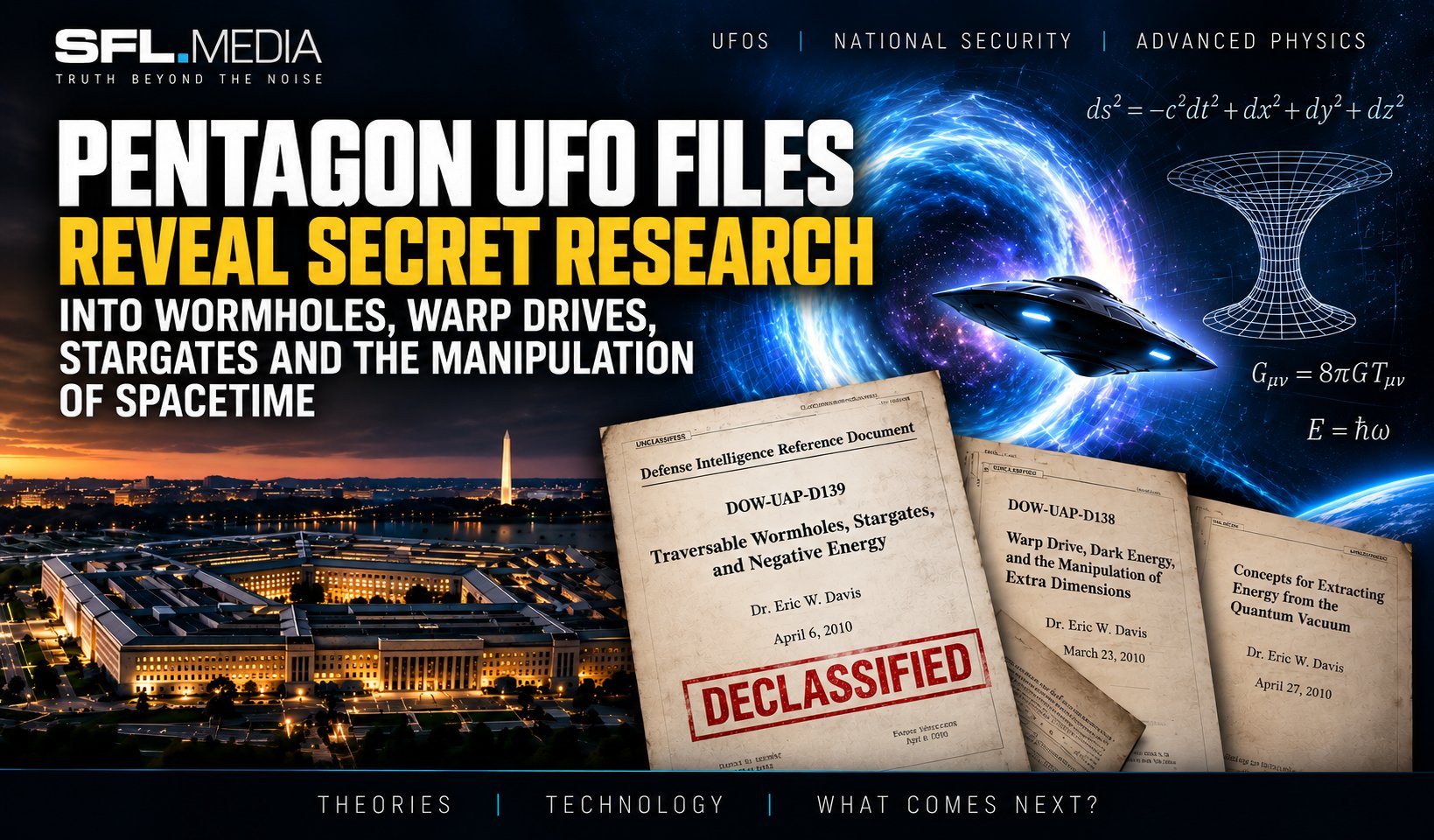
A remarkable collection of U.S. government records connected to the Pentagon’s historical investigation of advanced aerospace technologies is pulling back the curtain on something considerably stranger than flying saucers. Defense Intelligence Agency records confirm that the United States government commissioned technical studies examining traversable wormholes, warp drives, negative energy, extra dimensions, quantum vacuum energy and methods of manipulating spacetime, theoretical technologies that, if they could ever be engineered, would fundamentally alter humanity’s understanding of propulsion and transportation across enormous distances.
The documents do not mean the Pentagon built a wormhole, possesses a secret “stargate” or has military personnel traveling through portals. They establish something narrower but still extraordinary: the U.S. government spent real money asking scientists to investigate whether some of the most exotic concepts permitted by theoretical physics could conceivably become technologically useful. That distinction is essential because the documents are profound without turning them into something they are not.
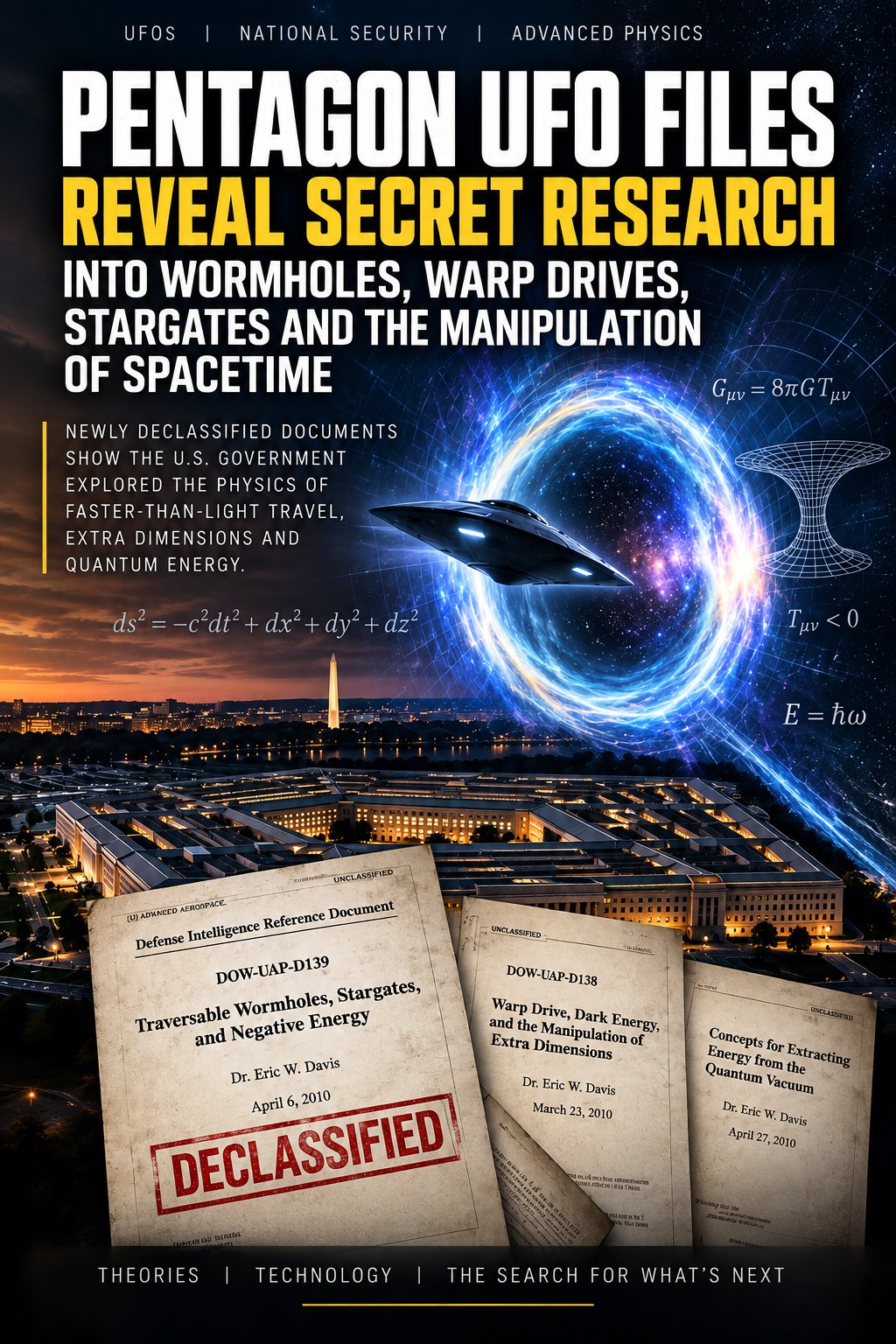
Among the records is a Defense Intelligence Reference Document titled “Traversable Wormholes, Stargates, and Negative Energy,” authored by physicist Eric W. Davis and dated April 6, 2010. Other papers examined “Warp Drive, Dark Energy, and the Manipulation of Extra Dimensions” and “Concepts for Extracting Energy From the Quantum Vacuum.” The reports were produced under the Defense Intelligence Agency’s Advanced Aerospace Weapon System Applications program, or AAWSAP, which funded a much broader portfolio of advanced aerospace and theoretical physics research.
Unlike decades of UFO mythology built around anonymous sources, unverifiable testimony and blurry photographs, these papers are authentic government records available through the DIA’s own electronic reading room. Their existence therefore raises a more interesting and defensible question than whether the Pentagon secretly owns a portal: Why was U.S. defense intelligence paying scientists to investigate whether technologies resembling warp drives and stargates were physically possible?
The Pentagon Literally Commissioned a Study About “Stargates”
One of the most extraordinary documents carries a title that sounds more like science fiction than a Defense Intelligence Agency technical report: “Traversable Wormholes, Stargates, and Negative Energy.” The April 2010 paper examines whether general relativity and quantum physics permit shortcuts through spacetime capable, at least mathematically, of transporting matter across enormous distances without conventionally traveling through all of the space between two locations.
The fundamental concept is a wormhole. Under Einstein’s general theory of relativity, matter and energy determine the geometry of spacetime, and the equations permit a wide range of unusual geometries. Some theoretical solutions can be interpreted as tunnels connecting otherwise distant regions of spacetime. Instead of a spacecraft crossing the entire conventional distance from Point A to Point B, a traversable wormhole would theoretically provide a dramatically shorter path through the underlying geometry.
The problem is not simply describing such a geometry mathematically. The problem is creating one, keeping it open and making it safe enough for matter to pass through. That problem leads directly to one of the central concepts examined in the DIA paper: negative energy.
The Entire Concept Runs Into the Negative Energy Problem
Traversable wormhole models generally require unusual stress energy conditions to prevent the wormhole throat from collapsing. The DIA paper consequently examines negative energy density and what physicists often describe, in this context, as “exotic matter.” Quantum field theory permits restricted circumstances in which local energy density can behave in ways that have no simple classical counterpart, and the Casimir effect is frequently discussed in connection with the broader physics of quantum vacuum phenomena.
The Casimir effect is real and experimentally measurable, but it does not mean scientists possess containers full of negative energy waiting to power a portal. Producing controlled quantum effects across microscopic distances is radically different from creating, accumulating and manipulating the macroscopic energy configurations envisioned in speculative traversable wormhole models. No demonstrated human technology can construct and stabilize a traversable spacetime wormhole through which a person, spacecraft or ordinary macroscopic object could travel.
The DIA paper nevertheless goes surprisingly far into the theoretical engineering problem. It discusses traversable wormhole geometries, negative energy, quantum vacuum effects and configurations designed to reduce dangerous tidal forces on objects passing through a hypothetical throat. That makes the document much more than a casual discussion of science fiction, but it still remains a theoretical study rather than evidence of an operational machine.
The Pentagon Also Studied Warp Drives
The government’s advanced aerospace research did not stop with wormholes. Another DIA sponsored paper, “Warp Drive, Dark Energy, and the Manipulation of Extra Dimensions,” examines an entirely different theoretical method of overcoming the staggering distances separating stars. Instead of accelerating a spacecraft conventionally beyond the speed of light, something ordinary massive objects cannot do under special relativity, a hypothetical warp drive would attempt to manipulate spacetime itself.
The concept draws heavily from physicist Miguel Alcubierre’s 1994 warp drive metric. In simplified terms, an Alcubierre style configuration would contract spacetime in front of a spacecraft while expanding it behind the vehicle. The spacecraft itself could remain locally inside a comparatively ordinary region of spacetime while the surrounding geometry produced effective motion across enormous distances.
There is, once again, an enormous catch. The best known versions of the concept require extraordinary energy conditions, including negative energy densities far beyond anything humanity has demonstrated it can produce or control. The DIA sponsored work explored whether additional spatial dimensions proposed in some theoretical models could alter those energy requirements, examining higher dimensional physics, dark energy and whether manipulating the geometry of additional dimensions could influence the vacuum energy conditions associated with a warp configuration.
None of this demonstrates that a warp drive exists. What it demonstrates is that U.S. defense intelligence was willing to investigate whether established and speculative areas of theoretical physics contained mechanisms that could someday make radically unconventional propulsion possible.
The Government Also Asked Whether Energy Could Be Extracted From Empty Space
Another DIA document, “Concepts for Extracting Energy From the Quantum Vacuum,” pushes the research program into equally exotic territory. The paper examines zero point fields and the quantum vacuum, the lowest energy state of quantum fields, and considers whether useful energy could theoretically be extracted from vacuum phenomena. The DIA document discusses enormous theoretical vacuum energy densities and a range of quantum effects, but those calculations should not be confused with a demonstrated source of unlimited usable energy. Quantum field theory’s treatment of vacuum energy is deeply complicated, and there is currently no established technology capable of extracting limitless practical energy from empty space.
What matters historically is the breadth of the research portfolio. The government was not examining one isolated science fiction concept. It commissioned a series of technical papers exploring multiple pieces of a hypothetical advanced aerospace architecture: unconventional energy sources, negative energy, warp metrics, extra dimensions, wormholes and other breakthrough propulsion concepts.
Why Would the Pentagon Spend Money on Something This Speculative?
This is where the story becomes less about aliens and more about how intelligence agencies confront technological uncertainty. Military research is not restricted to systems that engineers can build tomorrow. Defense organizations conduct horizon scanning precisely because unexpected technological breakthroughs can reshape global power, and governments have powerful incentives to understand potentially disruptive technologies before an adversary does.
AAWSAP operated within that broader environment. The program became associated publicly with roughly $22 million in appropriated funding and work performed through Bigelow Aerospace Advanced Space Studies, or BAASS, the organization established by aerospace entrepreneur Robert Bigelow that received the DIA contract. The resulting technical portfolio examined numerous advanced aerospace subjects, ranging from relatively conventional emerging technologies to deeply speculative theoretical physics.
The titles reveal how far investigators were willing to look, but commissioning a study does not mean the government endorsed its conclusions or believed the technology had already been developed. Intelligence agencies commission assessments precisely because they do not know whether an idea is possible, whether an adversary might be pursuing it or whether a seemingly impossible technology could become important decades later. That distinction is critical to understanding these records. They are evidence of investigation, not evidence of possession.
The Documents Help Explain Years of “Secret Portal” Stories
The records also provide important context for one of the strangest branches of modern UFO mythology: claims that classified military units already possess operational portals, jump gates or other systems capable of transporting people instantaneously across great distances. The DIA documents do not substantiate those stories. No publicly available evidence associated with these papers demonstrates that the United States built an operational wormhole, and the existence of theoretical research should not be retroactively converted into proof of every claim made by someone who says he or she encountered a classified portal program.
What the records do demonstrate is how legitimate government research can become intertwined with mythology. A contractor or servicemember who learns that a restricted aerospace program commissioned a technical paper literally titled “Traversable Wormholes, Stargates, and Negative Energy” is dealing with a real fact. As that information passes through secondhand conversations, classified environments, UFO communities, social media and alleged whistleblower accounts, however, the distinction between “the government studied a stargate” and “the government has a stargate” can disappear remarkably quickly.
AARO’s historical review of UAP claims has separately warned about circular reporting and the repeated retelling of unverified claims within interconnected government, contractor and UAP communities. That does not prove every extraordinary allegation is false, but it establishes why documentary evidence and independently verifiable data matter so much when evaluating them. A real Pentagon paper about stargates is extraordinary. It is not evidence that the technology described in the paper was successfully built.
Then the Story Gets Stranger: Physicists Observed Wormhole Like Dynamics on a Quantum Computer
The historical Pentagon research becomes even more fascinating when compared with developments in mainstream physics that occurred years later. In 2022, a team of researchers reported in Nature that it had used Google’s Sycamore quantum processor to experimentally realize a simplified quantum system displaying dynamics corresponding, through holographic duality, to a theoretical traversable wormhole. This experiment is frequently described too loosely, so the distinction deserves precision. Researchers did not create a physical tunnel through ordinary spacetime inside Google’s laboratory. Instead, they used learning techniques to construct a sparsified version of a Sachdev-Ye-Kitaev, or SYK, quantum model whose behavior has a gravitational description under the mathematical framework of holographic duality. They implemented the resulting system using a nine qubit circuit containing 164 two qubit gates on Google’s Sycamore processor.
Researchers prepared two entangled quantum systems representing the two sides of the theoretical wormhole, introduced a probe qubit into one side and used an interaction whose gravitational dual corresponds to a negative energy shockwave that makes the theoretical wormhole traversable. Information from the probe subsequently emerged on the other side through a quantum teleportation process. The experiment displayed several signatures predicted by the wormhole model, including causal time ordering, scrambling behavior, a Shapiro time delay and dynamics consistent with the negative energy interaction required for traversability.
So did a qubit travel through a wormhole?
The scientifically careful answer is both more nuanced and more interesting than a simple yes or no. In the quantum information description, information was transferred through a teleportation protocol between quantum systems. In the mathematically equivalent gravitational description used by the researchers, the process corresponds to a qubit traversing a wormhole. Caltech’s research team explicitly states that no rupture or deformation of physical 3+1-dimensional spacetime was created.
The researchers therefore did not open a portal in the laboratory, but neither was the wormhole terminology simply a publicity metaphor. The point of the experiment was precisely that the same underlying process can be described through two mathematical languages, quantum information on one side and gravitational wormhole dynamics on the other, providing an experimental platform for investigating ideas at the intersection of quantum mechanics and gravity.
Artificial Intelligence Helped Make the Wormhole Experiment Possible
The role of machine learning in the experiment is particularly significant. The full quantum models associated with holographic wormhole physics are too complicated for today’s small quantum processors, so researchers used learning techniques to identify a drastically simplified, or “sparsified,” SYK-like model that retained key gravitational properties while becoming small enough to implement on available hardware.
This is an important glimpse of how artificial intelligence and quantum computing may increasingly interact with fundamental physics. Machine learning systems can search enormous mathematical spaces, identify useful approximations and help researchers reduce models that would otherwise be too computationally demanding to implement experimentally. Quantum processors can then test the behavior of those systems in ways that may eventually become impossible to reproduce efficiently on classical computers as the models grow.
That does not mean an AI system is about to design a stargate. It means humanity is developing increasingly powerful computational tools for interrogating mathematical structures connected to quantum gravity and spacetime, precisely the kinds of questions that earlier generations could investigate primarily with equations on paper.
CERN Is Investigating Some of the Same Fundamental Physics, Not Opening Portals
CERN inevitably enters conversations about wormholes because the Large Hadron Collider investigates matter at extraordinarily high energies and searches for physics beyond the Standard Model. CERN scientists have searched for experimental signatures associated with extra dimensions, dark matter and hypothetical microscopic black holes, concepts that overlap with some of the theoretical frameworks appearing in discussions of exotic propulsion and higher dimensional physics. That overlap has fueled years of internet claims that CERN is attempting to “open portals,” but there is no evidence supporting that claim. The Large Hadron Collider accelerates particles and collides them so scientists can examine the resulting interactions. CERN’s own scientific materials explain that if hypothetical microscopic black holes associated with certain extra dimensional models could be produced at collider energies, they would decay extraordinarily rapidly, on the order of 10^-27 seconds, leaving detectable particle signatures rather than stable gateways to somewhere else.
The legitimate scientific connection is considerably more interesting than the conspiracy theory. CERN is experimentally testing whether nature contains additional structures and particles beyond the Standard Model, while theoretical physicists and quantum information researchers are exploring mathematical relationships between gravity, entanglement, information and spacetime. These are different research programs, but they touch some of the same profound questions about the underlying architecture of reality.
Could Wormholes Actually Exist?
Mathematically, wormholes occupy a legitimate place in gravitational theory. Engineering one is another matter entirely. General relativity permits an enormous variety of spacetime geometries, but the fact that equations permit a particular geometry does not establish that nature produces it or that humans can manufacture it. Traversable wormholes face extraordinary obstacles involving stability, quantum effects, causality, energy requirements and the need for unusual negative energy configurations that have never been demonstrated at anything approaching the macroscopic scale required for transportation. There is currently no experimental evidence that naturally occurring traversable wormholes exist, much less that anyone knows how to manufacture one.
That makes the scientifically responsible conclusion simultaneously less sensational and more interesting: modern physics has not established that practical traversable wormholes can be built, but the underlying mathematical questions are serious enough that physicists continue investigating them, and serious enough that U.S. defense intelligence once paid scientists to examine their potential aerospace implications.
What the Pentagon Files Actually Prove
The significance of these documents should neither be exaggerated nor dismissed. The United States government funded scientists to investigate some of the most radical technologies contemplated within modern theoretical physics. Researchers examined whether spacetime itself could be engineered, whether negative energy configurations could stabilize wormholes, whether extra dimensions could affect warp drive energy requirements and whether quantum vacuum phenomena might have useful energy or propulsion applications. Those facts are part of the public record.
The documents do not establish that the United States possesses extraterrestrial spacecraft. They do not demonstrate that UFOs travel through wormholes. They do not prove that CERN has opened portals, and they do not verify stories about secret military teams traveling through stargates. They are theoretical and technical assessments commissioned by a real defense intelligence program.
The most remarkable part of the story is that no exaggeration is necessary. The Pentagon really did commission a paper titled “Traversable Wormholes, Stargates, and Negative Energy.” It really did sponsor research into warp drives, extra dimensions and quantum-vacuum energy. The papers are sitting today in an official Defense Intelligence Agency archive. That alone deserves serious examination.
The 2026 UAP Release Gives Old Research New Relevance
One final distinction is important as these records circulate again amid the federal government’s 2026 UAP transparency push. Many of the underlying AAWSAP documents are not newly written and some were already available publicly through previous Freedom of Information Act releases. The new development is the much broader government effort to consolidate, review and release historical UAP material through the Presidential Unsealing and Reporting System for UAP Encounters, or PURSUE, alongside AARO’s continuing historical record work.
That context matters because old documents can become misleading when presented online as though the Pentagon secretly declassified them yesterday. Their provenance is more interesting: these are historical defense intelligence studies that have gradually entered the public record and can now be examined alongside a much larger government archive concerning decades of UAP investigations.
The result is an opportunity to separate three subjects that have too often been mixed together: documented government research, unresolved anomalous observations and extraordinary claims for which no public physical evidence currently exists.
The Most Important Question May Be What Happens Next
When these AAWSAP studies were produced around 2009 and 2010, artificial intelligence was primitive compared with today’s systems, useful quantum computers were embryonic and many of the computational tools now available to physicists did not exist. Barely more than a decade later, researchers used machine learning techniques and a quantum processor to reproduce experimentally a system displaying mathematical dynamics associated with a traversable wormhole. That does not mean humanity is 10, 20 or 100 years away from building a portal. There is no credible scientific basis for assigning a timetable to such technology, and it remains entirely possible that macroscopic traversable wormholes are physically impossible to engineer. What the progression does demonstrate is why governments investigate technologies that initially appear impossible. The purpose of horizon scanning research is not necessarily to predict what engineers can build today. It is to determine what the laws of physics might permit tomorrow, and what could happen if an adversary discovers how to exploit a phenomenon first.
The Pentagon’s wormhole papers therefore occupy an extraordinary territory between science fiction, legitimate theoretical physics and national security planning. They are not blueprints for a secret stargate, but they are documentary evidence that the U.S. government was willing to ask whether technologies resembling one could ever become possible. And now, as artificial intelligence, quantum computing and high energy physics give scientists increasingly sophisticated ways to interrogate the mathematics of spacetime itself, the most profound part of these documents may not be what the government knew. It may be the questions the government thought were worth asking.

Sources & Further Reading
- Defense Intelligence Agency — FOIA Electronic Reading Room — Official DIA archive containing the Advanced Aerospace Weapon System Applications Program records and Defense Intelligence Reference Documents, including studies on wormholes, warp drives and other advanced aerospace concepts. (Defense Intelligence Agency)
- DIA — “Traversable Wormholes, Stargates, and Negative Energy” — The official April 6, 2010 Defense Intelligence Reference Document examining traversable wormholes, negative energy and theoretical “stargate” configurations. (Defense Intelligence Agency)
- DIA — AAWSAP Defense Intelligence Reference Documents Archive — Government archive containing the wormhole paper alongside “Warp Drive, Dark Energy, and the Manipulation of Extra Dimensions” and other AAWSAP technical studies. (Defense Intelligence Agency)
- Nature — “Traversable Wormhole Dynamics on a Quantum Processor” — The peer-reviewed 2022 paper describing the Google Sycamore experiment. Researchers used learning techniques to create a sparsified SYK model implemented with 164 two-qubit gates on a nine-qubit circuit and observed dynamics corresponding to a traversable wormhole. (Nature)
- Caltech — “Physicists Observe Wormhole Dynamics Using a Quantum Computer” — Caltech’s explanation of the experiment, including the insertion of a probe qubit into one quantum system and the emergence of its information from the other through quantum teleportation — equivalent to passage through a traversable wormhole in the complementary gravitational description. (Caltech)
- Caltech INQNET — Wormhole Experiment Technical Explanation — Particularly useful for avoiding sensationalism: the researchers explicitly state that they did not produce or observe a wormhole deformation of ordinary 3+1-dimensional spacetime. (Inqnet)
- CERN — “Extra Dimensions, Gravitons, and Tiny Black Holes” — CERN’s official explanation of its searches for extra dimensions, gravitons and hypothetical microscopic black holes at the Large Hadron Collider. CERN says hypothetical micro black holes, if produced, would disintegrate in roughly 10⁻²⁷ seconds rather than form persistent “portals.” (CERN)
Primary DIA / AAWSAP Declassified Files
DOW-UAP-D139(Wormholes & Stargates)- The Black Vault Mirror: Traversable Wormholes, Stargates, and Negative Energy (PDF) (Unredacted FOIA archive copy)
DOW-UAP-D138(Warp Drives & Extra Dimensions)
Related Academic & Technological Papers Cited
- Simulating Wormholes via Quantum Processors (ER=EPR & Quantum AI)
- Nature Journal: Traversable wormhole dynamics on a quantum processor (Google Quantum AI / Caltech experiment using machine learning to sparsify negative-energy shockwave physics onto 9 qubits)
- AARO & DoD Program History
- All-domain Anomaly Resolution Office (AARO) Official Portal (Central repository for government UAP tranches and historical program reviews)



















































Want to join the conversation?
Create an account or sign in to share your thoughts, vote,
and reply to other readers.
Showing 0 of 0 comments
Don't have an account?
Already have an account?