
Kennedy Center Board Votes to Put Trump’s Name Back on Building, Setting Up New Clash With Federal Court
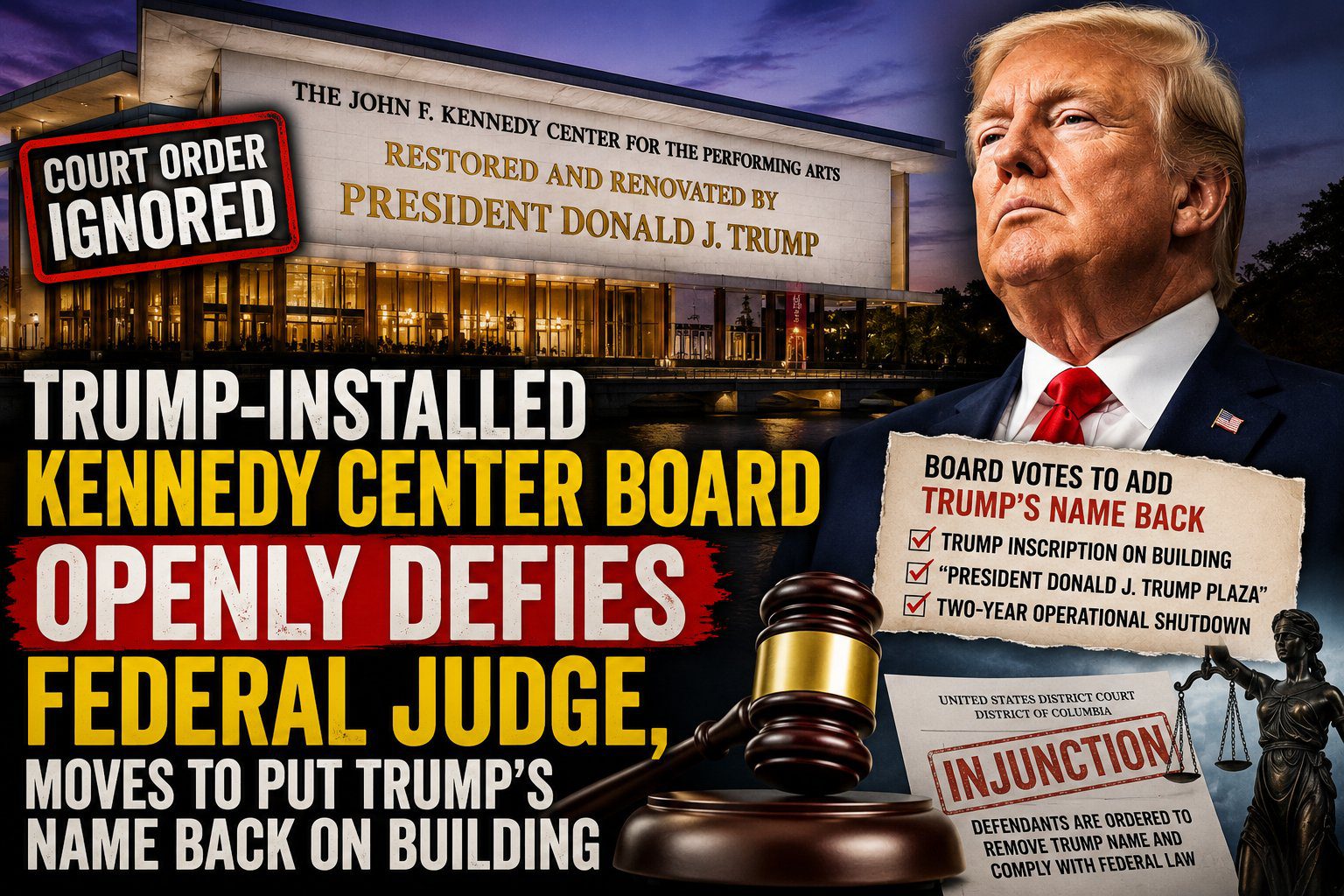
WASHINGTON — President Donald Trump and the board he helped remake at the John F. Kennedy Center for the Performing Arts are headed toward another confrontation with the federal judiciary after trustees voted Thursday to put Trump’s name back on the landmark building, create a “President Donald J. Trump Plaza” and move forward with a two year closure for renovations, less than three months after a federal judge blocked remarkably similar actions.
The August 13 vote represents the latest escalation in Trump’s transformation of the Kennedy Center from a historically bipartisan national cultural institution into an increasingly personalized project of his administration. But this time, the fight carries an additional dimension, a federal judge has already ruled against the board, ordered Trump’s name removed and enjoined the Kennedy Center from proceeding with its previous shutdown plan. (apnews.com)
Rather than simply renaming the institution again, the board approved language designed to preserve the Kennedy Center’s official name while adding a Trump inscription beneath it. According to Rep. Joyce Beatty, an Ohio Democrat and ex-officio Kennedy Center trustee who successfully challenged the previous actions in federal court, the proposed façade would read:
“The John F. Kennedy Center for the Performing Arts Restored and Renovated By President Donald J. Trump.”
The board also voted to designate the grounds surrounding the building as the “President Donald J. Trump Plaza.” The distinction between renaming the building and attaching a permanent presidential inscription to it appears likely to become the center of the next legal fight. (reuters.com)
Trump’s Board Is Testing a Court Order That Already Went Against It
The significance of Thursday’s vote cannot be understood without what happened in May. U.S. District Judge Christopher R. Cooper of the District of Columbia ruled on May 29 that the Kennedy Center board had exceeded its legal authority when it attempted to add Trump’s name to the institution and move forward with a two year closure. Cooper ordered the defendants to remove signage purporting to rename the Kennedy Center for Trump, restore its official identity as the John F. Kennedy Center for the Performing Arts, remove Trump branding from official materials and the center’s website, withdraw related trademark applications and provide sworn evidence of compliance. The judge separately blocked the center from winding down programming and closing its doors under the previously approved renovation plan. (beatty.house.gov)
The Kennedy Center subsequently began complying. Its general counsel instructed employees to remove Trump’s name from email signatures, letterhead, brochures, signs and other materials. Trump’s name was physically removed from the building by June 13, and government attorneys filed a notice informing the court that the center had complied with the signage portion of Cooper’s order. (cbsnews.com)
Trump’s attempt to pause the order while appealing also failed. Cooper denied a stay, concluding that the defendants had not demonstrated either irreparable injury or a sufficient likelihood of succeeding on appeal. Two months later, the board is trying again. (axios.com)
This Time, They Are Calling It an Inscription
The new strategy is legally more sophisticated than simply renaming the institution “Trump Kennedy Center.” The Kennedy Center would retain its congressionally established name while the building would receive a prominent inscription crediting Trump with its restoration and renovation. That distinction is almost certainly intentional. The federal statute governing the institution identifies it as the John F. Kennedy Center for the Performing Arts, a living memorial to the 35th president. Cooper’s earlier ruling found that the board lacked authority to unilaterally transform that congressionally established identity.
The board now appears to be testing whether it can accomplish much of the same symbolic result without technically changing the institution’s formal name. Reuters described Thursday’s decision as setting up a potential clash with Cooper’s previous order, while the Associated Press characterized the vote as challenging the judge’s ruling. (reuters.com) (apnews.com)
That distinction matters journalistically. The board has unquestionably voted to take actions that test the boundaries of Cooper’s injunction. Whether the new inscription constitutes a technical violation of the existing order, and whether contempt is warranted, is ultimately for Cooper, not critics or the board, to decide.
The Kennedy Center Board Is Now Packed With Trump Appointees
The institution governing this dispute looks dramatically different from the Kennedy Center board that existed before Trump returned to office. In February 2025, Trump removed numerous existing trustees and installed a slate of new members. The reconstituted board then elected Trump himself chairman and fired Kennedy Center President Deborah Rutter. Reuters described the episode at the time as a “swift takeover” of an institution historically associated with bipartisan governance. (reuters.com)
The White House subsequently published the names of Trump’s new appointees. They included Trump himself; White House Chief of Staff Susie Wiles; White House Deputy Chief of Staff Dan Scavino; second lady Usha Vance; then-White House Presidential Personnel Office Director Sergio Gor; Allison Lutnick; Pamela Gross; Mindy Levine; Lynda Lomangino; John Falconetti; Cheri Summerall; Emilia May Fanjul; Patricia Duggan; and Dana Blumberg. (presidency.ucsb.edu)
Several of those appointments have obvious connections to Trump’s political operation and administration. Susie Wiles is Trump’s White House chief of staff and previously served as one of the principal architects of his 2024 presidential campaign. Dan Scavino is one of Trump’s longest serving political aides and currently serves as White House deputy chief of staff. Usha Vance is the wife of Vice President JD Vance and serves as second lady. Sergio Gor served in Trump’s presidential personnel operation. Allison Lutnick is the wife of Commerce Secretary Howard Lutnick. Emilia Fanjul is the wife of sugar executive José “Pepe” Fanjul, a longtime Trump supporter and donor. Dana Blumberg is married to New England Patriots owner Robert Kraft, who has had a longstanding relationship with Trump.
Other presidentially appointed trustees have included Attorney General Pam Bondi, country singer Lee Greenwood and prominent Republican donors and political figures. (cbsnews.com)
The political composition is important because the board is not an independent group of cultural administrators that unexpectedly decided to honor Trump. Trump dismantled much of the previous board, appointed allies to replace ousted members and was then elected chairman by the reconstructed board. Now that board is voting to place the chairman’s name on the building.
Trump Personally Joined Thursday’s Meeting
Trump was not merely a passive beneficiary of the proposal. According to reporting on Thursday’s meeting, Trump participated by phone as trustees considered the new renovation and naming measures. Beatty objected to the process and accused the board of attempting to evade the earlier court ruling.
The proposal reportedly emerged near the end of the virtual meeting rather than appearing as a conventional advance agenda item, contributing to objections from Democratic ex-officio members. The board nevertheless approved the inscription, plaza designation and renovation strategy. (apnews.com)
The optics are extraordinary even by Washington standards: the sitting president chairs the board of a congressionally established national memorial, participates in the board meeting, and the board then votes to permanently place his name on the building and name its plaza after him.
Congress Created the Kennedy Center as a Memorial to John F. Kennedy
The fight is not simply about architecture or branding. Congress transformed the National Cultural Center into a living memorial to President John F. Kennedy following his assassination, establishing the institution’s identity through federal law. That statutory history was central to the earlier legal challenge.
Congressional opponents of Trump’s takeover have argued that the board cannot simply substitute its own naming decisions for Congress. Legislation introduced after the original Trump renaming effort explicitly declared that Congress retains authority over the institution’s name and sought to prohibit the board from undertaking future renaming efforts. (congress.gov)
The proposed legislation itself is not what invalidated the original name change, Cooper’s court order did that, but it illustrates the underlying constitutional and statutory conflict. The Kennedy Center is not Trump Tower. It is a federally established presidential memorial operating under a statute enacted by Congress.
The Two Year Shutdown Is Back Too
The Trump inscription was not the board’s only consequential decision Thursday. Trustees also approved moving forward with a roughly two-year closure of the Kennedy Center’s main building for extensive renovations. Trump has repeatedly argued that the aging facility requires major repairs. A renovation plan obtained by Axios describes extensive work involving the building’s marble exterior, grand halls, theaters and other structural and aesthetic components. The planning documents evaluated multiple approaches, including phased construction and a complete shutdown. (axios.com)
The board chose the shutdown option. But that creates another legal problem. Cooper previously enjoined the Kennedy Center from implementing its earlier closure strategy, finding serious deficiencies in the process by which the board had reached the decision. The new proposal therefore appears designed to establish a fresh administrative record and potentially argue that the board has now performed the analysis missing from its previous effort. Whether that is enough to satisfy Cooper remains unresolved.
Joyce Beatty Is Preparing to Fight Again
Beatty, who sits on the Kennedy Center board by virtue of her congressional position, has become the central legal opponent of Trump’s effort to remake the institution. Her previous lawsuit produced the May injunction requiring Trump’s name to come down and blocking the closure. Following Thursday’s vote, Democracy Defenders Action, whose attorneys represent Beatty, accused the board of flouting the previous court order and said it would return to court. (democracydefendersaction.org)
Beatty’s legal team includes attorneys Norman Eisen and Nathaniel Zelinsky. That means Thursday’s vote is unlikely to remain merely a political controversy. It is heading back into federal litigation.
What Can Judge Christopher Cooper Actually Do?
The next stage depends heavily on exactly what the Kennedy Center does. A board vote alone is not necessarily equivalent to physically violating an injunction. If the center begins installing Trump’s inscription, changes official signage, initiates a prohibited shutdown or otherwise implements actions covered by Cooper’s existing order, Beatty’s attorneys can ask the court for immediate relief.
Cooper could clarify or modify the existing injunction to explicitly address the new inscription strategy. He could issue additional preliminary injunctive relief preventing the Kennedy Center from installing the lettering while the legal dispute is resolved. If necessary and legally justified, a temporary restraining order could preserve the status quo. The court can also order Kennedy Center officials to explain how the new resolutions comply with the May judgment.
The more serious possibility is contempt. Federal courts possess inherent authority to enforce their orders. If Cooper determines that Kennedy Center officials knowingly violated a clear and unambiguous injunction, civil contempt could become available as an enforcement mechanism. Civil contempt is primarily coercive rather than punitive. A judge can impose monetary sanctions designed to compel compliance, order corrective action and potentially assess attorneys’ fees and costs associated with enforcing the injunction.
But contempt is not automatic. The judge would need to determine what his previous order actually prohibited, whether the new actions fall within that prohibition and whether the defendants failed to take reasonable steps to comply. That is particularly important here because the board appears to have deliberately reformulated its strategy from renaming the institution to installing a presidential renovation inscription. The legal question will be whether that distinction is meaningful or merely an attempt to accomplish indirectly what the court already prohibited directly.
A Federal Judge Can Enforce His Order, But He Cannot Simply Imprison the Entire Board
Some of the rhetoric surrounding the dispute has gotten ahead of the law. Cooper has substantial enforcement authority, but the process matters. He cannot simply declare everyone associated with the Kennedy Center guilty of criminal contempt because he dislikes Thursday’s vote. Civil contempt proceedings require notice and an opportunity to respond. Criminal contempt involves additional procedural protections and is considerably more serious.
The most immediate tools are therefore likely to be motions to enforce the judgment, clarification of the injunction, emergency injunctive relief, an order to show cause and potentially coercive civil sanctions if the court finds actual noncompliance. The judiciary’s power ultimately rests on enforcing specific legal orders, not adjudicating the political wisdom of Trump putting his name on a memorial to another president.
The Board’s New Strategy Could Become a Textbook Test of Judicial Authority
The Kennedy Center controversy has now moved beyond a fight over arts programming or presidential vanity. It is becoming a test of what happens when an executive-aligned governing board loses in federal court, formally complies with the judgment, then adopts a revised strategy aimed at reaching a remarkably similar destination. The administration can appeal Cooper’s rulings. It can ask the court to modify the injunction. Congress can amend the law. The Kennedy Center can present a newly developed renovation plan and argue that circumstances have changed.
Those are normal legal mechanisms. What a government-linked institution cannot safely assume is that changing the wording of a resolution automatically frees it from a federal injunction. Courts look at substance as well as labels. If the previous judgment prohibits defendants from using Kennedy Center property and official materials in ways that effectively rename the memorial for Trump, Cooper will have to decide whether “Restored and Renovated By President Donald J. Trump” is genuinely different or simply a workaround.
The Historical Problem Is Bigger Than the Lettering
There is also an unavoidable historical dimension to what Trump and his allies are doing. The Kennedy Center was created as a national memorial to a president assassinated in office. Its name is not a corporate sponsorship agreement waiting for the highest bidder or the most powerful politician currently occupying Washington.
Presidents routinely participate in the construction, restoration and renovation of federal buildings. They generally do not chair the governing boards of those institutions and then preside over efforts to engrave their own names onto the structures while still serving in office. Trump’s supporters can reasonably argue that he deserves recognition if his administration secures funding and oversees a successful restoration of the Kennedy Center.
But Congress, not a board dominated by presidential appointees, has the constitutional power to legislate the identity of federal institutions. And a federal court has already told this board that its authority has limits. That is what makes Thursday’s vote more consequential than another Washington naming controversy. The first time Trump’s name went up, a federal judge ordered it taken down. The Kennedy Center complied. Now Trump’s board wants to put it back. The next inscription may therefore be written not merely in stone, but in the increasingly consequential question of whether a president and a board populated with his political allies are willing to accept the authority of a federal court when the answer is no.
Sources
Reuters — Kennedy Center Board Votes to Inscribe Trump’s Name on Building
Associated Press — Kennedy Center Votes to Restore Trump’s Name and Close for Two Years
ABC News — Board Votes to Close for Renovations and Add Trump’s Name Again
Rep. Joyce Beatty — Federal Court Reverses Kennedy Center Renaming and Blocks Shutdown
CBS News — Trump’s Name Removed From Kennedy Center Following Court Order
Axios — Judge Rejects Attempt to Pause Removal of Trump’s Name
Axios — Kennedy Center Renovation Plans
White House — Trump’s 2025 Kennedy Center Board Appointments
Reuters — Trump Takes Control of Kennedy Center Board in 2025
Congress.gov — Kennedy Center Protection Act
Democracy Defenders Action — Beatty Legal Team Responds to August 13 Board Vote


















































Want to join the conversation?
Create an account or sign in to share your thoughts, vote,
and reply to other readers.
Showing 0 of 0 comments
Don't have an account?
Already have an account?