
The Whole Stunt Was Tongue in Cheek… and That Was the Point
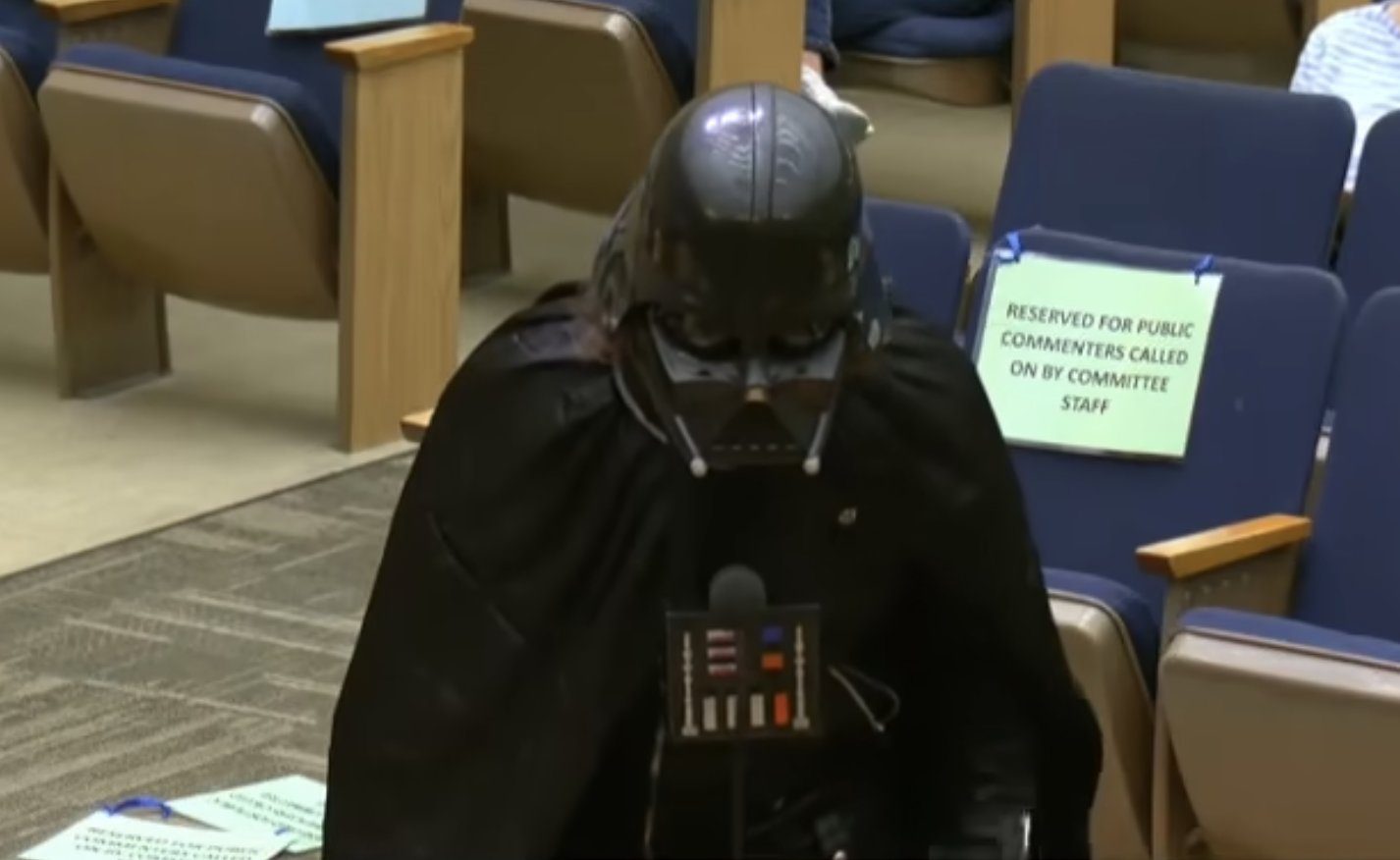
San Diego’s debate over government surveillance took a decidedly strange turn when Darth Vader himself appeared before the City Council to make the case for Flock cameras.
Well, technically it wasn’t Darth Vader. It was a man dressed in a full Darth Vader costume. But for a few minutes, the Dark Lord of the Sith had the microphone, the breathing apparatus and a message that was unmistakably aimed at the city’s controversial surveillance program.
The appearance took place August 19th during a meeting of the San Diego City Council’s Public Safety and Livable Neighborhoods Committee. When “Darth Vader” was called to the podium, the costumed speaker walked up and delivered his remarks in the familiar voice of the Star Wars villain.
“The Emperor is a fan of Flock,” Vader declared, before arguing that the city should continue using the technology to track “Rebel scum.”
The performance was deliberately absurd. It was also deliberately uncomfortable.
Flock Safety operates automated license plate reader cameras, commonly known as ALPRs, that capture information about vehicles and license plates. Law enforcement agencies can use the resulting data to help locate vehicles connected to investigations. Supporters describe the technology as a valuable tool for solving crimes and finding suspects.
Critics see something considerably darker: a system capable of turning ordinary driving into a searchable record of where people have been.
That was the point of the Darth Vader stunt.
“I Need This So I Can Stalk My Ex-Girlfriend”
Vader’s supposed enthusiasm for Flock quickly made it obvious that this was not a genuine endorsement.
During his two-minute public comment, he joked that the technology would be useful for tracking people throughout the city, including children traveling between playgrounds, pools and gyms. Then came perhaps the most deliberately disturbing line of the performance.
“I need this so I can stalk my ex-girlfriend.”
The joke works because it exposes the fundamental concern surrounding surveillance technology: the technology itself may be neutral, but giving people powerful tools to track others creates opportunities for abuse. If the idea of Darth Vader using a giant government surveillance network to hunt down Luke Skywalker sounds sinister, that is rather the point.
Vader went on to suggest that the cameras could help locate the Rebel base on Hoth and track Luke Skywalker as he traveled through the galaxy in his X-wing. In the fictional universe, that is exactly what an authoritarian surveillance state would want. And that is precisely why the costume was so effective.
The Real Battle Is Over Flock
The Darth Vader appearance came as San Diego continues debating the city’s relationship with Flock Safety.
The city has already approved continued use of the technology, despite substantial opposition from privacy advocates and members of the public. At one recent meeting, protesters carried American Civil Liberties Union signs reading “Get the Flock Out.”
The controversy isn’t simply about cameras sitting on street corners. Flock has increasingly marketed its technology as a broader law-enforcement intelligence platform. The company’s systems can allow agencies to search vehicle movements and connect information across jurisdictions.
That creates an obvious question: How much information should the government be able to collect about ordinary people who have never been accused of committing a crime? Police departments argue that the technology helps solve crimes, locate stolen vehicles and identify suspects. That’s a legitimate argument. Nobody wants police to be forced to investigate serious crimes with one hand tied behind their backs.
But the opposing argument is equally straightforward. A government capable of recording and searching where citizens drive possesses an extraordinary amount of information about innocent people.
And once that infrastructure exists, the question becomes who gets access to it, how long information is retained, what databases can be connected to it and what prevents someone from abusing the system. Those aren’t exactly minor details.
When Darth Vader Becomes the Perfect Spokesman
The brilliance of the San Diego performance was that it turned the argument in favor of surveillance upside down. Instead of saying Flock cameras are dangerous, Vader pretended they were wonderful. Instead of warning about government overreach, he celebrated it. Instead of talking about protecting citizens, he talked about tracking the “Rebel scum.”
And instead of pretending surveillance technology could never be abused, he jokingly demonstrated exactly how somebody might abuse it.
At one point, Vader even suggested that city officials should use their “Jedi mind tricks” to convince residents that the technology was necessary. The sarcasm wasn’t subtle. Neither was the message.
The performer was essentially asking council members to imagine the same technology in the hands of someone they absolutely should not trust. That is a useful thought experiment for any surveillance system.
Because government officials don’t get to choose who holds power forever. Today’s mayor may be responsible and today’s police chief may be trustworthy. Tomorrow’s officials could have very different priorities. Technology doesn’t care. Once surveillance infrastructure exists, it can potentially be used by whoever controls it.
The $2.2 Million Question
The debate also comes down to money. San Diego’s continued Flock contract has been reported at approximately $2.2 million, a particularly sensitive figure in a city facing major budget pressures.
Critics have pointed out the apparent contradiction of spending millions on surveillance technology while other public services face financial constraints. Vader made that contradiction part of his performance, sarcastically suggesting the city doesn’t need parks, libraries, daycare centers or homeless shelters.
What the city really needs, he joked, is more money for Stormtroopers It’s funny because it is ridiculous. It’s also effective because it forces people to consider what governments prioritize when budgets get tight. Public safety is obviously important. The question is whether expanding surveillance infrastructure is always the best use of limited public money.
A Joke With a Serious Message
The man underneath the Vader helmet is San Diego-based DJ and civic activist Anthony Ralphs, who has spent months attending City Council meetings and opposing the city’s use of Flock.
Ralphs told WIRED that the performance was essentially a last resort after more conventional forms of activism failed to get the response he wanted. He had attended meetings, researched council members and attempted to engage with officials directly. Eventually, he decided that if conventional political activism wasn’t getting people’s attention, perhaps a little guerrilla theater would. It worked.
The video of Darth Vader defending government surveillance quickly spread across social media and attracted millions of views. Suddenly, people who had never heard of Flock Safety were talking about automated license plate readers.
That may ultimately be the most important part of the stunt. It took a subject that normally produces incredibly boring government meetings, technical explanations and bureaucratic language and turned it into something people actually wanted to watch.
A man dressed as one of cinema’s most famous authoritarian villains stood in front of elected officials and enthusiastically demanded more surveillance. The joke practically writes itself.
The Dark Side of Surveillance
There is a legitimate argument that Flock cameras can help police catch criminals. If a stolen vehicle is captured on camera or a suspect’s vehicle can be located quickly, that can be valuable information.
But that doesn’t automatically mean every possible use of the technology should be accepted without scrutiny. The real question isn’t whether surveillance technology can catch criminals. It obviously can.
The question is what happens when the same technology becomes a permanent infrastructure for tracking millions of innocent people. That’s where Darth Vader’s appearance becomes more than an Internet joke.
The most unsettling part of the performance wasn’t that Darth Vader supported surveillance. It was that he made surveillance sound exactly like something Darth Vader would support. An authoritarian government obsessed with finding its enemies, tracking their movements and connecting information about them sounds like the plot of Star Wars.
San Diego residents are now being forced to decide how much of that technology they are comfortable bringing into the real world. And if the guy wearing the black helmet and breathing like a malfunctioning air conditioner is the one making the strongest argument for it, perhaps the City Council should at least stop and think about which side of the Force they’re actually on.














































Want to join the conversation?
Create an account or sign in to share your thoughts, vote,
and reply to other readers.
Showing 0 of 0 comments
Don't have an account?
Already have an account?