
Eleven Missing in Terrifying Pacific Ocean Disaster
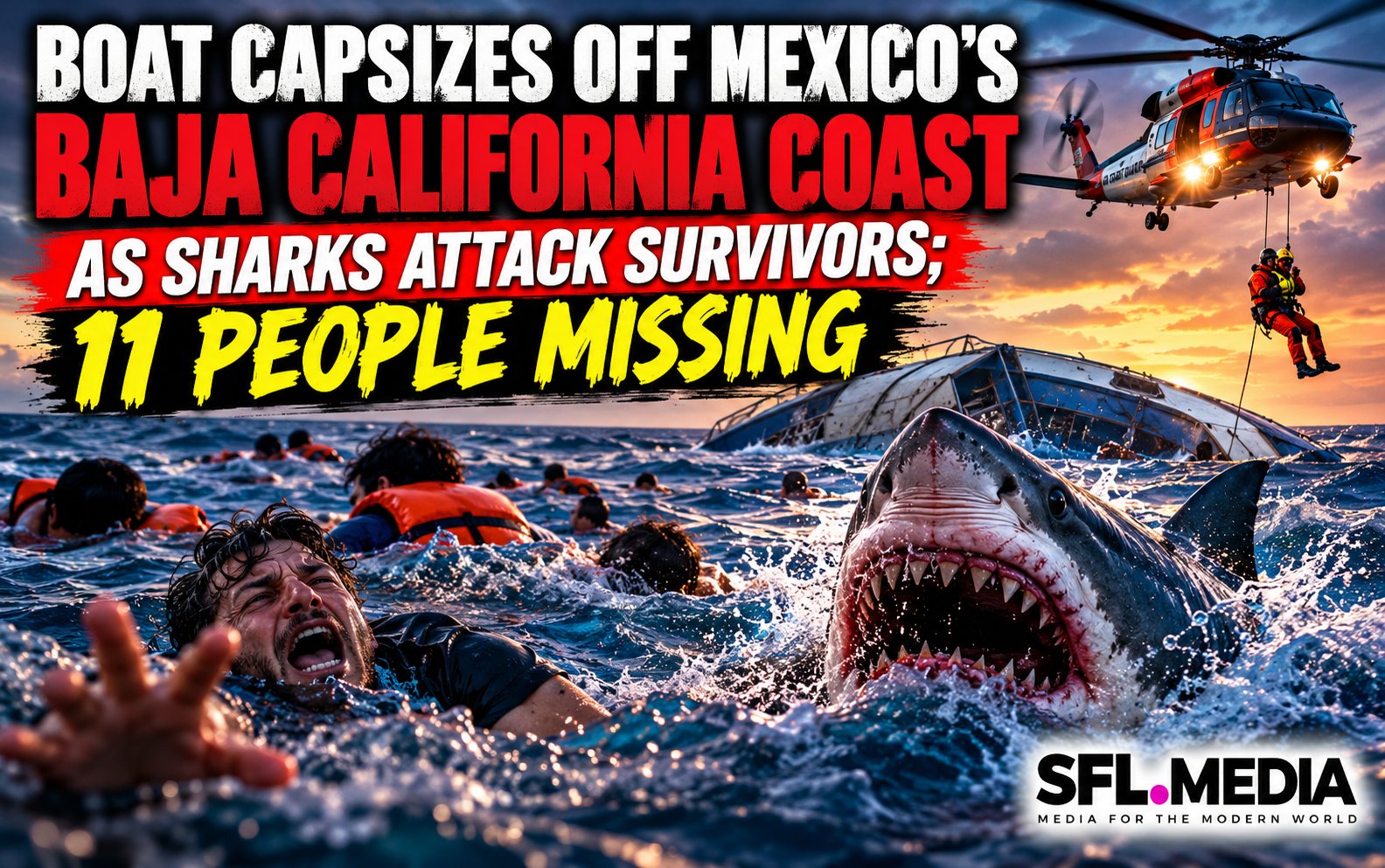
A desperate fight for survival is unfolding in the Pacific Ocean after a boat capsized off Mexico’s Baja California coast, leaving eleven people missing and several survivors suffering severe injuries consistent with shark bites. Sixteen people have been rescued so far, but the search for the missing passengers continues as the U.S. Coast Guard, U.S. Navy and Mexican Navy coordinate a major search and rescue operation. The incident occurred in the early morning hours of Friday, October 16th, 2026, approximately 140 miles west of Ensenada, Mexico. What began as a distress call from a sinking vessel quickly became a life threatening ordeal for people left floating in the open ocean, some clinging to debris and one another while rescuers raced to reach them.
A Mayday Call in the Middle of the Night
According to the U.S. Coast Guard, a Mayday distress call was transmitted at approximately 1 a.m. Friday, reporting that a boat was sinking. A rescue helicopter arrived in the area roughly two hours later. But when rescuers reached the reported location, they did not find an intact vessel. Instead, they encountered people scattered across the water, with debris providing some of the only available support for those struggling to stay afloat.
Coast Guard Lieutenant Santiago Tamburini described the desperate conditions survivors faced while waiting for help. People were holding onto each other and pieces of debris, treading water and doing whatever they could to keep their heads above the surface. A rescue swimmer joined the operation, and it took approximately 90 minutes for the rescue crew to pull all 16 survivors from the water. The survivors told authorities that as many as twenty seven people had been aboard the boat. That left eleven people unaccounted for after the initial rescue operation. Authorities have not publicly established exactly how the vessel capsized, how quickly it sank or whether everyone aboard had access to life jackets.
Survivors Suffer Suspected Shark Bite Injuries
The most disturbing aspect of the disaster is the report that several survivors suffered severe injuries consistent with shark bites. The Coast Guard confirmed that rescued individuals had injuries of this nature and said personnel provided life saving first aid while transporting them toward San Diego for medical treatment. Early reports indicated that at least one person was being treated for a suspected shark bite, while subsequent Coast Guard statements described several individuals with injuries consistent with shark bites. Two survivors were also reported to be in critical condition, although available reporting did not establish whether their condition was directly related to the suspected attacks.
Authorities have not identified the shark species involved, confirmed how many sharks may have been present or explained precisely when the bites occurred. There is also no confirmed public account establishing whether the sharks approached people immediately after the boat capsized or later, while survivors were stranded in the water.
It is important to separate what investigators have confirmed from what remains unknown. The reported injuries are real and serious, but there is not yet enough publicly available information to reconstruct the encounters or determine whether sharks were responsible for additional casualties among those still missing. For anyone stranded in the ocean, the combination of physical injuries, exhaustion, exposure and the possibility of encountering marine predators creates a terrifying situation. Even without sharks, remaining afloat for hours in open water can be deadly, particularly when people are injured or separated from flotation devices.
Survivors Were Taken to San Diego Hospitals
The rescued individuals were transported to San Diego for medical treatment and assistance from Mexican consular officials. The Mexican consulate in San Diego confirmed that the people rescued were Mexican nationals. Hospital information released in early reports indicated that three people were taken to Scripps Mercy Hospital in San Diego. That group included the person being treated for a suspected shark bite and two people receiving care for cold exposure. Three additional survivors were evaluated at Scripps Memorial Hospital La Jolla and later discharged, according to hospital representatives cited in news reports.
Two patients were reported to be in critical condition, but authorities had not clearly established whether those patients included the suspected shark bite victim. The available reporting also did not provide a complete medical accounting for all sixteen survivors. The fact that some survivors required treatment for cold exposure underscores how quickly people can become vulnerable after entering the ocean unexpectedly. Even when air and water temperatures are relatively mild, remaining in the water for an extended period while exhausted or injured can place considerable strain on the body.
A Major Search Operation Is Underway
The U.S. Coast Guard and U.S. Navy have been working alongside Mexican naval authorities to search for the eleven missing people. The operation has involved helicopters, a fixed wing aircraft, Coast Guard vessels and a Navy ship, with Mexican authorities conducting their own search efforts. The search area reportedly covered approximately 950 square nautical miles, equivalent to roughly 3,200 square kilometers. That is an enormous stretch of ocean to cover while looking for people who may be difficult to spot from the air or sea.
Authorities have not publicly confirmed that the missing individuals are dead. They remain missing, and search crews have continued working to locate them. The outcome will depend on what rescuers find and what investigators learn about the circumstances of the sinking. The Coast Guard has emphasized that it launched its resources because people were in distress, even though the incident occurred outside U.S. territorial waters. The agency’s involvement reflects the reality of maritime rescue operations: when people are in immediate danger and nearby rescue assets can help, international boundaries do not eliminate the need to respond.
What Caused the Boat to Capsize?
One of the biggest unanswered questions is why the vessel went down in the first place. The Coast Guard has not publicly established whether the boat suffered mechanical failure, took on water, encountered difficult seas, became unstable because of its passenger load or experienced some other problem. The type of vessel involved also had not been definitively identified in early reports.
Weather information offered some context. National Weather Service meteorologist Jonathan Suk told the Associated Press that winds from the north and northwest were around 10 knots, or approximately 18.5 kilometers per hour, near the time of the distress call. Waves at the closest reporting buoy were approximately five feet high, while the water temperature was about 68 degrees Fahrenheit. Those conditions do not, by themselves, establish what caused the accident. The actual conditions at the precise location of the boat may have differed, and the vessel’s design, condition, loading and handling would all be relevant to an investigation. The Coast Guard also reported that some, but not all, of the rescued individuals were wearing life jackets. Whether the missing passengers had flotation devices remains unclear.
Was the Boat Carrying Migrants Toward the United States?
Investigators are also trying to determine the purpose of the voyage. The vessel went down in an area used by fishing and recreational boats, but the region is also known as a route for maritime smuggling operations transporting migrants toward the United States. Small boats known as pangas have been used for long and dangerous journeys along the Pacific coast, sometimes departing at night. The Coast Guard noted that the vessel was traveling along a route normally associated with illegal maritime smuggling. However, officials have not publicly confirmed that the boat involved in this incident was carrying migrants as part of a smuggling operation. Its precise origin, destination and intended purpose were not immediately known.
Customs and Border Protection has been interviewing survivors as authorities work to establish what happened. Those interviews may help investigators determine who organized the voyage, why the passengers were aboard and whether anyone was operating the vessel unlawfully. The fact that the rescued individuals were Mexican nationals does not, on its own, establish their immigration status or the purpose of their trip. Until authorities release additional findings, claims about the passengers’ intentions should be treated as unconfirmed.
Not the First Deadly Boat Accident in the Region
The disaster follows other fatal maritime incidents involving boats traveling between Mexico and Southern California. In May 2025, at least three people died after a boat capsized off the Southern California coast, approximately 35 miles north of the U.S. / Mexico border. In 2023, eight people died when one of two boats approaching the San Diego coast capsized in heavy fog and surf. These incidents demonstrate the risks associated with small boats operating far from shore or attempting to navigate coastal waters under difficult conditions. A mechanical failure, sudden loss of stability or unexpected change in sea conditions can leave passengers in the water with little time to react.
The current disaster is especially alarming because the boat went down far offshore, where survivors could not simply swim to land. For those left floating in the Pacific, rescue depended on someone receiving the distress call, locating their position and reaching them before they succumbed to their injuries or exhaustion.
Sources for the Story:














































Want to join the conversation?
Create an account or sign in to share your thoughts, vote,
and reply to other readers.
Showing 0 of 0 comments
Don't have an account?
Already have an account?