

Magnitude 5.0 Earthquake Rocks Southern California, Shattering Glass at LAX and Triggering Aftershocks
An offshore earthquake near Manhattan Beach rattled the greater Los Angeles area Saturday morning, prompting emergency inspections, damage at Los Angeles International Airport and renewed warnings about Southern California’s vulnerability to more powerful seismic events.
LOS ANGELES — A magnitude 5.0 earthquake struck off the coast of Southern California on Saturday, November 28, 2026, sending tremors across the Los Angeles metropolitan area, alarming residents and travelers, and prompting emergency response teams to inspect critical infrastructure throughout the region. The earthquake was the strongest to strike the Los Angeles County Orange County metropolitan area in 12 years, interrupting the busy Thanksgiving holiday weekend and triggering dozens of aftershocks.
According to the United States Geological Survey (USGS), the earthquake occurred at approximately 9:30 a.m. Pacific Time near Manhattan Beach, just miles from Los Angeles International Airport and several densely populated South Bay communities. Residents reported buildings trembling, objects falling from shelves and earthquake warnings appearing on their mobile devices as seismic waves moved through the region.
Although localized damage was reported, authorities initially found no significant structural damage or serious injuries. Officials also indicated that the earthquake did not generate a tsunami threat along the Southern California coastline.
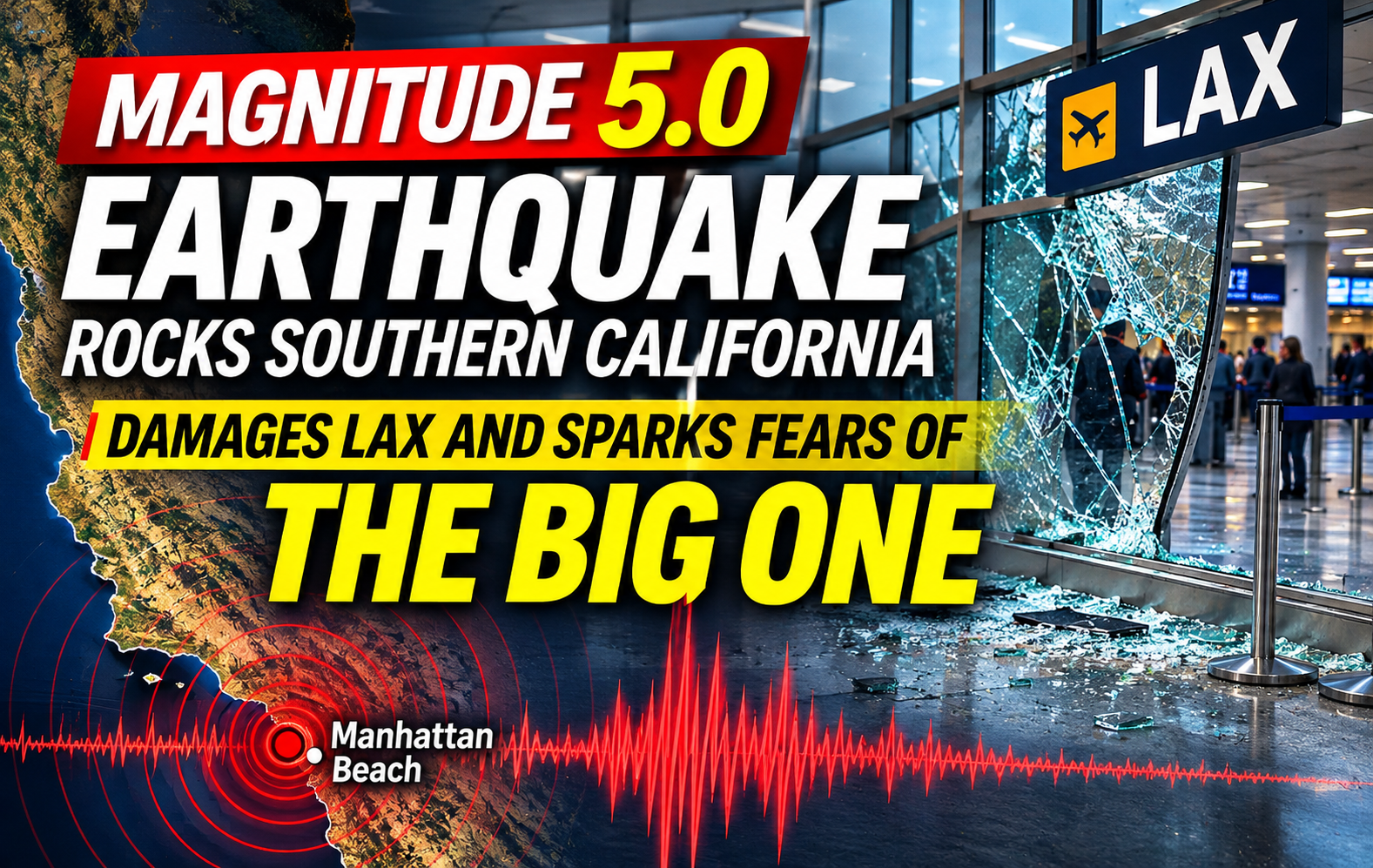
USGS Confirms Magnitude 5.0 Earthquake Near Manhattan Beach
The USGS confirmed that the earthquake occurred approximately 3.7 miles west-southwest of Manhattan Beach at a depth of 7.6 miles beneath the Earth’s surface. Preliminary magnitude estimates fluctuated between 4.7 and 5.2 before scientists settled on a reviewed magnitude of 5.0. Such revisions are common in the immediate aftermath of an earthquake as scientists collect additional seismic data and refine their calculations.
The offshore epicenter placed the earthquake close to Manhattan Beach, Hermosa Beach, Redondo Beach, El Segundo and other coastal communities. Its proximity to densely populated areas allowed the shaking to be felt well beyond the immediate South Bay region, with reports extending across metropolitan Los Angeles and into Pasadena.
Speaking during Fox News’ earthquake coverage, Boston College seismologist Dr. John Ebel explained that earthquakes of this magnitude occur periodically throughout greater Los Angeles and approach the threshold at which localized property damage can occur. Caltech research associate and prominent seismologist Lucy Jones also emphasized the significance of Saturday’s earthquake in an interview with the Los Angeles Times.
“It is one of the larger ones we’ve had in the Los Angeles area in quite a while.” — Dr. Lucy Jones, seismologist and Caltech research associate
The previous earthquake of comparable magnitude to strike the Los Angeles County, Orange County metropolitan area was the magnitude 5.1 earthquake that hit the Brea-La Habra area in 2014.
Shattered Glass and Falling Ceiling Panels Reported at Los Angeles International Airport
Los Angeles International Airport became an immediate focus of concern following the earthquake because of its proximity to the epicenter and heavy passenger traffic during the Thanksgiving holiday weekend. Fox News reporter Natalie Chuck documented broken glass inside the airport, while separate reporting confirmed that ceiling panels fell inside Terminal 7 as the building shook.
Airport personnel restricted access to affected areas to protect passengers from broken glass and other potential hazards. The earthquake also temporarily disrupted incoming aircraft, with Delta Air Lines confirming that two of its flights were instructed to discontinue their initial landing approaches during the seismic activity. Both aircraft subsequently landed safely.
The incident prompted concerns about runway conditions and other critical airport infrastructure. Following significant seismic activity, inspections are essential to identifying potential damage to runways, terminals, electrical systems and other equipment necessary for safe aviation operations.
Despite the reported damage, LAX continued operating, and there were no immediate indications of widespread destruction or a major aviation emergency. Authorities in Manhattan Beach and Hermosa Beach also closed their respective piers as a precaution while officials assessed their structural condition.
Los Angeles Fire Department Mobilizes Across 106 Neighborhood Fire Stations
The Los Angeles Fire Department activated its earthquake response procedures following the initial shaking, deploying personnel from all 106 neighborhood fire stations to inspect critical infrastructure and identify potential hazards throughout the city. Emergency personnel conducted assessments across the department’s approximately 470 square mile jurisdiction before returning to normal operations after finding no significant damage or injuries.
The relatively limited impact underscores the importance of California’s earthquake preparedness measures, including modern construction standards, emergency response protocols and seismic monitoring systems. However, the absence of widespread destruction following a magnitude 5.0 earthquake should not be interpreted as evidence that Southern California is adequately protected against every potential seismic event. Earthquakes of greater magnitude can produce substantially more destructive ground motion, particularly when they occur beneath densely populated urban areas or near vulnerable infrastructure.
Magnitude 4.5 Aftershock Strikes Southern California as Seismic Activity Continues
The initial earthquake was followed by dozens of smaller seismic events, including a significant magnitude 4.5 aftershock recorded at approximately 11:41 a.m. Pacific Time. The second substantial tremor occurred in the same general offshore region, with shaking reported in Hermosa Beach, Redondo Beach, Torrance and other surrounding communities.
By midday, seismologists had recorded approximately 40 aftershocks. Additional tremors measuring between magnitude 2.5 and 3.7 were also reported following the initial earthquake. Scientists expect additional seismic activity as the surrounding rock adjusts to changes in stress generated by the mainshock, a process that can continue for days, weeks or longer. The USGS issued an initial forecast outlining the probability of additional earthquakes during the following week:
| Aftershock Magnitude | Initial Probability |
|---|---|
| Magnitude 3.0 or greater | 82% |
| Magnitude 4.0 or greater | 31% |
| Magnitude 5.0 or greater | 5% |
| Magnitude 6.0 or greater | Less than 1% |
| Magnitude 7.0 or greater | Less than 1% |
These preliminary probabilities are subject to revision as scientists collect additional seismic data. Although the likelihood of a substantially larger earthquake remains low, seismologists cannot completely rule out the possibility that Saturday’s earthquake could precede a more powerful seismic event. The occurrence of multiple aftershocks does not necessarily indicate that a catastrophic earthquake is imminent. Aftershock sequences are a normal geological phenomenon following earthquakes of this size, although their frequency and intensity can vary considerably.
Smoke Rises From Chevron Refinery in El Segundo Following Earthquake
Adding to concerns Saturday morning, a plume of smoke was observed rising from Chevron’s refinery in El Segundo following the earthquake. Emergency personnel responded to the facility after local authorities reported that emergency flaring operations were underway.
Chevron said the earthquake activated automated safety systems at the refinery, resulting in intermittent use of the facility’s safety flares. Emergency flaring is a controlled industrial process designed to safely burn excess combustible gases when operational disruptions occur. The company maintained that the incident did not present a safety risk to the surrounding community.
The incident nevertheless illustrates the broader industrial risks associated with earthquakes near major metropolitan areas. Southern California contains extensive networks of petroleum facilities, natural gas pipelines, electrical transmission systems, highways and other critical infrastructure that could be vulnerable during a substantially larger seismic event.
ShakeAlert Early Warning System Activated Across Los Angeles
Saturday’s earthquake activated California’s ShakeAlert earthquake early warning system, providing residents with automated notifications as seismic activity was detected. Some residents reportedly received warnings before experiencing noticeable shaking, while others received notifications during or shortly after the tremors began. The system was also activated during subsequent seismic activity.
Developed through a partnership involving the USGS and research institutions, ShakeAlert operates by detecting the first seismic waves generated by an earthquake and rapidly transmitting warnings to areas where stronger shaking may subsequently occur. The system does not predict earthquakes before they happen. Instead, it identifies earthquakes immediately after they begin, potentially giving people valuable seconds to protect themselves before more destructive seismic waves arrive.
Residents located particularly close to an earthquake’s epicenter may receive little or no advance warning because seismic waves can reach their location before electronic alerts are processed and delivered. Nevertheless, even a few seconds of warning can allow individuals to take cover, transportation operators to initiate emergency procedures and industrial facilities to activate automated safety systems.
Could California Fall Into the Pacific Ocean During a Major Earthquake?
Significant California earthquakes frequently generate renewed speculation about one of America’s most enduring geological myths: that a sufficiently powerful earthquake could cause California to break away from the continental United States and disappear into the Pacific Ocean. Despite decades of disaster movies, sensational headlines and popular speculation, the scenario has no credible geological foundation.
The San Andreas Fault, one of the world’s most recognizable geological fault systems, represents a transform boundary between the Pacific Plate and the North American Plate. Along this boundary, the plates predominantly move horizontally past one another, gradually reshaping California’s geography over millions of years.
Rather than causing California to fall into the ocean, this movement is slowly carrying portions of Southern California northwestward relative to the North American Plate. Over tens of millions of years, Los Angeles and San Francisco are expected to move closer together as the tectonic plates continue shifting.
California does face legitimate geological hazards, including localized subsidence, landslides, liquefaction, coastal displacement and tsunami risks under certain circumstances. However, those hazards are fundamentally different from the fictional scenario in which the entire state collapses into the Pacific Ocean. The specific fault responsible for Saturday’s offshore earthquake has not been conclusively identified, and the event should not automatically be attributed to the San Andreas Fault.
California’s Real Threat Is the Next Major Earthquake
Although Saturday’s magnitude 5.0 earthquake caused relatively limited damage, Southern California remains vulnerable to earthquakes capable of producing catastrophic consequences across densely populated metropolitan areas. The region’s complex network of active geological faults includes the San Andreas, Newport-Inglewood, Puente Hills and numerous other fault systems, several of which are capable of producing significantly more powerful earthquakes.
The earthquake magnitude scale is logarithmic, meaning that relatively small numerical increases represent enormous differences in seismic energy. A magnitude 7.0 earthquake releases approximately 1,000 times more energy than a magnitude 5.0 earthquake, while a magnitude 8.0 earthquake releases approximately 32,000 times more energy.
Southern California’s experience with the devastating 1994 Northridge earthquake demonstrates the potential consequences of a powerful seismic event striking a major metropolitan area. The magnitude 6.7 earthquake killed dozens of people, injured thousands and caused billions of dollars in economic damage, including collapsed freeway structures, damaged apartment buildings and widespread infrastructure failures.
While California has strengthened its building codes and emergency preparedness systems considerably since that disaster, older buildings, vulnerable transportation networks and aging utility infrastructure remain significant concerns. A much larger earthquake striking metropolitan Los Angeles could simultaneously disrupt transportation, communications, utilities, healthcare facilities and emergency response operations, creating challenges far beyond the immediate structural damage.
Scientists Cannot Predict When the Big One Will Strike
Despite substantial advances in seismic monitoring, geological research and earthquake early warning technology, scientists remain unable to predict the precise date, location or magnitude of a future major earthquake. Researchers can identify active faults, estimate long term earthquake probabilities and analyze historical patterns of seismic activity, but no scientifically validated method exists for consistently predicting exactly when a major earthquake will occur.
Saturday’s earthquake is therefore not proof that California’s long-anticipated Big One is imminent. Nor does the release of energy associated with a magnitude 5.0 earthquake meaningfully eliminate the broader threat posed by the region’s major fault systems. The amount of energy released by smaller earthquakes is substantially less than that associated with the major seismic events capable of causing widespread destruction.
Earthquake preparedness remains considerably more valuable than speculation about catastrophic predictions. For Southern California residents, the question is not whether the region will experience additional powerful earthquakes, but when they will occur and how effectively communities will respond.
Emergency Officials Urge Residents to Prepare for Additional Shaking
Emergency management officials continue to encourage Southern California residents to prepare for aftershocks, inspect their homes for potential damage and remain alert to official safety notifications. The USGS reiterated its standard earthquake safety guidance following Saturday’s seismic activity.
“If you feel shaking, Drop, Cover, and Hold On.”
— United States Geological Survey
Residents should protect their heads and necks, seek shelter beneath sturdy furniture when possible and remain away from windows or objects that could fall during shaking. Individuals indoors should generally remain inside until the shaking stops rather than attempting to run outside during an earthquake. Authorities also recommend securing heavy furniture, maintaining emergency supplies of food and water, keeping essential medications accessible and developing household emergency communication plans.
For Americans living in other disaster prone regions, including South Florida, where hurricanes and flooding represent more immediate environmental threats, Saturday’s earthquake reinforces a universal lesson about emergency preparedness. Natural disasters can disrupt transportation, utilities, businesses and essential services with little warning, making advance preparation critical to public safety and economic resilience.
Southern California Avoids Major Disaster, but the Seismic Threat Remains
Saturday’s earthquake appears to have spared Southern California from widespread destruction, despite broken windows at LAX, falling ceiling panels, precautionary pier closures, industrial safety responses and repeated tremors throughout the region. Emergency inspections found no immediate evidence of significant structural damage or serious injuries, although authorities continue to monitor seismic activity and assess potential impacts.
The incident nevertheless serves as a reminder of the extraordinary geological forces operating beneath one of America’s most densely populated metropolitan regions. California’s earthquake risk is a permanent feature of its geography, and modern engineering, scientific monitoring, infrastructure investment and public preparedness remain the most effective defenses against future disasters.
California is not going to fall into the Pacific Ocean. However, the possibility of a genuinely devastating earthquake striking Southern California remains a scientifically established reality. The real danger is not a Hollywood style geological apocalypse. It is a major earthquake striking millions of people, aging infrastructure and communities that may not be adequately prepared for the consequences.

Sources & Further Reading
-
Fox News – BREAKING: 5.0 Magnitude Earthquake Rocks California
-
Los Angeles Times – Magnitude 5 Earthquake Rattles Southern California, Followed by 4.5 Aftershock
-
Associated Press – Magnitude 5 Earthquake Hits California, No Immediate Reports of Injuries
-
ABC7 Los Angeles – Video Shows Broken Windows at LAX Following Earthquake
-
ABC7 Los Angeles – Live Earthquake Coverage and Aftershock Updates
-
The Spokesman-Review – Southern California Earthquake, Refinery Response and Airport Disruptions
-
Los Angeles Fire Department – Official Emergency Incident Reports
-
United States Geological Survey – Earthquake Hazards Program
-
South Florida Media – National News and Breaking News Coverage

















Loading comments…