
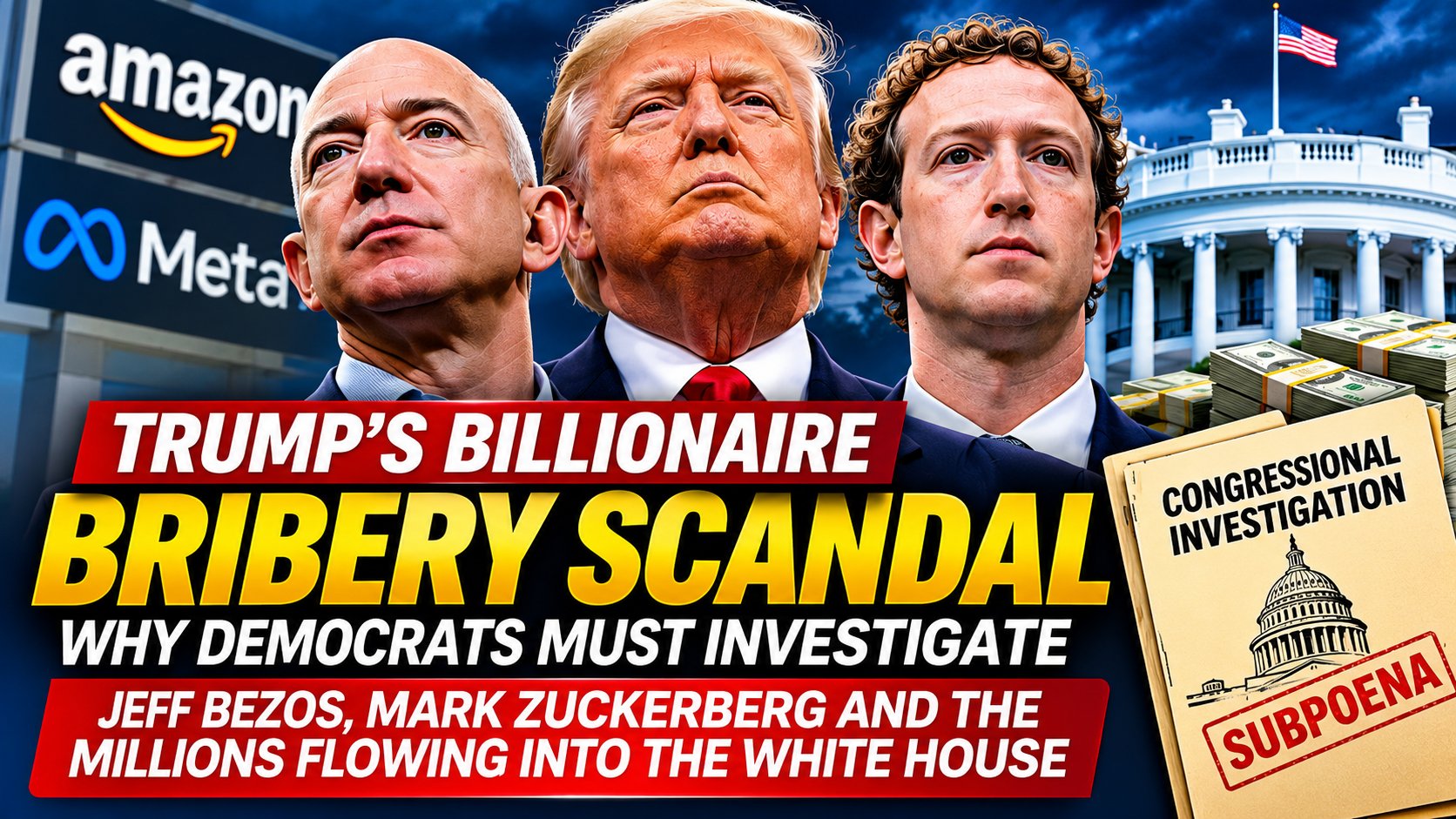
Trump’s Billionaire Influence Machine: Bezos, Zuckerberg and the Millions Flowing Into the President’s Orbit as Democrats Prepare Corruption Investigations
Amazon’s $40 million Melania Trump documentary deal, Meta’s $25 million settlement with the president, hundreds of millions in White House donations, and regulatory decisions affecting major corporate donors are raising fundamental questions about bribery, political coercion, and whether America’s wealthiest executives are purchasing influence or paying to avoid presidential retaliation.
WASHINGTON — In Donald Trump’s second presidency, the relationship between corporate America and the White House has evolved into something far more complicated than traditional campaign fundraising. Some of the world’s wealthiest executives have directed extraordinary sums toward presidential projects, legal settlements, entertainment ventures, and political committees while their companies face federal investigations, antitrust lawsuits, regulatory decisions, and government contracting opportunities worth billions of dollars.
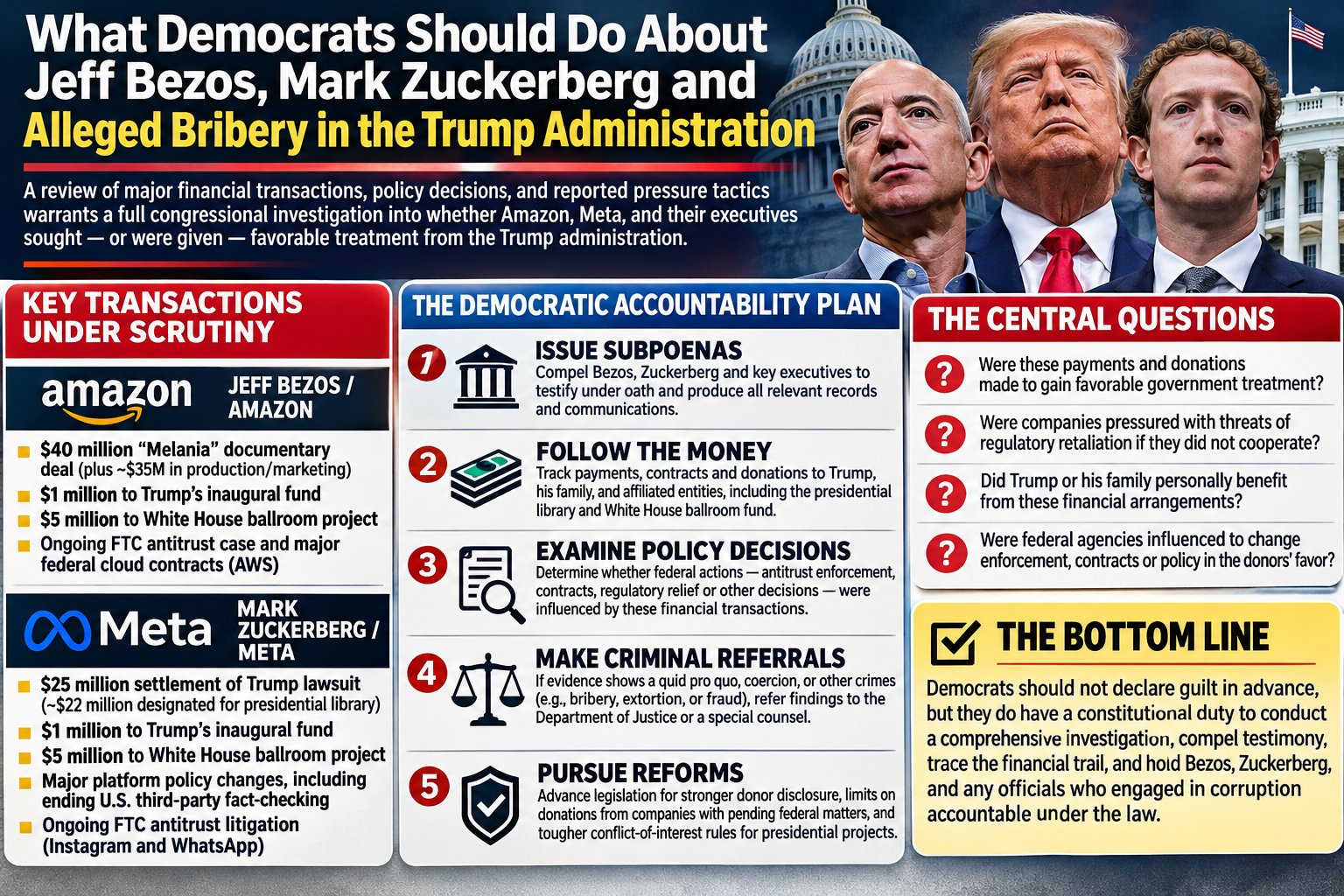
Amazon founder Jeff Bezos and Meta chief executive Mark Zuckerberg are among the most prominent examples. Amazon MGM Studios agreed to pay approximately $40 million for rights to a documentary about First Lady Melania Trump and a companion series, while Amazon separately committed $1 million to Trump’s inauguration and $5 million toward his White House ballroom project. Meta contributed $1 million to the inauguration, committed $5 million to the ballroom, and agreed to a roughly $25 million settlement of Trump’s lawsuit over his suspension from Facebook and Instagram following the January 6, 2021, Capitol attack.
The transactions are not interchangeable. Some are commercial licensing agreements, others are political or charitable contributions, and Meta’s settlement resolved litigation brought by Trump. None independently establishes criminal bribery. Nevertheless, their combined scale, timing, and proximity to federal decisions affecting the companies create substantial grounds for congressional investigation.
The larger financial picture is even more extraordinary. An October 2026 investigation by The Washington Post uncovered records identifying approximately $333 million in private commitments to Trump’s White House ballroom project, including major contributions from technology companies, defense contractors, wealthy investors, and corporations with significant interests before the federal government. Separate reporting by The Wall Street Journal described a presidential fundraising operation that had raised more than $800 million since Trump’s return to office.
For Democrats preparing to assume expanded congressional oversight responsibilities following the 2026 midterm elections, the central question is no longer whether corporate money is flowing toward the president. The financial commitments are documented. The question is whether any of that money was solicited, offered, or accepted in exchange for official government action, or under threats of retaliation against companies that refused to cooperate. The distinction matters because the same transaction can appear to be ordinary corporate spending, an attempt to purchase political influence, or a response to coercive government pressure. Determining which explanation is supported by the evidence is precisely the responsibility of congressional investigators.
Amazon’s $40 Million Melania Documentary Deal Raises Questions About Presidential Profits
One of the most consequential transactions involves Amazon MGM Studios’ acquisition of Melania, a documentary directed by Brett Ratner about the first lady’s preparations for Trump’s return to the White House. Amazon reportedly paid $40 million for licensing rights covering the documentary and a related series, then committed approximately $35 million toward marketing and distribution. The combined reported investment reached roughly $75 million, an unusually large financial commitment for a documentary project.
The film generated approximately $16.6 million in worldwide theatrical ticket sales before its release on Prime Video. That box office figure does not account for streaming viewership, subscription value, international distribution, or other potential revenue. Nevertheless, the disparity between theatrical receipts and Amazon’s reported spending raises legitimate questions about how the company calculated the project’s commercial value.
Those questions became more significant in July 2026, when Variety reported that Trump’s 2025 financial disclosure included approximately $10.71 million in licensing income associated with the documentary. The disclosure established a reported financial connection between the president and the entertainment transaction, although it did not establish that the entire $40 million acquisition payment went to Trump or his family.
Amazon executives have rejected allegations that the documentary was intended to purchase presidential influence. Bezos characterized that interpretation as incorrect, while Prime Video leadership maintained that the project emerged from a competitive bidding process and performed well on the company’s streaming platform. Those explanations deserve consideration, as does the possibility that a corporation facing major federal regulatory challenges might have additional incentives to pursue a commercially unusual project associated with the president’s family.
The documentary arrangement is particularly relevant because Amazon faces an ongoing Federal Trade Commission antitrust case concerning its online marketplace practices. Amazon Web Services also participates in federal cloud-computing programs, including major defense and intelligence procurement opportunities. Congressional investigators should examine the documentary’s acquisition agreement, competing bids, internal financial projections, payment recipients, and communications involving Amazon executives and administration officials. The purpose would not be to criminalize a documentary investment, but to determine whether its commercial terms were influenced by considerations unrelated to the entertainment business.
The financial inquiry should also distinguish money paid to producers, distributors, and other participants from income ultimately received by Trump affiliated entities. Without that accounting, treating the entire $40 million licensing fee as a direct personal payment to the president would be inaccurate.
Zuckerberg’s Meta Paid $25 Million to Settle Trump’s Lawsuit, With $22 Million Intended for His Presidential Library
Meta’s financial relationship with Trump presents a different and potentially more complicated set of questions. In January 2025, Meta agreed to pay approximately $25 million to resolve Trump’s lawsuit challenging the suspension of his Facebook and Instagram accounts after the Capitol attack. According to reporting by the Associated Press, approximately $22 million was designated for Trump’s future presidential library, with the remaining funds intended for legal expenses and other plaintiffs.
The settlement followed Zuckerberg’s efforts to rebuild relations with Trump after years of political hostility. Zuckerberg visited Trump at Mar-a-Lago following the 2024 election, and Meta separately donated $1 million to the president’s inaugural committee. The company also announced significant changes to its content moderation policies, including the termination of its U.S. third party fact-checking program. Meta described those changes as an effort to reduce censorship and moderation errors, while critics argued that the timing reflected political accommodation.
The settlement’s financial structure warrants particular scrutiny because it directed a substantial amount toward an institution associated with the president rather than simply resolving a conventional commercial dispute. That concern intensified in 2026 when Democratic lawmakers began examining what happened to the money.
In March, Senators Elizabeth Warren and Richard Blumenthal, joined by Representative Melanie Stansbury, demanded information about settlements involving Meta, ABC, X, and Paramount. The lawmakers questioned the disposition of funds originally designated for a Trump presidential library organization that had subsequently been dissolved. Meta confirmed that $22 million had been paid for the purpose of supporting Trump’s presidential library but declined to disclose certain additional details, citing confidentiality. Lawmakers subsequently sought explanations about the location and handling of the money, including the relationship between the dissolved organization and a newer presidential library foundation.
The existence of a settlement does not establish that Meta purchased favorable treatment. Companies routinely resolve litigation for reasons unrelated to the underlying merits, including expense, uncertainty, and reputational risk. But the combination of a multimillion dollar payment, presidential access, major platform policy changes, and ongoing federal antitrust litigation makes the underlying communications a legitimate subject of investigation.
The Financial Trail: Amazon and Meta’s Reported Commitments
A review of the major publicly reported transactions reveals the scale of the financial relationships.
| Transaction | Amazon | Meta |
|---|---|---|
| Trump 2025 inaugural fund | $1 million | $1 million |
| White House ballroom commitment | $5 million | $5 million |
| Melania documentary rights | $40 million | — |
| Trump lawsuit settlement | — | Approximately $25 million |
| Combined reported amounts | $46 million | $31 million |
Together, the transactions represent approximately $77 million in reported licensing spending, settlement obligations, and financial commitments involving Amazon and Meta. These are different types of transactions, not a total of personal payments to Trump. Amazon’s reported $35 million documentary marketing and distribution expenditure is excluded. Meta’s settlement includes approximately $22 million designated for the presidential library and funds for other purposes, while ballroom figures represent reported commitments rather than necessarily completed payments.
The $77 million figure is not a bribery calculation. It is a starting point for examining how two corporations with substantial federal interests have financially engaged with projects and disputes associated with the president.
The White House Ballroom: $333 Million in Corporate Money and a Troubling Lack of Transparency
The ballroom fundraising operation offers perhaps the clearest illustration of how presidential fundraising and corporate regulatory interests can become intertwined. An October 15 investigation by The Washington Post uncovered an internal spreadsheet identifying 67 donations above $10,000, totaling approximately $333 million in private commitments. The records showed that at least $77 million was associated with donors who requested anonymity and that more than three quarters of the overall fundraising came from commitments of $5 million or more.
Unlike conventional campaign contributions, the ballroom donations were routed through the Trust for the National Mall, a nonprofit organization that is not generally required to disclose its donors. The funds were then directed toward the White House construction project through arrangements involving the federal government. The newspaper reported that the fundraising documents included a provision intended to preserve donor anonymity to the extent permitted by law. It also found that companies or executives associated with firms holding federal contracts during Trump’s second term accounted for approximately half the reported commitments.
The White House defended the donations as private contributions intended to improve the presidential residence for future generations, while corporate donors described their participation as philanthropic or civic-minded. But the underlying financial structure raises an important institutional concern: Companies subject to presidential regulatory authority were being asked to support a major construction project closely associated with the president, while the public initially lacked access to complete information about the donors and their financial interests.
That arrangement does not establish corruption. It creates precisely the kind of conflict-of-interest risk that disclosure rules and independent oversight are intended to address.
Which Billionaires and Corporations Gave Money and What Was at Stake?
The donor records reveal a broad network of corporations and investors with substantial interests in federal policy.
| Corporate donor or investor | Reported ballroom commitment | Federal interests |
|---|---|---|
| Apple | $25 million | Tariffs, App Store antitrust litigation |
| Nvidia | $25 million | AI chip export controls |
| Alphabet / Google | $22 million | Search and advertising antitrust remedies |
| Microsoft | $10 million | Federal cloud contracts and AI policy |
| Lockheed Martin | $10 million | Defense procurement |
| Palantir | $10 million | Defense and intelligence contracts |
| Comcast | $7.5 million | Media regulation and communications policy |
| Amazon | $5 million | FTC antitrust case, federal cloud contracts |
| Meta | $5 million | FTC antitrust case, platform regulation |
| Jeff Yass-associated donor fund | $5 million | TikTok investment exposure |
| Coinbase | $5 million | Cryptocurrency regulation |
The table identifies areas where donors have financial interests before the government, not evidence that contributions produced favorable decisions. Several examples, however, offer specific timelines that congressional investigators could examine.
One involves Rocket, the Detroit based financial technology and housing company associated with billionaire Dan Gilbert. A Rocket subsidiary committed $10 million to the ballroom approximately three weeks after the Federal Housing Finance Agency approved its acquisition of Mr. Cooper in August 2025. The company denied that the approval and donation were connected, and the FTC stated that Rocket received no special treatment.
Another involves Salesforce, which made two separate $1 million ballroom commitments, with the Pentagon awarding the company a contract worth up to $5.6 billion between the two commitments. The Defense Department said political connections played no role in its funding decisions. ServiceNow similarly committed $5 million after the General Services Administration announced a federal purchasing arrangement involving its software. The company said the negotiations had been underway for a considerable period and were unrelated to its donation.
These examples demonstrate why timelines matter but cannot substitute for evidence. An approval followed by a donation, or a contract awarded near a fundraising commitment, does not prove an exchange. Investigators would need procurement records, agency communications, donor solicitations, and evidence of any unusual intervention.
The potential stakes are enormous. Public Citizen reported that five major ballroom donors Apple, Alphabet, Lockheed Martin, Microsoft, and Palantir collectively received approximately $241 billion in federal contracts during the preceding five years. Those contracts were not necessarily awarded during Trump’s second administration, nor does their existence establish wrongdoing. They demonstrate the scale of government business potentially affected by presidential policy and procurement decisions.
The Regulatory Map: What Changed, What Was Avoided and Who Benefited?
The strongest congressional investigation would examine specific government decisions rather than assume that every policy favorable to a donor resulted from a financial arrangement.
For Amazon, the central questions involve antitrust enforcement, federal cloud contracts, and whether administration officials attempted to influence the company’s legal exposure. The FTC’s case against Amazon was initiated before Trump’s return to office, and the continued existence of that litigation is important evidence against any simplistic claim that the company purchased immunity.
Meta’s situation requires a similar distinction. The FTC’s antitrust litigation over Instagram and WhatsApp has proceeded through the courts, where judges, not the president acting alone, determine the legal outcome. Investigators should focus on whether White House officials attempted to influence enforcement strategy, settlement discussions, or the independence of agency decision making.
For Apple and Nvidia, tariff policy and export restrictions present more direct opportunities for executive influence. Decisions concerning exemptions, semiconductor exports, and access to foreign markets can have immediate consequences for corporate revenue and investor valuations. Congress should examine whether donor companies received unusual treatment compared with competitors and whether the relevant decisions followed established national security and economic procedures.
Defense contractors present another concern. Lockheed Martin and Palantir operate in industries where federal spending and procurement decisions are central to their businesses. Their donations should be examined alongside contract awards, modifications, and procurement procedures, particularly where political appointees had opportunities to intervene.
However, favorable policy outcomes must be separated from policies that simply remained unchanged. Congress has not enacted a sweeping repeal of Section 230, for example, but that does not establish that Meta purchased protection. Repealing the statute would require legislative action, and there are numerous political, legal, and economic reasons why such legislation might fail.
Similarly, increases in Bezos’s or Zuckerberg’s personal wealth cannot automatically be attributed to Trump administration decisions. Their fortunes fluctuate with corporate share prices, artificial intelligence investment, advertising revenue, cloud-computing demand, and broader financial markets. A serious investigation should compare relevant stock movements with market benchmarks and identify specific government announcements that materially affected corporate valuations. The objective must be to establish causation, not merely demonstrate that billionaires became wealthier.
The Scaramucci Allegations: Were Corporate Executives Buying Influence or Paying to Avoid Retaliation?
Former Trump White House communications director Anthony Scaramucci has repeatedly raised concerns about the pressure Trump can exert over corporate executives whose businesses depend on federal regulatory decisions. The underlying allegation presents a different form of potential corruption. Rather than wealthy executives independently approaching government officials to purchase favorable treatment, the president or his representatives could use threats of regulatory punishment to pressure corporations into providing money, political support, or other benefits.
That distinction is legally significant. A corporation voluntarily attempting to purchase an official act presents one set of bribery questions. A public official using government power to demand financial benefits under threat of punishment presents additional questions about extortion and abuse of office.
An account attributed to Scaramucci describes Zuckerberg being kept waiting for hours during a meeting and allegedly communicating that he had brought money and would cooperate with the administration. The precise details of that story, including the alleged three-hour wait and purported text messages, have not been independently corroborated and should not be treated as established facts.
What can be established is that Trump previously directed extraordinary hostility toward Zuckerberg and Meta. In 2024, Trump publicly warned that Zuckerberg could face imprisonment over alleged election-related misconduct. After the election, Zuckerberg pursued a rapprochement with Trump, including meetings at Mar-a-Lago and financial commitments associated with the inauguration.
Those developments create a legitimate basis for investigating whether the relationship involved threats, demands, or promises that went beyond ordinary political engagement. Congress should seek firsthand testimony and relevant communications rather than rely exclusively on secondhand accounts. The essential questions are whether government officials threatened adverse regulatory action, whether corporate executives understood financial contributions to be necessary to avoid punishment, and whether any government decisions were explicitly conditioned on cooperation.
Bezos, The Washington Post and the Business of Avoiding Presidential Retaliation
Bezos’s intervention in The Washington Post’s presidential endorsement process offers another example of how corporate ownership and political power can create competing incentives. In October 2024, the newspaper declined to publish a presidential endorsement after Bezos intervened in the decision. The move generated widespread criticism and raised concerns about whether the billionaire owner was attempting to protect his business interests from potential retaliation by a future Trump administration.
Bezos defended the decision as an effort to improve public confidence in journalism, arguing that presidential endorsements contributed to perceptions of institutional bias. There is no established evidence that Trump ordered Bezos to block the endorsement or promised favorable government treatment in exchange.
Nevertheless, the episode illustrates a broader structural problem: The owner of a major national newspaper also controls substantial interests in a corporation exposed to federal regulatory enforcement and government contracting. The possibility of presidential retaliation can influence corporate behavior even when no explicit demand is made. That is one reason congressional oversight must examine not only money changing hands but also the threats, incentives, and private communications surrounding corporate decisions.
The Presidential Library Money: Democrats Have Already Begun Investigating
The investigation is no longer entirely hypothetical. In March 2026, Warren, Blumenthal, and Stansbury formally questioned major technology and media companies about settlement payments intended for Trump’s presidential library. Their inquiry focused on the dissolution of the original fundraising organization and the lack of clarity surrounding the disposition of tens of millions of dollars.
The lawmakers examined settlements involving Meta, ABC, X, and Paramount, which collectively involved substantial payments designated for presidential library purposes. The original library fund was dissolved, and a separate foundation was subsequently established. The lawmakers questioned whether money had been transferred between the organizations, where the funds were being held, and how they would ultimately be spent.
By November, scrutiny had expanded to the ballroom fundraising operation and related regulatory decisions. On November 5, Reuters reported that Blumenthal, preparing to lead the Senate Permanent Subcommittee on Investigations, demanded records from Federal Communications Commission Chairman Brendan Carr and major technology companies associated with the ballroom project.
The inquiry included concerns about federal investigations involving media companies, the approval of the Paramount Skydance merger, and regulatory decisions affecting broadcasters. Blumenthal indicated that Democrats could pursue subpoenas after assuming control of the committee in January. That development is especially significant because it moves the controversy beyond political accusations and toward the collection of documentary evidence. Investigators now have an opportunity to compare corporate donations with federal decisions, examine whether regulators faced political pressure, and determine whether companies received unusual treatment after providing financial support to presidential projects.
The Supreme Court Has Narrowed Corruption Law, but Bribery Remains Illegal
Federal law does not prohibit corporations or wealthy individuals from attempting to influence government policy through every form of political spending. But neither does it permit public officials to sell government decisions. Under 18 U.S.C. § 201, federal bribery generally involves a corrupt exchange of something of value for an official act. Prosecutors must establish the required connection between the benefit and the government action, including the defendant’s corrupt intent.
The Supreme Court’s decision in McDonnell v. United States narrowed the definition of an official act for purposes of federal bribery prosecutions. Other decisions, including Citizens United v. FEC, have protected certain forms of political spending under the First Amendment. Those precedents complicate public-corruption prosecutions, but they do not legalize corrupt exchanges. Nor does a bribery agreement necessarily have to appear in a written contract or explicit confession. Depending on the applicable statute, intent and an unlawful agreement can be established through circumstantial evidence.
The challenge is distinguishing legitimate political participation, commercial transactions, and government advocacy from arrangements in which officials corruptly exchange public authority for financial benefits. A corporate donation followed by a favorable decision is not automatically bribery. A payment accompanied by evidence that an official agreed to intervene in a regulatory proceeding, alter enforcement, or award a contract in exchange would present a substantially different legal question.
Likewise, threatening legitimate regulatory action is not inherently extortion. But using official authority corruptly to demand benefits for oneself or another party could implicate criminal statutes, depending on the facts. Any congressional investigation must respect these distinctions. Its purpose should be to determine whether misconduct occurred, not to manufacture a criminal case against executives whose political relationships are unpopular.
Why the Ethics Problem Extends Beyond Criminal Bribery
One of the greatest weaknesses in America’s political accountability system is the distance between conduct that creates an appearance of corruption and conduct that prosecutors can prove violates a criminal statute. A president may possess substantial influence over federal regulators, enforcement priorities, and government contracts while simultaneously maintaining personal financial interests and relationships with wealthy donors.
Presidents are not subject to every executive branch conflict-of-interest restriction that applies to other federal officials. In particular, the principal criminal financial conflict-of-interest statute, 18 U.S.C. § 208, does not apply to the president and vice president in the same manner it applies to most executive branch employees. That exemption does not eliminate constitutional restrictions, federal bribery laws, disclosure obligations, or congressional oversight authority. It does, however, expose a significant gap in the legal framework governing presidential conflicts of interest.
The situation becomes especially concerning when donations are directed toward presidentially associated projects through nonprofit organizations with less public disclosure than ordinary campaign committees. Even where prosecutors cannot establish bribery, Congress can investigate whether existing laws adequately protect the public from influence-buying, coerced donations, and undisclosed conflicts of interest.
Possible legislative responses include stronger donor disclosure requirements for presidential projects, restrictions on fundraising from corporations with pending federal regulatory matters, independent review of unusually large government-related donations, and additional transparency concerning presidential financial relationships. These reforms would need to be carefully designed to comply with constitutional protections for political speech and association. But the difficulty of reform is not a justification for accepting an opaque system.
The Real Question: Who Was Paying, Who Was Threatened and What Did the Government Do?
The documented financial relationships between Trump’s administration and corporate America create several competing possibilities. Some executives may have made legitimate commercial investments or philanthropic contributions without expecting anything in return. Others may have sought access or goodwill, a common practice in American politics that is not necessarily criminal. Some may have feared retaliation and concluded that supporting presidential priorities was the safest business decision.
The most serious possibility is that officials solicited or accepted financial benefits in exchange for government action, or used threats of regulatory punishment to obtain those benefits. Determining whether that occurred requires evidence unavailable from public donation records alone.
Congress should obtain the relevant financial agreements, fundraising solicitations, internal corporate communications, government decision-making records, and testimony from officials and executives with firsthand knowledge. The investigation should also establish whether the companies received measurable financial benefits from specific government decisions, rather than relying on general increases in stock prices or executive net worth. The standard must be consistent. A Democratic administration engaging in comparable conduct would deserve the same scrutiny.
Democrats Have a Constitutional Responsibility to Follow the Money
The scale of corporate financial participation in Trump’s presidential projects demands a serious public accounting. Amazon’s reported documentary investment, Meta’s multimillion dollar settlement, the $333 million ballroom fundraising operation, and the broader network of presidential fundraising activities present substantial questions about conflicts of interest, political influence, and potential coercion.
The strongest evidence currently establishes the money, the relationships, and several specific timelines involving regulatory decisions and corporate commitments. It does not establish that Bezos, Zuckerberg, or the other named donors committed criminal bribery. But that distinction strengthens the case for investigation rather than weakening it.
Congress exists in part to examine the conduct of the executive branch, determine whether government authority has been abused, and protect the public from corruption. Its oversight responsibilities do not disappear because the individuals involved control major corporations or possess extraordinary wealth.
For Democrats preparing to exercise expanded oversight authority, the objective should be straightforward: Reconstruct the transactions, identify the government decisions, question the participants under oath, and refer credible evidence of criminal misconduct to appropriate law enforcement authorities when warranted.
The public deserves to know whether corporations were supporting presidential projects because they believed in them, because they wanted government favors, or because they feared what might happen if they refused.
A democracy cannot function properly when the line between public authority and private financial influence becomes impossible to see. And a government that allows wealthy executives to purchase favorable treatment, or pressures them to pay for protection, is no longer exercising power solely in the public interest.
The financial records already provide Congress with a substantial roadmap. The next step is determining what happened behind closed doors.
Sources & Further Reading
Corporate Donations and White House Fundraising
- The Washington Post — Secret Documents Reveal Donors Behind Trump’s $333 Million Ballroom
- The Washington Post — Full List of Major White House Ballroom Donors
- GeekWire — Amazon, Microsoft and Technology Industry Ballroom Contributions
- The Wall Street Journal — Inside Trump’s Unprecedented Fundraising Operation
Amazon, Meta and Presidential Financial Relationships
- Reuters — Amazon’s Melania Documentary and Its Financial Arrangements
- Variety — Trump Reports $10.71 Million in Melania Documentary Licensing Income
- Associated Press — Meta Agrees to $25 Million Trump Lawsuit Settlement
- Campaign Legal Center — 2026 Trump Financial Transactions and Influence Tracker
Congressional Investigations and Legal Accountability
- Reuters — Blumenthal Demands Documents From Technology Companies and FCC Chairman
- Senator Elizabeth Warren — Congressional Inquiry Into Trump Presidential Library Settlements
- Senator Elizabeth Warren — Follow-Up Inquiry Into Presidential Library Funds
- Cornell Law — Federal Bribery Statute, 18 U.S.C. § 201
- Cornell Law — McDonnell v. United States
South Florida Media Related Coverage





































Want to join the conversation?
Create an account or sign in to share your thoughts, vote,
and reply to other readers.
Showing 0 of 0 comments
Don't have an account?
Already have an account?